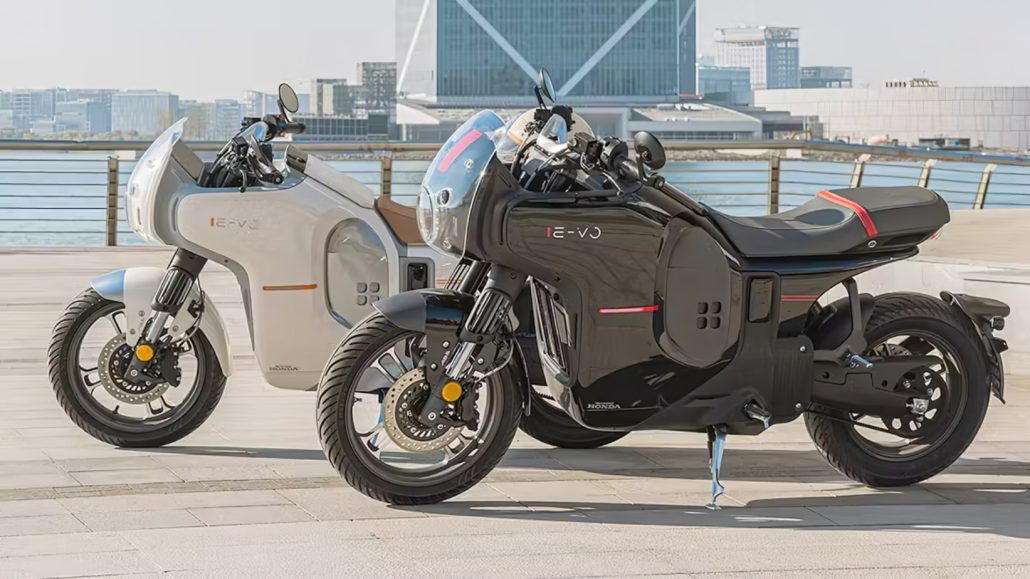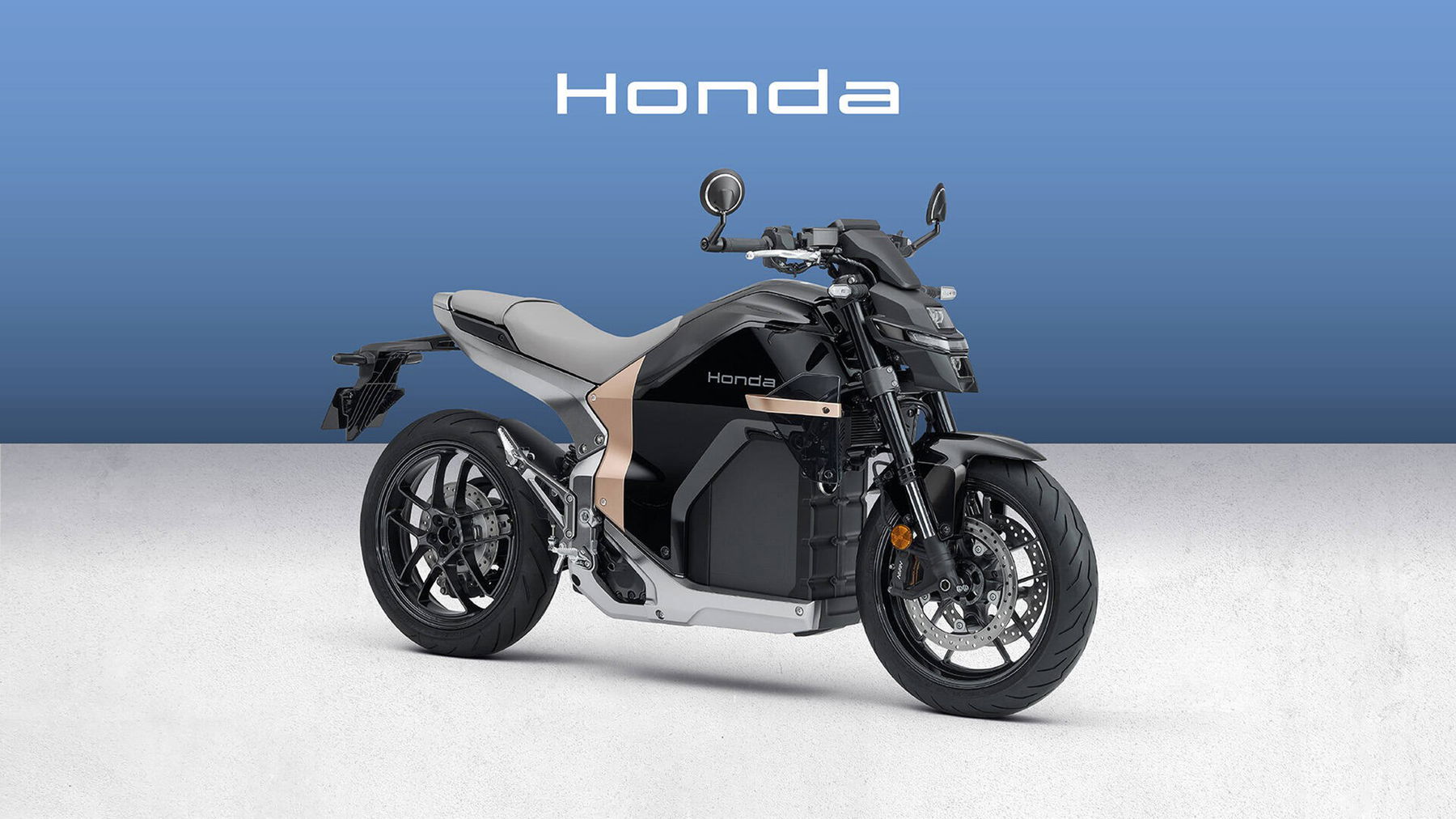
- Honda’s first major electric motorcycle for the European market
- Two power variants for A1 and A2 driver’s licenses
- Market launch planned for early 2026
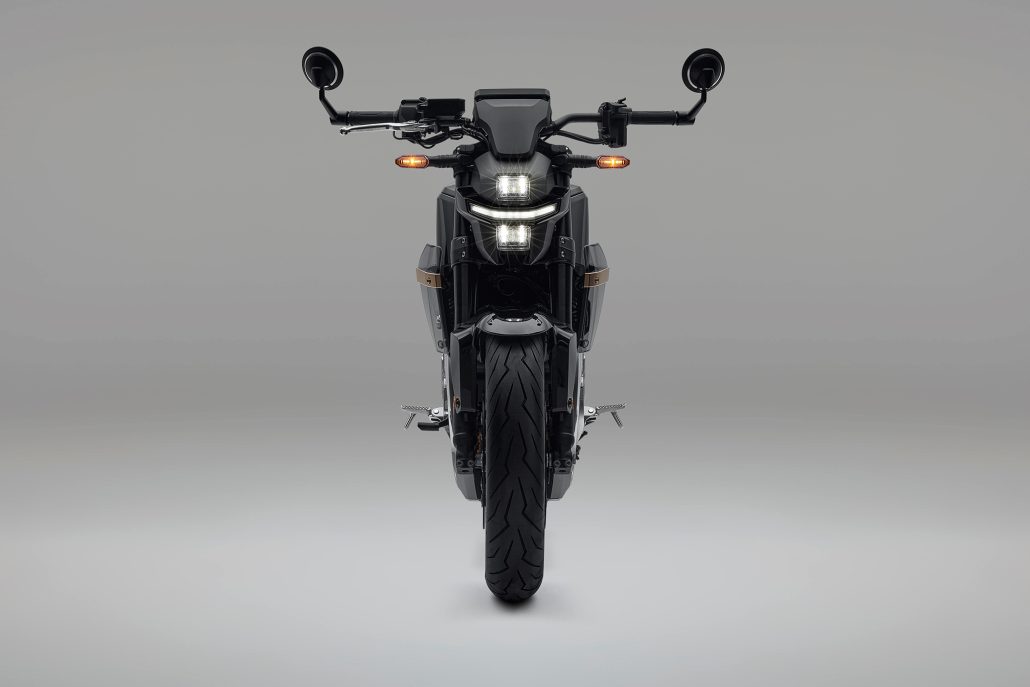
Honda has been the world’s largest motorcycle manufacturer for decades, producing more than 20 million vehicles annually. The signal effect is correspondingly large when the company emphatically addresses the topic of electric motorcycles. With the WN7, which was first presented at EICMA in Milan, the aim is now to explore how suitable for everyday use and accepted a battery-electric naked bike of this class actually is.
Honda’s entry into the electric mid-range market
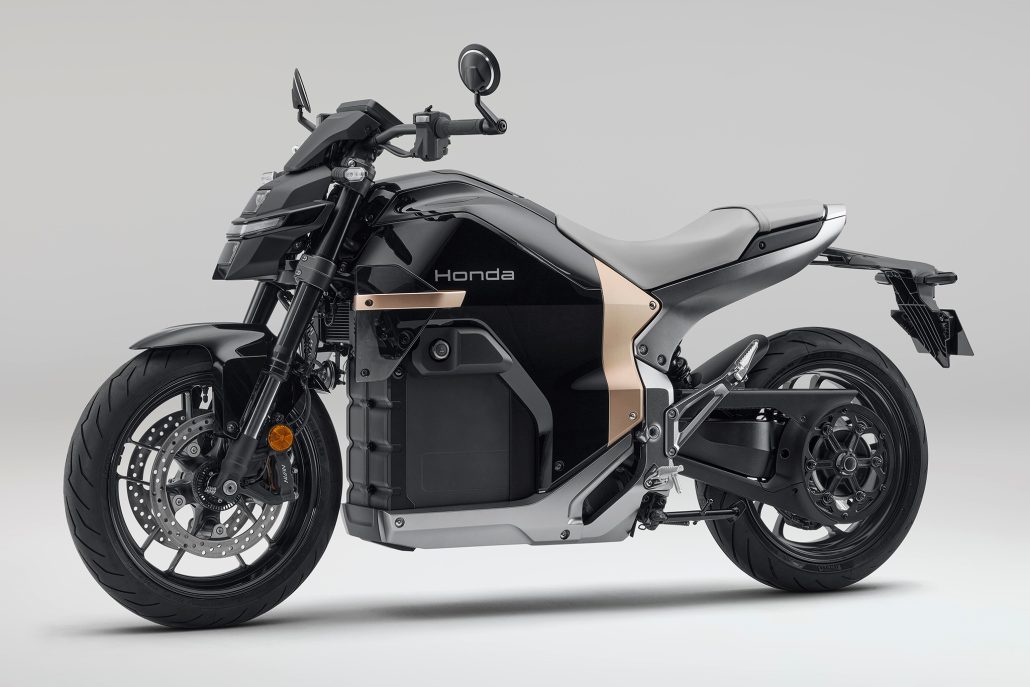
The presentation of the WN7 marks an important step for Honda. While the manufacturer has primarily offered small electric scooters in its range to date, the WN7 is clearly aimed at riders of classic motorcycles with combustion engines. Internally, the model is regarded as a learning project designed to gain experience with a view to building a broader electric portfolio in the long term.
Project manager Masatsugu Tanaka, who has been involved in the development of large Honda motorcycles for many years, sees the comparison with combustion engines as inevitable. The goal is to offer an electric motorcycle in the future that will satisfy even die-hard riders of conventional machines.
Drive, performance, and riding modes
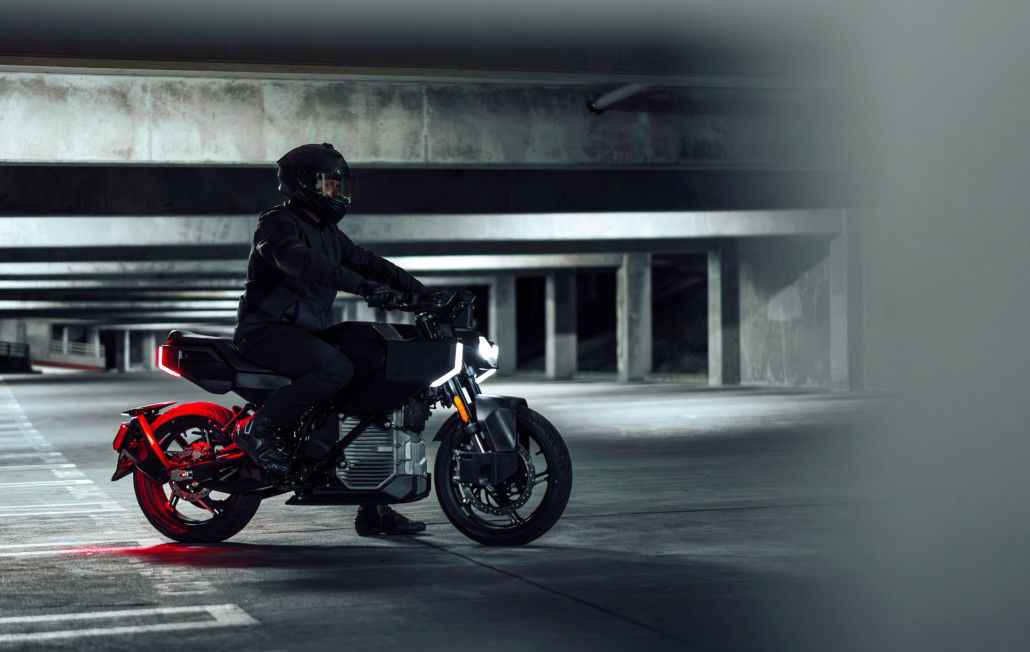
The WN7’s electric motor is located in the swing arm axle and drives the rear wheel via a belt. There is no classic clutch or transmission; power is delivered exclusively via the throttle grip.
Honda offers two performance variants.
In the A2 version, the continuous power output is 24.5 hp (18 kW), while the A1 variant delivers 14.9 hp (11 kW). The maximum power output is significantly higher: 68 hp (50 kW) in the A2 version and 15.2 hp (11.2 kW) in the A1 version. The maximum torque in both cases is 100 Nm, which corresponds to approximately 73.8 lb.ft.
Four riding modes are available: Sport, Standard, Rain, and ECO. Among other things, they influence the power output and are designed to make the WN7 easy to control both in urban environments and on winding country roads.
Battery, charging times, and range
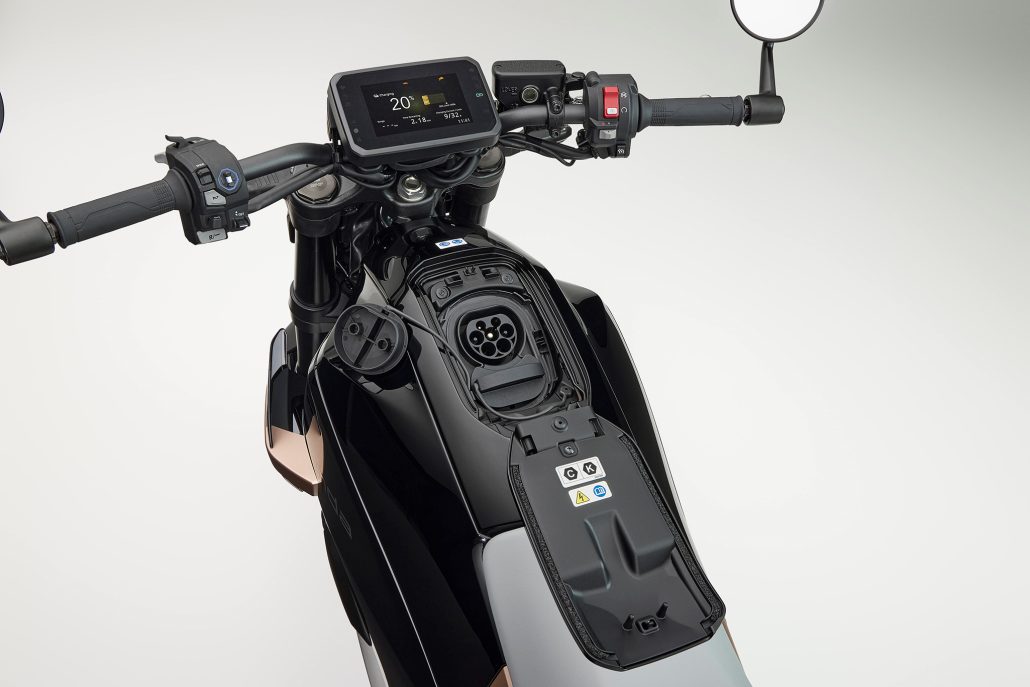
The permanently installed lithium-ion battery has a capacity of 9.3 kWh at 26.67 Ah and a system voltage of 349.44 volts. Charging is done either via a Type 2 connection or a CCS2 fast charger.
According to the manufacturer, using a CCS2 fast charger allows the battery to be charged from 20 to 80 percent in around 30 minutes. Honda specifies the range according to the WMTC test cycle as 140 km for the A2 version and up to 156 km for the A1 version. Earlier statements also mentioned a practical range of up to 87 miles, which corresponds to approximately 140 km. From today’s perspective, this is still a clear limitation for longer tours, which Honda itself openly admits.
Chassis, dimensions, and weight
The frame of the WN7 is designed as a load-bearing element. At the front, there is an upside-down fork with a diameter of 43 mm and 120 mm of travel, and at the rear, an adjustable monoshock damper with 120 mm of travel.
The WN7 measures 2,156 mm in length, is 826 mm wide and has a wheelbase of 1,480 mm. The seat height is 800 mm and the ground clearance is 139 mm. The ready-to-ride weight is 217.5 kg, which is equivalent to around 479.6 lbs.
Braking is provided by two 296 mm discs and radially mounted Nissin two-piston calipers at the front and a 256 mm disc at the rear. A two-channel ABS with inertial measurement unit (IMU) is standard equipment.
Features and connectivity
Standard equipment includes a 5-inch TFT display with connectivity and a USB Type-C socket. Honda RoadSync allows the motorcycle to be paired with Android and iOS smartphones. Storage space or transport options are not provided, as Honda primarily positions the WN7 as a commuter vehicle and classic naked bike.
Customer feedback as the key to further development
Masayuki Hamamatsu, General Manager and Assistant Vice President of the Electrification Business Division, emphasizes that the current technology does not yet meet all customer requirements. Feedback from the market is crucial for further improving range, weight, and everyday usability. In the long term, the electric range is to cover similar vehicle classes to the combustion engine models, from sports bikes and tourers to larger scooters.
Recycling and reuse of batteries
In parallel with vehicle development, Honda is working on concepts for the reuse and recycling of batteries. In India, used Mobile Power Pack e batteries are already being used as stationary power storage devices to replace generators. After use, the batteries are taken back and recycled. According to Honda, such systems could also be used in other countries in the future.
Classification
With the WN7, Honda is clearly demonstrating that electric motorcycles are set to play a greater role in its portfolio in the future. The model is intended less as a finished solution and more as a basis for further developments. The fact that the world’s largest motorcycle manufacturer is taking this path is likely to have a lasting impact on the entire industry.
What does this mean for me as a motorcyclist?
From a motorcyclist’s perspective, the Honda WN7 primarily shows where motorcycling could be headed in the medium term. The model makes it clear that electric motorcycles currently have their strengths primarily in urban environments and on shorter distances: quiet driving, instantly available torque, and easy operation without a clutch or gearshift. At the same time, it is clear that range, weight, and charging infrastructure currently still set limits, especially for longer tours or spontaneous trips without fixed planning. The WN7 is therefore less a replacement for a classic all-round motorcycle with a combustion engine and more an alternative for commuters or riders who are consciously looking for a second motorcycle with a clearly defined purpose. It shows what is possible today, without concealing the fact that the step to a fully-fledged replacement still needs development time.



Redakteur bei Motorrad Nachrichten. Fokus auf Technik, Szene und Motorradpolitik – neutral, sachlich, verständlich.
Verantwortlich für die Seiten www.Motorcycles.News, www.Motorrad.Training und den YouTube-Kanal "Motorrad Nachrichten", sowie deren social Media-Seiten.