- Brent crude oil price temporarily surged 13 percent to $82.37
- Super E10 averaged 1.839 euros per liter on Monday
- ADAC expert expects further price increases in the coming days
The conflict between Iran, Israel and the United States has shaken oil markets considerably. After the Iranian Revolutionary Guards fired rockets at three tankers in the Gulf region and the Strait of Hormuz and closed the strait to shipping, crude oil prices shot up on Monday. A barrel of North Sea Brent crude surged by up to 13 percent to $82.37 (approximately 77.25 euros), reaching its highest level since January 2025. The price of US light crude WTI briefly climbed to $75.33 (approximately 70.65 euros), its highest value since June 2025.
Over the course of the day, however, prices eased somewhat. Brent was last trading at $78.05 (approximately 73.18 euros), a gain of around 7.5 percent compared to the previous day. WTI rose by more than four dollars to $71.52 (approximately 67.06 euros). Citigroup analysts expect the Brent price to trade between $80 and $90 per barrel this week.
Fuel Prices Rise Sharply at German Gas Stations
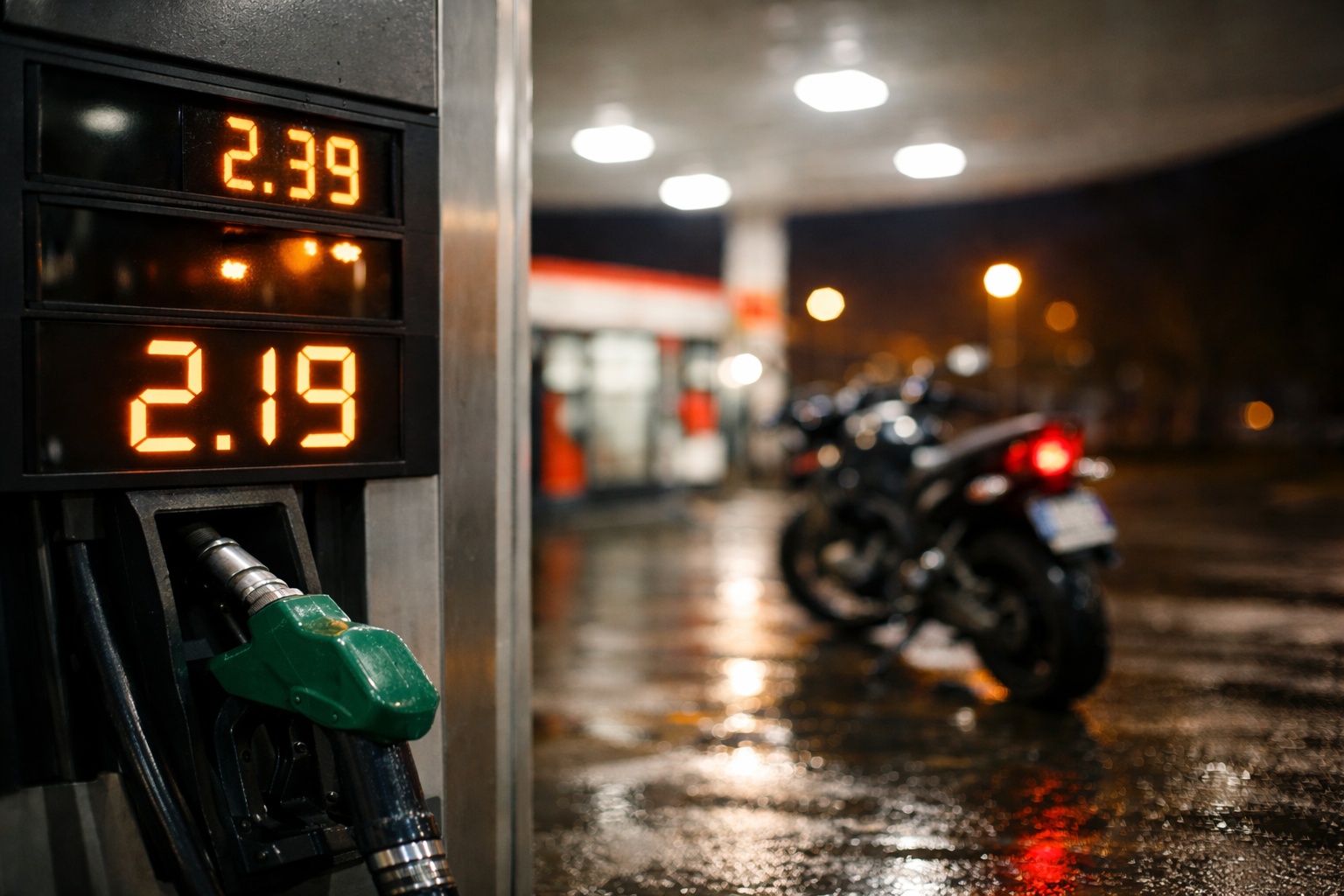
The impact on fuel pumps in Germany was not long in coming. The nationwide daily average for Super E10 stood at 1.839 euros per liter on Monday, with diesel at 1.816 euros per liter. Both fuel types were thus more expensive than at any point in roughly two years. Super E10 had last been higher in May 2024, diesel last in October 2023.
Compared to Friday, the last trading day before the escalation, Super E10 rose by 7.3 cents on Monday afternoon, diesel by as much as 8.1 cents. Over the weekend, the increase had initially been more modest at 1.6 cents for E10 and 1.3 cents for diesel, before prices surged sharply on Monday.
Christian Laberer, the ADAC’s fuel market expert, said: “I fear prices at the pumps will continue to rise today. The morning figures point to increases of three to four cents.” For Tuesday, the expert anticipated a further rise of several cents. “Should the oil price not come back down soon, the upward trend could continue over the coming days,” Laberer added.
Long Lines at Gas Stations, Heating Oil Above 120 Euros
Long queues have been forming at gas stations since Sunday. Herbert Rabl, spokesperson for the gas station industry association, reported heavy demand.
The price increase for heating oil was considerably steeper than for fuel. The online portal Heizoel24 reported prices temporarily exceeding 120 euros per 100 liters on Monday morning, rising to nearly 123 euros by Tuesday morning. Just on Friday, prices had been well below 100 euros. The site had already recorded unusually high demand on Saturday and Sunday. According to Laberer, the relatively smaller increase in fuel prices could also be because diesel in particular had already been overpriced in recent weeks relative to oil prices.
Strait of Hormuz Closed: One of the World’s Most Important Trade Routes Blocked
The background to the price development is the escalation of the conflict in the Middle East. The Iranian Revolutionary Guards declared they had hit three tankers from the US and UK in the Gulf region with rockets. Shipping companies and officials confirmed the damage. According to ship service provider V. Ships Asia, the oil tanker “MKD VYOM” was also hit off the coast of Oman, killing one crew member.
The Strait of Hormuz, through which roughly one-fifth of global oil shipments pass daily, was closed by Iran to shipping traffic. According to ship tracking data, more than 200 vessels, including numerous oil and gas tankers, were anchored outside the strait on Sunday. Danish shipping company Maersk announced it would once again reroute its vessels around the Cape of Good Hope at the southern tip of Africa. Earlier in the year, Maersk had undertaken initial test voyages through the Gulf of Aden and the Red Sea, but following threats from Houthi rebels in Yemen to attack commercial ships again, vessels are being redirected to the longer route.
ANZ analyst Daniel Hynes wrote in a note: “With retaliatory measures now escalating to attacks on oil tankers in the Strait of Hormuz, the threat to oil supply has increased significantly.” Japanese trading house Itochu also reported impacts on its deliveries from the Gulf region.
OPEC+ Increases Production, but the Effect Remains Uncertain
The OPEC+ oil cartel had approved a slight production increase shortly before the escalation. Daily output is to be raised by 206,000 barrels, as the group announced following an online meeting. The current conflict was not mentioned at all. Instead, the increase was justified by the stable outlook for global economic development and low oil inventories.
RBC Capital analyst Helima Croft put the decision in context: “The use of additional capacity is severely constrained, however, when key waterways are rendered impassable.” The International Energy Agency (IEA) said it was monitoring the situation to release strategic oil reserves if necessary.
In the medium term, the production increase could provide some relief, according to ADAC expert Laberer, provided the situation in the Gulf calms down. However, a well-known pattern applies — the so-called rockets-and-feathers effect: while rising oil prices are usually passed on at the pump very quickly, falling prices typically take considerably longer to filter through.
Political Dimension: US Gas Prices Cross the $3-per-Gallon Mark
The conflict is also having immediate consequences at gas stations in the United States. The average gasoline price crossed the psychologically important $3-per-gallon mark for the first time since November, equivalent to approximately 0.68 euros per liter. Experts expect a further increase to up to $3.25 per gallon (approximately 0.74 euros per liter) this week.
Mark Malek, chief investment strategist at Siebert Financial, told Reuters: “Gas prices have an enormous psychological impact. It’s the price at which consumers read inflation every day.” For US President Donald Trump, the development carries political risks. Nearly half of respondents in a Reuters poll said they would be less supportive of Trump’s Iran campaign if oil and gasoline prices rise. Rising fuel prices could hurt Republican chances in the November congressional elections.
Supply in Germany Secured, Criticism of Pricing
Federal Economics Minister Katherina Reiche urged calm regarding the supply situation. As for liquefied natural gas, no significant quantities are imported to Germany via the Strait of Hormuz. Germany obtains gas primarily through pipelines from Norway and Belgium, and liquefied natural gas predominantly from the US and Canada. “Price increases are possible,” Reiche did not rule out for Germany, however.
The industry association Fuels und Energie emphasized that fierce price competition persists at German gas stations even in the current situation. Germany’s supply is secured as crude oil is sourced from around 30 countries, including Norway, the US, Libya, Kazakhstan and the UK.
Criticism of the rapid passing on of price increases came from the SPD. Esra Limbacher, spokesperson for the pragmatic SPD Seeheimer group, described the developments at gas pumps as profiteering. The gasoline and diesel being sold now was largely purchased at significantly lower crude oil prices. It was unacceptable if geopolitical uncertainties were used as a pretext for inflated margins. Those who pass on rising world market prices immediately must do the same with falling prices.
Commerzbank chief economist Jörg Krämer assessed the situation: “The Brent oil price has so far reacted relatively moderately to the Middle East conflict and the de facto closure of the Strait of Hormuz.” If the conflict only lasts a few weeks, the domestic economy would effectively be unaffected. However, if the escalation drags on, the domestic economy and inflation could indeed suffer.
Saving at the Pump: What Motorcyclists and Drivers Can Do Now
Despite rising prices, there are ways to save some money at the pump. The ADAC recommends avoiding the particularly expensive period between 7 and 8 a.m. and filling up in the evening instead, when prices are generally lower. Especially in times of sharply fluctuating prices, it pays to compare prices at different gas stations, as the differences can be particularly large. Drivers whose cars are compatible with Super E10 can also save a few cents per liter, as E10 is on average five to six cents cheaper than E5.


- Sonax Lederpflege Premium Class, Set 7-teilig, für Glattleder, mit UV-Schutz, 3 x 250mlGrundpreis: € 73,19 / l