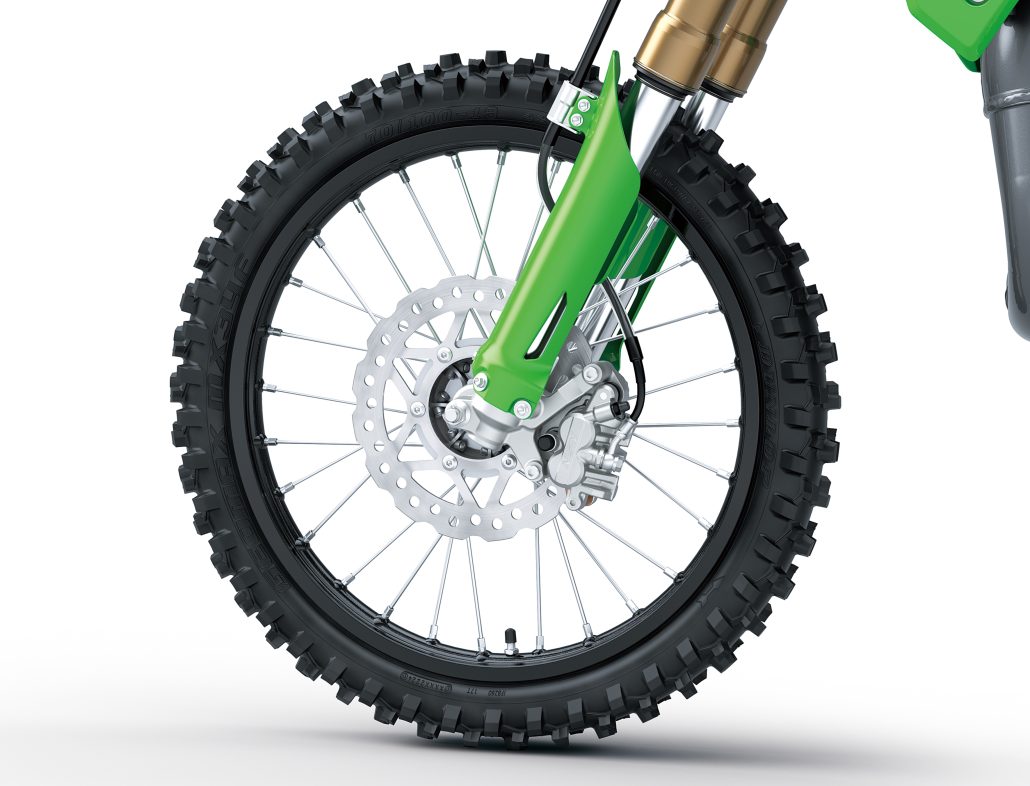
- New 43 mm upside-down fork with Kashima coating and adjustable rebound and compression damping
- Larger brake discs, 240 mm at the front and 220 mm at the rear, with components from the KX250
- Four adjustable handlebar positions and two height options for individual customization
The Japanese brand has taken a comprehensive approach to development for the coming model year, further refining the popular youth motocross models in almost every area. The engineers’ stated goal was to keep the machines competitive through targeted improvements to the chassis, suspension, and front end.
Completely redesigned chassis
The most striking update concerns the front wheel suspension. A newly developed upside-down fork with 43 mm stanchion diameter replaces the previous 36 mm unit. The assembly, which features a low-friction Kashima coating, not only offers greater rigidity but also, for the first time, adjustable rebound damping. Together with the existing compression damping adjuster, this allows the suspension to be tuned much more precisely to different track conditions and rider weights.
At the rear, a completely redesigned shock absorber with full adjustability is at work. The piston diameter has been increased from 12.5 mm to 14 mm, while the cylinder length has grown from 380 mm to 390 mm. These changes are intended to provide firmer damping characteristics and better bottoming reserves. The KX85 L with large wheels and the KX112 also feature a revised linkage that allows for 305 mm of suspension travel. This value corresponds to that of the full-size KX models for adults.
Significantly improved braking system
The developers have also made improvements to the braking system. An enlarged brake disc with a diameter of 240 mm is now used at the front. This works in conjunction with the same brake caliper and master cylinder that is also installed on the KX250. The combination is designed to provide more braking power, greater durability, and better controllability.
The rear wheel has also been upgraded. Instead of the previous 184 mm disc, a 220 mm unit now provides braking power. In addition, pedal play has been reduced, which should result in a more precise pressure point and better controllability. The new configuration with 240 mm at the front and 220 mm at the rear replaces the previous combination of 220 mm and 184 mm.
The bikes are equipped with Dunlop Geomax MX34 tires as standard. According to the manufacturer, these are designed to improve traction, braking, and cornering grip while providing better feedback from the front wheel.
Optimized frame and lighter components
The proven perimeter frame has also been further developed. The head tube is now 25 mm longer, which increases stiffness in the front area and should result in smoother handling at higher speeds.
Various components have also been converted to aluminum, making them lighter than their predecessors. These include the handlebars, steering column, and rear chainring. The new Renthal Fatbars are equipped with ODI Lock-On grips that prevent twisting.
Versatile ergonomic adjustments
An important aspect for young riders is the ability to adjust the bike to different body sizes. The new upper triple clamp offers two different handlebar mounts that can also be turned around. This results in four possible positions: 10 mm forward, standard, 10 mm backward, and 20 mm backward. In combination with two height options using spacer rings (standard and plus 5 mm), riders have a total of eight different adjustment options available.
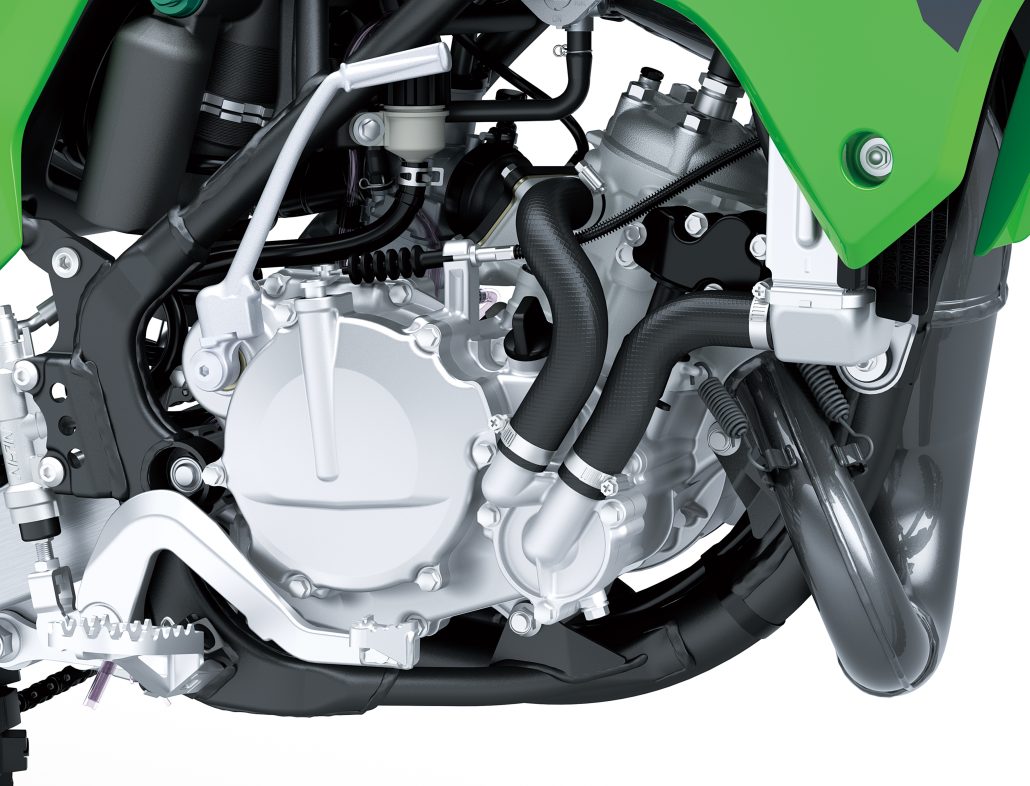
The footrests have also been redesigned. They are now significantly wider at 48 mm than before at 40 mm and have more teeth for better grip. The flatter design is also intended to contribute to a more secure footing.
More aggressive appearance
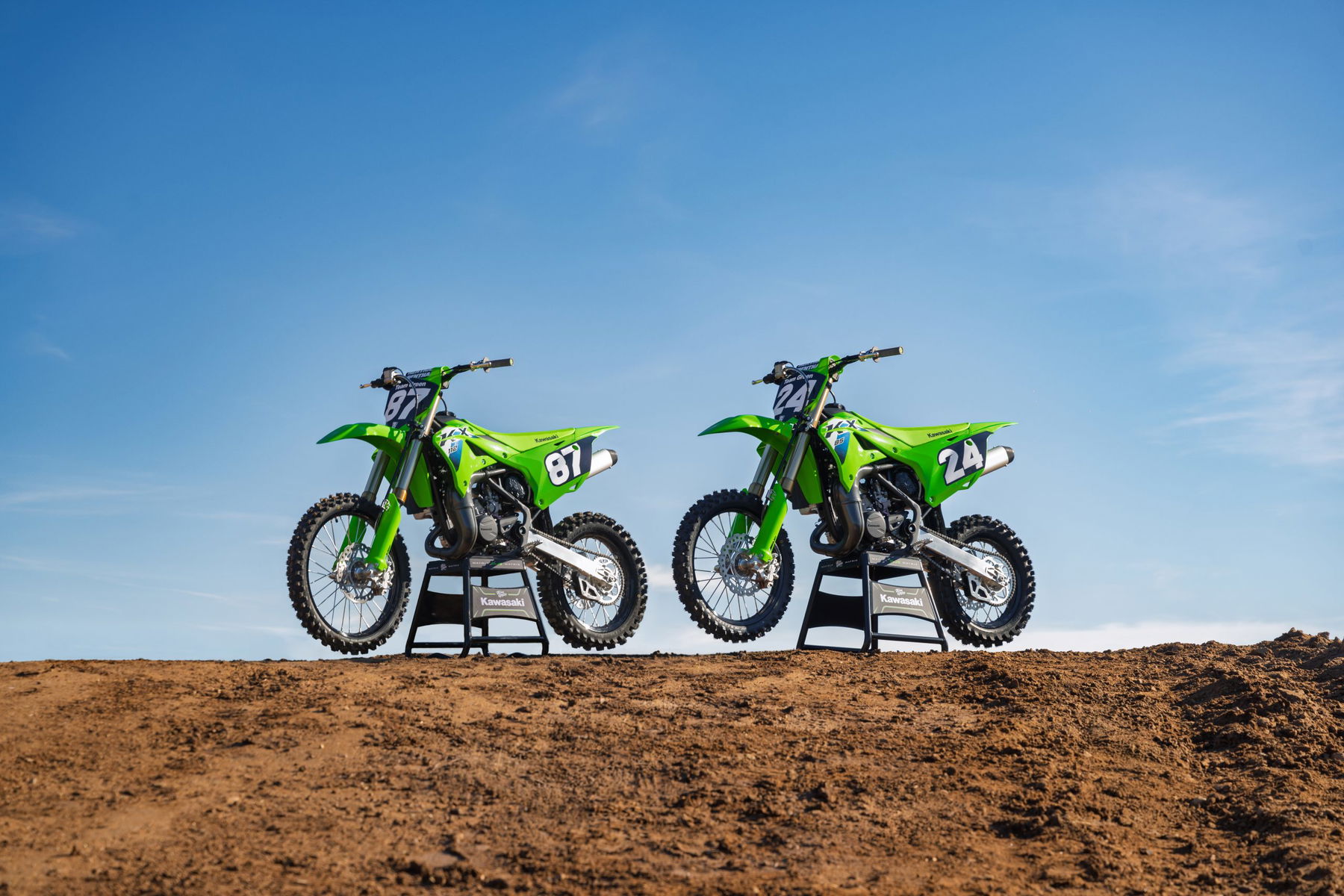
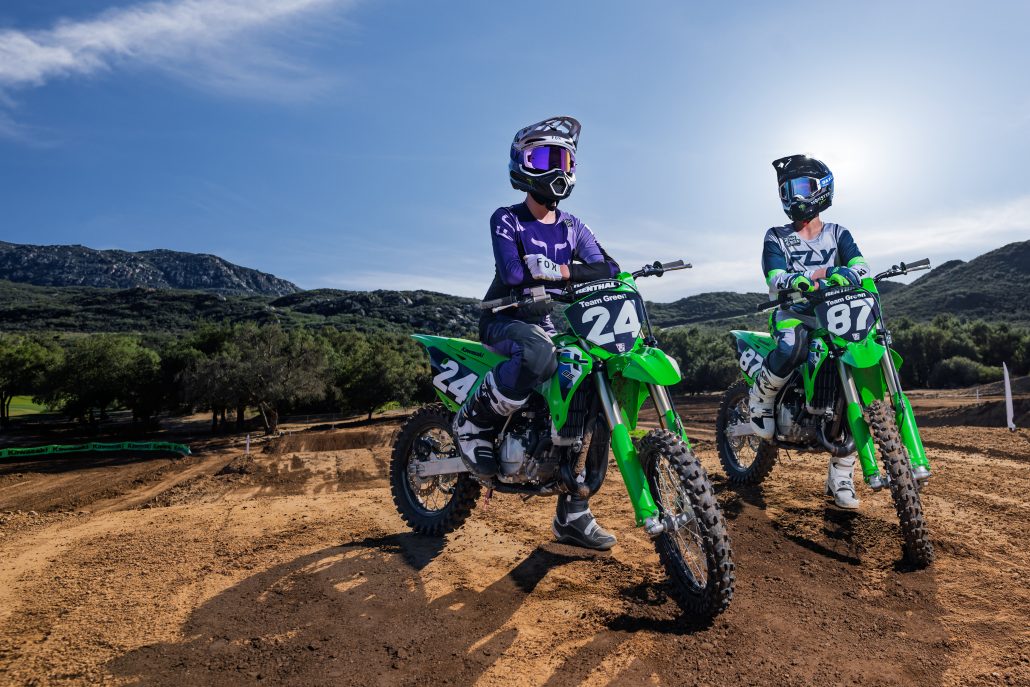
Visually, the junior models are strongly based on the large KX machines. A new, angular front fender, a redesigned start number plate, and newly designed fork guards characterize the appearance. Black rims and green anodized suspension adjusters emphasize the factory racing character of the machines and create a clear visual connection to the adult class models.
Model variants and availability
Kawasaki offers the KX85 in two wheel size configurations. The standard version has a 17-inch front wheel and a 14-inch rear wheel, while the KX85 L model, designated for large wheels, has a 19-inch front wheel and a 16-inch rear wheel. The larger KX112 model benefits from the same technical innovations.
The bikes are expected to be available in Lime Green from the end of February 2026.
With extensive changes to the chassis, brakes, and ergonomics, Kawasaki is positioning the 2026 KX85 and KX112 models as competition-oriented tools for ambitious young motocross riders.
What does that mean for me as a motorcyclist?
For parents of young motocross talents and the young riders themselves, the innovations bring noticeable advantages in everyday training and racing. The improved fork with adjustable rebound and compression damping allows for much more precise adjustment to different track conditions and the growing skills of young riders. In particular, the more powerful brakes with components from the larger KX250 give young riders more safety and confidence when slowing down before jumps and entering corners. The eight different handlebar adjustment options allow the machine to be optimally adjusted over several growth phases without the need for a new motorcycle. The extended suspension travel of 305 mm on the KX85 L and KX112, as well as the stiffer rear damping, mean fewer bottom-outs on hard landings and thus more controllable handling even on demanding tracks. Overall, the new KX models are closer to the equipment and riding feel of the big race bikes, which makes the transition easier and can also improve the learning curve for young riders.