- Sales decline by 46 percent to €1.009 billion
- Sales drop to 209,704 motorcycles, a significant proportion of which are from older stock
- Number of employees reduced by almost 29 percent within a year
After a period of profound cuts and organizational upheaval, KTM hoped for economic stabilization in 2025. However, the preliminary and unaudited figures now published by the parent company Bajaj Mobility AG paint a different picture. Both sales and unit sales declined significantly, while further cost reductions were announced for the coming years.
Sales development in 2025: figures with restrictions
In total, KTM sold 209,704 motorcycles across the group in 2025. Of these, 85,284 units were sold in the first half of the year and 124,420 motorcycles in the second half of the year. At first glance, this result appears more stable than it actually is.
A significant portion of these figures comes from the production of Indian partner Bajaj. Specifically, this involves 78,906 motorcycles in the smaller displacement classes, such as the 390 series and below. If these units are deducted, 130,798 motorcycles from the classic KTM core portfolio remain.
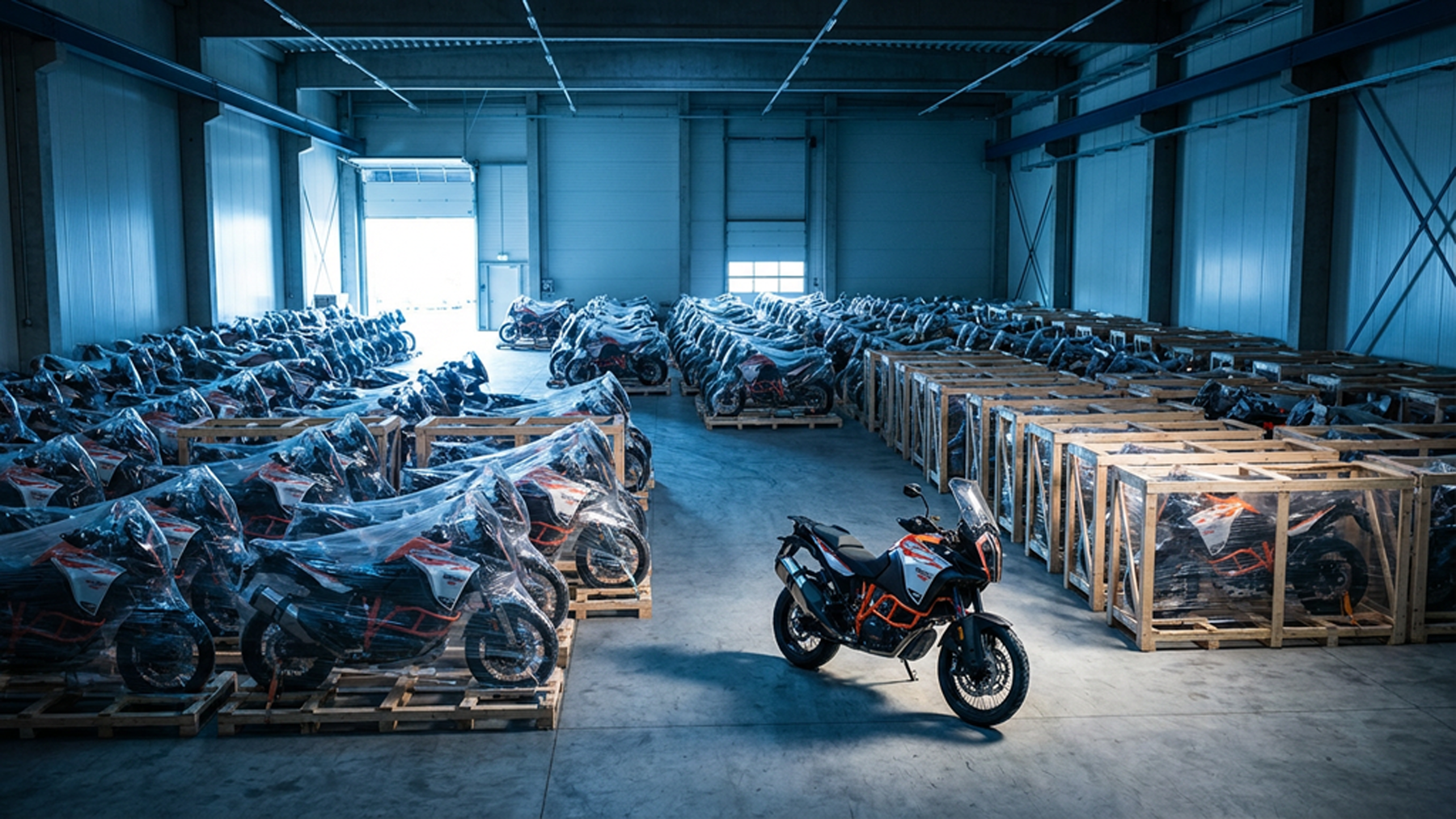
It remains unclear how many of these motorcycles actually come from current production. At the end of 2024, the group had exceptionally high inventory levels. According to the company, group-wide motorcycle inventories were reduced by 101,153 units in the course of 2025, but inventories at the end of the year still stood at 147,427 motorcycles.
Sales slump significantly
Group sales fell by 46 percent compared to the previous year to 1.009 billion euros, equivalent to around 1.09 billion US dollars. The company cites the restructuring phase in the first half of 2025, during which production and supply chains were severely restricted at times, as the main reason for this.
The sharp decline in sales is significantly higher than the decline in unit sales of around 28 percent. This indicates that a significant portion of the motorcycles sold came from older inventory that was sold at reduced prices. Accordingly, these sales had a negative impact on the average revenue per vehicle.
Improvement in earnings due to special effects
Despite weak sales, the Bajaj Mobility Group reported a significantly improved earnings situation for 2025. Preliminary EBITDA amounted to €874 million, while EBIT came in at €748 million. However, these figures are significantly influenced by a restructuring gain of €1.193 billion.
This results from the completed restructuring procedures at KTM AG, KTM Components GmbH, and KTM Forschungs und Entwicklungs GmbH. Without these one-time effects, the operating result would have been significantly lower.
On the other hand, the financial structure developed positively. Net debt was reduced from €1.643 billion to €798 million. At the end of 2025, equity was back in positive territory at €385 million, and the equity ratio rose to 24.3 percent.
Significant job cuts and portfolio streamlining
As part of the restructuring, the Group reduced its workforce from 5,310 to 3,782 employees. This corresponds to a decline of around 28.8 percent within one year. Part of this reduction is related to the sale of the X Bow supercar division, the separation from MV Agusta, and the exit from the bicycle business.
At the same time, investments were significantly reduced. These fell by almost 69 percent to 73 million euros. The company is thus responding to the tense liquidity situation and focusing on its core motorcycle business.
Outlook for 2026: Further cost reductions planned
Bajaj Mobility AG has announced that it will continue its restructuring program in the 2026 fiscal year. The focus will be on the core motorcycle business, accompanied by further efficiency gains through cost reductions. The aim is to achieve a significant improvement in revenue, sales, and cash flow.
The new CEO, Gottfried Neumeister, explained:
“In 2026, our clear focus is on the consistent and systematic continuation of the restructuring path we have set. We have made a strong start to the new year: our newly introduced models are being very well received, and our recent motorsport successes are providing additional momentum – visibly contributing to sales growth.”
Whether these expectations can be met remains to be seen, given the continuing high inventory levels and the announced austerity measures.
What does this mean for me as a motorcyclist?
For me as a motorcyclist, the current situation at KTM means uncertainty above all, but also short-term opportunities. On the one hand, it can be assumed that KTM will continue its austerity measures. This could result in a leaner model range, fewer new products per year, and a stronger focus on high-margin series. In the long term, this could mean that certain niche models will disappear or model cycles will become longer. On the other hand, the continuing high inventory levels indicate that motorcycles from previous years will still be offered at attractive prices in 2026. For buyers, this could mean lower prices or better equipment for the same price. At the same time, it remains to be seen how cost reductions will affect service, the dealer network, and spare parts availability. In short, those who buy now may benefit financially, but should take a close look at how the brand and model are positioned in the long term.


- Kärcher 6.295-763KÄRCHER Motorradreiniger 3-in-1 (0,5 l)



Redakteur bei Motorrad Nachrichten. Fokus auf Technik, Szene und Motorradpolitik – neutral, sachlich, verständlich.
Verantwortlich für die Seiten www.Motorcycles.News, www.Motorrad.Training und den YouTube-Kanal "Motorrad Nachrichten", sowie deren social Media-Seiten.