- Aprilia employs a novel double-duct system beneath the fairing of the RS-GP26
- The concept is reminiscent of the McLaren F-Duct from the 2010 Formula 1 season
- The rider controls the system with their forearms on the straights
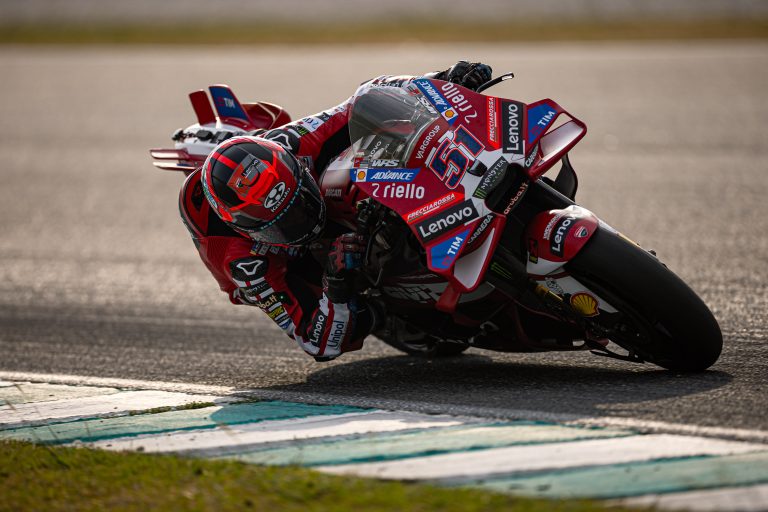
What initially appears to be a conventional aerodynamics update reveals itself on closer inspection as one of the most innovative technical solutions in MotoGP in recent years. Aprilia has developed a system for the RS-GP26 that is strongly reminiscent of Formula 1 in its basic concept and has never been used in motorcycle World Championship racing before. The new fairing features two inlets at the front and two outlets at the rear of the fairing, precisely where the rider rests their forearms when tucking behind the screen on the straights.

Inspired by Formula 1: The F-Duct Principle
The system’s operating principle shows clear parallels to the famous McLaren F-Duct, which caused considerable stir during the 2010 Formula 1 season. Back then, drivers used their knee to block an opening in the cockpit, redirecting the airflow from the upper inlet. Instead of reaching the engine and gearbox, the air was channeled directly to the rear wing. There, it flowed through the gap between the main plane and the upper wing element, creating flow separation at the trailing edge and causing the wing to stall. The result was reduced drag and higher top speed on the straights. Other teams developed their own variants of the system, some controlled by hand, which ultimately led to the technology being banned from 2011.
At Aprilia, the basic principle works similarly: when the rider presses their arms against the fairing, they seal both outlets. The airflow that normally passes through these ducts is redirected. Since the system is activated on the straights, it is likely that the effect primarily aims to reduce aerodynamic drag.
Where the Air Flows: Possible Functions
Exactly where the air is directed when the outlets are sealed, and which path it takes, cannot be determined with absolute certainty without detailed knowledge of the internal duct routing. One possibility is that the air exits laterally from the main fairing and aerodynamically influences the outer part of the bodywork there. This area is shaped to generate downforce in cornering. Targeted airflow could trigger flow separation in this zone, reducing downforce on the straights and thereby lowering drag.
There are also other conceivable functions for the system. An aerodynamic benefit could lie in reducing turbulence in the sensitive lower fairing area, which would improve cooling by creating a more uniform and controlled airflow. A direct benefit for the rider is also imaginable: fresh air directed toward the pilot could shield them from the heat of the engine and radiator, helping them remain physically and mentally fit over the race distance.

A Rolling Laboratory: More Innovations on the RS-GP26
The double-duct system is far from the only novelty on the RS-GP26. The technical duo of Fabiano Sterlacchini as technical director and Marco De Luca as head of the vehicle department has invested heavily in aerodynamic development. After extensive CFD simulations, the concepts were refined down to the last detail in the Toyota wind tunnel in Cologne.
The RS-GP26 has already featured a Formula 1-inspired S-Duct since the previous year. This collects air in the lower fairing area and redirects it upward alongside the windscreen. This double bypass increases flow velocity, reduces turbulence, and improves overall aerodynamic efficiency.
At the Buriram test, further aerodynamic solutions were tested alternately on the machines of Marco Bezzecchi and Jorge Martin. The partially faired rear swingarm, first seen in Sepang, reappeared. Its carbon profile extends downward and features a small recess shaped like a micro-Venturi channel designed to accelerate airflow. At the rear of the machine, two configurations with the internal designations “Panoramix” and “Obelix” alternated, apparently still under thorough evaluation.
First Noticed Since Sepang: The System’s Timeline
The new fairing was first used at the Sepang test and was subsequently also run at the two-day Buriram test, but initially went largely unnoticed. On Friday of the first race weekend in Thailand, Aprilia used the fairing consistently throughout practice. Bezzecchi finished Friday at the top of the timesheets. Should Aprilia now wish to change the fairing, a new version would need to be homologated.

What the Competition Must Watch: Homologation Rules
For the other manufacturers in the field, the Aprilia system presents a particular challenge. Anyone wishing to develop their own version must have a new fairing homologated. Each MotoGP rider has only one fairing update available per season. An exception is Yamaha: the Japanese manufacturer has the right to two fairing updates per season due to its fourth-level concession status, but must give up the previous version once a new one is introduced.
As the 1000cc engine regulations enter their final year, such an innovation push was not necessarily expected. Once the aerodynamic packages are homologated, the teams will inevitably shift their focus to the upcoming 850cc regulations, which on paper at least envision tighter limits for wind tunnel development.
Aprilia enters the new season as the runner-up in the 2025 manufacturers’ championship. The RS-GP26 impressively demonstrates that the Noale factory has the technical ambition not just to keep pace, but to chart its own course.

- Cardo PTP00001Cardo Packtalk Pro (1er Set) (PTP00001) Schwarz