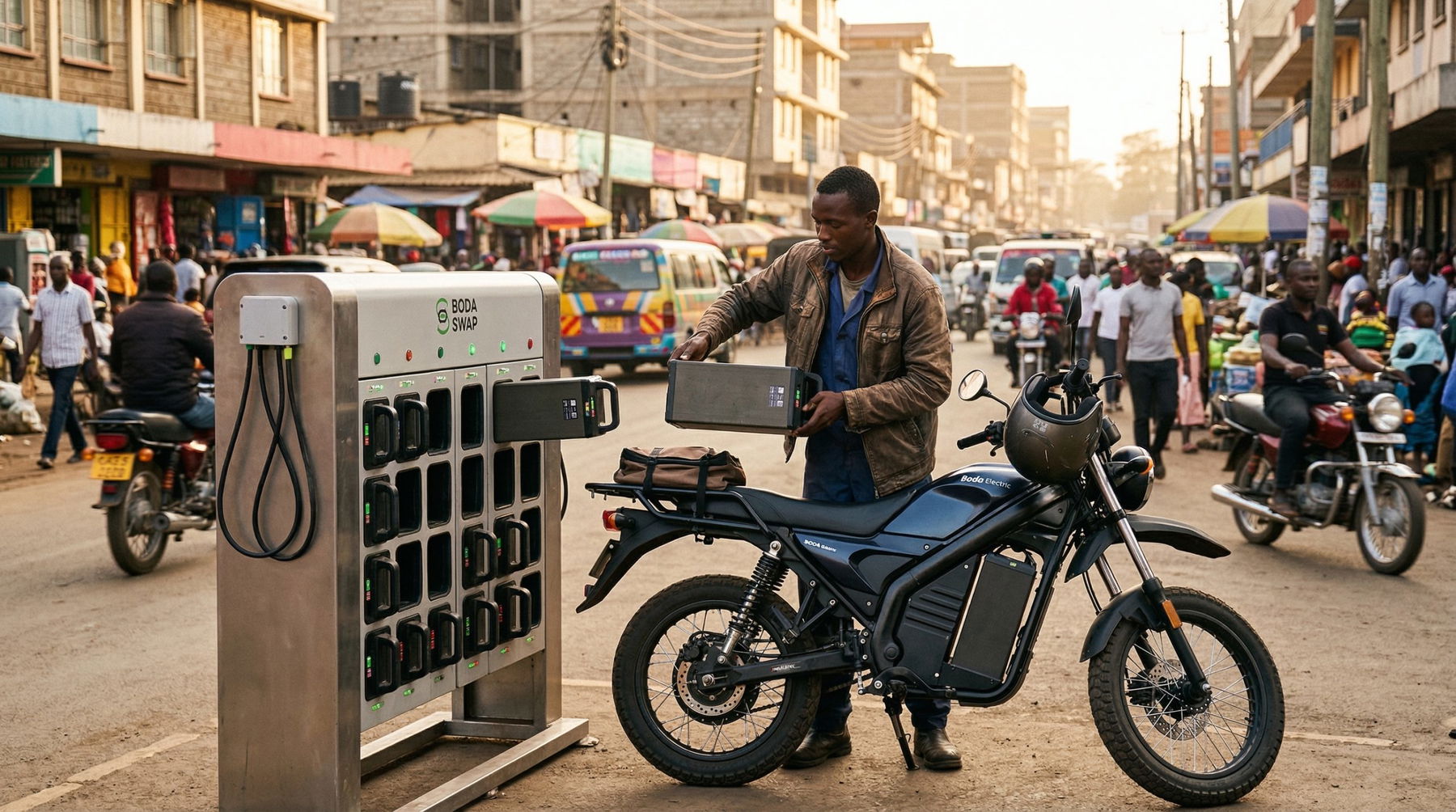
- In Kenya, 15.3 percent of all newly registered motorcycles were electric in 2025
- Spiro has raised over 150 million US dollars (approximately 139 million euros) in total and operates more than 80,000 electric motorcycles in six countries
- Electric motorcycles are expected to reduce operating costs for taxi drivers by 30 to 40 percent
Motorcycles are the most widely used motorized form of transport in large parts of Africa. Known as Boda-Bodas in East Africa and Okadas in West Africa, motorcycle taxis form the backbone of urban mobility and provide income for millions of riders. An estimated 30 million motorcycles are said to be in use as taxis across the continent, with nearly 99 percent still powered by combustion engines. It is precisely this enormous fleet that makes Africa one of the most promising markets for two-wheeled electrification.
In recent years, a new generation of startups has been pushing into this market. Unlike in Europe or North America, where electric motorcycles are primarily marketed as recreational vehicles, African providers focus almost exclusively on the commercial sector. Taxi drivers and delivery services are the target audience, as for this group the switch to electric power is primarily an economic decision. Anyone who spends 10 to 12 hours on the road daily, covering 150 to 200 kilometers, spends a significant portion of their income on fuel and repairs. Electric motorcycles are expected to reduce operating costs by 30 to 40 percent or more, noticeably increasing riders’ disposable income.
East Africa as the Epicenter of Electrification
The hotspot of this development lies in East Africa, particularly in Kenya, Rwanda, and Uganda. Millions of motorcycle taxis operate in these countries, and drivers are particularly sensitive to rising fuel prices. This makes electric motorcycles economically attractive.
Kenya has emerged as the frontrunner. Figures from the Kenya National Bureau of Statistics reveal an impressive trajectory: in 2021, the share of electric motorcycles in new registrations stood at just 0.5 percent. It rose to 2.8 percent in 2022, 3.6 percent in 2023, and 7.1 percent in 2024. In 2025, the market share reached 15.3 percent. Of the total 168,286 newly registered motorcycles in Kenya, 25,277 were electric. Just eight years earlier, only 44 electric motorcycles had been registered nationwide.
Kenya has thus long surpassed the so-called tipping point of five percent, beyond which mass adoption is considered to be underway. The country now ranks among the most dynamic markets for electric two-wheelers worldwide and is mentioned in the same breath as Vietnam and China in terms of growth momentum.
Battery Swapping Instead of Long Charging
A key factor driving the rapid adoption is the battery swapping concept. Instead of charging their motorcycles for hours, riders can exchange an empty battery for a full one at swap stations within minutes. It works essentially like a fuel stop for a combustion engine and avoids the downtime that taxi drivers simply cannot afford.
Most companies combine battery swapping with flexible financing models. The so-called Battery-as-a-Service model ensures that riders do not have to purchase the battery but pay per swap. Together with leasing and installment payment plans for the motorcycle itself, the barrier to entry drops significantly. Especially for riders earning the equivalent of 5 to 10 US dollars (approximately 4.65 to 9.30 euros) per day, the initial investment would otherwise be nearly impossible to manage.
Spiro: Africa’s Largest E-Mobility Provider
By far the biggest company in this market is Spiro. The Dubai-based company, which operates from Nairobi, claims to have more than 80,000 electric motorcycles in operation, over 2,500 battery swap stations, and more than 30 million battery swaps completed. The fleet is said to have covered over one billion carbon-free kilometers in total.
Spiro operates in six countries: Kenya, Uganda, Rwanda, Nigeria, Benin, and Togo. Pilot projects are underway in Cameroon and Tanzania. In Kenya alone, the company reportedly sold over 15,000 electric motorcycles in 2025, which would represent approximately 60 percent of the Kenyan e-motorcycle market. The network in Kenya allegedly comprises more than 400 swap stations.
The financing reflects the pace of growth. In October 2025, Spiro raised 100 million US dollars (approximately 93 million euros), led by the Fund for Export Development in Africa (FEDA), the investment arm of Afreximbank. It was the largest single investment in the African two-wheeled e-mobility sector. In February 2026, an additional 50 million US dollars (approximately 46.5 million euros) in debt followed, provided by Afreximbank, Nithio, and the Africa Go Green Fund. In total, Spiro has raised over 230 million US dollars (approximately 214 million euros) in equity and debt since its founding in 2022.
CEO Kaushik Burman, who previously worked at Taiwanese battery swap specialist Gogoro, describes the target audience: “These riders spend 10 to 12 hours a day on the road, cover 150 to 200 kilometers, and pay high fuel costs. At the end of the day, most of them have barely anything left. That’s why electric mobility, especially through a battery swap model, is a perfect fit for this segment. The riders can’t afford downtime and save money at the same time.”
Spiro operates its own assembly plants in Kenya, Uganda, Rwanda, and Nigeria. A typical Spiro model reportedly costs around 800 US dollars (approximately 745 euros) in Kenya or Rwanda, making it significantly cheaper than comparable gasoline motorcycles, which range from 1,300 to 1,500 US dollars (approximately 1,210 to 1,395 euros).
Roam: Local Manufacturing and Fast-Charging Infrastructure
Alongside Spiro, Roam has established itself as one of the most important players. The Swedish-Kenyan company, formerly Opibus, was founded in 2017 and is headquartered in Nairobi. Roam develops and manufactures electric motorcycles designed in collaboration with Boda-Boda riders, with a particular emphasis on local production.
The flagship model Roam Air was unveiled in its second generation in 2025. It features two swappable batteries with a total capacity of 6.5 kWh and is said to offer a range of up to 180 kilometers. The top speed is 90 km/h (approximately 56 mph), with a price of around 1,500 US dollars (approximately 1,395 euros). The reinforced frame of the Gen-2 version supports up to 240 kilograms (approximately 529 lbs) according to Roam, 20 kilograms (approximately 44 lbs) more than the predecessor.
Roam’s production facility Roam Park in Nairobi’s industrial area spans 10,000 square meters and is said to have an annual capacity of over 50,000 motorcycles. In February 2024, the company completed a Series A round of 24 million US dollars (approximately 22.3 million euros), including a 10 million US dollar (approximately 9.3 million euros) debt commitment from the US International Development Finance Corporation (DFC). In the Financial Times ranking of Africa’s fastest-growing companies in 2025, Roam placed 35th.
In late 2025, Roam also took a different path than most competitors by launching a crowdfunding campaign on the European platform Crowdcube, giving private investors worldwide the opportunity to participate in the expansion.
Beyond battery swapping, Roam also invests in fast-charging technology. With the Roam Point network launched in November 2025, the company opened Kenya’s first fast-charging stations for light electric vehicles. The stations are said to add 10 to 20 kilometers of range in under five minutes, use the open Type-6 connector, and are compatible with all light electric vehicles that support the same standard. Payment is via SMS, M-PESA, or the Roam app. Roam motorcycles are already deployed through ride-hailing platforms such as Bolt and Uber.
Ampersand: Pioneer from Rwanda
Another pioneer is Ampersand, based in Kigali, Rwanda. The company was among the first to offer electric motorcycles for the taxi sector in Africa and operates a growing network of battery swap stations in Rwanda and Kenya. Ampersand closed a financing round of 7 million US dollars (approximately 6.5 million euros) in late 2025 to expand the fleet to 13,000 motorcycles by the end of 2026. By 2026, over 40,000 electric motorcycles are targeted for deployment according to the company. The existing fleet of over 5,000 vehicles is said to have already covered more than 280 million kilometers.
A partnership with Wylex Mobility is intended to integrate Wylex motorcycles into Ampersand’s battery swap network in East Africa.
Why Africa Specifically?
The question of why the electrification of the motorcycle sector is progressing so rapidly in Africa has several answers. First, there is economic necessity. In Kenya, for example, the trade deficit in 2023 amounted to 11.4 billion US dollars (approximately 10.6 billion euros), with petroleum products accounting for around 4 billion US dollars (approximately 3.7 billion euros) as the largest import item. Decarbonizing transport is therefore not just a climate issue but an economic imperative.
Additionally, Kenya’s energy mix favors the transition. Over 83 percent of Kenyan energy was generated from low-carbon sources in 2024, primarily geothermal, hydropower, and wind energy. The combination of electric vehicles with solar-powered charging infrastructure is particularly well-suited to regions where the power grid does not function reliably everywhere. Africa has the highest solar potential in the world.
The concrete cost advantages for riders are also substantial. According to Kenyan startup Kiri EV, the cost per kilometer for an electric motorcycle is less than one Kenyan shilling, while a gasoline motorcycle consumes about three shillings per kilometer. The difference in maintenance is even more pronounced: while a combustion engine requires service every 2,000 kilometers at around 15 US dollars (approximately 14 euros), an electric motorcycle reportedly costs only about 3 US dollars (approximately 2.80 euros) for the same interval.
Christopher Maara, founder of Kiri EV, explains the company’s approach: “People often struggle with big changes. That’s why we made sure our electric motorcycles closely resemble gasoline motorcycles in design and riding feel. This way, the switch doesn’t feel like a radical upheaval but rather a gentle, logical evolution.”
A Continent Full of Startups
Beyond the big three, a multitude of other companies are working this market. In East Africa, active players include ARC Ride from Kenya with a Battery-as-a-Service ecosystem, GOGO Electric from Uganda (formerly Bodawerk) as a local manufacturer of e-motorcycles and lithium-ion batteries, Kiri EV, Fika Mobility, eWAKA, Zembo, and ZENO. International companies are also entering the market: Maltese startup Fleevigo launched in Kenya in 2025, and Chinese company Power Gogo is preparing its market entry.
In West Africa, MAX (Metro Africa Xpress) from Nigeria has positioned itself as a ride-hailing platform with its own e-motorcycle fleet and swap infrastructure. MAX raised 24 million US dollars (approximately 22.3 million euros) to finance 120,000 electric vehicles. In Ghana, Kofa is working on battery swap technology, SolarTaxi on solar-powered e-motorcycles, and Valternative on electric vehicles and energy infrastructure. In Ethiopia, Dodai is active with e-motorcycles and swap infrastructure.
Southern Africa is also seeing movement. In South Africa, Green Riders offers e-motorcycles for delivery fleets. And Chinese company Jiangmen Tengxin Motorcycle Technology is planning to build an electric vehicle factory in Zimbabwe to supply southern Africa with two- and three-wheelers.
On a continental level, Morocco is playing an increasingly important role. The country surpassed the one million mark for passenger vehicles produced in 2025 and aims to convert around 60 percent of its vehicle production capacity to electric drive by 2030. A battery gigafactory with an investment volume of 5.6 billion US dollars (approximately 5.2 billion euros) is expected to begin production in 2026.
Challenges and Limitations
Despite all the momentum, the industry faces significant challenges. Rural regions of West Africa remain largely cut off from electrification. Gasoline motorcycles continue to dominate there because battery swap or charging infrastructure is lacking, while the fuel station network is widely spread. For independent taxi drivers, a three-minute refuel remains more practical than any charging solution.
Purchase costs remain a barrier in many places despite financing models. A standard 125cc gasoline motorcycle is still cheaper than an electric model in most African markets. The maintenance infrastructure for e-motorcycles is still being built. And the rapid growth brings its own problems: in Kenya, riders already report bottlenecks at swap stations when demand for charged batteries exceeds supply.
Observers expect gasoline motorcycles to dominate overall volumes on the continent for the next five to ten years. Full electrification before 2035 is considered unlikely. Electrification is likely to spread first in urban clusters with functioning infrastructure, not across the board.
Market Forecasts: 200,000 Electric Vehicles by 2030
Market analysts forecast that between 150,000 and 200,000 electric vehicles could be on Africa’s roads by 2030. Electric motorcycles are expected to account for over 80 percent of that total and exceed the 100,000-unit mark. The number of battery swap stations in East and West Africa could grow to over 1,000 active locations, while public and fleet charging points could reach 20,000 to 25,000. Local assembly is expected to gain further importance in Kenya, Rwanda, Morocco, Egypt, and South Africa.
The African motorcycle market is estimated to have an annual volume of over 15 billion US dollars (approximately 14 billion euros). Electrifying just 10 percent of Africa’s motorcycle fleet could save 7 to 11 million tons of CO2 per year. For international electric motorcycle manufacturers, Africa could become one of the most important growth markets over the next decade.
What This Means for Motorcyclists on Other Continents
The developments in Africa may seem far removed at first glance, but they are certainly relevant for motorcyclists in Europe, Asia, and North America. African startups are developing technologies and business models under extreme conditions: poor roads, unreliable power grids, price-sensitive customers, and tropical climates. Battery swap systems that function reliably under these circumstances could find applications in other markets too. Roam’s fast-charging technology with open standards and interoperability between different manufacturers is an approach that has barely been pursued in Europe so far. At the same time, production capacities are emerging in Kenya and Rwanda that could potentially serve export markets. Roam’s manufacturing facility in Nairobi is designed for over 50,000 motorcycles per year, and Morocco is positioning itself as a future production hub with its own battery cell manufacturing. For the established motorcycle manufacturers in Japan and Europe, this creates long-term new competition from a direction that has barely been on the radar. And not least, the African model demonstrates that the breakthrough of electric mobility on two wheels does not have to come through lifestyle products and premium segments, but through commercial utility and measurable cost advantages for the individual rider.
For the commercial riders who earn their living on their motorcycles every day, the equation is already simpler: less money spent on fuel and repairs means more income at the end of the day. That is the most powerful argument for making the switch.

- Milestone Ride 6 Day 1 Edition (Xbox Series X)