- Net profit after nine months: ¥465.4 billion, equivalent to approximately €2.87 billion or approximately $3.00 billion
- Operating profit: ¥591.5 billion, equivalent to approximately €3.65 billion or approximately $3.80 billion
- Operating loss in the automotive division: ¥166.4 billion, equivalent to approximately €1.03 billion or approximately $1.10 billion
Honda is under considerable pressure in the current fiscal year. The automotive business in particular is suffering from external factors such as US import tariffs, weaker demand for electric vehicles in North America, and one-time charges related to the realignment of its EV strategy. At the same time, however, another division is stabilizing the balance sheet.
Business figures after nine months at a glance
After nine months of the current fiscal year, Honda reported a net profit of ¥465.4 billion. This corresponds to approximately €2.87 billion or approximately $3.00 billion. Compared to the previous year, this represents a decline of 42.2 percent.
Operating profit fell by 48.1 percent to 591.5 billion yen, which corresponds to approximately €3.65 billion or around $3.80 billion. Sales fell by 2.2 percent to 15.9 trillion yen, equivalent to around €98.0 billion or approximately $102 billion.
In the third quarter alone, operating profit slumped by 61 percent, falling short of expectations.
Automotive division slips into the red
The impact on the automotive sector is particularly evident. The automotive division recorded an operating loss of ¥166.4 billion, equivalent to around €1.03 billion or approximately $1.10 billion. The main reasons for this are US tariffs on imported vehicles, write-downs related to the electric vehicle strategy, and slower-than-expected market development for battery-electric models in North America.
In addition, competitive pressure in China is exacerbating the situation. Other international manufacturers such as Ford and Stellantis have also recently reported high write-downs related to their EV activities.
Despite the tense situation, Honda is sticking to its forecast for the year as a whole, but points to risks associated with the further development of the electric vehicle market. The decision to postpone the comprehensive establishment of an EV supply chain in Canada is seen as a strategic adjustment.
Motorcycles as a global volume and stability business
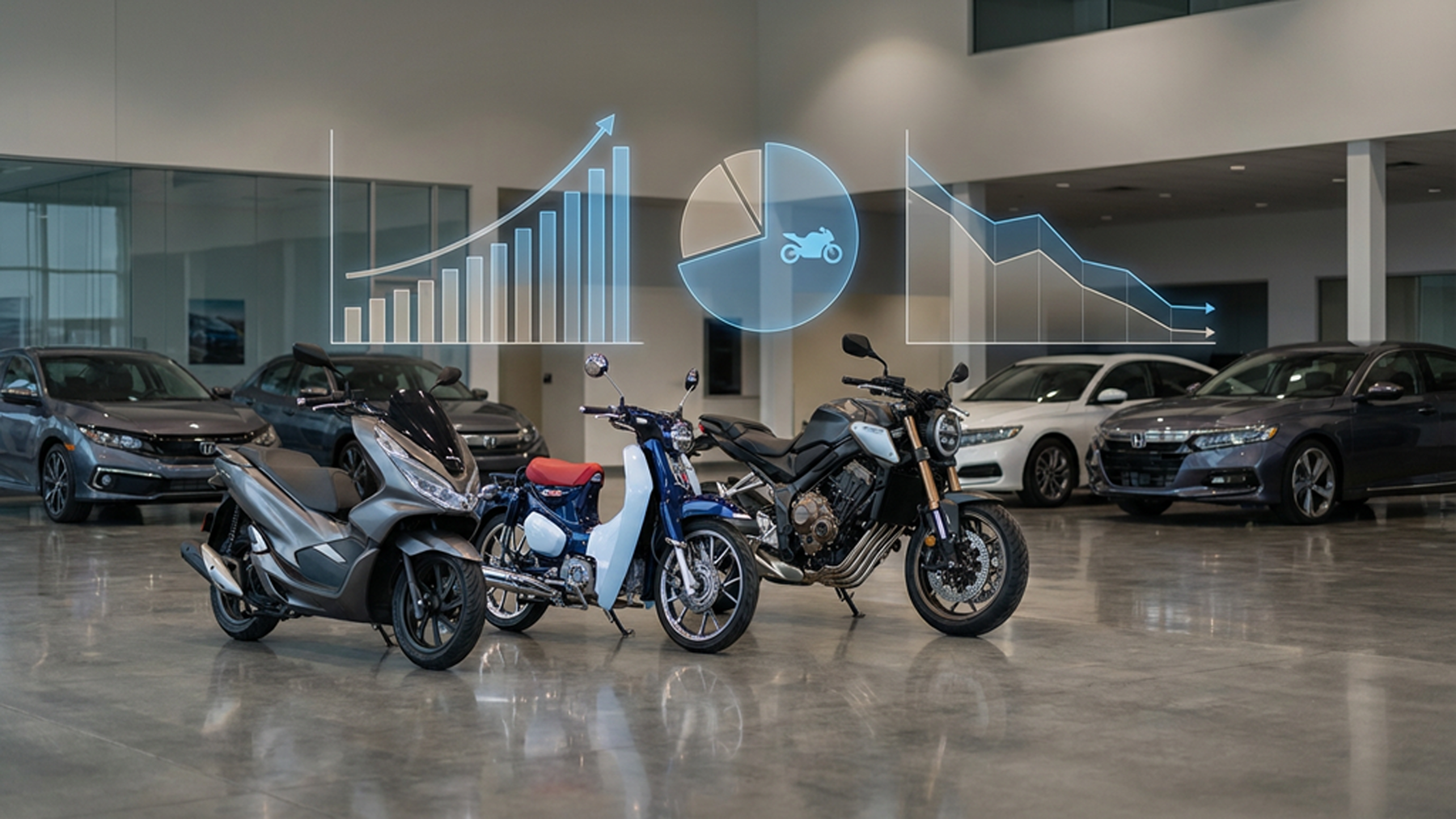
In contrast, the motorcycle business is proving to be a stabilizing factor. Honda sells more than 18 million motorcycles worldwide in a typical year, with sales volumes approaching 19 million units in some cases. This compares with sales of around 3.5 to 4 million automobiles. This illustrates the structural importance of the two-wheeler division.
A large proportion of these units are sold in markets in Southeast Asia and India. In many regions there, motorcycles are the primary means of transportation. Small-volume models with a displacement of 125 cubic centimeters play a central role in this. Their development and production are significantly less capital-intensive than complex battery-electric vehicles. There is no need for high investments in battery factories or extensive software architectures.
Although the margin per vehicle is comparatively low, the enormous volume ensures stable and recurring revenues. Risks are spread across millions of units, while production costs and market fluctuations in many emerging markets are less dependent on political support programs or customs regulations.
Structural shift in perception
In Western markets, Honda is often perceived primarily as an automobile manufacturer. However, the global picture is different. In terms of volume, the motorcycle business is the core of the company and contributes significantly to its financial stability.
With net profit down 42.2 percent and quarterly earnings down 61 percent, it is clear how strongly external factors influence the automotive business. At the same time, developments show that the two-wheeler division is currently playing a balancing role and compensating for operating losses in the automotive business.
Motorcycles are not only a familiar sight on the streets of many Asian cities, but are also ensuring the group’s economic stability in the current phase.
What does this mean for me as a motorcyclist?
For motorcyclists, the current development means that the two-wheeler division plays a central economic role within the group. The high global sales figures of over 18 million units per year ensure stable revenues, even when the automotive business is under pressure. This financial stability can help ensure that investments in existing model series and new projects in the motorcycle sector remain possible, even if other divisions of the company are posting losses. This shows that motorcycles are not just a complementary product in the portfolio, but a key component of the entire corporate structure.


- Kärcher 6.295-763KÄRCHER Motorradreiniger 3-in-1 (0,5 l)