- 96,071 new motorcycle registrations over 125 cc in 2025
- Decline of around 36 percent compared to 2024
- Euro 5+ causes massive shifts between years
After an exceptionally strong year in 2024, 2025 will see a sharp decline in statistics. At first glance, the new registration figures paint an alarming picture. However, looking at a single year in isolation is insufficient and does not reflect the actual market situation.
New motorcycle registrations in 2025: figures at their lowest level in ten years
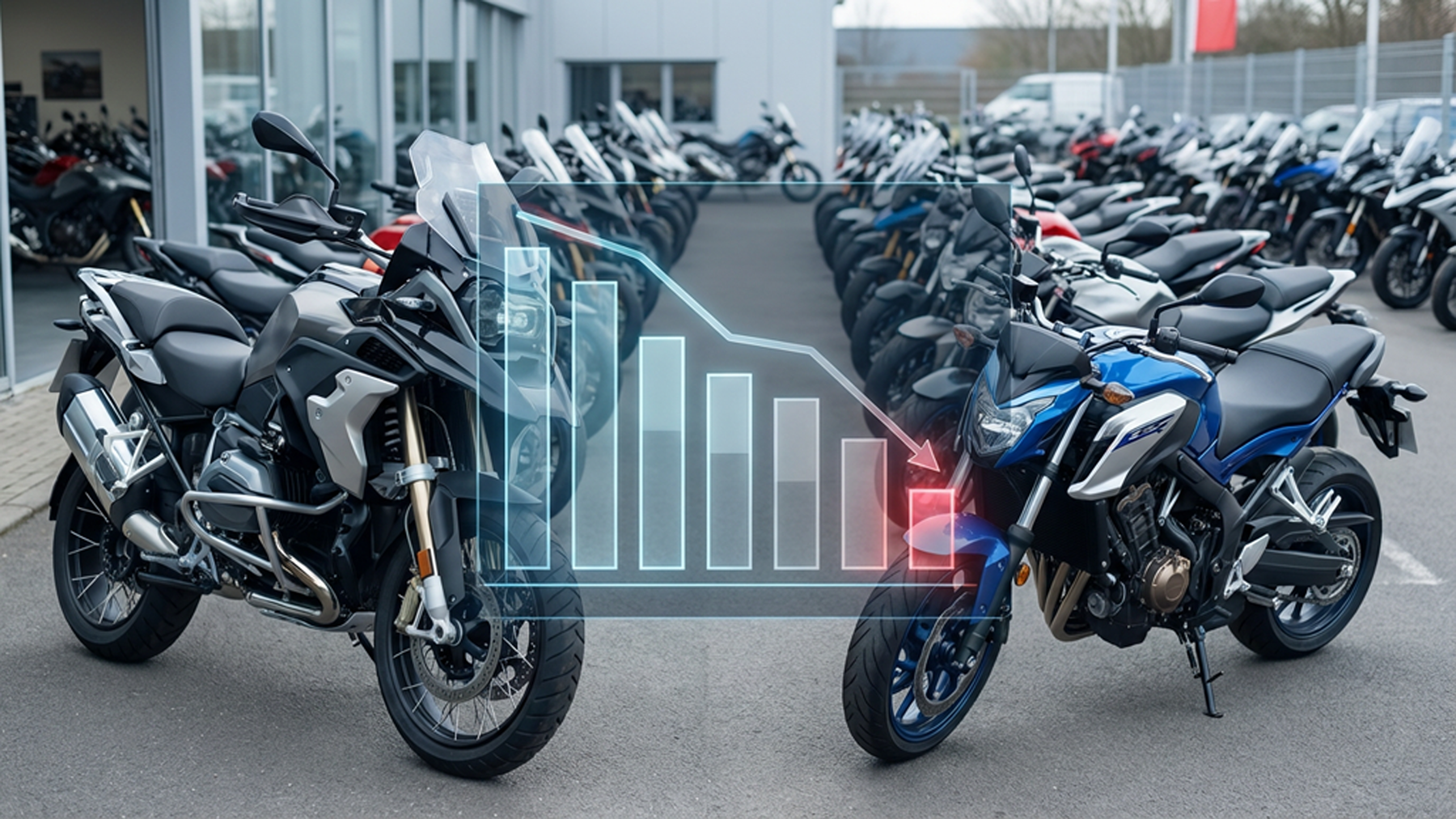
With 96,071 newly registered motorcycles over 125 cc, the German motorcycle market will reach its lowest level in ten years in 2025. Compared to 151,036 new registrations in 2024, this represents a decline of 36.4 percent. The result is also significantly weaker than in 2023, when 124,538 units were registered.
A look at the long-term trend shows that even years without special effects usually exceeded the 100,000 mark. Only in 2014 did the market remain at a similar level, with 96,292 units. However, the actual historical low point lies much further back: in 2009, new registrations slumped to around 80,000 units as a result of the financial crisis.
Euro 5+ as the main cause of the slump
The key factor for the weak year 2025 is the switch to the Euro 5+ emissions standard. At the turn of the year 2024 to 2025, numerous vehicles that only met the previous Euro 5 standard had to be registered in advance. Dealers and manufacturers responded with extensive one-day registrations to secure their inventories.
These vehicles appear in their entirety in the statistics for 2024, even though a significant proportion of them were not sold until 2025. New registrations only reflect the date of initial registration, not the actual date of sale. This creates a distorted picture that artificially inflates the market in 2024 and deflates it accordingly in 2025.
Why comparing individual years is not very meaningful
Under normal conditions, new registrations can be used to draw conclusions about market developments. However, the years 2024 and 2025 are characterized by regulatory interventions and are therefore only comparable to a limited extent. Statements such as a slump in the motorcycle market by more than a third fall short and ignore the special effects.
A two-year comparison is more meaningful. Adding the registrations from 2024 and 2025 results in 250,403 newly registered motorcycles. This puts this period above the comparative figures for 2022 and 2023, with 233,701 units, and roughly on par with the strong years of 2020 and 2021.
Market in context: Two-wheelers overall more stable than expected
A look at the overall two-wheeler market also puts the negative headlines into perspective. Motorcycles, 125cc bikes, and power scooters will together account for a total of 405,814 new registrations in 2024 and 2025. This is only slightly below the two previous years and significantly above the figures for 2018 to 2019.
The decline in the overall market is particularly noticeable in the 125cc segment. After the strong boom in the wake of the B196 regulation, demand is noticeably flattening out here. In contrast, motorcycles over 125 cc are more stable than they have been for a long time in a two-year comparison.
Manufacturers and models: Clear winners and losers
Despite the weak overall year, significant shifts within the market can be seen. BMW remains by far the strongest manufacturer and once again has the most registered motorcycle with the R 1300 GS. 8,075 new registrations secure the model’s place at the top of the rankings, followed by the Kawasaki Z 900 with 4,530 units and the Kawasaki Z 650 with 2,220 units.
However, it is striking that the GS’s lead over the competition has narrowed. Adjusted for commercial registrations, the gap to the Z 900 shrinks to around 1,000 vehicles. In previous years, the GS was sometimes more than twice as high as the second-placed model.
KTM is on the losing side. Its market share has fallen from 10.3 percent in the previous year to just 2.8 percent. This corresponds to a decline of around 75 percent and represents one of the most striking declines in the manufacturer comparison.
New models with surprising momentum
Despite overall weak market performance, several new models were able to establish themselves over the course of the year. The Voge DS 900 made a visible entry into the statistics in April, reaching 37th place. The CFMoto 450 MT showed a clear growth curve from the summer onwards. The BMW R 1300 R also had a strong second half of the year after its market launch in May.
These developments show that new products can continue to generate demand, even in a statistically difficult environment.
Segments and performance classes: powerful motorcycles continue to dominate
Despite declines, naked bikes remain the highest-volume segment. Enduros, on the other hand, recorded the sharpest losses, which can be interpreted as a catch-up effect from the many registrations in the previous year.
A look at the performance classes shows a clear dominance of powerful motorcycles. Models with more than 73 kW, i.e., over 99 hp, account for the largest share in many segments. For touring bikes, this share is around 77 percent, and for naked bikes and sports bikes, it is around half of all new registrations.
Choppers and enduros show a wider spread. Lower-powered models and the A2 class with a maximum of 48 hp also play an important role here. It is also striking that even for sports motorcycles, the A2 class continues to be a relevant factor.
Electric motorcycles: growth in a niche market
While combustion engine two-wheelers are heavily affected by the Euro 5+ issue, this is not the case for electric vehicles. Here, the years can be compared directly. In 2025, new registrations of electric two-wheelers will increase by 16.3 percent to 6,266 units.
After several difficult years and bankruptcies, this indicates a cautious recovery. Positive sales reports from individual manufacturers and technological advances in range and battery technology are expected to further support this development.
Conclusion: Statistical low point, but no structural slump
Although 2025 marks the mathematical low point of the last ten years, it is primarily a product of exceptional circumstances. The introduction of Euro 5+ has shifted registration figures massively between years and distorted the perception of the market.
In a longer-term comparison, the motorcycle market appears stable and at a high level. New models, revived series, and new manufacturers point to sustained demand. The figures for 2025 are less a warning signal than a statistical outlier in an overall robust development.
What does this mean for me as a motorcyclist?
For motorcyclists, the figures have mainly pragmatic effects and fewer fundamental changes. A statistically weak registration year does not automatically mean less choice or poorer supply. On the contrary: many models are available, inventories from the previous year have a stabilizing effect on prices, and competition between manufacturers remains high. At the same time, the market shows that powerful motorcycles and established segments are still in demand, which ensures long-term model maintenance and further development. Anyone looking to buy a new motorcycle in 2025 will therefore not encounter a depleted market, but rather an environment characterized by a wide range of products, moderate demand, and, in some cases, improved conditions.

Redakteur bei Motorrad Nachrichten. Fokus auf Technik, Szene und Motorradpolitik – neutral, sachlich, verständlich.
Verantwortlich für die Seiten www.Motorcycles.News, www.Motorrad.Training und den YouTube-Kanal "Motorrad Nachrichten", sowie deren social Media-Seiten.