- Compensation claims for potholes have risen by 91 percent since 2021.
- Only 26 percent of claims led to payouts in 2024.
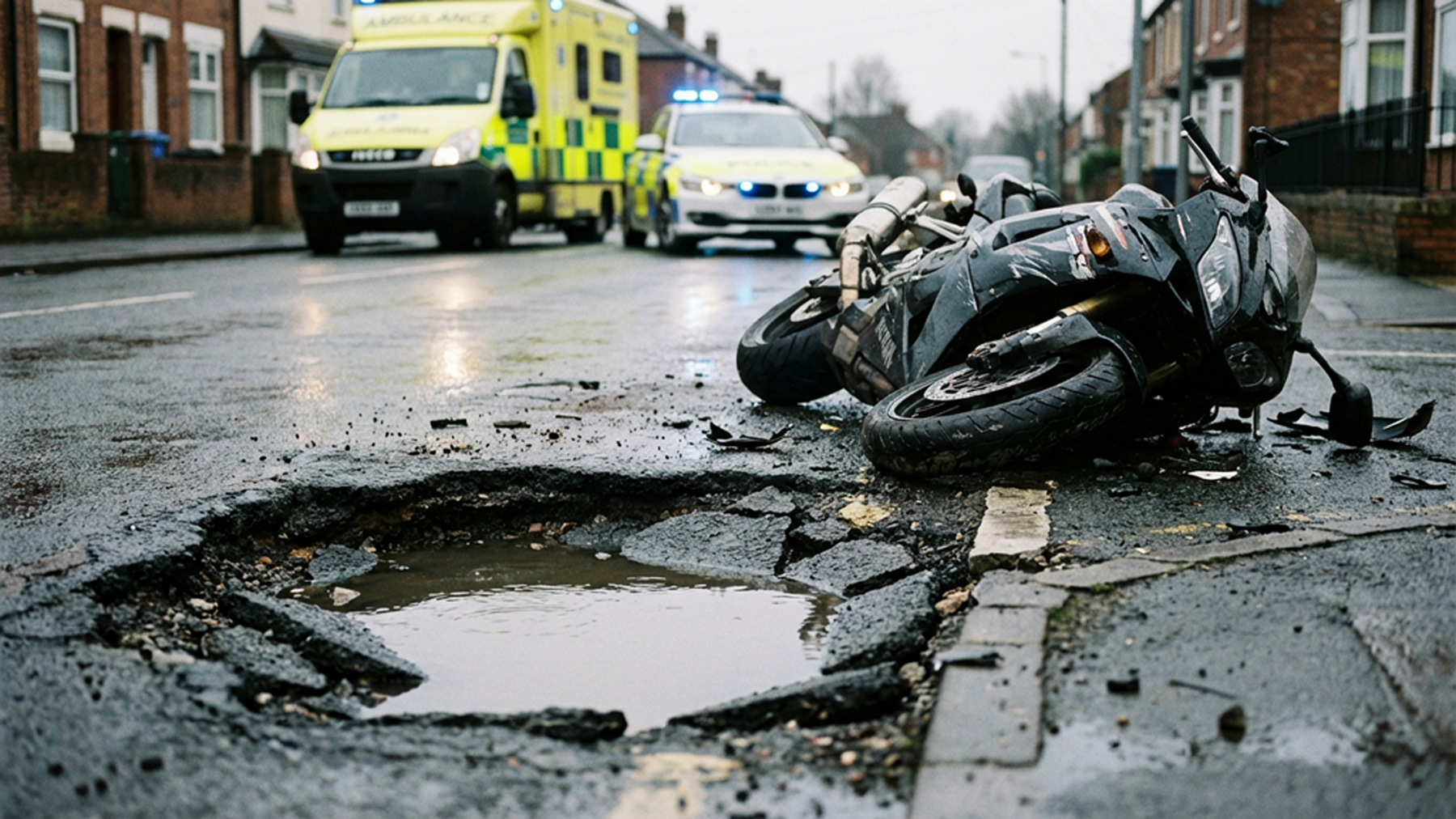
- For motorcyclists, potholes mean a significantly higher risk of injury.
The poor condition of many roads has been a topic of discussion for years. New figures now show how much the problem has worsened. However, the statistics reveal not only damaged vehicles, but also serious accidents with long-term consequences, especially for motorcyclists.
Significantly more compensation claims due to road damage
An evaluation by the RAC automobile club based on requests under the Freedom of Information Act shows a significant increase in pothole compensation claims. A total of 53,015 claims were received from 177 responding municipalities in 2024. In 2021, the figure was 27,731. This represents an increase of 91 percent within three years.
The increase was particularly strong in Derbyshire, where the number of claims rose from 224 to 3,307. Glasgow also saw more than a doubling of claims to 2,794. Oxfordshire followed with an increase from 488 to 1,941 claims.
Despite this development, the total number fell slightly compared to 2023, when 56,655 claims were counted. However, the decline of around six percent does little to change the fundamental scale of the problem.
Only a fraction of claims are accepted
Of the more than 53,000 claims submitted in 2024, only 26 percent resulted in a payout. A total of 13,832 cases were settled. Local authorities paid out around 3.56 million euros (€) or approximately 3.87 million US dollars ($) for these claims.
The average compensation was around 449 euros (€) or approximately 488 US dollars ($) per case. This contrasts with average repair costs of around 679 euros (€) or 739 US dollars ($) for damage beyond a simple flat tire.
Some municipalities rejected almost all claims. In Gloucestershire, Worcestershire, Medway, Carmarthenshire, and Telford, around 99 percent of claims were rejected. Bridgend was an exception, paying out all 52 claims received.
Motorcyclists are at particularly high risk
While car drivers are usually confronted with damaged tires or chassis components, potholes pose an acute safety risk for motorcyclists. Even a single defect in the road surface can lead to loss of control. Without crumple zones or protective bodywork, the consequences of a fall are often much more serious.
This is also demonstrated by the fate of Richard Cheshire. At the age of 19, he was paralyzed from the neck down after an accident caused by a pothole. The accident occurred in October 2010 on a country road near Mansfield. After crashing into a fence, he suffered severe spinal cord injuries and spent six months in hospital.
“It has been 15 years, and the roads are a massive embarrassment. Nothing has changed.”
Richard is now permanently confined to a wheelchair. His own compensation claim was unsuccessful.
Although the road in question was later repaired and the speed limit reduced, no legal responsibility was established. Although the road in question was later repaired and the speed limit reduced, no legal responsibility was established.
Lifelong consequences instead of one-time repair costs
Today, Richard Cheshire works in specialized clinics and is involved as a wheelchair trainer for the charity Whizz Kidz. He points out that the long-term costs of serious accidents are significantly higher than regular road maintenance.
“The NHS is paying throughout my life. I’ve adapted, but I’m aging differently. It takes a toll on your body and your mind.”
These costs do not appear in any damage statistics, especially for motorcyclists. An accident can mean the loss of mobility, a job, and independence.
Investments announced, but skepticism remains
The British government has announced investments of around 8.5 billion euros, or approximately 9.3 billion US dollars ($), over four years to repair roads and eliminate potholes. This is intended to give local authorities planning security and enable them to implement more preventive measures.
The RAC sees this as a step in the right direction, but warns that improvements are only likely to be noticeable in the medium term. Until then, the risk remains high, especially for motorcyclists.
The increasing number of claims shows how great the need for action is. For many two-wheelers, it is not a question of damaged rims or tires, but of their own physical integrity.


- Michelin Road 6 190/50ZR17 73W