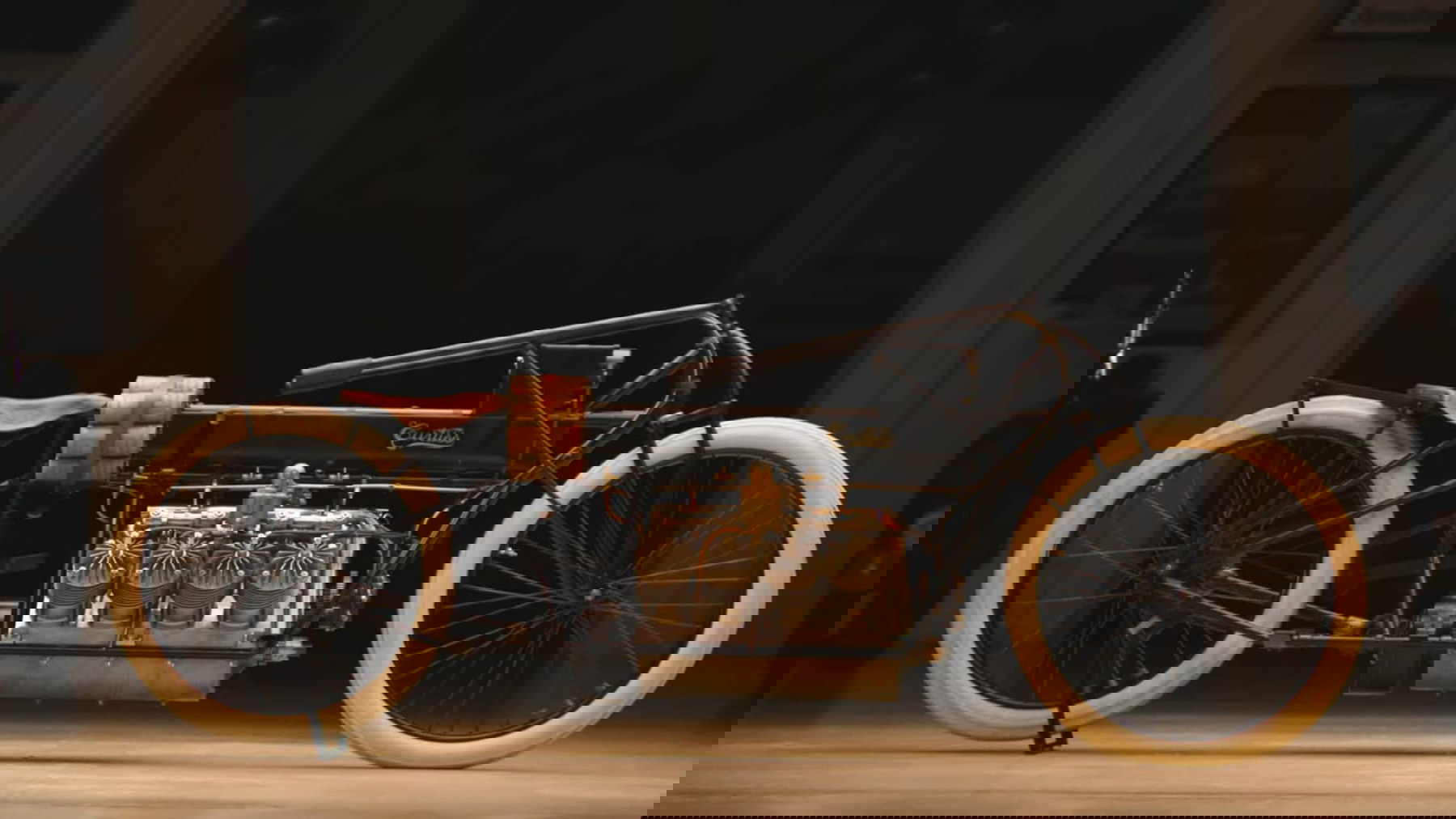
- 1907 V8 motorcycle with aircraft engine Origin
- Displacement approx. 4.4 liters, eight cylinders
- Reconstruction based on historical model, fully roadworthy
Speed can be measured objectively, but its effect depends heavily on the technical environment. While modern motorcycles enable high speeds with stability, driving aids, and safety reserves, speed was a risky experiment at the beginning of the 20th century. It was precisely during this era that the Curtiss V8 motorcycle was created, which is still considered one of the most extreme two-wheelers in history.
Glenn Curtiss and the pursuit of speed
The name Glenn Curtiss is closely associated with the early days of motorcycle and aviation history. Curtiss began building his own motorcycles in 1902 and quickly made a name for himself as a designer of lightweight, powerful engines. The V8 motorcycle was not created as a production vehicle, but as a rolling test bed for a newly developed aircraft engine.
In 1907, this motorcycle appeared at the Speed Carnival in Ormond Beach. Officially, it was not allowed to participate in the regular competitions because it did not comply with any current regulations. Nevertheless, the organizers allowed it to run. Contemporary reports speak of a top speed of allegedly around 136 mph. For an official record, a second run in the opposite direction would have been necessary. This did not happen because, according to tradition, there was a defect in the drive train.
Technology beyond reason
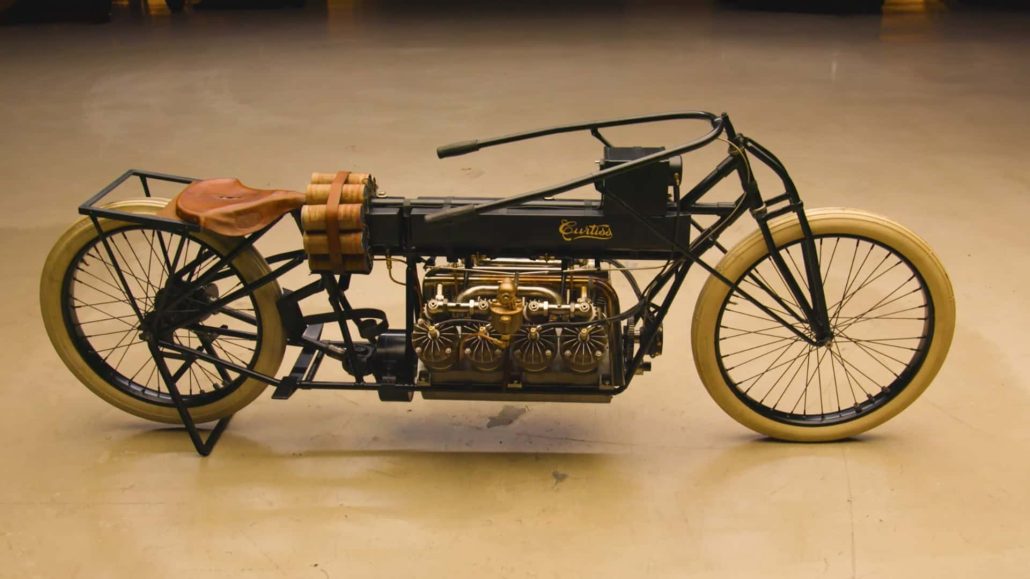
The heart of the motorcycle is an air-cooled V8 engine with a displacement of around 4.4 liters, which corresponds to approximately 268 cubic inches. The engine was originally intended for use in aircraft. Its power output is stated as around 40 hp, which corresponds to approximately 29 kW. By today’s standards, this figure seems unspectacular, but in 1907 it was exceptionally high. Contemporary motorcycles usually had single-cylinder engines with significantly lower power outputs.
The design of the vehicle was strongly based on the bicycle construction of the time. The long wheelbase, narrow tires, and almost complete lack of suspension comfort made high speeds extremely risky. Braking was provided solely by a simple rear brake, which can be described more as a friction brake. Real deceleration, as we take for granted today, was hardly possible with this system.
A reconstruction for history
The model known today is not the original motorcycle from 1907. That one hangs as a museum piece in the Smithsonian Institution and is considered too valuable for test drives. Instead, it is a detailed, fully functional replica built by American engineer Dale Stoner.
Stoner reconstructed the motorcycle as accurately as possible using historical documents, measurements, and archive material. The engine dimensions, stroke, and bore, as well as the basic design, correspond to the original. However, he made specific improvements to the materials and lubrication. Instead of the original very simple lubrication system, the replica uses a more modern oil circuit to keep the engine running reliably. These adjustments are intended to increase reliability without distorting the historical character.
Appearance on Jay Leno’s Garage
The roadworthy reconstruction became famous thanks to its appearance on Jay Leno’s Garage. Jay Leno is considered a proven expert on historic vehicles and is known not only for collecting machines, but also for actually riding them. His treatment of the Curtiss V8 is correspondingly respectful.
The show clearly demonstrates how uncompromisingly this motorcycle is designed. There are no safety reserves, no assistance systems, and hardly any possibilities to compensate for mistakes. Leno himself makes no secret of the fact that even speeds well below the theoretical maximum performance represent a high risk. The motorcycle is not presented as a nostalgic toy, but as a technical relic from a time when courage was often more important than calculation.
Speed in a historical context
At the beginning of the 20th century, 100 mph was considered almost unimaginable. Tires, metallurgy, and chassis designs were still in their infancy. Anyone who sat on such a vehicle at that time relied almost exclusively on the quality of craftsmanship and their own nerves. Modern systems such as ABS, traction control, and powerful braking systems were still decades away.
This is precisely why the Curtiss V8 still has special significance today. Not only because of the speed it could reach, but because of what that figure represented at the time. The motorcycle symbolizes an era in which technical boundaries were pushed back through a willingness to experiment and take risks.
Significance beyond the motorcycle
The V8 engine was later also used in aviation. Among other things, it was used in the June Bug aircraft, which in 1908 completed the first publicly documented powered flight of more than one kilometer in the USA. The prize money offered for this achievement was US$25,000. This success contributed significantly to establishing Curtiss as one of the leading developers of his time.
The 1907 motorcycle is therefore not only an extreme two-wheeler, but also an important link between motorcycle construction and early aircraft technology. Its reconstruction brings this phase of technological history back to life.


- Cardo PTP00001Cardo Packtalk PRO Kommunikationssystem Einzelset Schwarz male