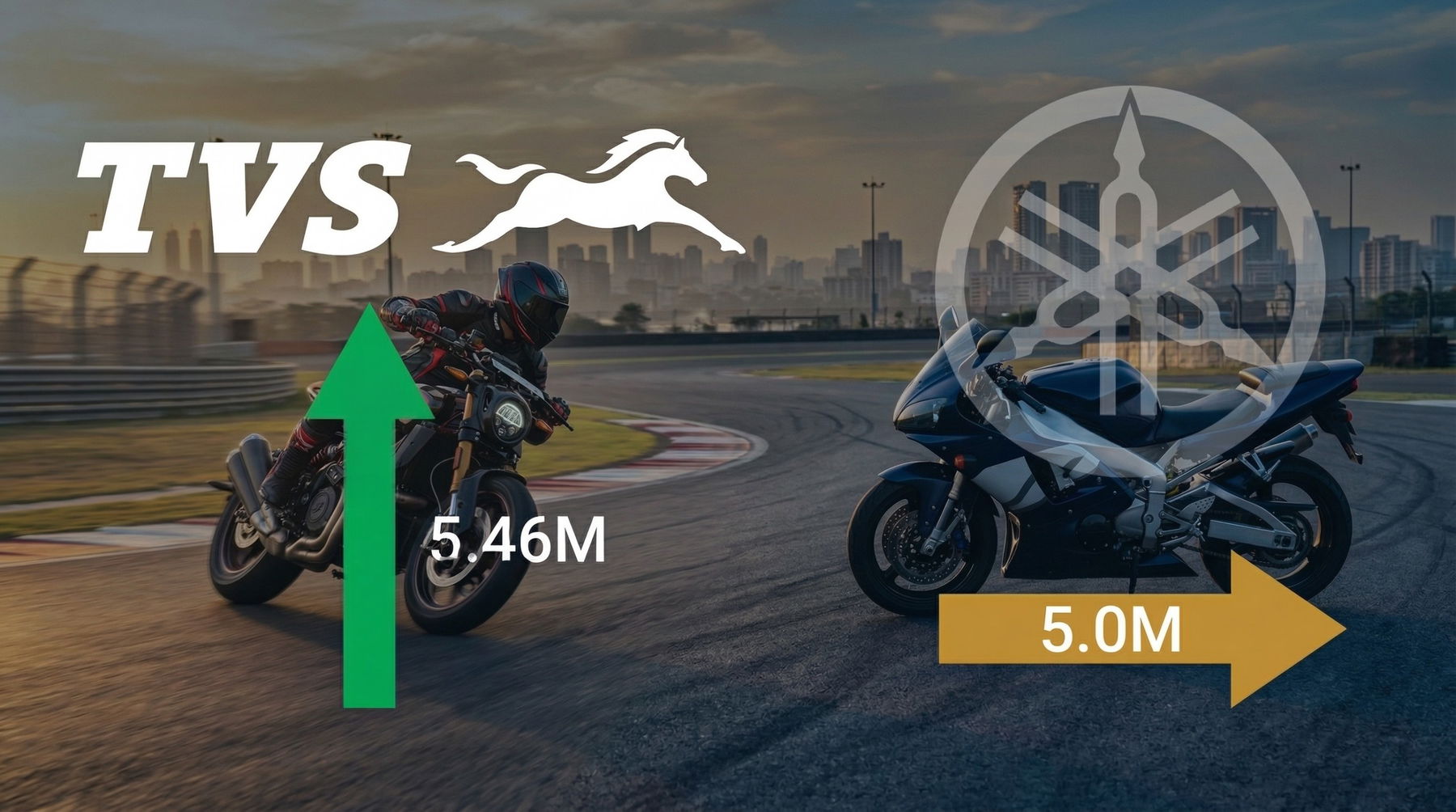
- TVS sold a total of 5.46 million two-wheelers in 2025, an increase of 20.7 percent over the previous year
- Yamaha sold around 5 million units in the same period with growth of only 0.8 percent
- Two of the three largest two-wheeler manufacturers in the world now come from India
The ranking among the world’s largest two-wheeler manufacturers had long been considered set in stone. Honda at the top, Hero MotoCorp in second place, Yamaha in third. But in 2025, the Indian manufacturer TVS Motor Company from Chennai broke through this order and displaced Yamaha from third position. It is one of those rare shifts in the global motorcycle industry that point to a fundamental change in market dynamics.
The Numbers Behind the Change
TVS sold a total of 5.46 million motorcycles and scooters in calendar year 2025. The previous year the figure had been 4.52 million units, representing growth of 20.7 percent. Yamaha sold around 5 million two-wheelers in the same period, after 4.96 million in 2024. That corresponds to an increase of just 0.8 percent.
The gap between the two manufacturers at around 460,000 units is not enormous, but clear enough to establish a shift that had been building over several years. For comparison: as recently as 2023, TVS was still in fifth place in the global rankings with 3.4 million two-wheelers sold, behind both Yamaha and Indian competitor Bajaj.
At the top of the global ranking, Honda continues to reign with 16.44 million units sold in 2025, an increase of 6 percent over the 15.51 million of the previous year. Around 85 percent of Honda’s global sales come from the Asian region. Hero MotoCorp holds second place with 6.25 million units, up from 5.94 million the previous year, representing growth of 5.2 percent.
Why TVS Is Growing So Fast
TVS’s rise has several causes. The manufacturer from Chennai in southern India has a broad product portfolio ranging from mopeds to commuter bikes, scooters, and sporty motorcycles. This wide range allows the company to grow simultaneously across multiple market segments.
A key driver is the so-called premiumization trend in the Indian market. Demand there is increasingly shifting toward motorcycles with more than 150 cubic centimeters of displacement, and TVS has specifically expanded its offerings in this segment. Models like the Apache range are benefiting from this trend.
At the same time, TVS is the third-largest two-wheeler manufacturer in India behind Hero MotoCorp and Honda, with an estimated market share of 19 to 20 percent. But unlike many competitors, TVS has not based its growth solely on the domestic market. The company has built a strong export presence particularly in Africa, which contributes significantly to overall volume. Latin America, Southeast Asia, and the Middle East are also in focus of the expansion strategy.
Electric Mobility as an Additional Growth Driver
In the electric two-wheeler sector, TVS has also moved to the forefront. In India, the company regularly leads monthly sales statistics with models like the iQube and the Orbiter. Its market share in the Indian electric two-wheeler segment is said to be over 30 percent, with an average of more than 30,000 units sold per month. Annual production capacity is approaching the 500,000-unit mark according to industry reports, and further expansion is being considered.
Yamaha’s Different Path
Yamaha’s trajectory has gone in the opposite direction. The Japanese manufacturer has increasingly concentrated on niche segments within the mass market over the years and has exited several high-volume categories. A considerable portion of Yamaha’s sales comes from developed markets like Japan, Europe, and North America, where demand growth tends to be slower than in emerging markets.
In North America, for example, Yamaha is strongly positioned in premium motorcycles, performance segments, and off-road models — areas with comparatively low unit volumes compared to the commuter machines that dominate in developing countries.
Yamaha itself described its 2025 business performance as mixed. Sales in Japan increased, but demand in Europe and the USA declined. In emerging markets, production and deliveries in Vietnam were temporarily disrupted, while sales in Indonesia, the Philippines, and Thailand grew. Overall, revenue and motorcycle sales remained at the previous year’s level according to company statements, although operating profit declined due to higher procurement costs, increased research and development spending, rising labor costs, and the impact of new US tariffs.
TVS and Norton: Reaching for the Premium Market
TVS is not limiting itself to the mass market. The company has been the owner of the storied British brand Norton Motorcycles for several years and has effectively revived it. Norton recently unveiled four new models intended for global sale. With the acquisition, TVS is also positioning itself in the premium segment beyond the Asian core market.
Additionally, TVS cooperates with BMW Motorrad. This partnership produces, among other things, the BMW G 310 range as well as the BMW CE 02 electric scooter. These partnerships demonstrate that TVS is not just operating as a volume manufacturer but also as a development and production partner for established Western brands.
To further build technological expertise, TVS appointed Sudarshan Venu as its new chairman and brought Nick Rogers, the former engineering chief of Jaguar Land Rover, into the leadership team. These personnel decisions underscore the company’s ambition to establish itself as a long-term global player in the premium space.
What the Shift Means for the Industry
TVS’s rise to third place is more than a footnote in sales statistics. With TVS and Hero MotoCorp, two Indian manufacturers now rank among the three largest two-wheeler producers in the world. This reflects the growing influence of Indian industry in the global motorcycle market and shows how significantly the industry’s center of gravity has shifted toward emerging markets.
The formula behind it is essentially simple: whoever is present in the high-volume markets of Asia, Africa, and Latin America with a broad, affordable product portfolio while simultaneously serving the electric mobility trend grows faster than a manufacturer that primarily targets premium segments in saturated Western markets. Whether Yamaha can close this gap in the coming years depends not least on whether the Japanese manufacturer adjusts its strategy in high-volume markets.

- Abus 10079270-01Abus Granit Detecto XPlus 8008 2.0, Alarm-Bremsscheibenschloss – Silber male