- Bill HB 1367 allows motorcycles to temporarily drive on the right shoulder
- Only when stationary or up to a maximum speed of 25 mph Traffic flow on freeways
- Obligation to exit at the next exit and full liability for the driver
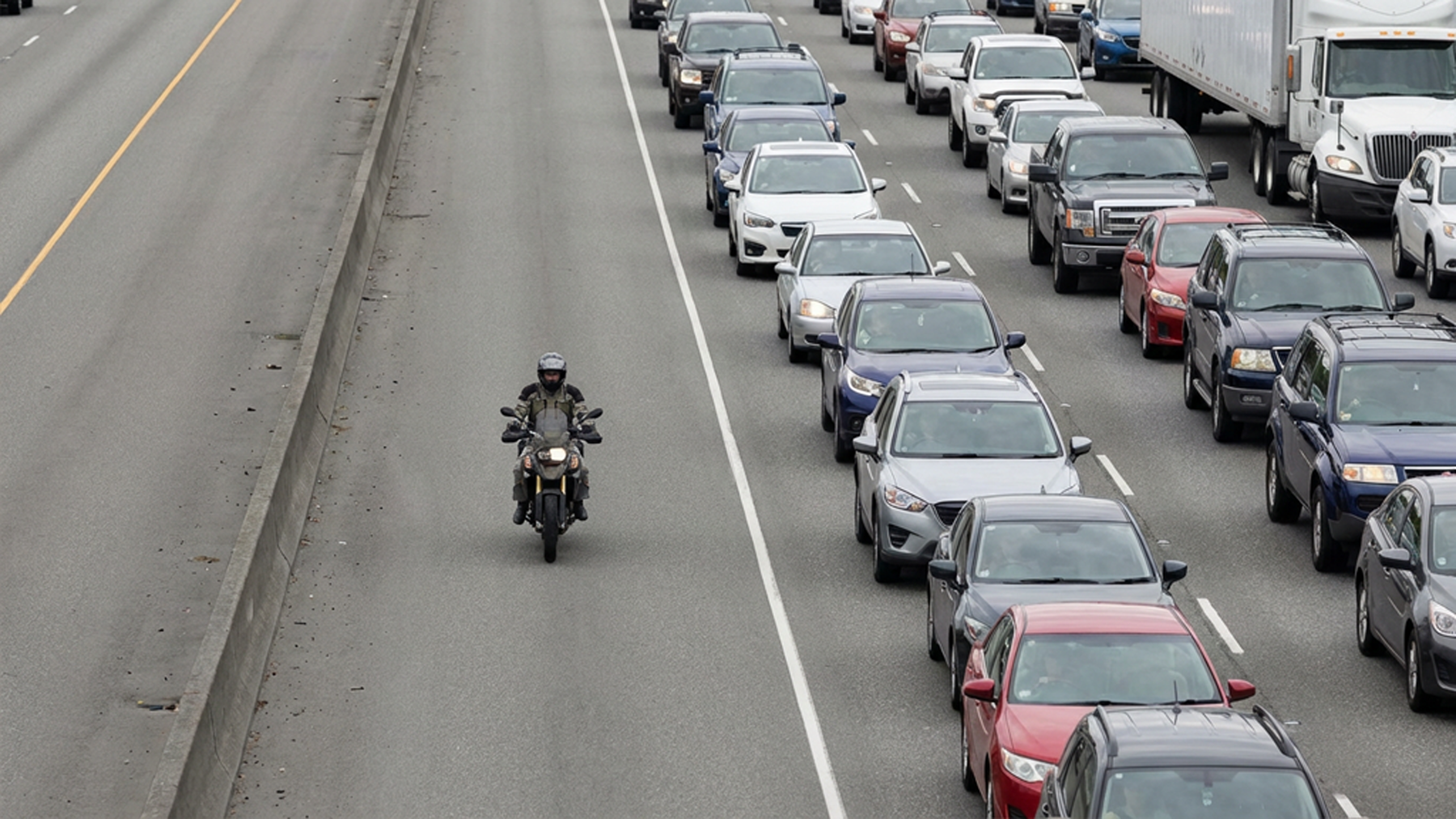
Traffic jams on freeways and expressways are part of everyday life in many regions of Washington. This situation poses an increased risk for motorcyclists, as they are less protected in slow-moving traffic and can be particularly vulnerable in rear-end collisions. Against this backdrop, the state legislature is once again considering a regulation that would give motorcycles limited options for avoiding traffic jams without legalizing riding between lanes, which remains prohibited.
Bill HB 1367 and its approach
Representative Ed Orcutt introduced Bill HB 1367 during the 2025–2026 session of the Washington State Legislature. The aim is to allow motorcyclists to temporarily drive on the right shoulder under clearly defined conditions.
The regulation would apply exclusively to freeways and so-called limited access roadways. The prerequisite is that traffic is at a standstill or moving at a maximum speed of 25 mph. In these situations, motorcycles would be allowed to use the shoulder, but only for a short time and under strict conditions. According to the initiator, this is intended to be a controlled alternative to lane splitting, which remains prohibited in Washington.
Proposed restrictions on driving on the shoulder
The bill provides for several binding rules. Motorcycles may drive on the shoulder at a maximum speed of 10 mph faster than the surrounding traffic. In addition, only driving in single file is permitted. Driving side by side is prohibited.
The shoulder must be at least four feet wide. If the shoulder is blocked by a parked vehicle, a broken-down vehicle, a tow truck, or an emergency vehicle, the motorcyclist must return to the regular flow of traffic until the obstacle has been safely passed. The same applies to debris or other sources of danger.
Another restriction concerns the length of the route. Motorcyclists must leave the shoulder at the next exit. This is to prevent motorcycles from passing traffic jams over longer distances.
Rejection of lane splitting and justification for the proposal
Ed Orcutt has repeatedly made it clear that he still considers driving between lanes to be dangerous. In a hearing, he stated:
“I don’t like lane splitting. I think it’s dangerous, and I have concerns that someone is going to get squished between a couple of cars if they’re lane splitting in that situation. But, you know, they’re still trying to hold that bike up. They still got that strain. So what is an alternative solution? And that’s what led me to this bill: to allow shoulder driving.”
Voices from the motorcycle community
The proposal has received support from representatives of motorcyclists. A member of ABATE Washington pointed out in a hearing that driving on the shoulder is already permitted in Hawaii and works well there. He stated:
“This works. It’s safe. And if you’ve ever seen a motorcycle rear-ended by a vehicle, this is a very dangerous situation. Seven to 11% of accidents involving motorcycles are rear-end collisions, and that may be just a fender bender for a car, but for a motorcycle, it’s a life-and-death situation.”
Larry Walker, also associated with ABATE Washington, commented:
“Getting hit from behind is probably not a really good thing for a motorcycle.”
In addition to the risk of accidents, thermal stress was also addressed. In slow traffic or when stationary, heat can build up on the engine. Even with water-cooled motorcycles, the effect of the radiator fans is not always sufficient, according to statements made during the hearings. Continuing to roll along the hard shoulder is intended to provide additional air supply.
Liability, training, and current status of proceedings
A central component of the draft law is the liability provision. Motorcyclists would assume full responsibility for any damage or injury caused while driving on the hard shoulder.
In addition, HB 1367 provides for the topic of hard shoulder driving to be included in driver training and official driver’s manuals. In addition, public information campaigns are to be carried out.
The bill had already been introduced in an earlier session but failed in committee. The current version has been revised to address concerns raised by the Washington State Patrol and the Washington State Department of Transportation. A new hearing in the Transportation Committee is scheduled for February 2026.
What this means for me as a motorcyclist
If the bill is passed, motorcyclists in Washington will have a clearly regulated additional option for maneuvering in traffic jams without lane splitting being legalized. In situations with stationary or very slow traffic, the shoulder may be used for a short time to escape potentially dangerous traffic jams. At the same time, the scope for action remains very limited: low speed differences, the obligation to exit at the next exit, and full liability on the part of the rider require a very conscious and defensive driving style. For motorcyclists, this means less downtime and possibly a lower risk of rear-end collisions, but also more personal responsibility and no blanket approval to bypass traffic jams over longer distances.


- Shoei 11189027Shoei X-SPR Pro Marquez Dazzle Helm Rot Blau male