- SWOV examined 50 serious motorcycle accidents from 2021 to 2023 in the Netherlands
- Excessive speed and failure to notice motorcyclists are among the most common accident causes
- The findings will inform a new national motorcycle safety action program
Motorcyclists live dangerously, that’s nothing new. But exactly how dangerous and especially why is the question that SWOV (Institute for Scientific Road Safety Research) has now investigated in a comprehensive in-depth study. The Dutch road safety research institute analyzed 50 serious motorcycle accidents that occurred between 2021 and 2023. The results paint a nuanced picture of the risks in everyday motorcycling and identify five clearly distinguishable accident types, which can be addressed with targeted countermeasures.
Little change in death tolls over the past decade
The background to the study is sobering. In the Netherlands, the number of motorcyclists killed in road accidents fluctuated between 42 and 56 per year over the past decade. No real improvement is evident. Yet motorcycle traffic accounts for only about half a percent of all travel kilometers, but represents over seven percent of all traffic fatalities annually. This disproportion between traffic share and accident risk was reason enough for SWOV to conduct an in-depth study. The last comparable major investigation into motorcycle accidents was around 20 years ago: the European MAIDS study.
Since April 2022, the SWOV in-depth research team has investigated every reported serious motorcycle accident in its investigation region. The multidisciplinary team of psychologists, engineers and vehicle specialists inspected accident sites, examined damaged vehicles and conducted interviews with those involved. Based on this detailed data collection, each individual accident was subsequently reconstructed and analyzed.
Five accident types at a glance
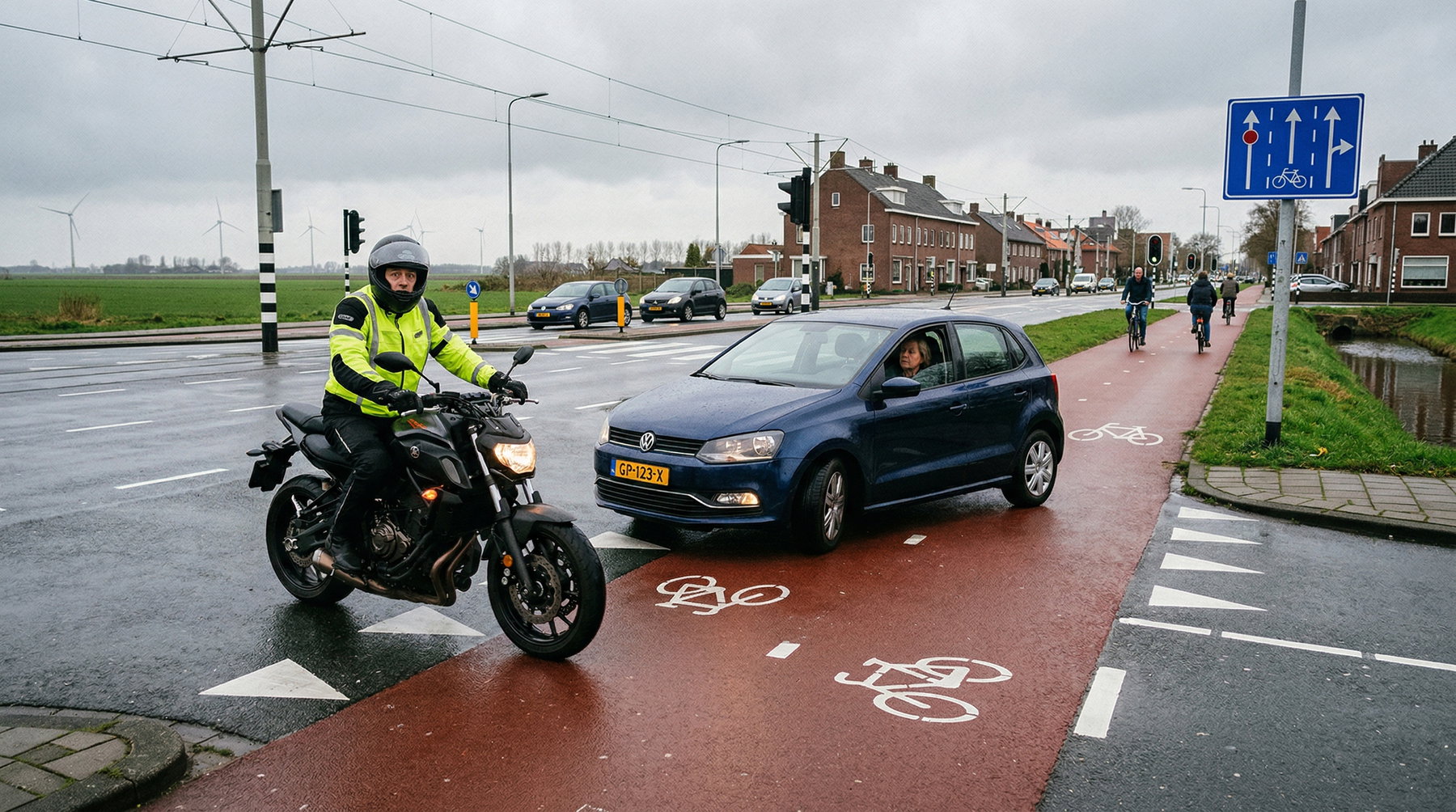
From the 50 accidents examined, five recurring patterns emerged. Most frequent were situations where the motorcyclist was simply not noticed by another road user. This accident type occurred 13 times. Closely following were accidents caused by excessive speed with twelve cases. Rear-end collisions accounted for eleven of the incidents examined. Less frequently, but still clearly identifiable, were loss of control in curves (six cases) and skidding while braking at a red light (five cases).
The 50 accidents involved a total of 51 motorcyclists, almost exclusively men. The age distribution was relatively even: approximately one third each was younger than 30 years, between 30 and 50 years old, or over 50 years old. The majority of drivers whose license status was known had held their motorcycle license for at least two years, 20 of them for at least five years. Nine drivers had their license for less than two years, three were riding completely without a license.
Human behavior as the central cause of accidents
Analysis of accident factors on the motorcyclists’ side revealed a complex picture. Particularly striking was the role of excessive speed: in 11 to 12 cases, the motorcyclists deliberately rode faster than permitted, in another 5 to 6 cases the speed was at least too high for the circumstances. The ranges in the numbers arise because in some accidents a factor played a role with high probability, but not with absolute certainty.
Beyond that, the SWOV team identified a number of other behavioral factors. In 8 to 13 cases, the driver’s attention was too focused on another aspect of the driving task. Substance use, haste or fatigue played a role in 5 to 11 accidents. Too small a distance to the center line, roadside or vehicle ahead was found in 4 to 9 cases. Distraction from external influences occurred in 5 to 7 accidents, the search for an adrenaline rush in 4 to 7. Traffic violations such as failure to yield right of way or running red lights were partially responsible in 4 to 5 cases.
Other road users and infrastructure as risk factors
At least as significant as the motorcyclists’ own behavior were environmental factors. In 25 to 27 of the 50 accidents examined, the behavior of another road user played a role, with most frequently the motorcyclist being denied right of way. Traffic density and congestion contributed to the accident in 12 to 15 cases. Obstructed visibility from other vehicles, buildings or vegetation was a factor in 4 to 9 accidents.
The infrastructure itself also proved problematic. Suboptimal intersection design that created false expectations among road users was found in six cases. In 4 to 5 accidents, the applicable speed limit didn’t match the actual road design. Lack of traffic calming measures played a role in 3 to 6 accidents, as did wet road surfaces. In 2 to 6 cases, the design of road equipment, such as curb construction, contributed to the accident.
On the vehicle side, one factor stood out particularly: the absence of an anti-lock braking system was a relevant influence factor in 6 to 12 accidents.
Targeted measures for each accident type
Based on the five identified accident types, SWOV formulated concrete recommendations for action. Against motorcyclists being overlooked at intersections, researchers primarily recommend better sightlines, such as by removing visual obstructions. However, the study acknowledges that the “looked but failed to see” phenomenon also occurs: the other road user looks but still doesn’t perceive the motorcyclist.
To prevent loss of control in curves, better maintenance of roads and roadsides should help. The problem of skidding when braking could be mitigated by greater ABS prevalence. Since many older motorcycles still lack ABS, SWOV proposes exchange programs where the old motorcycle is taken off the road when a new one with ABS is purchased.
To combat excessive speed, the study recommends the use of traffic calming measures such as bumps and intersection plateaus, as well as combined camera monitoring of red light and speeding violations. Intelligent speed assistants (ISA) could also contribute to speed control.
Advanced rider training for motorcyclists and a stronger focus on hazard recognition in regular driving education should help drivers better assess risks and drive more anticipatively.
Accident consequences can also be mitigated
Beyond accident prevention, SWOV also addresses limiting accident consequences. Safer roadsides, more motorcycle-friendly road design such as beveled curbs, underride guards on barriers and better education about proper protective equipment, including helmets, protective clothing and additional protectors, can significantly reduce the severity of injuries in an accident.
Study serves as foundation for national action program
The SWOV in-depth study does not stand alone. Together with a broad-based analysis by VeiligheidNL, which documents, among other things, around 4,100 emergency room visits after motorcycle accidents in 2024 and 57 motorcyclists killed in traffic, it forms the basis for a new “Action Plan for Improving Road Safety for Motorcyclists” (Actieplan Verbetering Verkeersveiligheid Motorrijders). This is being developed by the Dutch Ministry of Infrastructure and Water Management together with the Motorplatform Foundation and is scheduled to be completed by mid-2026.
The findings from the Netherlands should also be relevant beyond national borders. The identified accident types and risk factors are not specific to the Netherlands, but reflect patterns that affect motorcyclists throughout Europe.
Frequently Asked Questions
-
How many motorcyclists die annually in the Netherlands?
Over the past decade, the number of motorcyclists killed in the Netherlands has ranged between 42 and 56 per year. This represents over seven percent of all traffic fatalities annually, even though motorcycles account for only about 0.5 percent of all travel kilometers.
-
What five accident types did the SWOV study identify?
The study distinguishes the following five types: motorcyclist overlooked by other road users (13 cases), accidents caused by excessive speed (12), rear-end collisions (11), loss of control in curves (6), and skidding while braking at red lights (5).
-
What role does ABS play in motorcycle accidents?
According to the SWOV study, the absence of an anti-lock braking system was a relevant factor in 6 to 12 of the 50 accidents examined. Particularly for the accident type involving skidding during braking, ABS could be decisive in preventing a crash. The study therefore recommends exchange programs for older motorcycles without ABS.
-
What is the most common cause of motorcycle accidents according to SWOV?
On the environmental side, the behavior of other road users was the most frequent factor, particularly failure to yield right of way to motorcyclists (in 25 to 27 of 50 cases). On the driver side, deliberately excessive speed was the most common cause (11 to 12 cases).


- Sonax 02819410SONAX PremiumClass LederPflegeSet inkl. 2x LederReiniger, 1x LederPflegeCreme, 1x MicrofaserTuch, 1x MicrofaserPflegePad, 1x IntensivreinigungsBürste | Art-Nr. 02819410