- EU Driving Licence Reform 2025: Digital licences, Europe-wide penalty points and stricter rules for novice riders
- Motorcycling MEP Club: since 1 July 2026, motorcycles, scooters and mopeds have their own cross-party group in the European Parliament
- France: Extreme speeding is now a criminal offence — including for foreign motorcyclists
- Keep-right rule in a group: staggered riding cost one motorcyclist half of his compensation
- Contaminated road surface: Flensburg Regional Court awards 75 percent of the damages – 25 percent contributory liability for failing to adjust speed
- US legislation: Bill H.R. 3385 threatens autocycle classification, Supreme Court overturns tariffs
- Noise badge: German associations demand an 80 dB limit and nationwide noise protection zones with badge requirement
- Dashcams and action cams: no European country bans factory-fitted cameras – retrofitted cameras cost 1,000 to 2,000 euros in Baden-Württemberg
- Mandatory motorcycle inspections, equipment regulations and international developments
Motorcycle law affects every rider, yet it rarely gets the systematic coverage it deserves. From EU regulations reshaping driving licences and vehicle inspections to country-specific crackdowns in France, landmark court rulings and shifting political landscapes — the legal environment for motorcyclists is constantly evolving.
This page brings together all major legal and political developments relevant to motorcyclists: EU-wide regulations, national legislation in key riding destinations, international court decisions and the advocacy work of rider organisations fighting for your rights.
What’s Changing Across Europe
EU directives affect every motorcyclist on the continent — often before riders even hear about them.
Automated Speed Control: Is the EU Examining a Satellite Speed Brake?
After the mandatory ISA warning systems, the European Commission is reportedly examining technology that would no longer merely warn but actively slow a vehicle down when the speed limit is exceeded. Whether motorcycles would be included at all remains open – no draft law exists yet.
▸ EU Considers Satellite Speed Brake: What It Means for Motorcyclists
How the system of satellite positioning, maps and cameras is meant to work, why studies show weaknesses in limit recognition and when the technology could become mandatory at the earliest.
The Big EU Driving Licence Reform
The European Union adopted a comprehensive driving licence reform in 2025. Digital driving licences, a Europe-wide penalty point system, mutual recognition of licence suspensions and significantly stricter rules for novice riders are among the key changes. Implementation into national law is required by 2029 at the latest, but many provisions may take effect earlier. The European Commission has since detailed how the digital driving licence is to work in a draft implementing regulation.
▸ EU Driving Licence Reform: What Changes for Motorcyclists
Digital licences, cross-border penalty points, B196 recognition and new restrictions for novice riders — the complete overview.
▸ Digital EU Driving Licence: Plastic Card Stays, Revocation Gets New Rules
How the digital licence works in the EU Digital Identity Wallet, what applies to cross-border revocation and when it is coming.
Mandatory Motorcycle Inspections: Is the EU Pushing for PTI?
The debate over mandatory periodic technical inspections for motorcycles resurfaces regularly in the EU. However, the data tells a clear story: technical defects account for less than two percent of all motorcycle accidents. Despite this, the topic keeps returning to the political agenda.
▸ EU Motorcycle Inspection Debate: Doubts About Safety Benefits
Why FEMA and national rider associations oppose mandatory PTI and what alternatives they propose.
Equipment Requirements: What’s Mandatory Where
Helmets, high-visibility vests, gloves, first-aid kits — requirements vary considerably across Europe. Touring riders crossing multiple borders need to know the differences.
▸ Dashcams Abroad in 2026: Cyprus Allows Them, Four Countries Crack Down Harder
Which countries allow or ban dashcams — the current overview for motorcycle travel abroad.
▸ Motorcycle Travel in Europe: Equipment Requirements 2025 — All Countries at a Glance
Country-by-country breakdown from Albania to Cyprus: what’s mandatory, what’s recommended and where the most common pitfalls lie.
Dashcams and Action Cams: The Purpose Decides, Not the Device
No European country bans vehicles with permanently installed cameras – what is prohibited is always one specific form of data processing. Motorcyclists, however, lack the European legal backing that car drivers enjoy: EU Regulation 2019/2144 (General Safety Regulation) applies expressly only to vehicle categories M, N and O, and motorcycles in category L are not covered. Retrofitted cameras are where it gets expensive. In Baden-Württemberg the state data protection commissioner imposed fines of 1,000 to 2,000 euros on vehicle owners, while in Austria the documented penalties were 80, 250 and 300 euros. The case law has shifted repeatedly of late: the Swiss Federal Supreme Court ruled in 2019 that dashcam footage may only be used in criminal proceedings for serious offences, the Austrian Administrative Court struck down the provision on private documentation in October 2025, and in July 2026 the European Court of Justice spelled out what journalistic purposes require – the decisive line for motovloggers.
▸ Dashcam on a Motorcycle: Factory Camera Fine, Action Cam Costly
Why EU Regulation 2019/2144 does not protect motorcycles, which models film from the factory (Zontes 703F, 703T and 368G record, while the Yamaha Tracer 9 GT+ and Kawasaki Ninja H2 SX SE only control the high beam), what Tesla sentry mode has to do with motorcycles and how high the fines are in Germany and Austria.
Spain: The Airbag Debate
Various media outlets reported that Spain’s traffic authority DGT was allegedly planning to make airbags mandatory for motorcyclists from 2026. These claims have been proven false — no EU country currently requires airbag vests.
▸ Motorcycle Airbags in Spain: Not Mandatory
Current status, background information and why FEMA supports affordability over legislation.
Spain: Stricter Equipment Rules from October 2026
Spain is tightening its rules for motorcyclists with a reform of its road traffic regulations. From October 1, 2026, protective gloves become mandatory outside urban areas, closed shoes are required on all roads, and use of the right hard shoulder in traffic jams is permitted only on designated sections at a maximum of 30 km/h. Violations cost 200 euros and count as a serious traffic offense. The requirements apply regardless of the country of registration and therefore also to foreign tourists.
▸ Spain Tightens Motorcycle Rules: What Changes for Tourists
Glove requirement, closed shoes, hard-shoulder rule and homologated helmets – all the details of the reform.
Barcelona: More Space for Motorcycles Instead of New Bans
While Germany still has no nationwide rule on motorcycle parking, Barcelona treats the two-wheeler as an integral part of urban traffic. By 2027 the city plans to double the number of advanced stop zones for motorcycles at traffic lights (ZAM) from 52 to around 100, will test impact absorbers rated for speeds of up to 50 km/h at tunnel entrances for the first time, and is shifting parking from the pavement to the roadway – 84,083 on-street spaces already exist, with around 40,000 more planned by 2030. Parking on the pavement now costs between 50 and 500 euros. The comparison with Paris (paid parking since September 1, 2022, some 42,000 dedicated spaces), the United Kingdom (4,241 out of 1,046,437 council car park spaces) and Germany (no federal rule, just over five million registered motorcycles) shows how differently European cities treat the motorcycle.
▸ Barcelona Expands Motorcycle Zones: How Germany Compares
ZAM expansion, impact protection in city traffic, the pavement parking ban with fines of 50 to 500 euros – and the comparison with the UK, France and Germany.
Austria: Traffic Fines Nationwide Uniform and Higher from 2027
Austria is standardizing its traffic fines from January 1, 2027. Fines issued by anonymous penalty notice will then be equally high in every federal state and rise by around 50 percent on average – relevant for anyone touring through Austria.
▸ Traffic Fines in Austria 2027: Nationwide Uniform and More Expensive
Why fines will be the same everywhere, how much they rise and what it means for touring riders.
France: What Every Rider Needs to Know
France is one of Europe’s most popular motorcycle touring destinations. It’s also tightening its traffic laws more aggressively than almost any other country.
Speeding Is Now a Criminal Offence
Since late 2025, exceeding the speed limit by more than 50 km/h in France is no longer a simple traffic violation — it’s a criminal offence. Penalties include up to three months in prison and fines of up to EUR 3,750. For repeat offenders, penalties double. Foreign riders are equally affected: imprisonment is possible if you’re still on French soil when caught.
▸ France: Extreme Speeding Now a Criminal Offence
What the new legislation means in practice and why foreign motorcyclists need to pay particular attention.
Speed Cameras Now Automatically Check Insurance
Since February 2026, French radar devices automatically verify whether a vehicle caught speeding by more than 50 km/h has valid liability insurance. Riding without insurance in France carries fines of up to EUR 3,750, potential vehicle confiscation and a driving ban.
▸ France: Speed Cameras Automatically Check Insurance Coverage
569,000 uninsured vehicles on French roads — how the automated system works and what riders risk.
Lane Filtering: Legal in France, Banned in Germany
France legalised lane filtering nationwide in January 2025 under clearly defined conditions. The road was long: a five-year trial initially led to a ban in 2021 before the final legalisation. Meanwhile in Germany, filtering remains illegal: weaving between lanes counts as improper overtaking on the right (around EUR 100), using the hard shoulder costs at least EUR 75 and one point, and misusing the emergency corridor at least EUR 240, two points and a one-month ban. The debate gained fresh momentum in June 2026 when Federal Labour Minister Bärbel Bas admitted on the ARD talk show „Caren Miosga“ to filtering through traffic, while a petition to the Bundestag gathers signatures for legalisation.
▸ Motorcycles in Traffic Jams: Bas Debate Fuels Petition for Legalized Lane Splitting
What Bärbel Bas said, the legal situation in Germany and what the lane-splitting petition aims for.
▸ Lane Filtering Now Officially Permitted Throughout France
Full details on the new regulation: where, how fast, which vehicles — and the contrast with Germany.
France Abolishes Low-Emission Zones (ZFE)
In April 2026, the French National Assembly and Senate passed the abolition of the Zones à Faibles Émissions (ZFE). These low-emission zones previously barred older motorcycles without a Crit-Air sticker from city centres such as Paris, Lyon or Grenoble. The Constitutional Council could, however, still strike down the rule.
▸ ZFE Abolition: France Scraps Low-Emission Zones in Parliament
How parliament voted, what role the Constitutional Council plays and what it actually means for motorcyclists.
Instant Licence Suspension for Phone Use: Four Départements Crack Down
In four French départements, drivers caught using a mobile phone behind the wheel now face immediate licence suspension — even without any additional offence. The measure applies in Landes, Lot-et-Garonne, Pas-de-Calais, and since May 2026 also in Charente-Maritime. Suspension periods range from 15 days to six months depending on the département, and the rule applies to all vehicle operators including motorcyclists.
▸ France Cracks Down on Phone Use Behind the Wheel
Instant licence suspension in four départements: how the measure works, what penalties apply and why 67 percent of French motorcyclists admit to using their phone while riding.
United States
From federal legislation to Supreme Court rulings — developments in the US that affect motorcyclists globally.
Repealed Helmet Law in Michigan: Hospital Costs Rise by 26 Percent
A new study by the American College of Surgeons shows that inpatient treatment costs per motorcycle crash patient in Michigan rose by $5,785 after the repeal of the universal helmet law — a 26 percent increase. The financial burden falls on taxpayers and trauma centers.
▸ Repealed Helmet Law in Michigan: Hospital Costs After Motorcycle Crashes Rise by 26 Percent
Kansas Motorsports Venue Protection Act
Kansas has become the third US state to pass Right-to-Race legislation, granting existing racetracks immunity against nuisance lawsuits from residents who moved in after the tracks were built.
▸ Kansas Motorsports Venue Protection Act: Racetracks Protected by Law From Resident Lawsuits
Motorcycle Definition Under Threat
Bill H.R. 3385 proposes to update the federal definition of “motorcycle” in the Code of Federal Regulations. If passed, autocycles — three-wheeled enclosed vehicles currently registered as motorcycles — would no longer qualify. The Motorcycle Industry Council warns this could create a regulatory vacuum affecting tens of thousands of existing registrations.
▸ US Motorcycle Definition: Bill H.R. 3385 Threatens Autocycles
The two sides of the debate, the MIC’s opposition and what it means for manufacturers and riders.
Supreme Court Overturns Tariffs
▸ Supreme Court Rules Against Tariff Policy — Impact on Motorcycle Imports
A 6-3 ruling against the administration’s tariff powers. What it means for Kawasaki, Ducati and other importers.
International Developments
Switzerland: Racing Ban Overturned After 67 Years
Both chambers of the Swiss parliament voted to lift the historic ban on circuit racing that had been in place since a fatal accident at Le Mans in 1955. While no permanent race circuits currently exist in Switzerland, the decision opens the door for future developments.
▸ Switzerland’s Racing Ban Overturned
The background, the parliamentary process and what comes next.
Netherlands: Hells Angels Banned
▸ Hells Angels Banned in the Netherlands
Utrecht court rules the MC endangers public order — ban applies to the worldwide organisation.
United Kingdom: Insurance Law and Policy Change
▸ James May in Court: When an Uninsured Classic Motorcycle Becomes a Legal Problem
Continuous Insurance Enforcement: Why simply owning an unregistered vehicle without insurance is a criminal offence in the UK – and how it can catch collectors off guard.
▸ Guy Martin Banned From Driving for Six Months
Two speeding offences on his motorcycle cost the former TT rider his driving licence. The British penalty points system triggers an automatic ban – Martin accepted the six-month disqualification without appeal.
▸ NMC Calls for Recognition of Motorcycles as Sustainable Transport
The National Motorcyclists Council demands a paradigm shift in UK transport policy: better data, infrastructure investment and equal treatment for riders.
▸ UK Motorcycle Industry Demands Comprehensive Licensing Reform
MCIA, NMC and NMDA submit joint response to DVSA consultation: return to single-part test, incentivised progression from CBT to full licence, and inclusion of electric L-category vehicles.
▸ British Motorcycle Heritage Under Pressure: Organisations Demand Protective Measures
VMCC and NMC publish joint policy paper: 400,000 classics, £1.6 billion economic contribution – and growing threats from fuel policy and environmental regulations.
Russia / Annexed Crimea
▸ Crimea Bans Motorcycles at Night: Engine Noise Meant to Disrupt Drone Defenses
The Russian-installed administration has banned the nighttime use of motorcycles, scooters and quads since June 17, 2026 – officially because the engine noise is said to interfere with drone defenses.
Malaysia: Crackdown on Dangerous Stunts
▸ Superman Trick on a Motorcycle: Three Women Arrested in Malaysia
A 48-second video from the Kuantan bypass road led to three arrests within days – how firmly Malaysia is cracking down on dangerous stunts on public roads.
Superbike Road Racing: Europe-Wide Ban from 2026
The FIM has decided that international road races in Europe will no longer be sanctioned from the 2026 season. The IRRC has also removed the Superbike class from its programme. A newly founded European Road Racing Series is attempting to fill the gap.
▸ Superbike Road Racing Facing Extinction in Europe
What the ban means for Hengelo, Chimay, Horice and the wider road racing community.
Who’s Fighting for Your Rights?
Behind the scenes, organisations like FEMA, BVDM and national rider associations advocate for motorcyclists’ interests.
When new legislation or riding bans are proposed, it’s typically rider associations that push back first. The Federation of European Motorcyclists’ Associations (FEMA) represents riders at EU level, while national organisations fight local battles from court challenges to infrastructure improvements. Since 1 July 2026 there has been a permanent point of contact for this inside the European Parliament: the cross-party Motorcycling MEP Club, chaired by German MEP Andreas Glück (Renew Europe), brings MEPs together with manufacturers, rider organisations and road safety experts. FEMA and FIM have joined as official observers, while the administration is handled by the manufacturers’ association ACEM. In Germany, the BVDM backed a lawsuit against the one-way motorcycle closure at the Sudelfeld (B307) all the way to judgment: on July 29, 2026, Munich Administrative Court dismissed the case and classified the closure as a permissible trial measure. The association is now waiting for the written reasons and will decide on further steps depending on whether the closure becomes permanent for the 2027 season.
▸ Motorcycling MEP Club: Riders Get a Voice in Brussels
Founded on 1 July 2026, a board drawn from four countries and four political groups, FEMA and FIM as observers – and which topics from licensing rules to environmental requirements the club intends to follow.
▸ EU Motorcycle PTI: Why the Safety Debate Is a Lobbying Question
FEMA and national associations argue with data: technical defects cause fewer than 2% of motorcycle accidents.
▸ Motorcycle Associations Demand a Seat at the Table: FIM Europe, FEMA and NMC Publish 2026 Position Paper
77 organisations present 17 demands on electrification, licensing, infrastructure and guardrails.
▸ NMCU: Norway Focuses on Dialogue Instead of Age Limit
Four fatal accidents among under-18 A1 riders in 2024: Why NMCU prioritises prevention over raising the age and how FEMA’s Young Riders Initiative fits in.
▸ Sudelfeld Riding Ban Upheld: The 2027 Season Will Decide
Munich Administrative Court dismissed the BVDM-backed lawsuit on July 29, 2026 and declared the order of the Rosenheim district office lawful. The traffic trial now ends in late September 2026 — whether the closure becomes permanent will be decided for the 2027 season.
▸ Motorcycle Ban on L 1152 near Sonneberg: Now Extended to Fridays Despite Lawsuit
In Thuringia, too, the BVDM backs a lawsuit at the Meiningen Administrative Court — while the Sonneberg district even extends the 2026 ban to Fridays.
KTM Enduros and the “Alibi Registration”
An international investigation by ten European media outlets accuses KTM of selling sport enduros with valid street registration that are then derestricted by dealers before delivery. The German Federal Motor Transport Authority (KBA) has launched an investigation. KTM has since rejected the allegations, stating all models leave the factory in homologated condition and that dual usability is FIM-compliant and standard industry practice. The case raises questions about type-approval compliance, dealer responsibility and the consequences for riders of derestricted machines.
▸ KTM Enduros Under Suspicion: What Really Lies Behind the “Alibi Registration”
KBA investigation, undercover dealer visits, emission measurements – and why the comparison with Dieselgate does not hold up.
▸ KTM Responds to Enduro Allegations: All Models Leave the Factory in Compliance
The official KTM AG statement: FIM regulations, dealer responsibility and economic context.
Noise Badge: Environmental Groups Demand 80 dB Limit and Noise Protection Zones
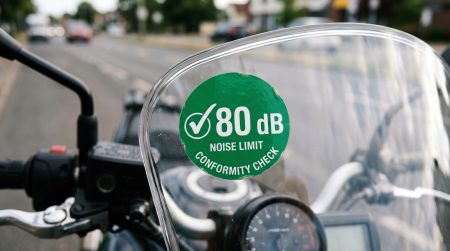
An application by the German Federal Association Against Motorcycle Noise to the Transport Ministers’ Conference – supported among others by Deutsche Umwelthilfe – demands a noise limit of 80 dB(A), a ban on factory-installed exhaust flaps and sound generators, and nationwide noise protection zones with a badge requirement modeled on the environmental badge. Depending on the measurement parameter, an 80 dB limit would affect virtually the entire current motorcycle fleet – even a comparatively quiet 125cc scooter exceeds it on stationary noise. No grandfathering provisions are included in the proposals.
▸ Noise Badge for Motorcycles: What the 80 dB Demand Would Mean
Stationary vs. pass-by noise, the Tyrolean model as a blueprint and what noise protection zones would mean for touring riders.
ROADPOL Speed Camera Marathon
The pan-European police network ROADPOL is organising a coordinated speed enforcement marathon in August 2026. Motorcyclists are explicitly included as a target group – a first in this form. The operation runs simultaneously across multiple European countries.
▸ Speed Camera Marathon in August 2026: ROADPOL Also Targets Motorcyclists
How the operation works, which countries participate, and what riders should expect.
▸ German Speed Camera Ranking: The Top Spot Does Not Survive Scrutiny
Why the city comparison of fine revenue and enforcement density partly measures something other than its headlines suggest.
▸ Steel & Speed 2026: Berlin’s Motorcycle Scene Shows What Article 2 Means
44 teams, first-ever demonstration ride through Berlin: How biker culture stands up for fundamental rights and freedom of self-expression.
Germany: Road Traffic Act 2026 — Points Trading Banned
Germany’s Fifth Act Amending the Road Traffic Act takes effect on July 1, 2026. It bans commercial points trading (fines up to EUR 30,000), creates the legal basis for scan cars in parking enforcement, extends the statute of limitations from three to six months and lays the groundwork for the digital driving licence.
▸ Points Trading Banned: What Changes in Traffic Law on July 1
The four central changes of the StVG amendment and what they mean for riders.
Germany: Keep-Right Rule and Staggered Group Riding
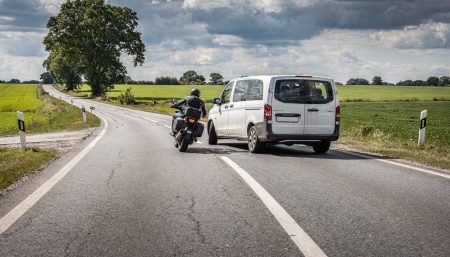
A rider from a six-strong group ended up bearing 50 percent of his own losses after colliding with an oncoming car. He was riding the left-hand position of the staggered formation within his own lane. Because it could no longer be established who had crossed the centre line, the courts split liability evenly – before the Schleswig Higher Regional Court the case ended in a settlement on that basis. Staggered riding is therefore not a legal category of its own: the keep-right rule under section 2(2) of the German road traffic regulations applies to every rider individually.
▸ Motorcycle Group: Riding Staggered Can Cost Half the Compensation
The Schleswig-Holstein case in detail, Federal Court of Justice case law on the keep-right rule, guideline distances to the centre line and why a private group ride is not a closed convoy.
Germany: Dirt on the Road – Whoever Causes It Is Liable, but Rarely Alone
Under Section 32 of the German Road Traffic Regulations, anyone who soils the carriageway in a way that endangers or obstructs traffic must clean it up without delay. A ruling by Flensburg Regional Court of 10 May 2024 (case reference 12 O 71/23) shows how far that liability reaches: after a forage harvester left mud on a road, a refuse truck slid into the ditch, causing damage of more than 26,000 euros. The court ordered the polluter’s liability insurer to pay 75 percent of the damage; the remaining 25 percent stayed with the injured party because the driver had not slowed down despite visible early contamination. For motorcyclists this is the decisive line: claims against the polluter exist, but contributory liability is realistic if the riding style did not match the conditions.
▸ Harvest season: why field entrances are risky for motorcyclists right now
The Flensburg ruling in detail, the duties under Section 32 StVO and why sudden changes in grip at field entrances are particularly critical for single-track vehicles.
Germany: DVR Country Road Campaign and the Risk Perception Gap
Road safety policy in Germany is not shaped by legislation alone. Since 2021 the German Road Safety Council (DVR) has been running a nationwide country-road campaign together with the Federal Ministry of Transport (BMV) and the German Social Accident Insurance (DGUV); the latest round, “Hartes Pflaster: Landstraße”, started on 20 July 2026. It is underpinned by a representative Forsa survey of 501 motorcyclists: 89 percent know that most fatal motorcycle accidents happen on country roads, yet 72 percent still consider riding there safe. That same road type accounts for 56 percent of all traffic deaths in Germany.
▸ 45 Percent Had a Near-Miss: Motorcyclists Underestimate Country Roads
The Forsa figures in detail, the corner as a blind spot and what the accident statistics really say about country roads.
Germany: Crimes Against Riders and Paragraph 315b
Riders are not only subject to traffic law, they are increasingly on the receiving end of criminal acts. In July 2026, unknown perpetrators daubed threats against motorcyclists onto the asphalt at nine locations on popular curvy roads east of Stuttgart. Police are not treating this as criminal damage but as a dangerous interference with road traffic under Paragraph 315b of the German Criminal Code, an offence that carries a prison sentence. An initial suspicion that oil had also been spread on the road was not confirmed.
Investigators now consider it likely that the incidents in the Rems-Murr district and in the Esslingen district are connected. The Aalen and Reutlingen police headquarters are therefore in direct contact, the investigation team is based at Schorndorf police station, and the Stuttgart public prosecutor’s office has been informed. Police have released no information on a motive or possible suspects, and no motorcyclist has been harmed or endangered so far.
▸ “Biker, Die” Near Stuttgart: What Police Say About the Oil Suspicion
Nine crime scenes in the Rems-Murr and Esslingen districts, a dedicated task force at Schorndorf police station and the legal classification as dangerous interference with road traffic.
▸ “Biker Die”: Police See Likely Connection Between Cases
The state of the investigation first-hand: why two police headquarters are cooperating, which wording is officially confirmed and what police advise motorcyclists to do.
Stay Up to Date
Motorcycle law is not a static topic. New rulings, legislative changes and political developments happen regularly. This page is updated whenever significant decisions are made.
Got a tip about a relevant ruling, legislative change or political development? Get in touch — we’re happy to cover it.