- New Desmosedici Stradale R 1100 engine with 1,103 cc and 228 HP (167.7 kW), 247 HP (181.6 kW) in race mode
- World’s first road motorcycle with carbon-ceramic brake discs and Öhlins fork with carbon stanchions
- Complete carbon chassis: frame, swingarm, subframe and wheels
- Wet weight without fuel: 173 kg (381.4 lbs), with Racing Kit only 167 kg (368.2 lbs)
- Limited to 500 numbered examples plus 100 units of the Tricolore Edition
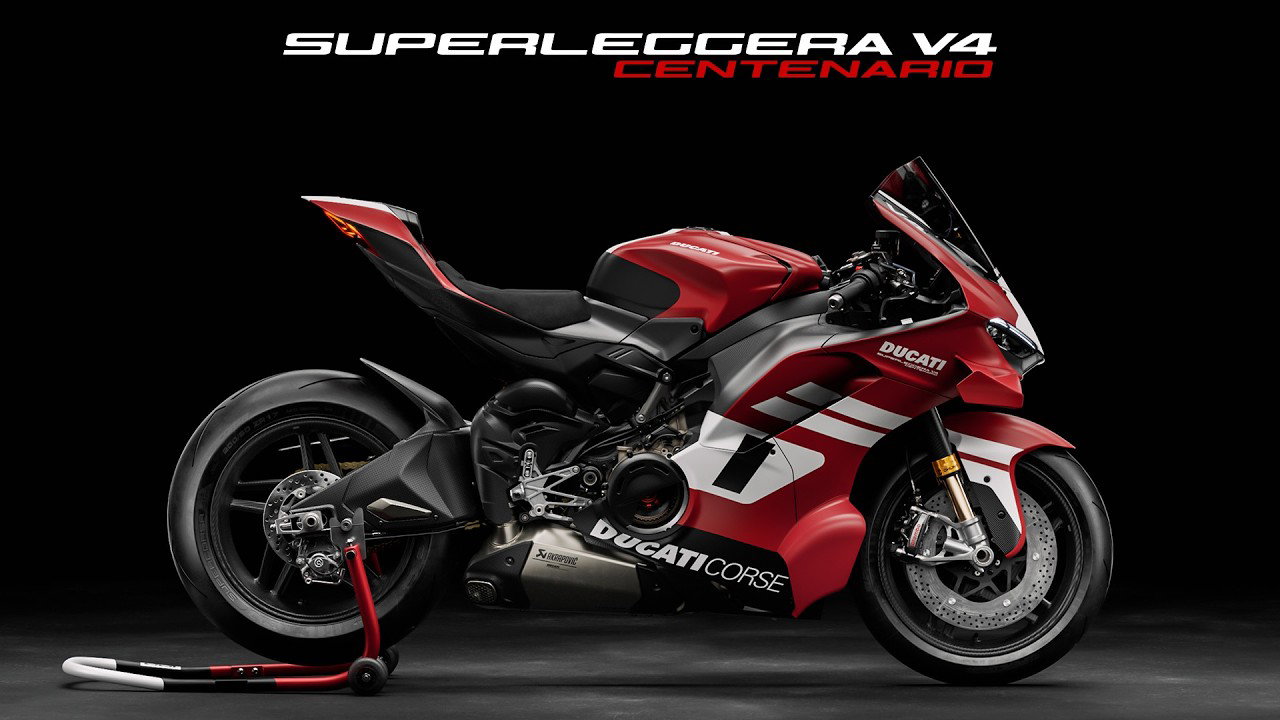
In the anniversary year of 2026, Ducati presents the fourth generation of its Superleggera line. The Superleggera V4 Centenario is based on the seventh generation of the Ducati Superbike platform and brings together a series of technologies that were previously reserved for racing machines in MotoGP and the Superbike World Championship. The world premiere took place at the Circuit of the Americas during the MotoGP race weekend in Texas.
New Engine with More Displacement and Less Weight
The heart of the Superleggera V4 Centenario is a completely new engine: the Desmosedici Stradale R 1100. Compared to the previous unit, displacement grows from 998 to 1,103 cc, achieved by extending the stroke from 48.41 to 53.5 mm. Ducati promises more torque in the mid-range without compromising acceleration.
In the road-legal Euro 5+ configuration, the engine produces 228 HP (167.7 kW) at 14,500 rpm. Maximum torque is 117.6 Nm at 10,500 rpm. With the standard-supplied Akrapovič racing exhaust and Ducati Corse Performance oil, output rises to 247 HP (181.6 kW) at 14,750 rpm and 126.3 Nm at 12,500 rpm. This gives a power-to-weight ratio of 1.48 HP per kilogram according to Ducati.
The engine is 3.6 kg lighter than the 1,103 cc unit of the Panigale V4 with dry clutch. The weight saving results from the use of titanium, lighter fasteners and revised internal components. The pistons use two rings and employ a so-called Box-in-Box technology with an oversized 18 mm gudgeon pin. The crankshaft was lightened by replacing the steel counterweights with tungsten inserts. Tungsten is significantly denser than steel, allowing the same balancing effect with smaller and more compact inserts.
The cylinder heads retain the configuration of the 998 cc Desmosedici Stradale R, with 34 mm titanium intake valves and 27.5 mm steel exhaust valves. All sixteen valves use titanium cotters, a solution otherwise used in competition. The Desmodromic system timing is set manually and certified with a plaque bearing the signature of the responsible technician.
The engine breathes through oval throttle bodies with a 56 mm diameter, larger than the 52 mm of the regular Desmosedici Stradale. The intake funnels are fixed and optimised in different lengths: 20 mm on the left and 10 mm on the right. The exhaust system uses titanium headers with an enlarged diameter of 41.7 mm and a homologated Akrapovič silencer. Intake and exhaust ports are polished.
Racing Gearbox with Neutral Below First Gear
For the drivetrain, Ducati uses the so-called Ducati Racing Gearbox. Neutral is located not between first and second gear as usual, but below first gear. Together with the Ducati Neutral Lock System (DNL), this is designed to prevent accidental engagement of neutral during the final and most critical phase of braking. At the same time, gear changes between first and second are meant to be faster and smoother.
The chain is a DID ERV7, as used by Superbike factory teams, running on an Ergal sprocket — a combination that saves 0.69 kg over the components of the Panigale V4 S. An STM Revo clutch is fitted.
Carbon-Ceramic Brakes and Carbon Fork as a World First
The Superleggera V4 Centenario is the world’s first road motorcycle with carbon-ceramic brake discs. The new Brembo discs are based on a C/SiC core, a carbon fibre-reinforced ceramic composite. This is said to offer a unique combination of lightness, stiffness and thermal stability. The disc maintains its efficiency at very high temperatures and, according to Ducati, ensures consistent braking performance even under extreme stress.
Compared to a steel disc, the carbon-ceramic discs offer the same braking performance with a weight saving of 450 grams per disc and a 40 percent lower moment of inertia. Compared to the 330 mm standard discs of the Panigale V4, the carbon-ceramic discs weigh the same but have an even lower moment of inertia thanks to a more favourable mass distribution. The diameter of the new discs is 340 mm.
The brake calipers are new Brembo GP4-HY monoblock units, machined from solid billet. They feature integrated cooling fins and differential pistons with 30 and 34 mm diameters. An anti-drag system fully releases the disc as soon as the rider releases the brake lever, eliminating residual braking torque and making corner entry smoother.
Ducati also sets new benchmarks in suspension: the Öhlins NPX 25/30 Carbon is the world’s first production fork with carbon stanchions. The stanchions are made from unidirectional layers and offer a weight saving of 8 percent over the Panigale V4 R and 10 percent over the standard Panigale V4, according to Ducati. The fork operates mechanically without electronic adjustment to save weight. The cartridge is pressurised to reduce cavitation and ensure more consistent support during braking and corner entry.
At the rear, an Öhlins TTX36 GP LW shock absorber works with a special steel spring for maximum lightness and MotoGP-derived valves. The suspension linkages are made of titanium. Hydraulic adjustment is tool-free.
Complete Carbon Chassis from MotoGP and Formula 1
The entire chassis of the Superleggera V4 Centenario is made of carbon fibre: frame, swingarm, subframe and wheels. The technologies are derived from MotoGP and Formula 1, according to Ducati.
The carbon front frame weighs 17 percent less than the aluminium frame of the Panigale V4 and is designed to provide calibrated stiffness that improves corner grip and the natural inclination to turn in. The swingarm is manufactured using a so-called sacrificial core process that enables a very light monocoque structure. Compared to the aluminium swingarm it is 21 percent lighter, while maintaining equivalent lateral and torsional stiffness values according to Ducati.
The five-spoke wheels are almost 300 grams lighter than those of the Panigale V4 S Carbon. The front subframe weighs 200 grams less. The rear monocoque saves 1.4 kg. As a result, the Superleggera V4 Centenario weighs 173 kg (381.4 lbs) wet without fuel in road configuration and 167 kg (368.2 lbs) with the standard Racing Kit.
For quality assurance, every individual carbon component of each Superleggera is inspected using three non-destructive testing methods: transient active thermography, phased array ultrasound and computed tomography. This process originates from the aerospace industry and has been used by Ducati since the 1299 Superleggera.
Aerodynamics from the Superbike World Championship
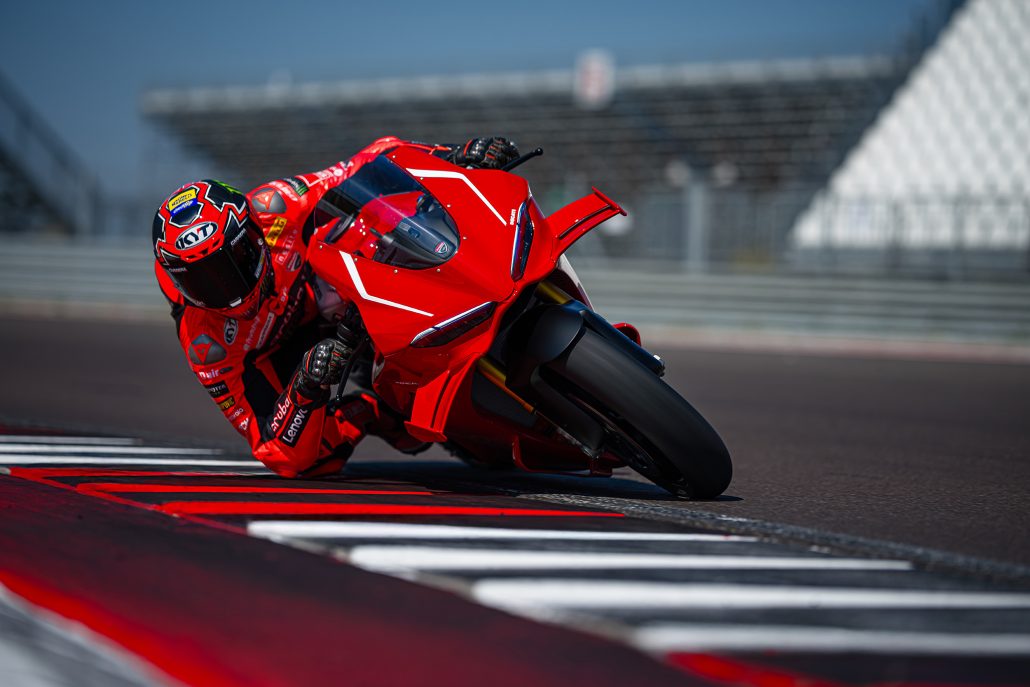
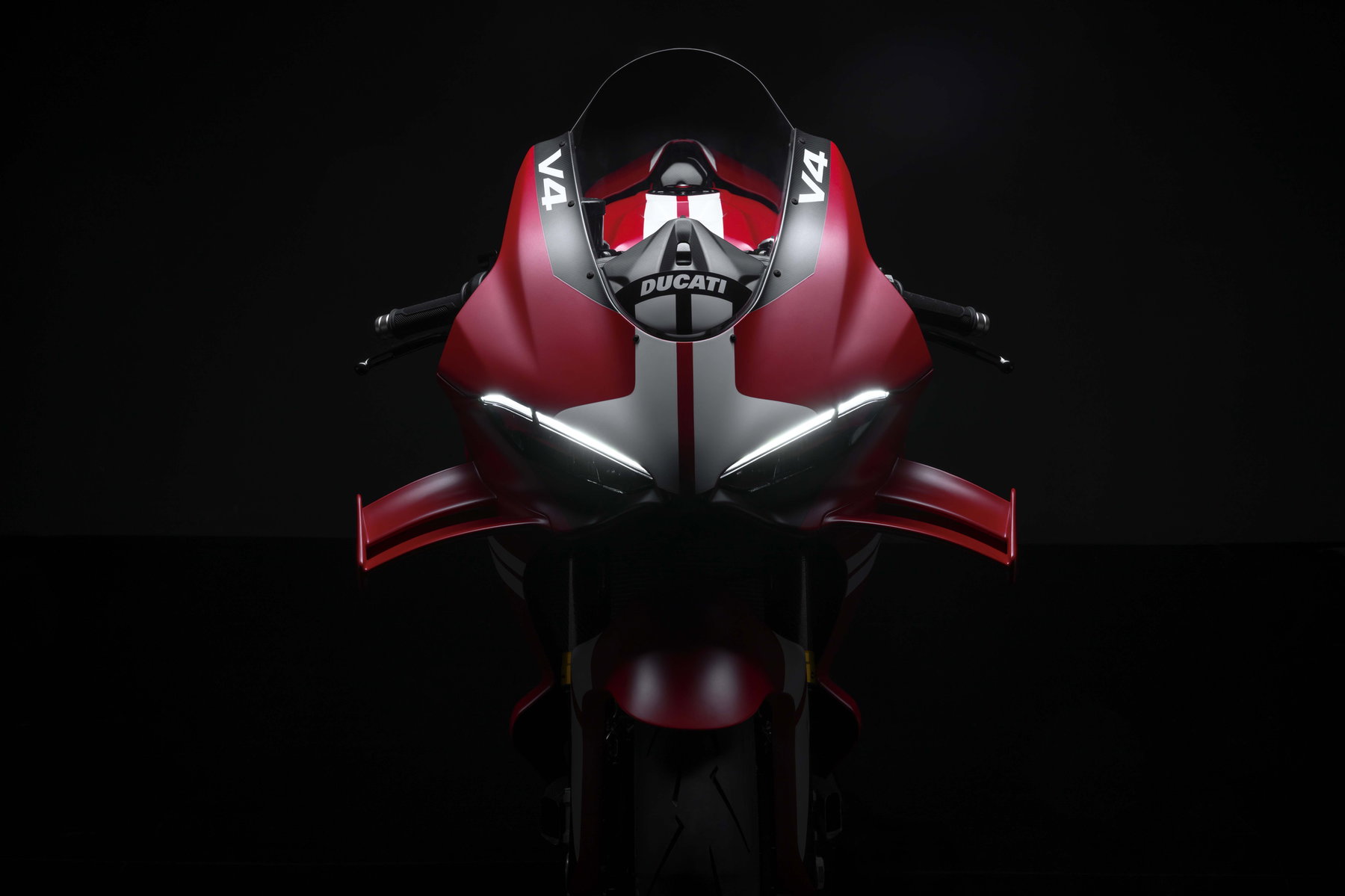
The aerodynamics of the Superleggera V4 Centenario come from the Panigale V4 R used in the Superbike World Championship. The highly efficient winglets and the so-called Corner Sidepods are designed to generate downforce even at high lean angles. The Corner Sidepods were introduced by Ducati in MotoGP in 2021 and generate a ground effect in the middle of corners, giving the tyre more grip and allowing higher cornering speeds.
The entire fairing is made of carbon fibre, which is partially left visible. Numerous other components are also made of carbon: mudguards, tank cover, radiator cover, sprocket cover, heel guards, handlebar splash guard, seat base, intake duct, number plate holder and rear seat cover.
Rosso Centenario: A Livery with History
The colour scheme of the Superleggera V4 Centenario is based on the new Rosso Centenario shade. It is a dark, matt red combined with Ducati’s iconic white stripes. The colour is designed to create a connection to the brand’s origins: from the red of the Ducati 60 of 1949, the manufacturer’s first complete motorcycle, to the Gran Sport Marianna of 1955, the first racing machine designed by engineer Fabio Taglioni. The livery of the Superleggera V4 Centenario served as the template for the official Desmosedici race machines of the Lenovo team in MotoGP 2026.
In addition to the 500 examples of the standard Superleggera, Ducati also produces 100 units of the Superleggera V4 Centenario Tricolore. This special edition carries a livery in the Italian national colours, designed as a homage to the 750 F1 Endurance Racing of the 1980s.
Electronics at MotoGP Level
The electronics are based on the system of the Panigale V4 R and have been expanded with the latest generation DVO strategies. Ducati Traction Control (DTC) DVO, Wheelie Control (DWC) DVO, Slide Control (DSC) and Power Launch (DPL) DVO use new algorithms for more precise control.
The Cornering ABS now also includes the new Engine Brake Control DVO with the Dynamic Engine Brake (DEB) function, in addition to RaceBrake Control and Road eCBS. This automatically adjusts the contribution of engine braking by also using the rear brake and maximising available grip based on the load on the rear wheel. DEB also activates the rear brake when the front brake is released, similar to what professional racing riders do — allowing less experienced riders to take tighter lines.
Exclusive Equipment and MotoGP Experience
The Superleggera V4 Centenario is delivered in an exclusive, personalised wooden crate. Each motorcycle comes with a certificate of authenticity, a dedicated motorcycle cover, a mat, and front and rear paddock stands.
The standard delivery includes a complete Racing Kit: the Akrapovič racing exhaust with DAVC Race Pro software and dedicated underbelly fairing, an open carbon clutch cover, swingarm and alternator cover protectors, a kit for removing the headlight, sidestand, number plate holder and turn signals, a billet-machined racing fuel cap, a brake lever guard, a battery maintenance charger and a neoprene race seat.
The model number is engraved on the billet aluminium upper fork clamp and also appears in a dedicated dashboard animation and on the titanium key insert.
Exclusively for Superleggera V4 Centenario owners, Ducati offers the MotoGP Experience: 26 owners will have the opportunity to spend a day on track under the guidance of Ducati instructors, culminating in laps aboard the DesmosediciGP26. The MotoGP Experience takes place on 6 and 7 July 2026, following the World Ducati Week 2026. Participation is not included in the purchase price.
The History of the Superleggera Line
The Superleggera V4 Centenario is the fourth generation in a line of limited special models that Ducati positions as the technological spearhead of its Superbike range. In 2013, the 1199 Superleggera appeared as the first motorcycle with a frame, swingarm and wheels made of magnesium alloy. The 1299 Superleggera followed in 2016 with the first complete carbon chassis. In 2020, the Panigale V4 Superleggera took aerodynamics to a new level. The Centenario now takes the next step with carbon-ceramic brakes and carbon fork stanchions.
Ducati notes that technical specifications may still change due to the ongoing homologation process.


- S100 2031S100 Total Plus, Reiniger Nachfüller – 2 l male