- Patent number US 2025/0354528 A1, filed on May 20, 2024, published on November 20, 2025
- Electronically controlled slide valve between piston and cylinder wall to improve gas exchange precision
- Potential application in hybrid vehicles possible
The idea of the two-stroke engine occasionally makes a comeback in engineering circles, even though modern production engines are almost exclusively designed as four-stroke engines. Now, a patent application from General Motors shows that one of the world’s largest automakers is working on a contemporary refinement of the two-stroke principle. The document introduces a newly designed slide valve control system that is intended to reduce several of the classic disadvantages of a two-stroke engine.

Electronically controlled slide valve instead of fixed channels
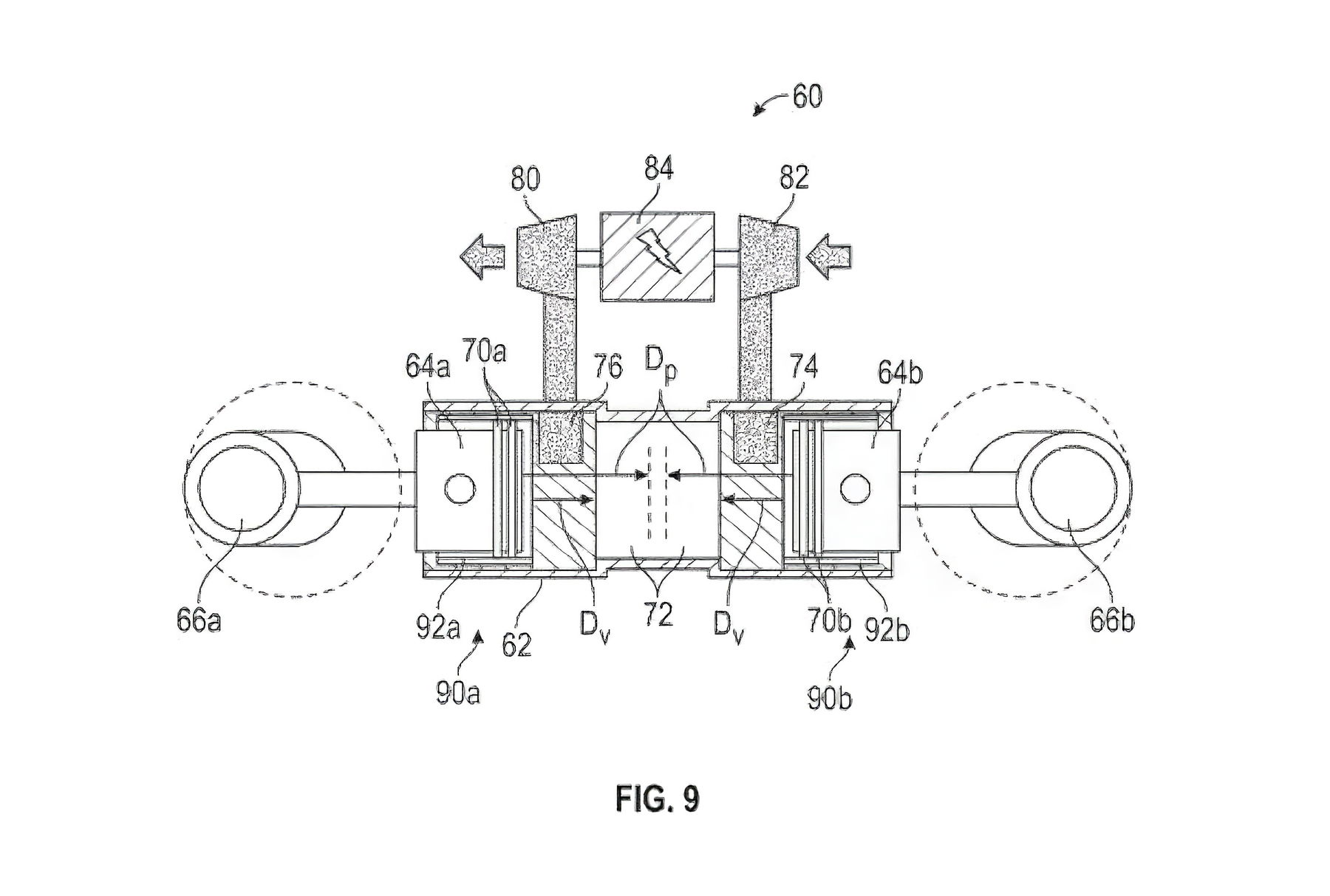
Conventional two-stroke engines operate with intake and exhaust channels fixed in the cylinder, which are opened or closed solely by the movement of the piston. This design is compact, but it causes difficulties with sealing, mixture control, and exhaust gas quality. The approach proposed by GM therefore relies on a movable valve element between the piston and the cylinder wall.
This component slides along the cylinder axis and moves synchronously with the piston. Depending on its position, it covers or opens the intake and exhaust ports. In some designs, the valve element is designed as a rotating sleeve, while in others, the air and exhaust gas flows are separated. It is controlled by an actuator that regulates the stroke movement depending on the current working cycle.

Goal: More precise gas exchange and less wear
A key advantage of the design is said to be improved sealing. Although the piston still has piston rings, the slide valve system prevents the rings from hitting the edges of the channels. Instead, the valve element “ferryt” the rings across the openings, which is intended to prevent damage and reduce wear.
In addition, the timing of the gas exchange can be adjusted independently of the piston position, which is not possible with conventional two-stroke engines. Control via an actuator could theoretically allow variable opening times, although this is not clearly confirmed in the patent application. Greater control over gas flows is intended to increase efficiency, reduce emissions, and improve engine durability.
Potential for improvement in modern applications
Thanks to their high power density and low number of components, two-stroke engines are considered an attractive option, but have been almost completely replaced by four-stroke engines in the passenger car sector. The GM development is intended to compensate for several of their disadvantages and could thus open up new areas of application. The patent mentions possible use in hybrid vehicles, which suggests a concept with a compact, lightweight combustion engine combined with electric assistance.
According to the patent description, such a design could offer advantages in terms of cost, packaging, and power-to-weight ratio. In addition to the automotive sector, applications in motorcycles, tools, construction machinery, and aircraft are also conceivable in principle. However, it is unclear whether and when GM will transfer the technology to a series production project. As with many two-stroke concepts, it remains to be seen whether the idea will be pursued beyond the early development phase.


- S100 2018S100 2018, Felgenreiniger – 500 ml male