- First-ever iF Design Gold Award for a Honda product
- Frameless construction with the battery as a load-bearing structural element
- Priced in the UK at 12,999 pounds (approximately 15,540 euros / 16,900 USD)
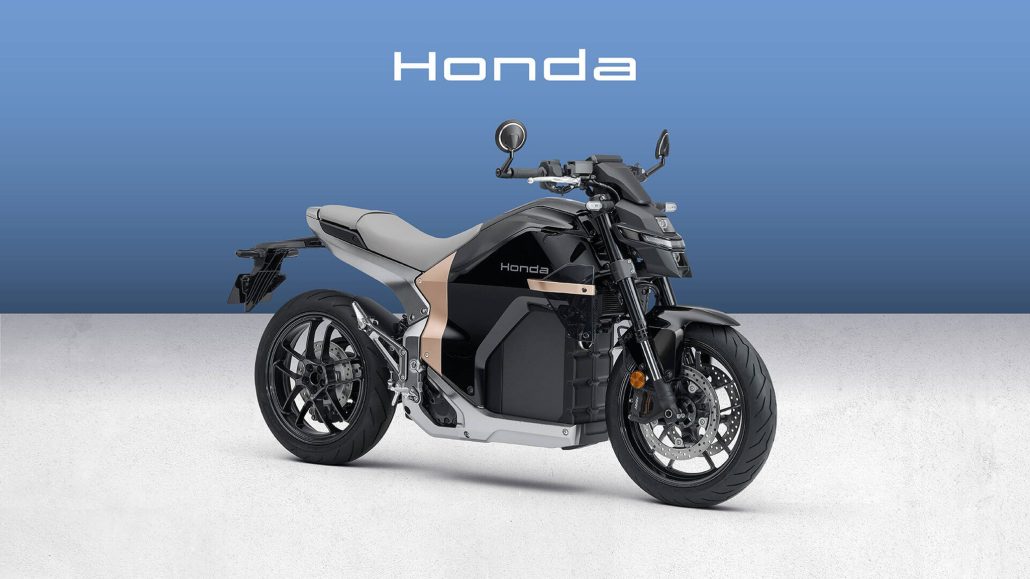
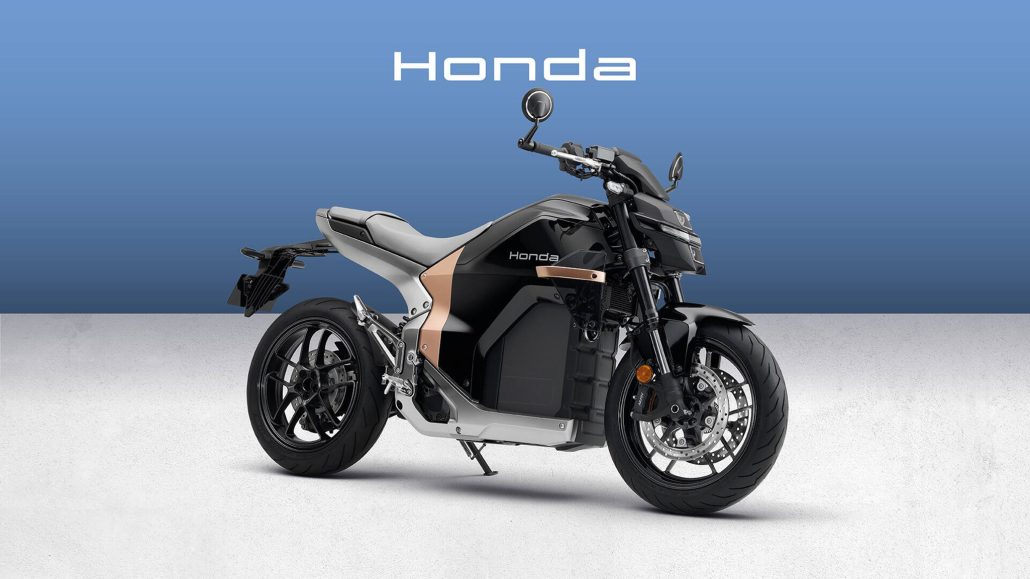
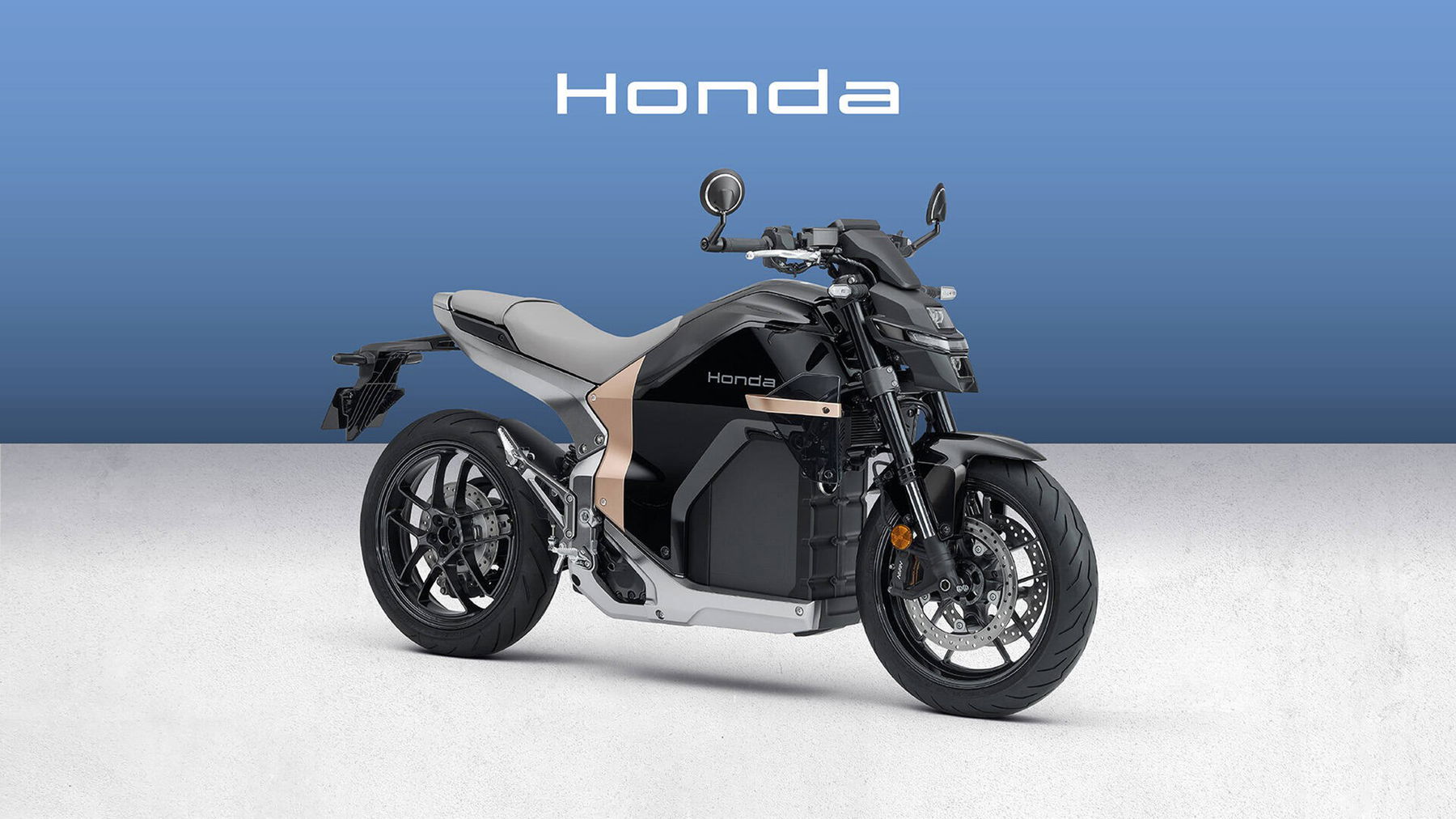
The Honda WN7 has won the iF Design Gold Award. While that may sound like a routine design story, the distinction is particularly significant for Honda, as it marks the first time ever that a product from the company has received this prize. The Gold Award is the highest honor within the Product Design category of the iF competition and is widely regarded as one of the most prestigious accolades in the field worldwide.
The WN7 was developed as the production version of the “EV Fun Concept” shown at EICMA 2024 in Milan and was publicly unveiled at EICMA 2025. Reservations for the motorcycle have been open since the beginning of the year. In the UK, the price stands at 12,999 pounds (approximately 15,540 euros / 16,900 USD). The motorcycle is reported to already be available in parts of Europe, with first deliveries expected shortly.
Frameless Chassis with the Battery as the Skeleton
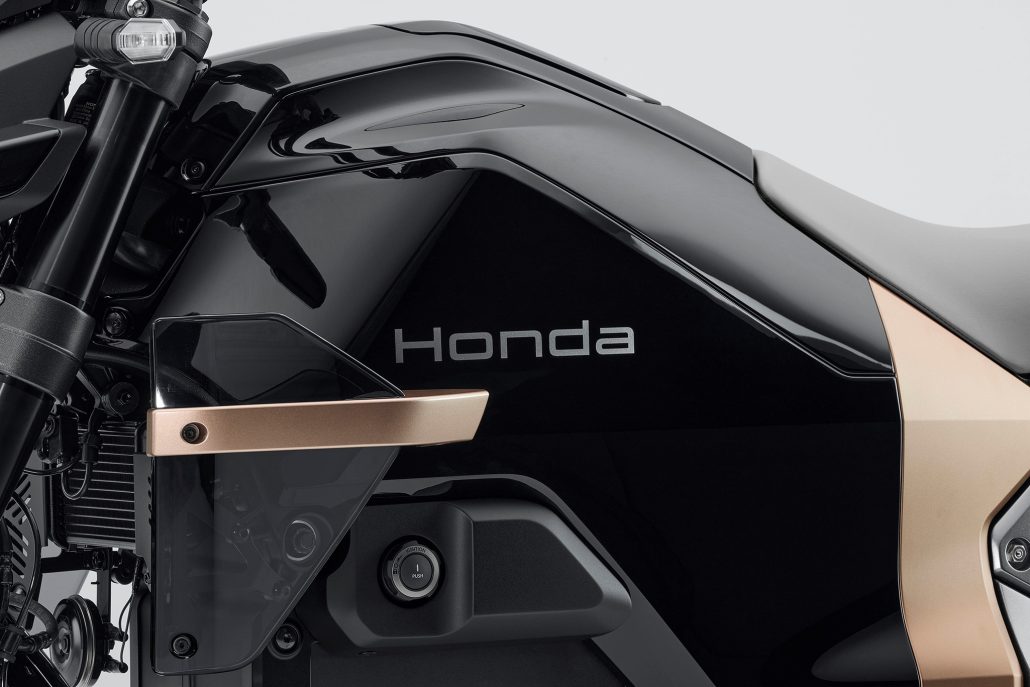
Rather than hiding the battery somewhere inside the motorcycle like a foreign body, Honda made it the central structural element of the WN7. The construction does away entirely with a conventional main frame. Viewed from the side, the battery forms an inverted L-shape and sits in the center of the motorcycle. A steering head bracket is attached at the front, and a swingarm pivot bracket at the rear. Together, these three components form the load-bearing skeleton.
In conventional combustion-engine motorcycles, a continuous frame provides the connection between front and rear. Had Honda kept this concept and routed the frame alongside the battery, a slim design would have been impossible. At the same time, weight would have increased. The frameless construction solves both problems and is a key factor in the WN7 achieving an overall weight of 217 kg.
The challenge with this split front-rear configuration, however, lies in the ride feel. With a conventional frame, the flexibility — and thus the handling character — can be deliberately shaped through the length of the frame tube. Between the steering head bracket and the nearly rigid battery, only short lever distances remain. Honda therefore manufactured the lower part of the steering head bracket from aluminum and fitted it with extended, deliberately curved arms that flex in a controlled manner. The upper part is made from high-strength sheet steel, also in an intentionally curved geometry, to deliberately create a loss of force during load transfer. This produces flex and bending that influence the ride feel.
The swingarm pivot bracket is made from aluminum. When it is attached to the battery, a cavity is created in which the rigid assembly of motor and gearbox housing sits. By bolting the motor and gearbox housing to the swingarm pivot bracket as a single unit, an effect similar to swingarm pivot cross-braces on combustion-engine motorcycles is achieved.
To minimize dimensional deviations, which would be particularly critical in this construction, the steering head bracket and swingarm pivot bracket are manufactured without welds and are instead machined.
67 hp and 100 Nm for the Middleweight Segment
The WN7 produces 50 kW (67 hp) and delivers 100 Nm of torque. This positions the electric motorcycle in the middleweight segment — fast enough for spirited riding and practical for everyday use. The 9.3 kWh lithium-ion battery is said to provide a range of 130 to 140 km (approximately 80 to 87 miles) in urban traffic. The A1-compliant variant reportedly achieves around 153 km (approximately 95 miles). Charging is via CCS fast charging, with Honda stating a charge time from 20 to 80 percent of approximately 30 minutes.
The riding position is designed for everyday practicality. The seat height is 800 mm, the wheelbase 1,480 mm, and the steering lock 35 degrees. At the front, a Showa upside-down fork with 43 mm stanchion tubes is fitted, while the rear features an aluminum cantilever swingarm in a Pro-Arm design.
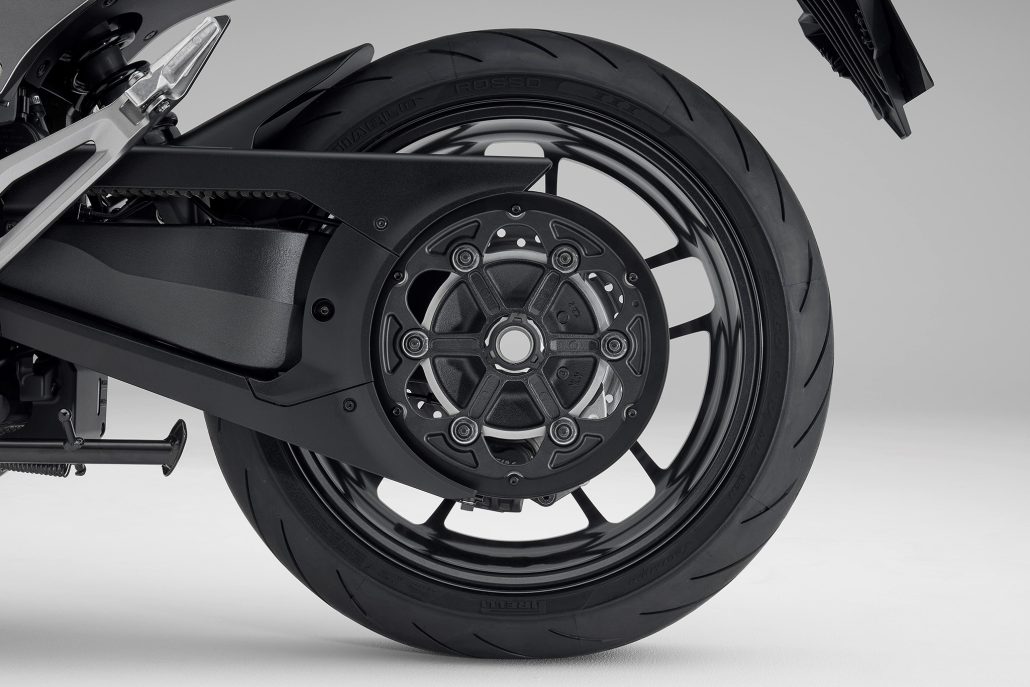
Belt Drive, Helical Gears, and Thoughtful Refinement
Instead of a chain, Honda uses a belt drive on the WN7. Belts consist of a rubber tooth profile around a carbon fiber core and experience virtually no stretch during operation, eliminating the need for regular adjustments. The oil lubrication typical of chains is also unnecessary, further reducing maintenance effort and avoiding contamination from oil spray. A belt guard prevents foreign objects from getting between the belt and the pulley.
Honda also optimized the gearbox for smooth operation. Instead of the spur gears commonly used in combustion engines, which offer good transmission efficiency but are comparatively noisy, the WN7 uses helical gears. The water-cooled motor sits low in the vehicle, and the drive shaft exits on the right side. From there, torque is transmitted upward through three gears and then back via a shaft to the left side, where it reaches the belt drive. The heavy triple-gear unit was deliberately placed on the right side to achieve an even weight distribution.
Four Regeneration Levels and an Adjustable Speed Limiter
The WN7 offers a four-stage deceleration selector for regenerative braking. Level 0 corresponds to the neutral gear of a combustion engine, while Level 3 provides strong regeneration. Each riding mode has a default level: Level 3 for ECON, Level 1 for RAIN, and Level 2 for STANDARD and SPORT. Controls are via plus and minus buttons on the left handlebar switch.
Additionally, the WN7 features a maneuvering mode that assists at low speeds in both forward and reverse. The throttle allows fine speed adjustment, for example when parking.
Another notable feature is the adjustable speed limiter. Up to three speed limits can be freely defined in 1 km/h increments from 20 km/h. In Europe, changing speed zones in urban traffic are a daily reality. When entering a 30 km/h zone, the WN7 automatically decelerates to the set speed. When leaving the zone, a single button press switches to a higher limit. During overtaking maneuvers, the limit can be temporarily overridden by holding the button down.
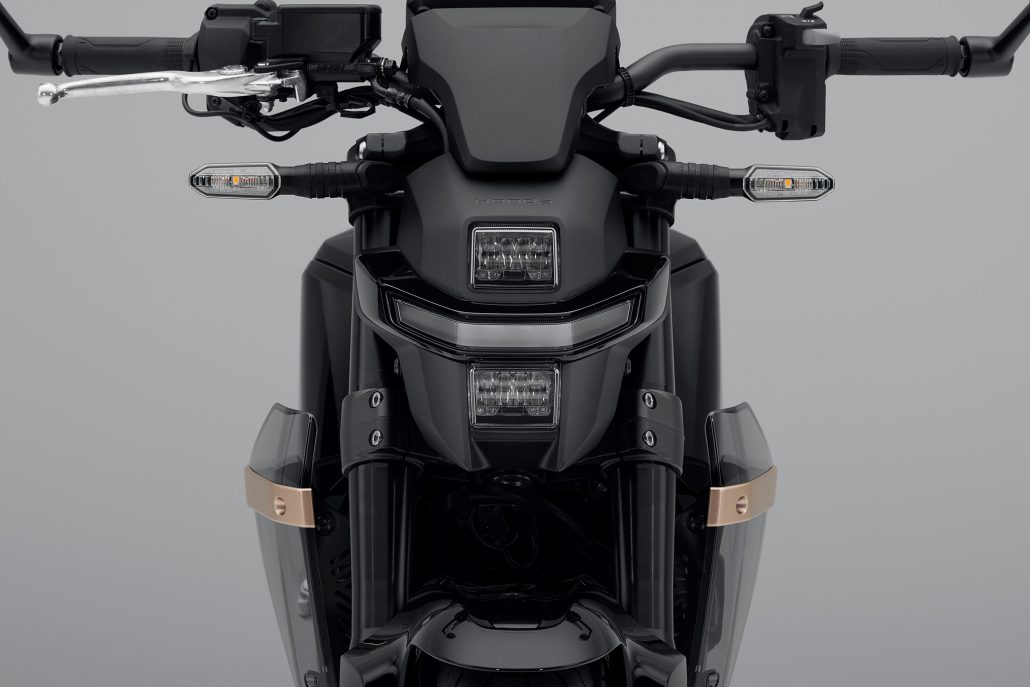
What the Design Award Says About the Future
Toshinobu Minami, Managing Director and Chief Operating Officer of the Design Center at Honda R&D Co., Ltd., commented on winning the iF Gold Award: “The Honda WN7 was able to win the Gold Award in the Product Design discipline of the world-renowned iF Design Award. We are extremely honored to receive the Gold Award for the first time ever.” He added that the jury had understood the new value that electrification brings: “We believe that this is the result of the jury’s understanding of the new value befitting the era of electrification – the joy of riding freely like the wind.”
Honda developed the WN7 under the guiding concept “Be the Wind, Listen to the Sounds of Nature, and Feel the Earth.” As an electric motorcycle, it allows the rider to perceive sounds that would be drowned out by a combustion engine — voices of pedestrians in the city or the splashing of puddles. At the same time, the electric drive provides a smooth acceleration and deceleration feel with minimal vibration and zero exhaust emissions.
The WN7 is thus one of the first full-fledged electric motorcycles from a major Japanese manufacturer that genuinely appears production-ready and is already being delivered. The price, however, remains a talking point: the equivalent of approximately 15,540 euros for a middleweight electric motorcycle is a statement that may not convince every potential buyer. Whether the WN7 finds favor with customers will become clear in the coming months.


- Dunlop SportSmart MK4 120/70ZR17 58W Sommerreifen



Redakteur bei Motorrad Nachrichten. Fokus auf Technik, Szene und Motorradpolitik – neutral, sachlich, verständlich.
Verantwortlich für die Seiten www.Motorcycles.News, www.Motorrad.Training und den YouTube-Kanal "Motorrad Nachrichten", sowie deren social Media-Seiten.