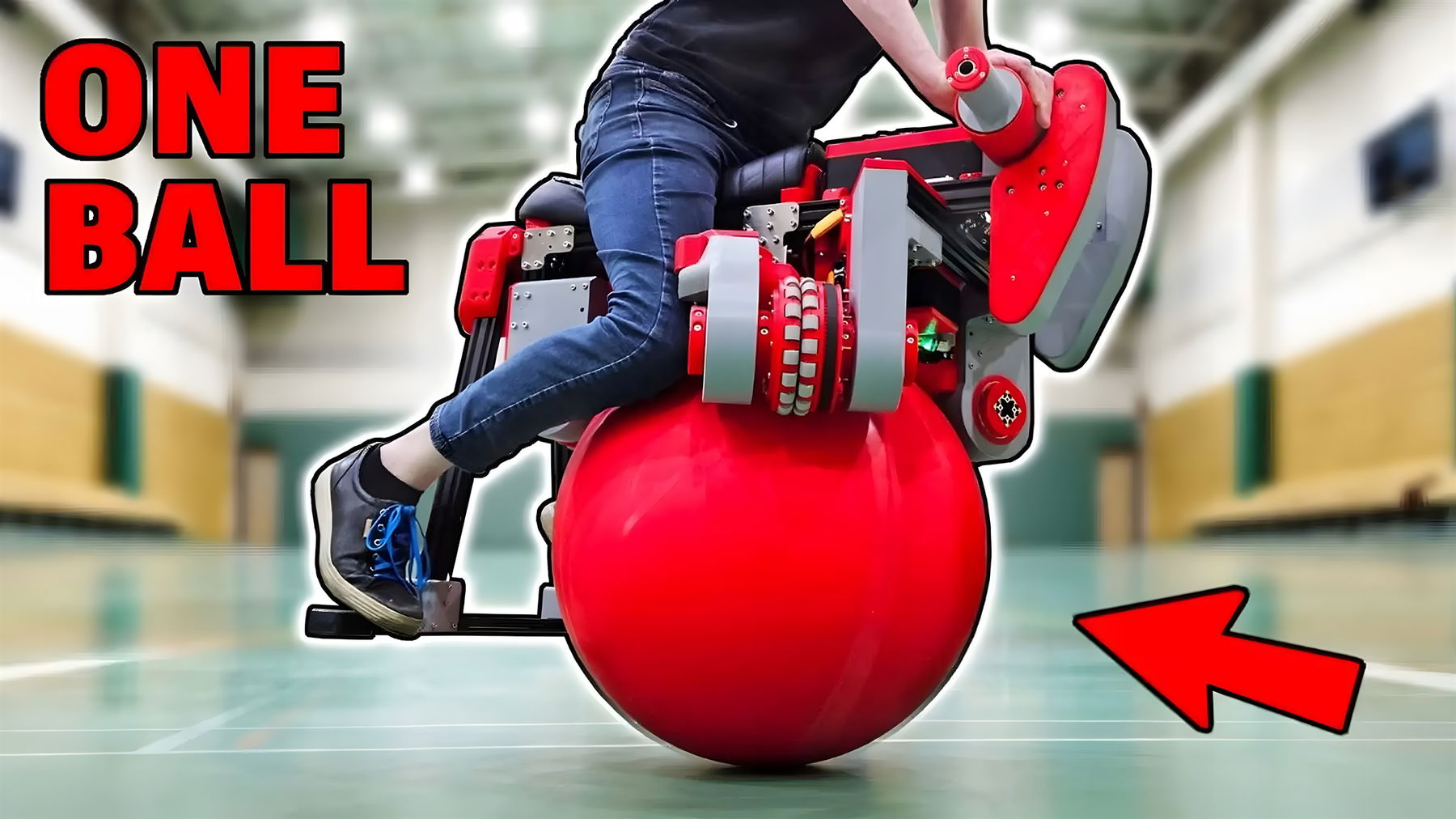
- The omnidirectional single-ball bike self-balances in all directions simultaneously
- Three custom-built omni-wheels with 216 ball bearings each drive a single circus ball
- The video of the two-ball predecessor has already garnered over 8.5 million views on YouTube
James Bruton from Hampshire, England, is one of the most creative makers on YouTube. The former toy designer and IT professional has made a name for himself on his channel, which now has around 1.37 million subscribers, by regularly building unconventional vehicles and robots. His portfolio ranges from a drivable Star Wars AT-AT to an Iron Man Hulkbuster suit to various self-balancing contraptions. His latest project is arguably the most ambitious yet: an omnidirectional bike that balances on a single ball and can move in any direction.
From the Two-Ball Bike to the Single-Ball Experiment
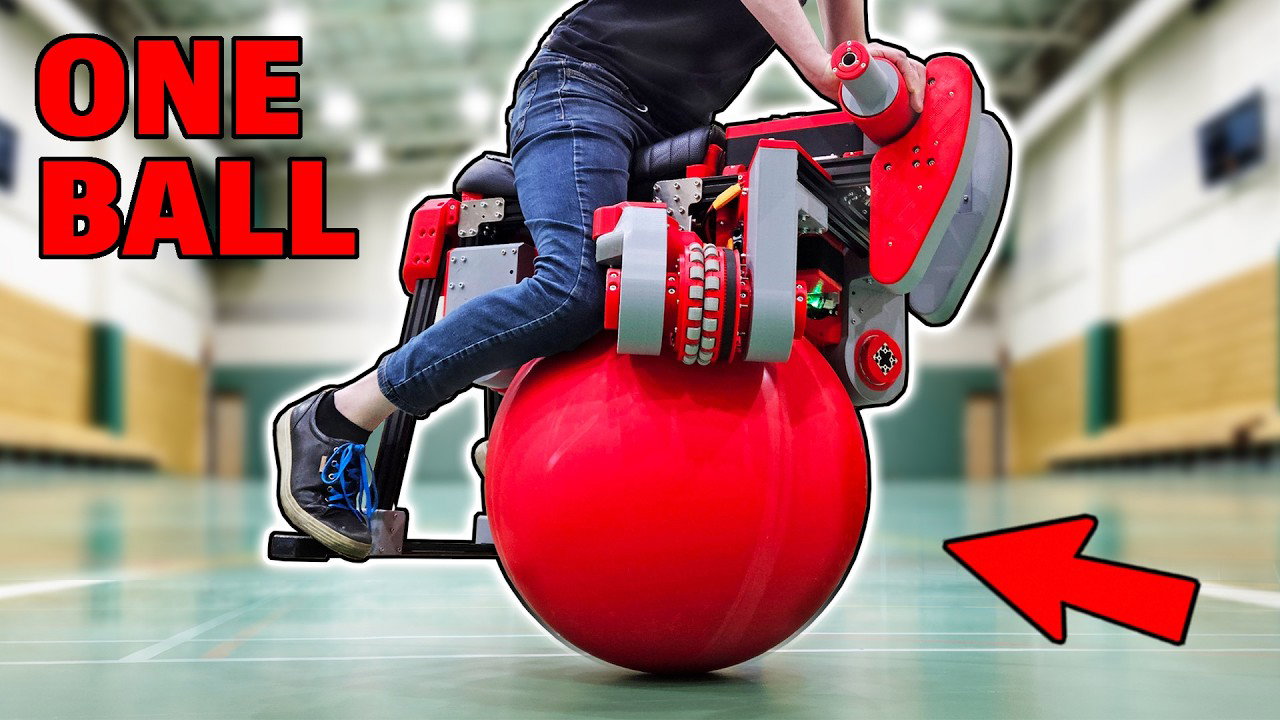
The single-ball bike, which Bruton himself calls “Ike,” is already the fourth omnidirectional vehicle in a series of experiments. The first attempt was a converted bicycle with a single motorized omni-wheel at the front. This was followed by a version with two omni-wheels that balanced sideways like a Segway and had to be blown by fans to move forward. The third model used four Mecanum wheels and could thus move in all directions for the first time. The two-ball bike was then the direct predecessor of “Ike” and already used circus balls as wheels, known as walking globes. These rigid hollow spheres are normally used by circus acrobats for balancing and are significantly harder than yoga balls, so they maintain their shape under load. Bruton imported the approximately 60-centimeter balls from the Netherlands.
While the two-ball bike only had to balance laterally, similar to a Segway, “Ike” must simultaneously maintain balance in both the longitudinal and lateral directions. This significantly increases the complexity.
Three Omni-Wheels Drive a Single Ball
The heart of the drive system consists of three omni-wheels arranged in a triangle around the ball, enclosing it at 120-degree intervals. Each of these wheels can drive the ball in a specific direction while simultaneously sliding laterally, enabling omnidirectional movement. Off-the-shelf omni-wheels proved unsuitable, as they overheated at higher speeds and generated too much friction. Bruton therefore built his own wheels with aluminum cores and 3D-printed TPU tires for better grip. In total, each wheel contains 216 ball bearings and two rows of small rollers that enable lateral sliding.
During the development process, Bruton experimented with the orientation of the drive wheels. In the original configuration, the motors worked against each other at higher speeds. The solution was to rotate the wheels 90 degrees and orient them vertically. Additionally, only two of the three omni-wheels are actively driven; the third runs as a freely spinning support wheel.
Drive System and Electronics in Detail
The drive is powered by three brushless ODrive S1 motors of the 8325 type, each capable of delivering up to 2 kW of power (approximately 2.7 HP). The motors are connected to the omni-wheels via a simple 1:1 belt drive to ensure sufficient torque for balancing. The ODrive controllers enable precise control of position, speed, and torque.
Six 6S lithium polymer batteries serve as the energy source, similar to those used in RC model building. Two of them are connected in series and then in parallel, resulting in a system voltage of approximately 50 volts. A large contactor and an emergency stop switch provide safety shutdown capability. The onboard electronics are powered by separate batteries.
The brain of the system is a Teensy 4.1 microcontroller, which works in conjunction with a BNO086 inertial measurement unit (IMU). This sensor continuously measures tilt and rotation in real time and feeds the data to a PID controller. The controller then calculates the necessary correction commands for the motors to keep the vehicle upright. Bruton wrote all the software himself in Arduino (essentially C++).
Static Charge as an Unexpected Problem
One of the biggest challenges was a problem Bruton hadn’t anticipated: the friction between the plastic balls and the omni-wheels generates significant static charge. These disturbances caused malfunctions in the sensitive electronics and threatened to damage components. Bruton addressed the problem by coating the electronics enclosure with nickel shielding spray and grounding all metal parts together to prevent electrostatic discharge.
Steering Like a Motorcycle, with Limitations
The controls of “Ike” are loosely modeled after a motorcycle. The handlebars feature Hall-effect twist grips: the right grip controls forward and backward movement by shifting the balance point by up to ten degrees. The vehicle then tilts in the desired direction and the ball rolls accordingly. The left grip handles yaw control, meaning rotation around the vertical axis. Additionally, trim and gain can be adjusted, similar to an aircraft, which affects the riding behavior.
However, steering turned out to be the most difficult problem. With only one freely rotating ball and vertically oriented wheels, the vehicle has no natural yaw control. Leaning into curves like on a motorcycle didn’t work. Bruton’s interim solution was as creative as it was unconventional: a large foam wing held out to the side generates aerodynamic drag while riding and pulls the vehicle into the curve. This is obviously not a permanent solution.
3D Printing as a Key Technology
Large parts of the vehicle were produced on a total of eleven 3D printers. Bruton used a 1.2-millimeter nozzle to produce massive structural components with particularly thick extrusions and coarse infill. The large-volume parts form the basic framework into which 4040-type aluminum extrusion rails are inserted. Finer parts, such as bearing mounts, were printed with a thinner nozzle to achieve an exact fit. This means that if tolerance issues arise, only the small insert parts need to be reprinted rather than the entire structural elements. Metal parts such as aluminum plates were externally manufactured according to Bruton’s own CAD designs. He has published all CAD files and the complete source code on GitHub.
Test Rides with Highs and Lows
During the first test rides in a sports hall, it became clear that the basic concept works. The vehicle balances on its own and can move omnidirectionally — forward, backward, sideways, and rotating in place. However, problems also emerged: the rubber rollers on the omni-wheels came loose at higher speeds, making the vehicle unstable. Additionally, the balls became dirty over time, which reduced traction. Wheel slip during acceleration required the installation of an additional motor on the rear wheel.
Despite all the difficulties, Bruton was able to equip the vehicle with handlebars, a seat, and the twist grips, and actually ride it. Speeds are still moderate, and without protective gear, there were a few falls. Nevertheless, Bruton sees the project as a success and continues to work on improvements to steering precision, electronic stability, and ergonomics.
Viral on YouTube
The concept has clearly struck a nerve. The video of the two-ball predecessor has now accumulated over 8.5 million views on YouTube. Bruton told the BBC that his goal is to make videos that people want to click on — and he has undoubtedly achieved that. Whether the experiment will ever become a practical means of transportation is questionable. The balls are not mechanically connected to the drive system but are held in position only by gravity, making the vehicle unsuitable for uneven terrain. However, as a demonstration of what a single engineer can achieve with 3D printers, brushless motors, and a lot of perseverance, “Ike” is quite impressive.

- Milestone Ride 6 Day 1 Edition (Xbox Series X)