- Ducati takes a clear stance against autonomous motorcycling
- North America CEO Chinnock: Self-driving motorcycles would destroy the purpose of riding
- Rider aids yes, full autonomy no: Ducati focuses on safety rather than removing control
The debate around autonomous driving has long reached every area of mobility. Waymo and Tesla robotaxis are already in regular operation in parts of the US, and the UK government has also approved test drives with self-driving vehicles. In the automotive sector, the gradual takeover by technology seems almost unstoppable. But in the motorcycle world, this development meets significantly more resistance. One of the most prominent critics is Jason Chinnock, CEO of Ducati North America, who positioned himself unambiguously in an interview with Business Insider.
Ducati’s Clear Line: Motorcycles Are Not Mobility Solutions
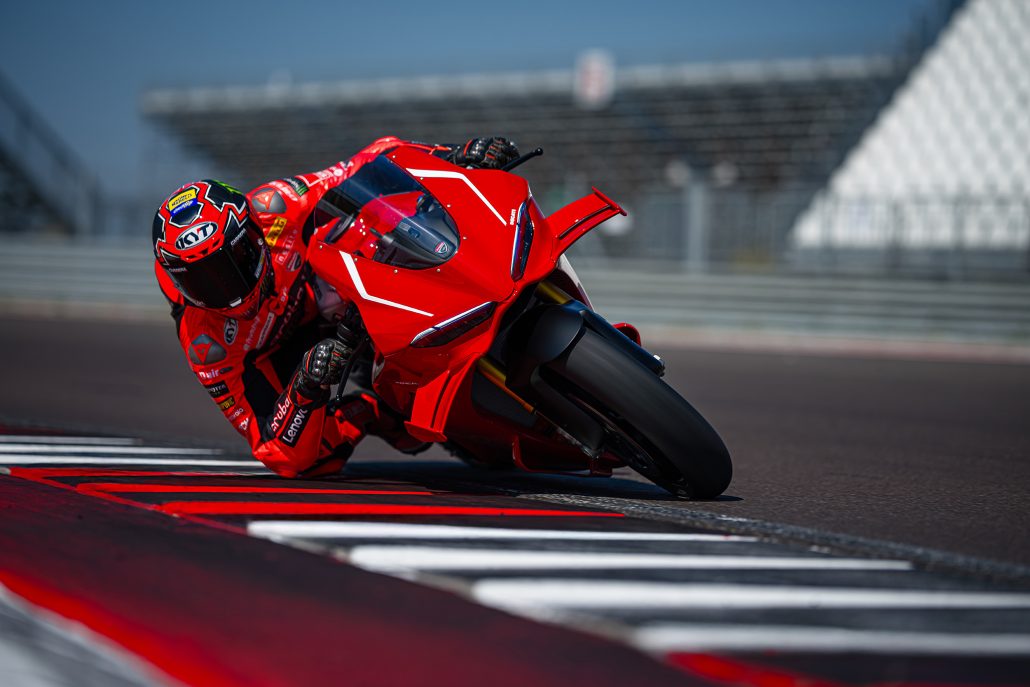
“I hope I never see the day,” Chinnock told Business Insider, making it clear that he never wants to experience the day when motorcycles steer themselves. A self-driving motorcycle would, in his view, “destroy the entire reason for motorcycling.” The reasoning behind this is as simple as it is fundamental: motorcycling is not purely a means of transport. It’s about riding dynamics, about consciously experiencing acceleration, lean angles, and the direct connection between human and machine.
“We are not building mobility. We’re building motorcycles. We’re building something for joy and for fun,” Chinnock explained. Anyone who hands over the riding experience might as well sit in a capsule and be driven from A to B. With this, he deliberately separates Ducati’s philosophy from the mindset of the tech industry, where mobility is primarily defined as seamless, efficient transportation.
Technology as a Helper, Not a Replacement
Chinnock’s statements don’t mean that Ducati rejects technological progress. Modern Ducati models are packed with electronics: cornering ABS, multi-level traction control, various riding modes, and adaptive cruise control have long been standard. These systems have gradually established themselves across the entire motorcycle industry over the years. Traction control was initially controversial, ABS was hotly debated, and semi-active suspension was once considered excessive luxury. Today, all these technologies are widely accepted and indispensable in everyday motorcycling.
The crucial difference, according to Chinnock, lies in the objective. All these systems exist to increase safety and sharpen the riding experience. They support the rider in their decisions but don’t take over control. Autonomous riding, on the other hand, would cross an entirely different boundary: the machine would no longer serve to amplify human input but would function independently of it. That, in Chinnock’s view, contradicts the very essence of motorcycling.
Physics Also Speaks Its Own Language
Beyond the philosophical dimension, there’s also a very practical side. A motorcycle on two wheels is inherently unstable. Balance only emerges through the physics of forward motion and through the rider’s constant micro-adjustments. While robotics research has shown that machines can be programmed to maintain balance on their own — autonomous motorcycle prototypes exist in controlled environments — technical feasibility is far from meaning that something is also sensible or desirable.
The Balancing Act Between Innovation and Identity
This positioning is also noteworthy within the corporate context. Ducati was founded in Bologna in 1926 and today belongs to the Volkswagen Group. In 2024, the brand sold approximately 55,000 motorcycles worldwide and generated revenue of around one billion euros (approximately 1.18 billion US dollars). Within the VW Group, Ducati holds a special position: while numerous models from the parent company already offer various levels of semi-automated assistance — from lane-keeping assistants to adaptive cruise control to parking aids — Ducati deliberately takes a different path.
In the future, however, motorized two-wheelers are expected to become more connected with their surroundings and other road users. This is particularly relevant when motorcycles share traffic with increasingly automated cars. Connected systems could ensure that motorcycles are better detected by the sensors of autonomous cars, which would significantly improve safety. The future, therefore, lies more in connectivity than in full automation.
Between Tradition and Future
Ducati wants to remain true to its philosophy: technology serves the rider — not as a replacement, but as assistance and to enhance safety. Whether motorcycling will still convey the same sense of freedom in 30 years as it does today, no one can say for certain. The big questions of the future revolve less around technical feasibility and more around societal acceptance and the mobility preferences of future generations.
Chinnock’s stance doesn’t come across as reactionary resistance to progress in this context, but rather as a deliberate line in the sand. Not every technological trend from the automotive world needs to be transferred to two wheels. Cleaner powertrains, smarter safety systems, better connectivity: all of this has its place in motorcycle development. But handing over control entirely to the machine would fundamentally change the motorcycle at its core. And that is precisely what Ducati apparently won’t allow.
What This Means for Me as a Motorcyclist
Chinnock’s statements are likely preaching to the choir for most motorcyclists. Anyone who has ever ridden along an empty country road on a Sunday morning, carved the perfect line through a set of corners, or taken off their helmet sweaty and happy after a long tour knows: that’s exactly what it’s about. Motorcycling is one of the last bastions of genuine, unfiltered experience in road traffic. Every ride demands full attention, every corner a conscious decision, every kilometer an active interplay of body and machine. That makes motorcycling exhausting, sometimes dangerous, but also incredibly alive. The fact that a manufacturer like Ducati stands up and says this experience is non-negotiable sends an important signal to the entire industry. At the same time, the development of rider aids shows that technology and riding enjoyment don’t have to be mutually exclusive. Cornering ABS has probably saved more motorcyclists’ lives than any debate about autonomous riding ever will. As long as electronics help the rider rather than replace them, everyone benefits in the end. The real danger lies in a different direction: when autonomous cars dominate mixed traffic and their sensors don’t reliably detect motorcycles. Whether connectivity will be sufficient here remains to be seen, because it will still take several decades before only motorcycles equipped with the corresponding technology are on the road.

- Milestone MotoGP 25 (Day One Edition) – Sony PlayStation 5 – Rennspiel – PEGI 3