- OLG Schleswig-Holstein confirms 100 percent liability for the left-turning driver
- Inherent operational risk of the motorcycle fully superseded by the driver’s gross negligence
- Severely injured motorcyclist awarded a total of 95,000 euros in compensation
For motorcyclists, encounters with left-turning vehicles are among the most dangerous situations in road traffic. An accident on the B202 federal road in Schleswig-Holstein, Germany, demonstrates in dramatic fashion how quickly a routine overtaking maneuver can turn into a catastrophe when the vehicle ahead suddenly changes lanes without any warning. The Higher Regional Court (OLG) of Schleswig-Holstein has now confirmed a lower court ruling in a decision dated September 10, 2025 (Case No.: 7 U 43/25), awarding a severely injured motorcyclist a total of 95,000 euros in compensation for pain and suffering while placing full liability on the driver who caused the accident. For the biker community, the ruling is significant in several respects, as it dispels the widespread misconception that motorcyclists virtually automatically share partial blame in collisions with left-turning vehicles.
The Accident on the B202: An Overtaking Maneuver Ends in Catastrophe
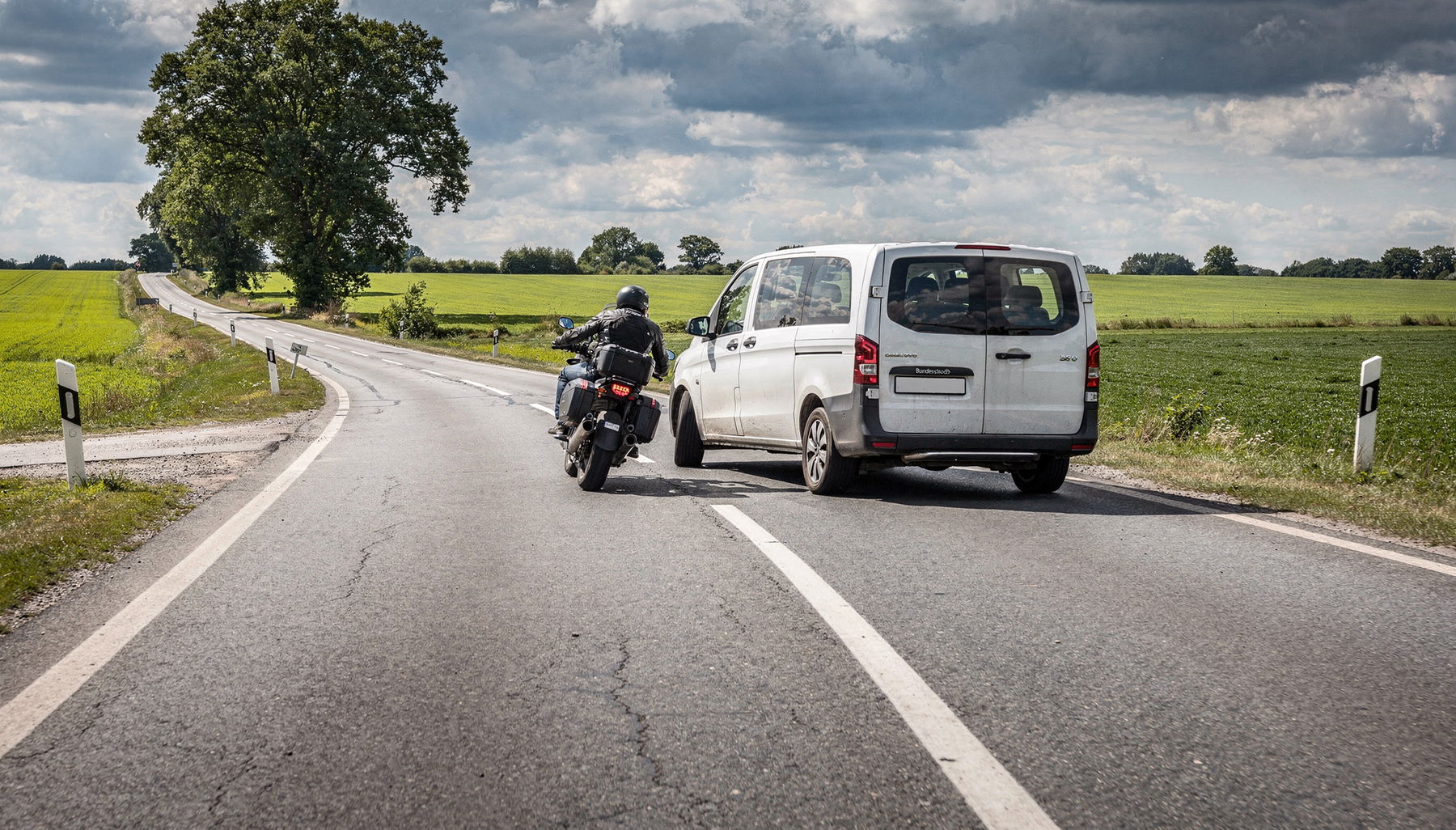
The incident occurred on August 24, 2021, on the B202 heading toward Kappeln. A then-42-year-old motorcyclist, a self-employed swimming instructor by profession, was riding his Suzuki and began overtaking a Mercedes Vito van. What followed was a nightmare that many bikers know from stories but never want to experience themselves: the van driver suddenly steered his vehicle to the left, crossing a solid center line in an apparent attempt to reach an exit on the opposite side of the road. He neither used his turn signal nor fulfilled his obligation to check his mirrors twice. The motorcyclist had no chance to evade.
The list of injuries reads like a catalog of horrors: traumatic brain injury with intracranial subarachnoid hemorrhage, fractures of the tenth, eleventh and twelfth thoracic vertebrae, bilateral serial rib fractures, right-sided pneumothorax, a complicated open fracture of the right humeral shaft, a displaced fracture of the right metacarpal bone, and fractures of the sternum. The motorcyclist required 17 days of inpatient treatment, followed by outpatient care and a three-week inpatient rehabilitation stay. Complications subsequently developed in his right upper arm and right hand. Among other issues, an implant broke, necessitating a further operation with an internal fixator. It was not until March 2023 that the implanted hardware could be surgically removed.
Insurer Sought to Establish Partial Liability for the Biker
The at-fault driver’s liability insurer initially paid 40,000 euros in compensation based on an assumed liability split of one-third to two-thirds. From the insurer’s perspective, the motorcyclist bore partial responsibility for the accident. The plaintiff disagreed and demanded an additional 55,000 euros, bringing the total to 95,000 euros. The Regional Court (Landgericht) ruled entirely in his favor and ordered the insurer to pay the remaining 55,000 euros as well as all material and further non-material damages.
The insurer appealed, arguing that the motorcyclist should have become suspicious due to the Mercedes Vito’s change in speed and aborted his overtaking maneuver. An unclear traffic situation had allegedly existed. Furthermore, the insurer contended that 95,000 euros in compensation was excessive, suggesting an amount between 35,000 and 50,000 euros would have been appropriate.
Court Finds No Fault on the Motorcyclist’s Part
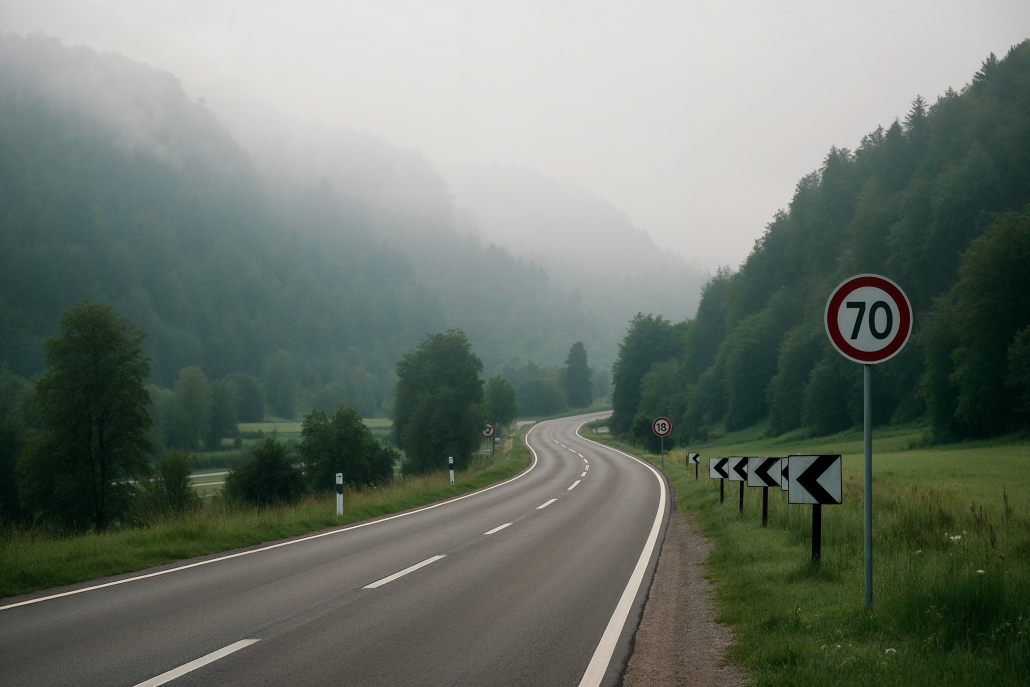
The OLG Schleswig-Holstein dismissed the appeal as manifestly unfounded. The judges of the 7th Civil Senate systematically dismantled the insurer’s arguments. First, regarding the allegation of an unclear traffic situation: the van had indeed reduced its speed from approximately 85 km/h to around 13 km/h over a period of ten seconds. However, a DEKRA expert report established that the calculated deceleration rate was just over 2 m/s², corresponding to only light braking. The speed limit in the area of the accident site was 70 km/h. The motorcyclist was therefore initially entitled to assume that the van was simply adjusting its speed to the limit. Additionally, a regular exit was located approximately 200 meters beyond the accident site, which the van could have been heading for. Gentle braking does not signal a sudden, illegal lane change across a solid center line.
Particularly relevant for motorcyclists: the court made clear that the biker was not required to abort his overtaking maneuver under these circumstances. Even when the van began to turn across his path, the expert report found the motorcyclist had a reaction window of just 1.6 seconds. Factoring in a normal startle reaction, this time span was physically insufficient to avoid the collision.
Motorcycle’s Inherent Operational Risk Fully Superseded
The legal core of the ruling concerns what German traffic law calls “Betriebsgefahr” — the inherent operational risk. Under German law, every motor vehicle poses an abstract danger simply by participating in road traffic, for which the owner is fundamentally liable. In practice, this frequently results in motorcyclists being assigned a share of liability in accidents with other vehicles, even when they bear no direct fault. Insurers regularly exploit this principle to reduce compensation claims from motorcyclists.
In this case, however, the judges ruled that the motorcycle’s basic operational risk was fully superseded by the van driver’s massive negligence. The driver of the Mercedes Vito had committed an entire bundle of gross traffic violations: he failed to signal, he did not fulfill his obligation to check mirrors twice, and he deliberately crossed a solid center line. Moreover, he cut off an oncoming vehicle so severely that its driver had to brake sharply. The court cited the established case law of the Federal Court of Justice (BGH), according to which a vehicle’s operational risk can be fully superseded by egregious misconduct on the part of the other driver.
What the Ruling Means for Compensation Amounts
The OLG also confirmed the total compensation amount of 95,000 euros. In assessing the sum, the court considered the severe and permanent consequences of the injuries. The plaintiff’s right arm is permanently shortened by several centimeters, which the Regional Court was able to verify through visual inspection during the oral hearing. For the plaintiff as a self-employed swimming instructor, this has existentially threatening consequences: he can no longer correctly demonstrate swimming movements or swim the breaststroke over longer distances. His profession as he knew it is over. The man was 41 years old at the time of the accident and now faces a complete career change.
The court emphasized that a holistic assessment of all circumstances must be applied when determining compensation for pain and suffering. Beyond the severity of the injuries, the multiple hospital stays, complications from broken implants, delayed healing and the risk of premature degenerative changes due to compensatory postures all factored into the evaluation.
Key Takeaways for Motorcyclists
The OLG Schleswig-Holstein’s decision makes clear that the often-feared automatic partial liability for motorcyclists is not an unshakeable principle. When the other party acts in gross violation of traffic rules and the biker cannot be shown to have failed to react, there is a realistic chance of full compensation. The decisive factor, however, is the evidence. In this case, an expert report and the testimony of an uninvolved witness supported the motorcyclist’s account. The driver of the vehicle that caused the accident has since died, meaning his version of events could no longer be presented.
For motorcyclists involved in an accident with a left-turning vehicle, the ruling underscores the importance of thorough evidence collection at the scene. Witness statements and technical expert reports can make the crucial difference between a reduced payout and full compensation.


- Shoei 12060291Shoei Neotec 2 Klapphelm Blau male

Redakteur bei Motorrad Nachrichten. Fokus auf Technik, Szene und Motorradpolitik – neutral, sachlich, verständlich.
Verantwortlich für die Seiten www.Motorcycles.News, www.Motorrad.Training und den YouTube-Kanal "Motorrad Nachrichten", sowie deren social Media-Seiten.