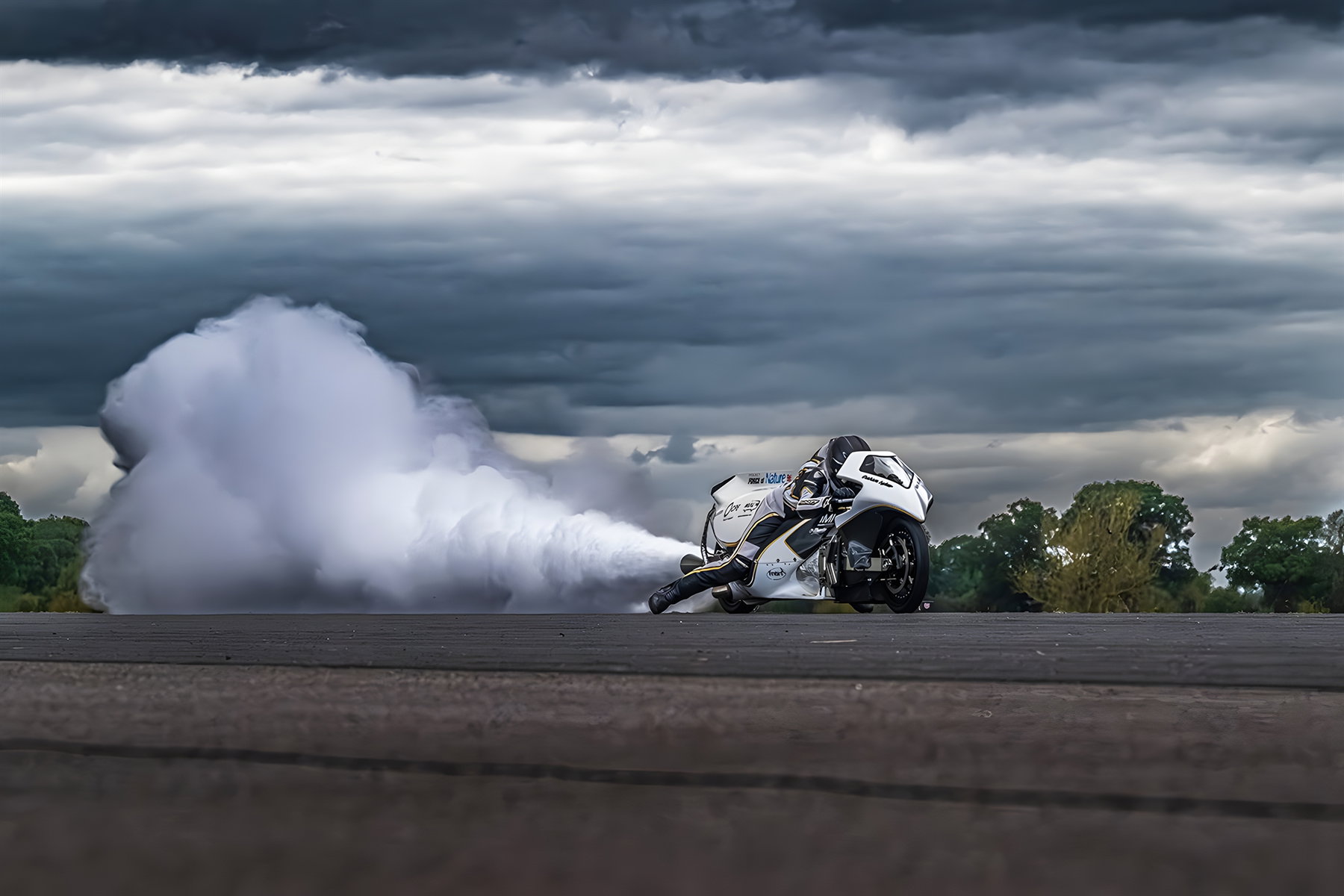
- Quarter mile in 5.5039 seconds at a Festival of Power event in Santa Pod
- Peak acceleration of up to 6.8 G at the start
- 120 litres of superheated water and two de Laval nozzles generate the thrust
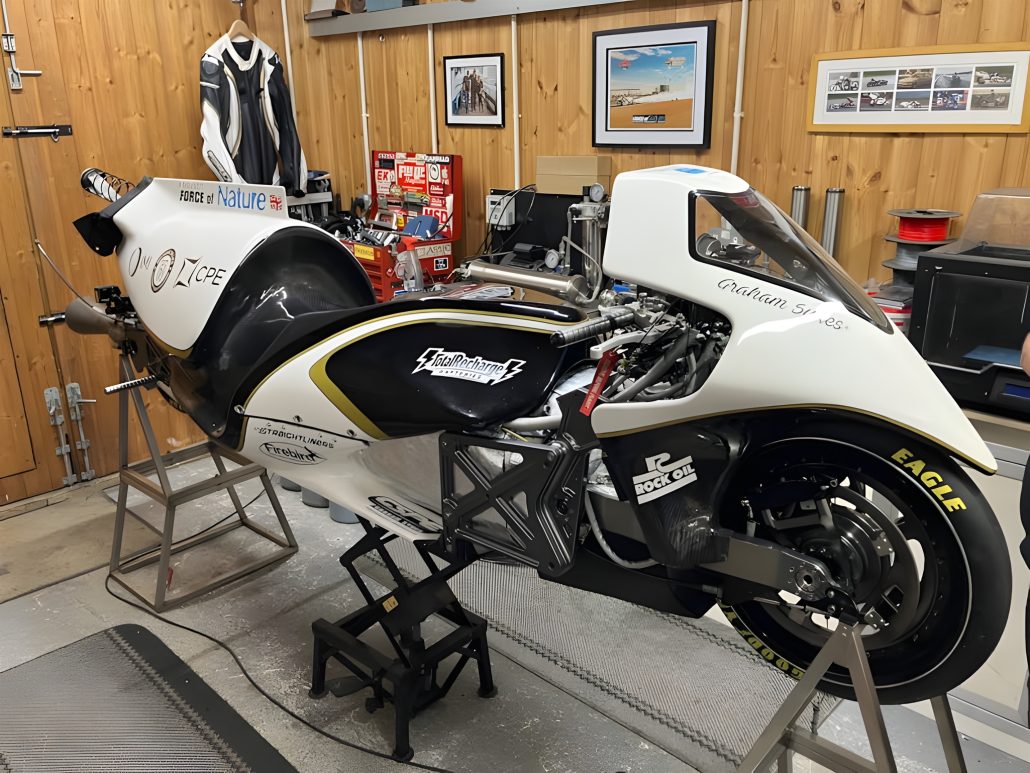
The “Force of Nature” project is a steam-powered rocket motorcycle that Graham Sykes has built together with a small team in a private workshop in Bedale in the north of Yorkshire. The precision engineer, now 62 years old, began the first design in 2020. The current running machine is the fifth stage of development and is still being refined. A few days ago, the latest version set a time of 5.5039 seconds over the quarter mile at the Festival of Power in British Santa Pod, making it the third fastest time a motorcycle has ever recorded over that distance.
How a motorcycle built in a shed became the third fastest in the world
There is no industrial manufacturer behind the project, but a small, family-run precision engineering firm. Graham Sykes has been involved in straight-line motorsport since 1979. His earlier roles include six years as a race engineer with Vauxhall’s successful touring car team in the British and European Touring Car Championships, work on the jet-powered dragster “Firestorm” and his ongoing effort on the motorcycle “52 Express”, which is aimed at a land speed record. Sykes also holds the current British land speed record for three-wheeled vehicles, set with his self-designed V8 trike “Syko”.
His wife Diane has been closely involved in his motorsport projects for more than 22 years and is in charge of finance, purchasing, logistics and start-line operations. The team also includes the second rider Phil Wood, Jim Dickman and Billy Hudson. The pressure vessel, the technical heart of the motorcycle, is supplied by the British company CPE Pressure Vessels in Tamworth. Mick Dowd looks after the project there, which CPE has supported for around ten years. The first pressure vessel held 50 litres and was built from 316/L stainless steel. Across several development stages the volume has grown to 120 litres, up from 88 litres in the previous iteration.
The idea for the project dates back around 14 years. Sykes recalls watching the televised broadcast of Evel Knievel’s jump over the Snake River Canyon and remembers that the propulsion used was steam-based. “I couldn’t quite believe that they could make a rocket have that much power with steam.” He then studied the basics of superheated water rockets in libraries. Years later, at a meeting, he saw a French rider on a steam-powered scooter reach 130 mph wearing only an overall and no leather suit. Sykes thought the setup was extremely dangerous and decided to redesign the concept from an engineering standpoint.
The technology behind the thrust
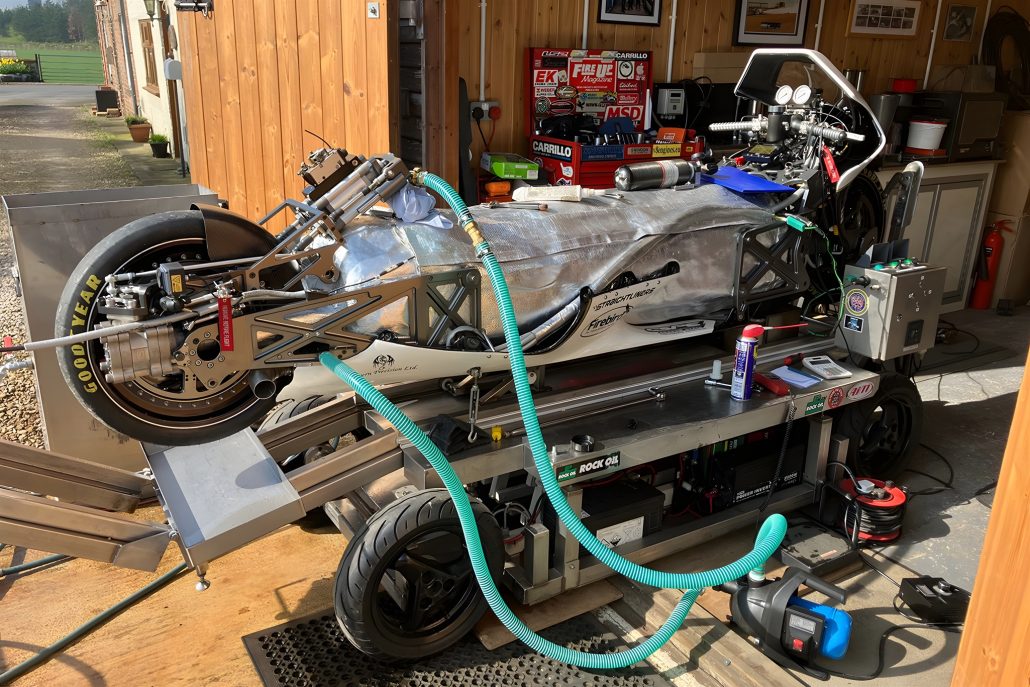
The operating principle is comparatively simple, the implementation anything but. A separate supply module, internally referred to as the “Mothership”, heats the water before launch. The current version uses a burner with a heat output of 44 kilowatts, up from a 20-kilowatt unit before. The fuel is either kerosene or hydrogenated vegetable oil. The hot gases are fed through a manifold into six burner tubes with internal turbulators that improve heat transfer. These tubes run through a pressure vessel containing 120 litres of demineralised and deionised water. The water is heated to up to 260 degrees Celsius, and the working pressure is between 40 and 50 bar, with older figures quoting 580 psi. According to Sykes, heating the full amount of water takes around three hours.
Once the machine is ready, the pressure vessel is disconnected from the Mothership. The motorcycle is then rolled to the start line and prepared for the run. The rider presses a button mounted on the handlebar, which opens two valves that have been holding back the water inside the tank. In the current version these valves are actuated by nitrogen pressure, which allows a more even release. The button has to be held down for the entire run; otherwise thrust is cut immediately.
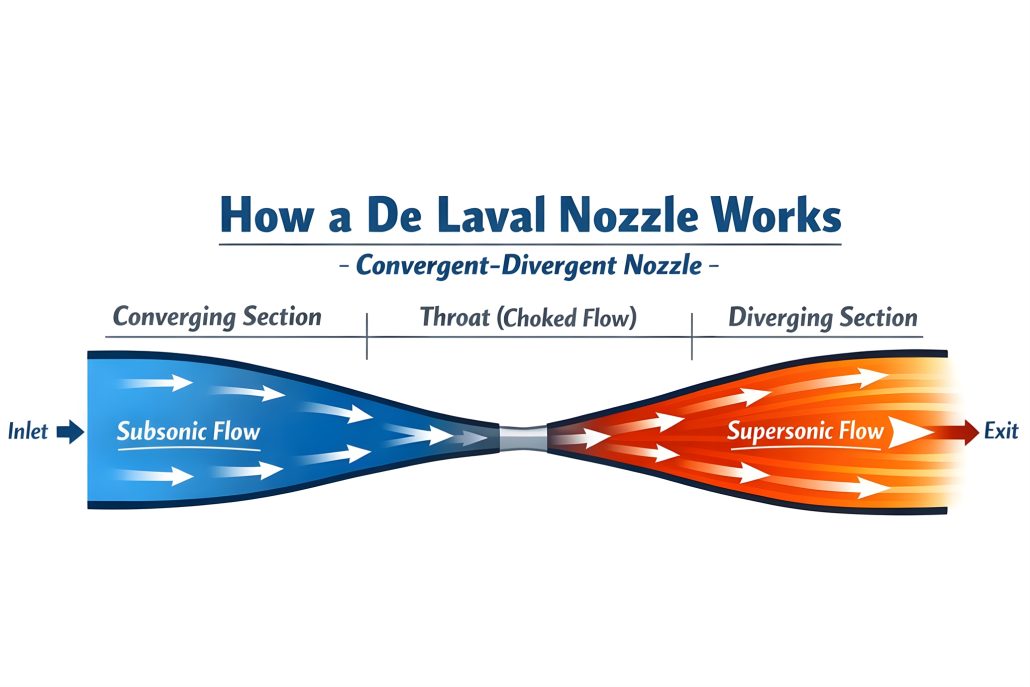
The water then flows through two symmetrically arranged outlet tubes, one on each side of the bike, where it is accelerated to 1.1 times the speed of sound in a nozzle geometry. These de Laval nozzles have a converging and then diverging cross-section. On exit, the liquid water flashes to steam, with the volume expanding in a ratio of 1620 to 1 according to the team. Around 40 litres of water leave the system every second. Sykes describes the process as producing an “almighty sonic boom”.
No throttle, just on or off
“The power is on or off. You can’t moderate the flow rate of the valves. It’s 100% or nothing.” Sykes speaks openly about the fact that a rocket cannot really be made fully safe and that risks can only be limited through sound engineering. During preparation he lets the water settle for a few seconds after filling. A countdown from five to one then follows before the button is pressed. At the same time, the rider has to pull himself down onto the handlebars, lower his head and get his feet onto the pegs immediately, because the acceleration that follows leaves no room to do so afterwards.
The reason is the forces that come into play. The team has measured peak values of 6.8 G. On average the readings are around 5.4 G during the first second and about 3 G during the second. For a rider weighing 85 kilograms (around 187 lbs), the peak equals a brief apparent weight of 578 kilograms (around 1,274 lbs). The sprint from 0 to 60 mph takes 0.4 seconds according to Sykes, with 100 mph reached in 0.8 seconds. On the first 60 feet the best is 0.72 seconds, while the current version has managed 0.81 seconds so far. For comparison, Sykes refers to the Top Fuel world record set by Clay Millican, who ran 3.628 seconds over the quarter mile and took 0.809 seconds on the 60-foot split.
The run at the Festival of Power 2026
The most recent record run took place at the Festival of Power in Santa Pod. It had been preceded by tests at Elvington in rather poor weather conditions. The first run with a small amount of water and minimal pressure ended at 7.30 seconds and 148 mph. The pressure vessel was then filled with the full 120 litres. Heating to the target temperature of 260 degrees Celsius took three hours. Despite a 20 mph headwind and crosswind, and a half-second in which Sykes briefly let go of the trigger for a correction, a quarter-mile time of 5.51 seconds was recorded in the end. Data analysis showed a speed of 206 mph after 549 feet. The machine was reportedly pushed slightly off the line, and the carbon underbody as well as Sykes’ boots were worn through.
From the same weekend, a Saturday time of 5.5 seconds over the quarter mile at 192 mph is also reported, with an eighth-mile time of 3.2 seconds at 209 mph. Because of the wind conditions on Sunday, the motorcycle classes were cut back to the eighth mile by the organisers. The individual values on the eighth mile stand at 3.17 seconds and 203 mph, while the team quotes 1.96 seconds from an earlier run as the eighth-mile record for two-wheelers. Over 1,000 feet, 4.53 seconds and 193 mph were recorded.
With the quarter-mile time of 5.5039 seconds, Force of Nature slots into third place among the fastest motorcycles in the world. Ahead of it are Frenchman Eric Teboul with 4.976 seconds and 290.51 mph, set in September 2022 with a rocket bike based on hydrogen peroxide, and Larry McBride with his wheel-driven Top Fuel motorcycle, which posted 5.50 seconds.
Why there is still headroom
The current setup uses up its water supply in around 2.9 seconds. Increasing the tank size is not an option for Sykes. The development direction is to get more run time and a more stable flow out of the existing amount of water. Sykes speaks of around three seconds of thrust being needed to run the 4.9 seconds over the quarter mile he has set as his next goal. A further intermediate target is times in the 2-second range over the eighth mile and ultimately a quarter-mile time in the 4-second range.
Technically he is working on several parameters. The new machine has a longer chassis and a revised seating position, in which the rider can brace himself more effectively under load. The carbon fairing is larger and reshaped to accommodate the revised pressure vessel. Inside the vessel, design changes are intended to improve flow to the nozzles, and the nitrogen-operated valves should trigger more evenly. The most important lever, from Sykes’ point of view, remains the flow itself. He explains that a steady, turbulence-free flow is necessary, because otherwise cavitation occurs, a partial vacuum forms, the water starts to boil there, and the flow is interrupted. The key is an undisturbed path for the water from the vessel to the nozzle.
Despite the aggressive figures, Sykes himself is rather sober about the project. He says that many vehicles have already gone fast and many have exceeded the 200 mph mark, but that the pure acceleration rate is new. Force of Nature, he says, is the most strongly accelerating vehicle in the world with the exception of a Top Fuel car. The data-logging system from AIM Technologies is intended to help secure further development steps with hard data. The next round is planned for the Easter weekend in Santa Pod, where Sykes wants to go quicker than 5.51 seconds.
Frequently Asked Questions
-
Who built the Force of Nature rocket motorcycle?
The motorcycle was developed by Graham Sykes from Bedale in North Yorkshire and built in a private workshop. He is supported by his wife Diane, the second rider Phil Wood and team members Jim Dickman and Billy Hudson. The pressure vessel is supplied by CPE Pressure Vessels in Tamworth.
-
How fast does the Force of Nature accelerate?
The steam-powered rocket motorcycle reaches 60 mph in 0.4 seconds and 100 mph in 0.8 seconds. Peak values of 6.8 G have been measured at the start, with an average of 5.4 G during the first second.
-
What quarter-mile time has the steam-powered rocket motorcycle achieved?
At the Festival of Power 2026 in Santa Pod, Graham Sykes set a time of 5.5039 seconds. That puts Force of Nature in third place among the fastest motorcycles, behind Eric Teboul with 4.976 seconds and Larry McBride with 5.50 seconds.
-
How does the steam propulsion of Force of Nature work?
Inside the pressure vessel, 120 litres of demineralised water are heated to around 260 degrees Celsius and pressurised to between 40 and 50 bar. At launch, the water flows through two de Laval nozzles, flashes instantly to steam and generates the thrust.
-
Where does Force of Nature compete?
Force of Nature mainly runs on the Santa Pod Raceway dragstrip and at Elvington airfield. The bike is campaigned there at events such as the Festival of Power and the FIA/FIM European Finals.

- HELITE MO.TX.VTD-BKHV-4XLHelite Airbag Jacke Vented 2.0 Sommerjacke mit Turtle Airbag schwarz-gelb