- New strategy plan “WireForward” expected in May 2026 alongside Q1 results
- Harley-Davidson projects 130,000 to 135,000 motorcycles sold worldwide for 2026
- Entry-level model “Sprint” set to launch in 2026
What had already been hinted at following the quarterly figures in February is now taking more concrete shape. Harley-Davidson is in the midst of a profound restructuring that the company internally refers to as a strategic reset. Under new CEO Artie Starrs, the Milwaukee-based manufacturer is working on a plan to be officially unveiled in May 2026 alongside the Q1 results. The name of the program: WireForward.
What Is Known So Far: The Key Points of WireForward
The name WireForward deliberately builds on the previous strategy “The Hardwire,” which under then-CEO Jochen Zeitz focused on high-margin touring models in the premium segment over five years. Zeitz led the company until October 1, 2025, and remained as an advisor in the background until February 2026. His successor Starrs came from Topgolf Callaway Brands, where as CEO he grew the leisure company’s revenues by over 50 percent within four and a half years, from approximately $1.1 billion to $1.8 billion (roughly €960 million to €1.57 billion). Before that, he served as Global CEO of Pizza Hut, a subsidiary of Yum! Brands, overseeing more than 18,000 locations in 110 countries.
Starrs thus brings experience in leading large franchise-driven brands. The question is whether this know-how can be transferred to a heritage company like Harley-Davidson, whose brand core has always been built on exclusivity and a certain lifestyle.
According to statements so far, WireForward aims to preserve the brand’s premium experience while simultaneously pushing into mid-range and smaller displacement classes to attract younger buyers. Specific model plans or investment volumes have not yet been disclosed.
The Numbers Behind the Restructuring: Fiscal Year 2025 in Detail
The financial results of fiscal year 2025 had made the pressure to act abundantly clear. Consolidated annual revenue dropped by 14 percent to $4.47 billion (approximately €3.89 billion). The motorcycle division HDMC alone recorded a revenue decline of 13 percent to $3.578 billion (approximately €3.11 billion) and slipped into the red for the first time with an operating loss of $29 million (approximately €25 million). The previous year, the division had still posted an operating result of $278 million (approximately €242 million).
Globally, Harley-Davidson sold 132,535 motorcycles at retail, a decline of 12 percent. Dealer shipments fell even further, down 16 percent to 124,477 units.
The fourth quarter highlighted the problems particularly sharply: quarterly revenue plunged 28 percent to $496 million (approximately €432 million), while the operating loss widened to $361 million (approximately €314 million). The loss per share came in at $2.44, significantly missing analyst expectations of minus $1.06.
Tariffs as a Growing Burden
A significant cost factor is trade barriers. Tariffs burdened Harley-Davidson with approximately $67 million (roughly €58 million) in fiscal year 2025. For 2026, the company expects this to rise to $75 to $105 million (approximately €65 to €91 million). While Harley produces the majority of its core models in the US and sources around 75 percent of components from US suppliers, imported parts including semiconductors continue to generate additional costs. In Europe, the current Euro 5+ emission standards further complicate matters by making the homologation of large-displacement engines increasingly expensive.
Job Cuts and Cost Reductions Taking Shape
That the announced cost reductions will also affect jobs was already confirmed by a company spokesperson in February. The wording at the time was that some of the measures would be achieved through “headcount reductions.” The United Steelworkers union indicated that both blue-collar and white-collar employees would be affected.
Starrs’ stated goal is to reduce ongoing costs by approximately $150 million (roughly €131 million). Harley-Davidson’s workforce has already shrunk by about 800 employees since 2022. At the end of 2025, the company employed approximately 5,500 people worldwide and operated 1,174 dealer locations.
Sprint Model as a Signal for a Broader Product Strategy
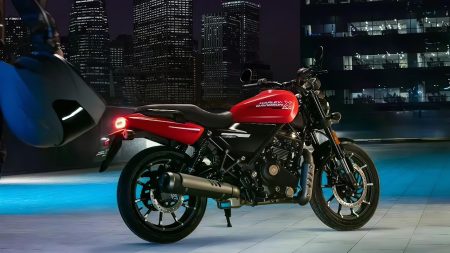
A concrete indication of the new direction is the planned entry-level model Sprint. According to industry publication Powersports Business, it is expected to be a smaller, more affordable motorcycle set to launch in 2026, specifically targeting new riders. This would mark the first time since the discontinuation of the Street lineup that Harley-Davidson offers a model below the cruiser and touring classes.
The experience with the X440 in India, produced in collaboration with Indian manufacturer Hero MotoCorp and selling well there, likely played a role in the decision. The India-built model demonstrates that the Harley-Davidson brand name can also work in lower price segments.
Parallel to this, the RMCR Café Racer Concept attracted attention at the latest show. The concept motorcycle in a sporty, stripped-back style evidently struck a chord with both the public and trade press. Whether and when a production version will come remains open. Should Harley-Davidson manage to bring the RMCR to market at a price that does not deter younger buyers, it could be an important signal to the market.
HDFS Deal with KKR and PIMCO: Financial Services in Transition
Beyond the motorcycle division, Harley-Davidson has also restructured its financial services subsidiary HDFS. In a transaction with investors KKR and PIMCO, existing loan receivables worth approximately $6 billion (roughly €5.22 billion) were sold, a 9.8 percent equity stake in HDFS was divested, and an agreement for the sale of future loan originations was concluded. The result: HDFS distributed a dividend of $1 billion (approximately €870 million) to the parent company in the fourth quarter. For the full year 2025, HDFS reported a record operating profit of $490 million (approximately €426 million).
The deal fundamentally changes the HDFS business model: from a capital-intensive lending bank to a leaner, lower-risk operation. How this will affect total revenues in the long run remains to be seen.
LiveWire: Small Steps in the Electric Segment
The electric brand LiveWire showed a significant increase of 61 percent in motorcycle sales in Q4 2025. In absolute numbers, however, this means only 381 units versus 236 in the prior-year quarter. For the full year 2025, 653 electric motorcycles were delivered, compared to 612 the previous year. The operating loss narrowed from $110 million to $75 million (approximately €65 million).
The next product in line is the S4 Honcho, a series of smaller electric motorcycles positioned at the performance level of 125cc combustion engines. LiveWire is also planning a capital increase of up to $50 million (approximately €44 million) through the issuance of new shares, supplementing an existing $75 million (approximately €65 million) credit facility from Harley-Davidson to secure additional development funding.
2026 Outlook: A Wide Corridor with Considerable Uncertainty
For 2026, Harley-Davidson expects global retail sales and shipments between 130,000 and 135,000 motorcycles. The forecast for the HDMC motorcycle division’s operating result ranges from minus $40 million to plus $10 million (approximately minus €35 million to plus €9 million). A range that shows even management can barely predict the short-term trajectory.
CFO Jonathan Root described 2026 as a “transition year,” while Starrs spoke of “tough but necessary steps” to stabilize the business and restore confidence. The manufacturer has announced that the WireForward plan results could still change the current forecast.
Stock Under Pressure, Board Member Sells
The uncertainty is clearly reflected on the stock market. The Harley-Davidson share has lost around 30 percent within a year, and roughly 50 percent over five years. The price currently hovers around the $18 to $20 mark (approximately €16 to €17).
Notably, Ford CEO Jim Farley, who sits on Harley-Davidson’s Board of Directors, sold 6,454 shares worth approximately $121,000 (roughly €105,000) in late February. It was his first open-market sale at Harley ever. The board will subsequently be reduced from nine to eight members, as Farley’s seat will not be filled.
What This Means for Motorcyclists
For Harley riders and prospective buyers, little changes in the short term. The 2026 model lineup is set, and the touring models have just been refreshed. Things will get interesting in May when the WireForward plan details are released. Should the Sprint model actually materialize, it would be the first real entry into a lower price segment in years. At the same time, ongoing sales promotions and dealer inventory clearances could well present attractive offers on current models. In the long run, the coming months will determine whether Harley-Davidson can manage the transition from a pure touring and cruiser specialist to a broader provider without losing its own identity.

Redakteur bei Motorrad Nachrichten. Fokus auf Technik, Szene und Motorradpolitik – neutral, sachlich, verständlich.
Verantwortlich für die Seiten www.Motorcycles.News, www.Motorrad.Training und den YouTube-Kanal "Motorrad Nachrichten", sowie deren social Media-Seiten.