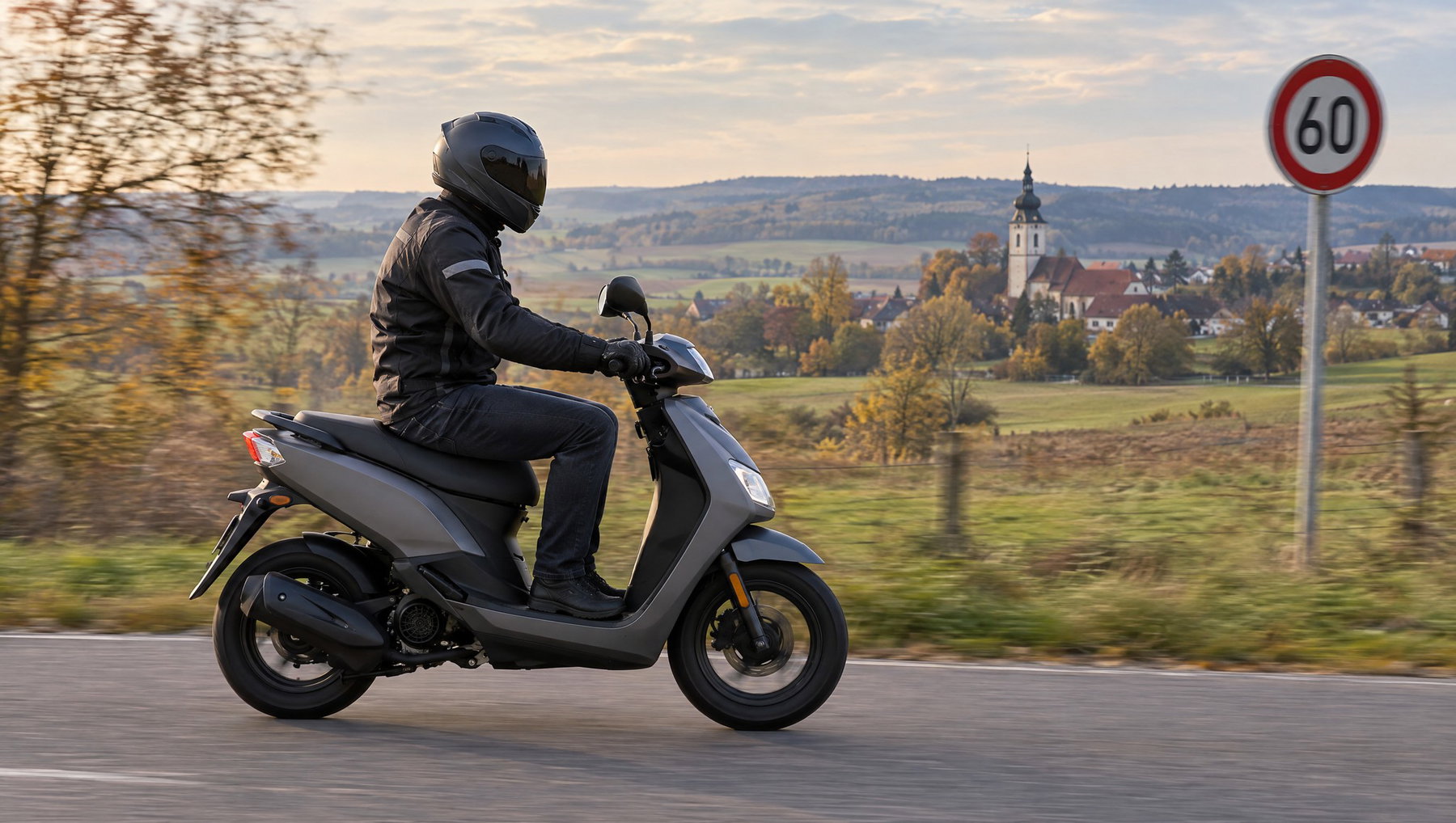
- The Bundesrat adopted the resolution at its 1070th session, with the wording unchanged from the motion submitted by Saxony.
- It covers the EU vehicle categories L1e-B, L2e and L6e, i.e. everything that can be ridden today with an AM licence.
- For the time being, the limit stays at 45 km/h, and the resolution does not permit any conversions.
It all started with the Saxon cabinet on 29 September 2026. On 16 October, Saxony introduced the motion for a resolution in the Bundesrat, Germany’s federal chamber of the states, with Thuringia having already joined as co-sponsor. The Committee on European Union Questions, the Committee on Internal Affairs and the Transport Committee then dealt with the issue and recommended that the states adopt the resolution. On 20 November, a majority in the plenary followed. A resolution is not a law, however, but a request to the federal government. Anyone who hoped to ride their scooter at 60 km/h after the Bundesrat vote will therefore have to be patient.
What exactly does the Bundesrat resolution call for?
The Bundesrat asks the federal government to push within the EU for vehicles in licence category AM to be allowed a design speed of up to 60 km/h in future. The adopted text is word for word identical to the motion Saxony submitted on 9 October.
At the heart of the demand is an amendment to EU Regulation 168/2013 and the technical rules adopted under it. The existing categories would then also cover vehicles up to 60 km/h and be eligible for EU type approval. Type approval is the Europe-wide approval of a vehicle model. The technical requirements are to remain proportionate. Where the new categories make it necessary, the federal government is also to press for corresponding changes to European driving licence law for category AM.
A fourth point concerns the details. Technical safety requirements are to be taken into account, as are the effects on road safety, mobility, the environment, the economy and enforcement, including the question of how new rules can be policed. The resolution also explicitly mentions the importance of these vehicles for people in rural and structurally weak regions.
The three categories cover more than just the classic 50cc moped. L1e-B stands for two-wheeled mopeds, including scooters and electric mopeds. L2e covers three-wheeled mopeds, and L6e light four-wheeled vehicles, which include small microcars.
Why can’t Germany raise the 45 km/h limit on its own?
The 45 km/h is not a speed limit under road traffic law but a defining feature of the European vehicle categories. Under current law, a vehicle with a higher design speed generally cannot be approved in these categories.
This classification dates back to the 1990s. Since then, 45 km/h has been the cut-off, no matter how much reserve the engine has. On the German side, it is above all the driving licence that depends on it: under German law, category AM today covers exactly the categories L1e-B, L2e and L6e. The initiative explicitly focuses, however, on the technical rules for classification, construction and approval.
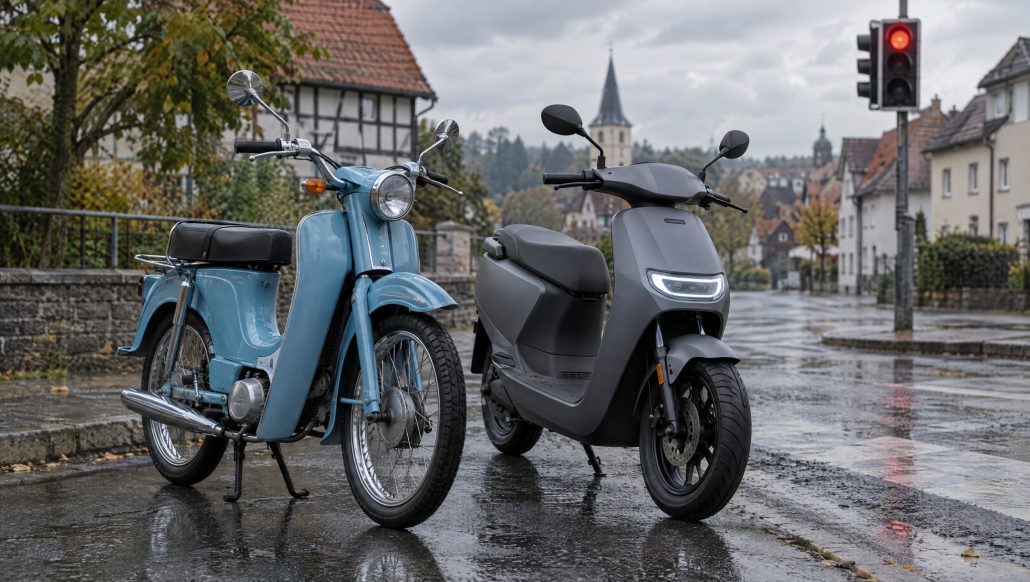
The fact that faster mopeds can still be found on German roads is down to special rules from the past. Some older West German models may ride at up to 50 km/h, and thanks to the Unification Treaty, East German mopeds such as the S51, S50, Star or Schwalbe are even allowed 60 km/h. The Bundesrat explicitly does not derive any entitlement for new vehicles from this.
What arguments do the states make for 60 km/h?
The states point above all to technical progress and to life in the countryside, where mopeds are often the only vehicle of their own for many young people.
Brakes, chassis, tyres and lighting have developed considerably since the vehicle categories were introduced, so the old limit is to be reassessed. In rural areas there are also long journeys to school, training or work, while buses and trains sometimes run only rarely. At 60 km/h, longer distances would be easier to manage, and the gap to the speed of cars would shrink.
Thuringia’s head of the State Chancellery, Stefan Gruhner (CDU), sees practical proof already in eastern Germany, where East German mopeds have been riding at 60 km/h for decades. He used to ride a Simson himself. His main concern is the mobility of teenagers and apprentices in rural areas.
Support comes from the German motorcycle industry association IVM (Industrie-Verband Motorrad), which explicitly welcomes the decision. In the association’s view, mopeds at 60 km/h could flow with the traffic instead of being crowded or overtaken dangerously. The IVM sees today’s 45 km/h as a risk for everyone, especially on country roads, while in towns the small vehicles are often seen as an obstacle. In its view, the issue is particularly important for pupils and apprentices under 18 in rural areas, who often could not get to school or work at all without a moped.
Does 60 km/h make mopeds safer?
That remains open. In its own explanatory statement, the Bundesrat writes that neither a reliable link between the 45 km/h limit and accident figures nor a safety benefit from a higher speed has been proven.
At the same time, the text notes that motorcyclists are among the most vulnerable road users. The Saxon Ministry of Infrastructure also stresses that it does not simply assume more speed means more safety.
Henrik Liers, managing director of the traffic accident research unit at TU Dresden, sees both sides. In his assessment, urban traffic already moves at around 55 km/h, and more uniform speeds could make critical overtaking manoeuvres and lane changes less frequent. But he also points to the physics: kinetic energy rises with the square of speed. At 60 instead of 45 km/h, that gives a factor of 1.78, i.e. almost 80 percent more energy acting in a fall or collision. According to him, too, there is no scientific evidence that slower mopeds actually cause more accidents.
Saxony-Anhalt’s transport minister Lydia Hüskens had announced her approval before the vote and sees benefits for traffic flow, but still calls for further studies on accident risks. For her, questions about insurance cover also remain open. ADAC Saxony sees the higher speed as an additional buffer in traffic. Its spokesman Florian Wagner makes clear, however, that the vehicles must be technically designed for 60 km/h. Anyone riding that fast should wear protective clothing, ADAC Saxony recommends.
When will mopeds be allowed to ride at 60 km/h?
There is no date. Until the EU changes its rules, 45 km/h continues to apply to new mopeds. Nor does the resolution permit conversions to a higher speed.
Next, it is up to the federal government. It is not bound by the states’ request, but it does have to address it. If it takes up the issue, it would have to submit a proposal in Brussels. There, both the type-approval rules and driving licence law for category AM would then have to be amended.
The IVM therefore expects a lengthy process and calls on the federal government to take the initiative into the European discussion anyway. Whether the proposal will find favour with the other EU member states and the European Commission is impossible to say so far.
Frequently Asked Questions
-
Does 60 km/h already apply to mopeds after the Bundesrat vote?
No. The resolution is a request to the federal government and does not change any rule. New mopeds and 50cc scooters may still only have a design speed of 45 km/h.
-
Which vehicles would be allowed to ride at 60 km/h in future?
It concerns the EU vehicle categories L1e-B, L2e and L6e. These include two-wheeled mopeds, scooters and electric mopeds, three-wheeled mopeds and light four-wheeled vehicles. In Germany, all three categories fall under the AM licence.
-
Why are Simson mopeds already allowed to ride at 60 km/h?
A special rule from the Unification Treaty applies to East German mopeds such as the Schwalbe, Star, S50 or S51. They are therefore allowed to ride at up to 60 km/h. No entitlement for new vehicles can be derived from this.
-
Who has to act now for 60 km/h to happen?
First the federal government, which would have to bring the matter to Brussels. The EU would then have to amend Regulation 168/2013 and European driving licence law for category AM. There is no timetable for this.