- Two new Honda patents focusing on V4 engine architecture
- New oil circuit and revised cooling in the cylinder V
- Indications of a more compact design and simplified production
After years without a V4 production model, there are growing signs at Honda of a technical revival of the traditional engine concept. Patents published at the end of 2025 reveal not only basic ideas, but also detailed design solutions. The development stage appears to be advanced, suggesting more than just the securing of concepts.
Honda’s long history with the V4
Honda has consistently relied on V4 engines since 1982. Models with the abbreviations VF and VFR have shaped the portfolio for decades, from sporty variants to touring machines. This era only came to an end in 2020 with the discontinuation of the VFR 1200. Since then, there have been repeated hints of a possible successor, but never as concrete as with the patents that have now been published.
New patents with unusual depth of detail
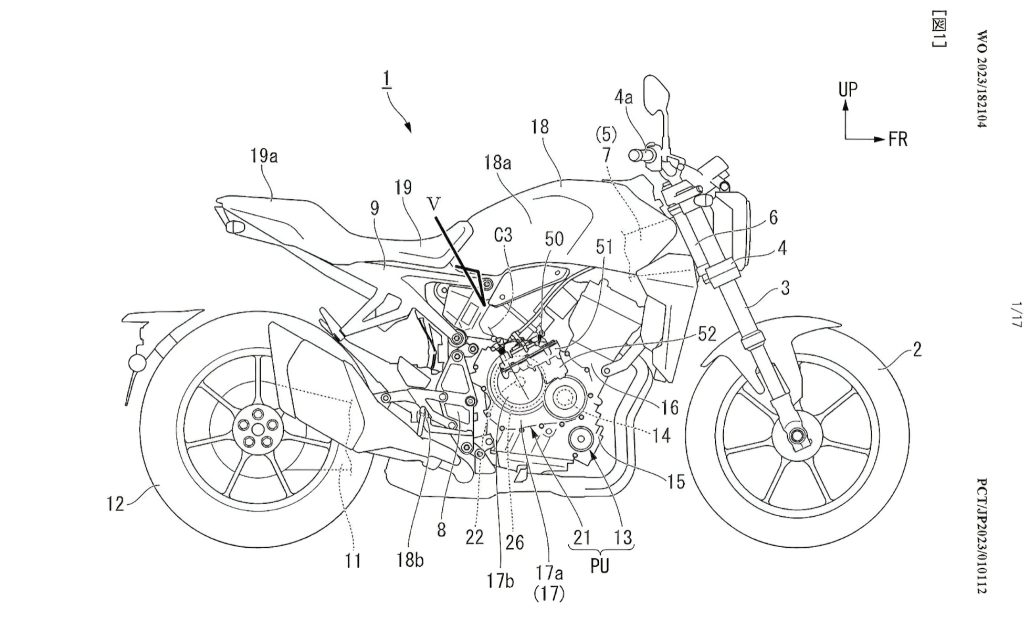
Honda has registered two patents that can be clearly attributed to a new V4 engine. The depth of the technical drawings is striking. While earlier patents only showed partial areas, the current documents provide a more comprehensive view of the design and functionality. This suggests that Honda is already working intensively on the practical implementation.
A central theme is the simplification of the design. This is not about technical reduction, but about more efficient production, lower weight, and a more compact design.
Revised oil circuit for less friction
One of the patents describes a newly developed oil circuit. The aim is to reduce the internal friction of the oil pump. Honda is relying on shorter internal oil channels that run directly through the engine housing. In addition, small internal reservoirs are used to supply specific components such as the power generator, starter freewheel, water pump, and clutch.
By eliminating long external lines, the engine should not only run more efficiently, but also be easier to package. This has a direct impact on size and assembly costs.
Modular design of cylinder head and housing
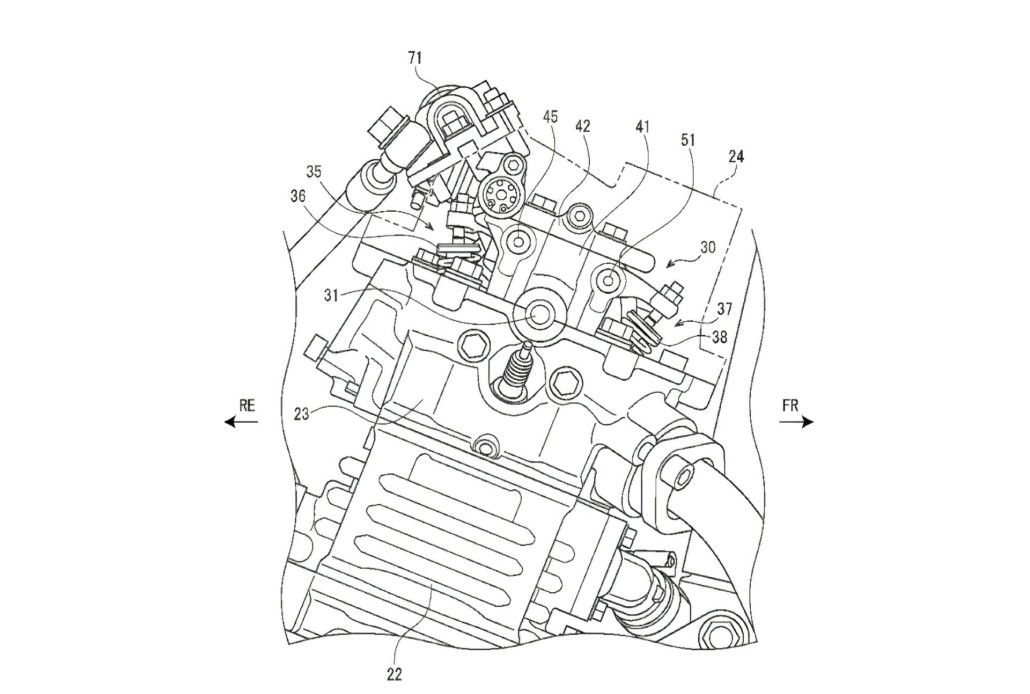
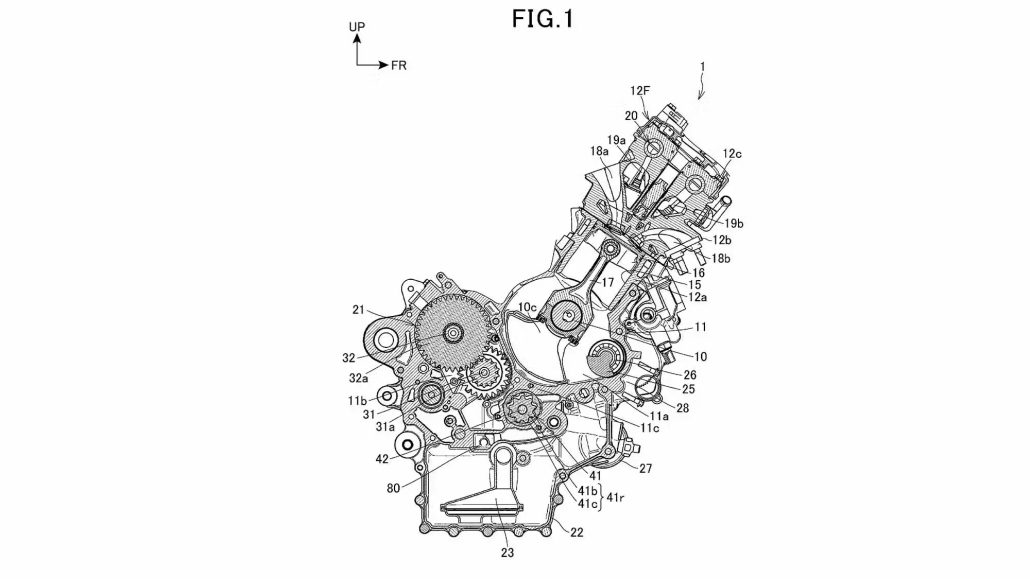
Another patent is dedicated to the connection between the cylinder head and engine housing. Although Honda illustrates this solution using an inline twin, technically it corresponds to half of a V4. The approach suggests a modular design principle that can be applied to the entire V4.
Less oversized material thicknesses and clearly defined connection points are intended to simplify machining and stabilize production quality. Compared to the last 1,200cc V4, the new engine appears significantly more compact in the drawings, especially in the area of the combined engine and transmission housing.
New cooling strategy in the cylinder V
The cooling system has also undergone a fundamental redesign. Honda routes cooling lines specifically through the space between the two cylinder banks. Priority is given to the rear cylinder bank, as it is exposed to higher thermal loads due to its design.
A more even temperature distribution allows for tighter tolerances and is intended to improve durability under high loads. This point is particularly crucial in performance-oriented applications.
Ignition sequence and cylinder angle remain open
The question of cylinder angle and ignition sequence has not yet been clearly resolved. The last large Honda V4 with 1,200 cubic centimeters relied on a 76-degree cylinder angle and 28-degree offset crankpins. This resulted in a big bang ignition sequence of 104-256-104-256 degrees, which did not require a balance shaft.
Older V4 engines with 750 and 800 cubic centimeters, on the other hand, used a 90-degree angle and a 180-degree crankshaft. This even ignition sequence required a balance shaft to reduce vibrations.
The current patents clearly specify a balance shaft, and the pistons are not offset. The cylinder angle appears to be closer to 90 degrees than 76 degrees, which suggests a more even ignition sequence. However, no definitive conclusion can be drawn from the drawings.
Chain drive instead of cardan
The type of final drive, on the other hand, is clear. Honda explicitly describes a chain drive for the rear wheel in the patent. There is no mention of a cardan drive. Although manufacturers often leave room for variants in patents, in this case the specification appears deliberate and clear.
Schedule remains unclear
The two patents were filed in May 2024 and published in late 2025. Experience shows that it takes several years after such a disclosure before a new engine actually goes into series production. Therefore, there are likely to be few concrete clues in the next one to two years.
Nevertheless, the scope and detail of the patents suggest that Honda does not view the V4 as merely a theoretical concept. The possibility of a new VFR generation with a modern V4 engine seems realistic, at least.
→ This article is part of our comprehensive overview of patents and future technologies – find all developments in our Patents and Future Motorcycle Technology overview.

- Milestone Ride 6 Day 1 Edition (Xbox Series X)



Redakteur bei Motorrad Nachrichten. Fokus auf Technik, Szene und Motorradpolitik – neutral, sachlich, verständlich.
Verantwortlich für die Seiten www.Motorcycles.News, www.Motorrad.Training und den YouTube-Kanal "Motorrad Nachrichten", sowie deren social Media-Seiten.