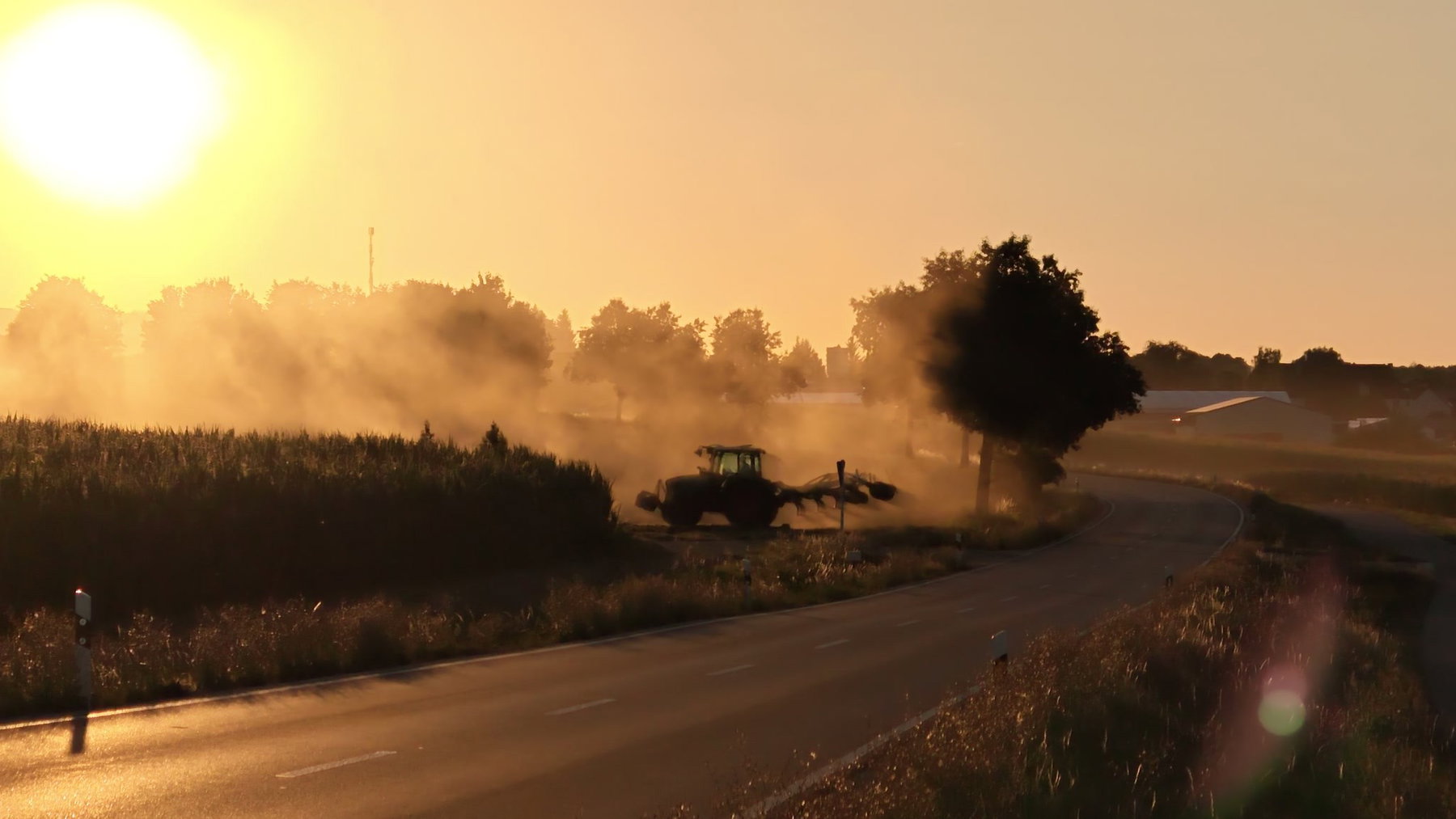
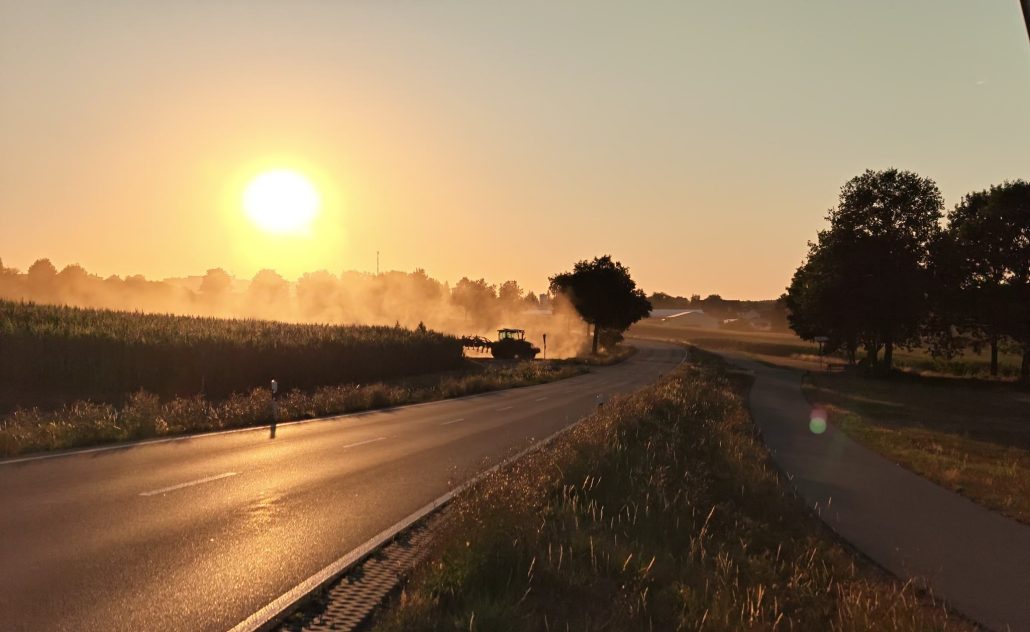
- Soil, straw and small stones collect above all in the area around field entrances
- In collisions with harvesting vehicles, DEKRA warns of the most severe injuries from as little as 60 to 70 km/h
- Anyone who dirties the road must clean it again immediately under Section 32 of the German Road Traffic Regulations
Wheat and rye are being brought in across the country at the moment. That increases the share of slow, heavy and often over-width vehicles on country roads. The German Institute for Motorcycle Safety (ifz) points out that for motorcyclists it is not only the vehicles themselves that are dangerous, but above all the traces they leave. Harvest season therefore joins a whole series of seasonal risks that accompany motorcyclists through the year, from loose chippings in spring to damp leaves in autumn.
Why are field entrances a danger spot for motorcyclists?
At field entrances, agricultural vehicles cross the road and carry soil, dirt, straw or small stones onto the asphalt. The ifz therefore advises specifically expecting contaminated sections in these areas.
The tricky part is the distribution. The dirt rarely lies evenly, but in patches and strips, often precisely where the machine turned from the entrance onto the road. In other words, frequently in the bend. Add rain or dew and the clay and soil turn into a greasy film. TÜV Süd describes how such spots can turn into slides in the wet.
What is a friction jump and why is it dangerous?
A friction jump is a sudden change in grip between tyre and road surface. If the surface switches from clean asphalt to a contaminated spot and back again, the available grip changes abruptly.
For a single-track vehicle this is considerably more critical than for a car. A motorcycle needs the tyre’s grip for braking and for holding the lean angle at the same time. According to the ifz, friction jumps therefore become a problem above all under braking or at lean. Anyone who hits a strip of soil in a bend loses cornering grip at exactly the moment they need it most.
On top of that comes poor visibility. A thin layer of soil on grey asphalt is barely noticeable against the light, in shady stretches of woodland or in the wet. In one case decided by the Flensburg Regional Court, the contamination was so hard to see that even the driver of a 26-tonne truck only noticed it once his vehicle was already sliding.
How does ABS help on changing surfaces?
ABS prevents the wheels from locking under braking and regulates brake pressure even when grip changes abruptly. It is precisely on changing road surfaces that the system plays to its strengths, according to the ifz.
Just how big the benefit is was shown by an analysis carried out by AXA Switzerland together with Bosch Accident Research. Based on more than 17,000 claims reports from five years, the study concluded that motorcycles with ABS cause up to a fifth fewer claims. Michael Pfäffli, head of accident research and prevention at AXA Switzerland, puts the benefit like this: “A motorcycle should absolutely be equipped with ABS, because it shortens the braking distance, makes braking manoeuvres safer and thus reduces the risk of a crash.”
That is not a free pass. The ifz stresses that anticipatory riding and an appropriate speed remain the best protection. ABS can prevent a lock-up, but it cannot create grip that is not there on the road.
Where the harvesting vehicles themselves become a risk
Alongside the traces they leave, encountering the machine itself remains an issue. Andreas Schäuble, accident researcher at DEKRA, describes the situation as follows: “In these weeks, country roads must be expected to carry many heavy, slow and in some cases over-width harvesting vehicles. When these meet faster car, truck or motorcycle traffic, it can result in a highly volatile mix.” In a collision with a combine harvester or tractor, the most severe or fatal injuries are therefore a threat from as little as 60 to 70 km/h.
Crests, bends and junctions are particularly critical, because there is barely any time to react there. TÜV Süd also points to the enlarged turning radius: tractor and trailer combinations of up to 18 metres in length often swing far to the left across the centre of the road when turning right. Combines and foragers are steered via the rear axle, so their tail swings out accordingly.
Two further points affect motorcyclists directly. Indicators, brake lights and tail lights on harvesting vehicles can be so dirty from field work that the signals are barely recognisable. And poorly secured loads such as hay bales can fall off in whole or in part. DEKRA advises planning for a bigger safety buffer and staying ready to brake. When overtaking, going without is considered the safer choice in unclear traffic situations or on narrow roads.
Who is liable when dirt on the road causes a crash?
In principle, whoever caused the contamination is liable. Section 32 of the German Road Traffic Regulations prohibits dirtying the road in such a way that traffic is endangered or obstructed, and obliges the responsible party to remove it without delay.
What that looks like in practice is shown by a ruling of the Flensburg Regional Court of 10 May 2024 (case number 12 O 71/23). A forage harvester had dirtied a road during harvesting work. Three days later, after rain, this had turned into a layer of mud several centimetres thick. A refuse truck slid on it into the ditch, with damage amounting to more than 26,000 euros (around 30,100 US dollars). The court found a breach of Section 32 StVO and ordered the forage harvester’s liability insurer to pay 75 per cent of the damage.
The remaining 25 per cent was borne by the injured party’s side. The court attributed minor contributory negligence to the driver because he had not reduced his speed despite visible initial contamination. For motorcyclists this means two things: claims against the party responsible do exist, but shared liability is realistic if the riding style did not match the conditions.
Where braking at the limit can be practised
The ifz points out that braking at the limit in particular can be practised in a motorcycle training course under expert guidance. Many courses run into late summer and autumn. Suitable dates can be found via the joint training portal of ADAC, DVR and ifz.
The AXA accident researchers also expressly recommend rider training, because many riders misjudge their abilities without regular practice. In addition, they name sufficient distance, clearly visible clothing and a technically sound motorcycle with good tyres.
Frequently Asked Questions
-
Why is harvest season particularly dangerous for motorcyclists?
During harvest season, soil, straw and stones end up on the road, above all in the area around field entrances. This contamination changes grip abruptly and lengthens the braking distance. On top of that come more slow and over-width vehicles on country roads.
-
What does ABS do about dirt on the road?
ABS prevents the wheels from locking and regulates brake pressure when grip conditions change abruptly. An analysis by AXA and Bosch Accident Research based on more than 17,000 claims reports found up to a fifth fewer claims for motorcycles with ABS. However, the system is no substitute for an appropriate speed.
-
Who is liable if a motorcycle crashes on a contaminated road?
Under Section 32 of the German Road Traffic Regulations, whoever caused the contamination is obliged to remove it without delay and is liable for any resulting damage. In a comparable case, the Flensburg Regional Court awarded 75 per cent of the damage. Anyone who does not slow down despite visible contamination must expect shared liability of around 25 per cent.
-
At what speed does a collision with a harvesting vehicle become critical?
According to DEKRA, collisions with combine harvesters, tractors or other working machines threaten the most severe to fatal injuries from as little as 60 to 70 km/h. The reason is the mass and the solid construction of the machines. Underrun protection is practically impossible to fit to harvesting machinery.
➜ This article is part of our comprehensive overview: Motorcycle Law & Policy: Legislation, Court Rulings and Developments for Riders. Find all key information on this topic in one place.