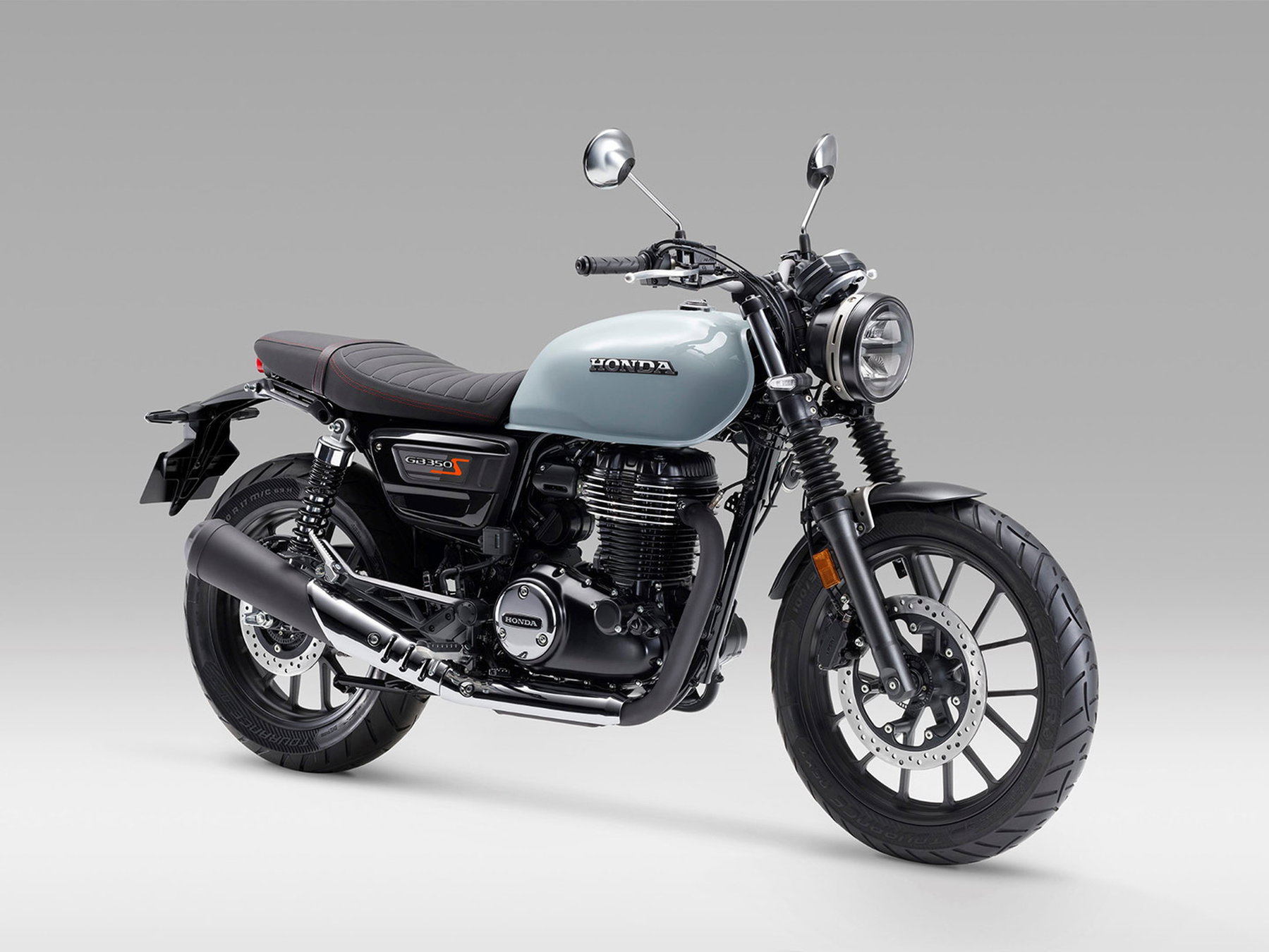
- New air- and oil-cooled single with 501 cc, 28 hp (20.6 kW) and 43.3 Nm (31.9 lb-ft)
- Three equipment variants, production in India, prices not yet announced
- The GB 500 trademark has been registered in the USA and the EU since November 2024
Large air-cooled singles were long regarded as a dying breed. Stricter emissions rules and the switch to liquid cooling almost made the category disappear. In India, a gap has been left since Royal Enfield ended production of its 500 engine in 2020, and nobody has filled it so far. That is precisely where the new Honda CB 500 comes in, presented by the manufacturer in India on 24 July 2026. Officially it is a model purely for the Indian market. Several indications suggest, however, that it will not stay that way.
What is inside the new 501 cc single of the Honda CB 500?
The engine is a new development with 501 cc of displacement, air and oil cooling and a single cylinder. It produces 28 hp (20.6 kW) and delivers 43.3 Nm (31.9 lb-ft) of peak torque.
Output is therefore modest for half a litre of displacement. What matters is the tuning: Honda has set the engine up for strong pull in the lower and middle rev range rather than for peak figures. Torque is considerably closer to what much larger twins deliver. The Royal Enfield Interceptor 650 makes 48 hp (35 kW) and 52.3 Nm (38.6 lb-ft) from 648 cc and two cylinders. The gap in torque is thus surprisingly small.
Power runs through a five-speed gearbox and an anti-hopping clutch, known in technical jargon as a slipper clutch. It prevents the rear wheel from chattering under hard downshifts. There is also a switchable traction control system that Honda calls Honda Selectable Torque Control (HSTC). According to reports from India, it is the largest air-cooled single Honda offers in that market.
How does the engine differ from the familiar 471 cc twin?
The new single has nothing in common with Honda’s widely used 500 twin. That parallel twin is liquid-cooled, measures 471 cc and produces around 47 hp (34.5 kW) at 8,500 rpm.
The familiar parallel twin powers the CB500 Hornet, the NX500, the CL500 and the CMX 500 Rebel, among others. It revs more freely and is more powerful, but it sits awkwardly with a classic concept visually, because the radiator and hoses spoil the look. The new single with its visible cooling fins delivers exactly the opposite: less on paper, but an appearance that suits the retro idea. Anyone interested in the CB 500 name should therefore look closely at which engine is meant.
Chassis, brakes and equipment at a glance
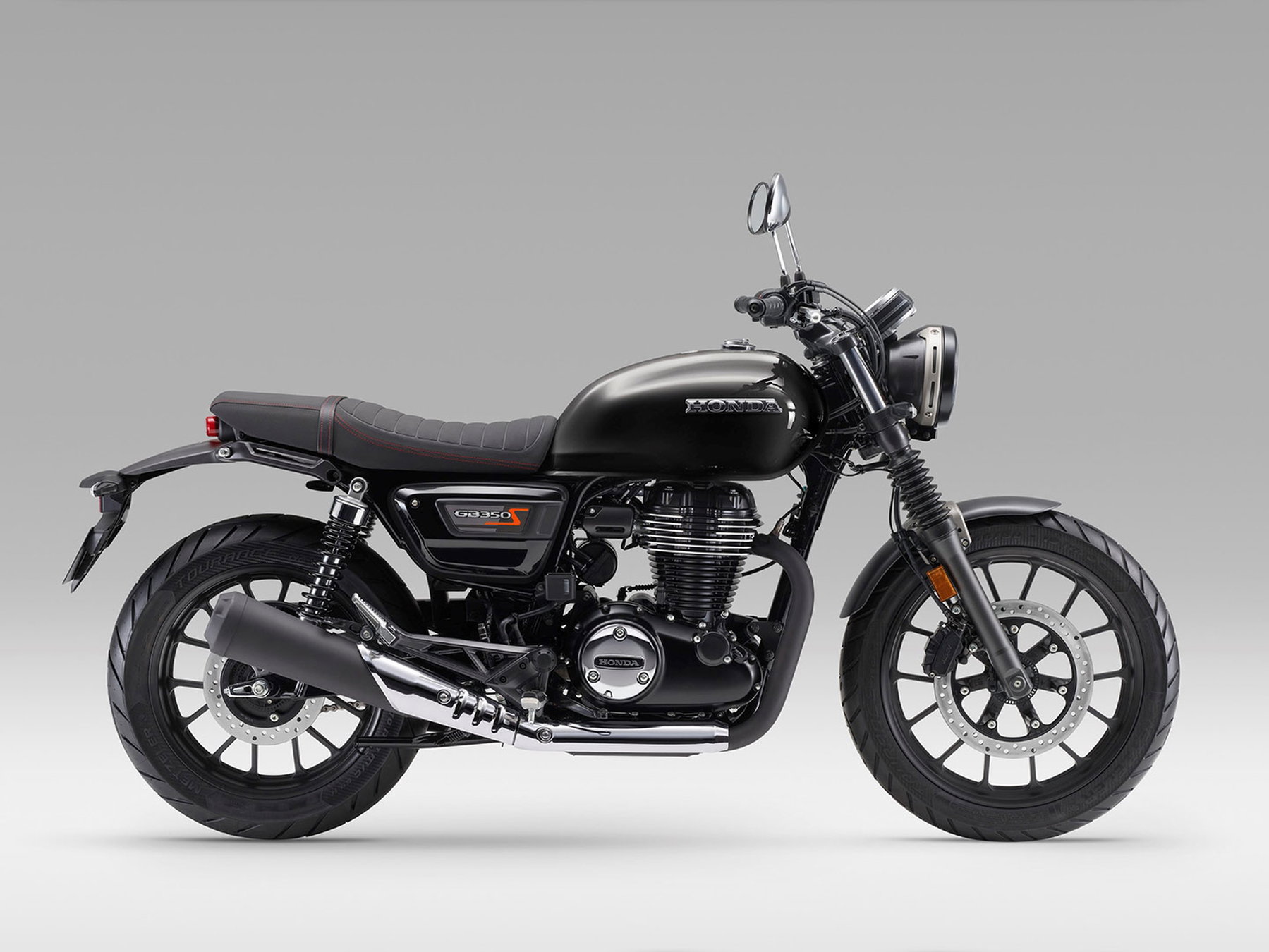
The chassis is deliberately simple. A tubular steel frame carries a telescopic fork with gaiters at the front, while two shock absorbers with reservoirs work at the rear. A 19-inch wheel runs at the front and a 17-inch wheel at the rear, shod with Maxxis tyres in 100/90-19 and 150/70-17.
Braking is handled by one disc per wheel, complemented by dual-channel ABS. Honda has not yet given a weight figure. The smaller GB 350 S weighs 178 kg (392 lbs) with a full tank, and the 500 should not exceed the 200 kg (441 lbs) mark.
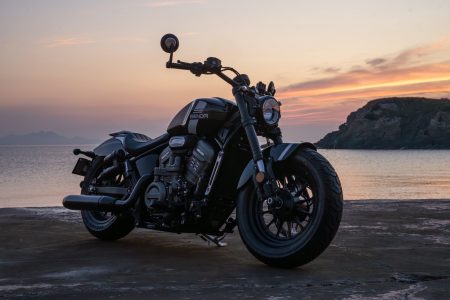
Visually the CB 500 clearly follows the CB 350, but looks a size larger. That includes a teardrop tank, wide handlebars with chrome mirrors, a ribbed seat and a chrome exhaust. Lighting is entirely LED, while the round headlight stays true to the classic template. A single round instrument serves as the display, combining analogue and digital elements and connecting to a smartphone via Honda RoadSync. Alongside the premiere, Honda has refreshed the CB 350 range in India with darker colours and new graphics, but left it technically unchanged.
Which variants of the Honda CB 500 are there?
Honda is planning three versions in India. The base model rolls on cast aluminium wheels, above it sits a variant with tubeless cross-spoke wheels, and the top model combines those wheels with multi-colour paint schemes and additional graphics.
The display remains the same across all three versions. Honda has not announced prices so far, and the market launch in India is still expected this year. There the CB 500 will compete against the Royal Enfield Interceptor 650 and the BSA Gold Star 650. Because it is built in the country itself, Honda has room to manoeuvre on price.
Why could the model be called GB 500 S in Europe?
Because Honda has already had the GB 500 name officially protected, and the GB label has long stood for the retro range in Europe. A registration was filed on 12 November 2024 with the US patent office USPTO, two days later with the European trademark office EUIPO, and also in New Zealand.
The background is simple: the CB 350 built in India is called the GB 350 S in Europe. If the 500 followed the same pattern, GB 500 or GB 500 S would be the obvious designation. It would also serve a practical purpose, because it would clearly set the model apart from the existing 500s with twin-cylinder engines. Honda in the UK said on request that it was not commenting at present on possible additions to the European model range.
What the GB 350 S reveals about the starting position
The GB 350 S has been available in Europe since 2025 and shows that there is a market for simple retro singles. In Germany it recorded 573 new registrations in the first half of 2026, placing it 28th.
That is notable, because its air-cooled 348 cc single with 21 hp (15.5 kW) and 29 Nm (21.4 lb-ft) is underpowered even for the A2 class. That was also the most common criticism: on country roads and motorways it lacks reserves. The new 501 adds around half as much torque again and thus targets exactly that weak point. The GB 350 S currently costs 4,709 euros (around 5,370 US dollars).
When could the Honda GB 500 S come to Europe?
An early realistic date would be 2027. None of this is confirmed, and Honda is keeping quiet about future models.
The sequence is easy to estimate: first production starts in India, then sales begin there. After that, a European premiere at EICMA in Milan would be the usual next step, with deliveries to dealers to follow. On price the model should sit above the GB 350 S, so above 5,000 euros (around 5,700 US dollars). It is also conceivable that the 500 will replace the 350 in Europe as the A2 offering. That would make the machine one of the few new large-capacity singles in the 2027 model year.
The GB 500 name has history
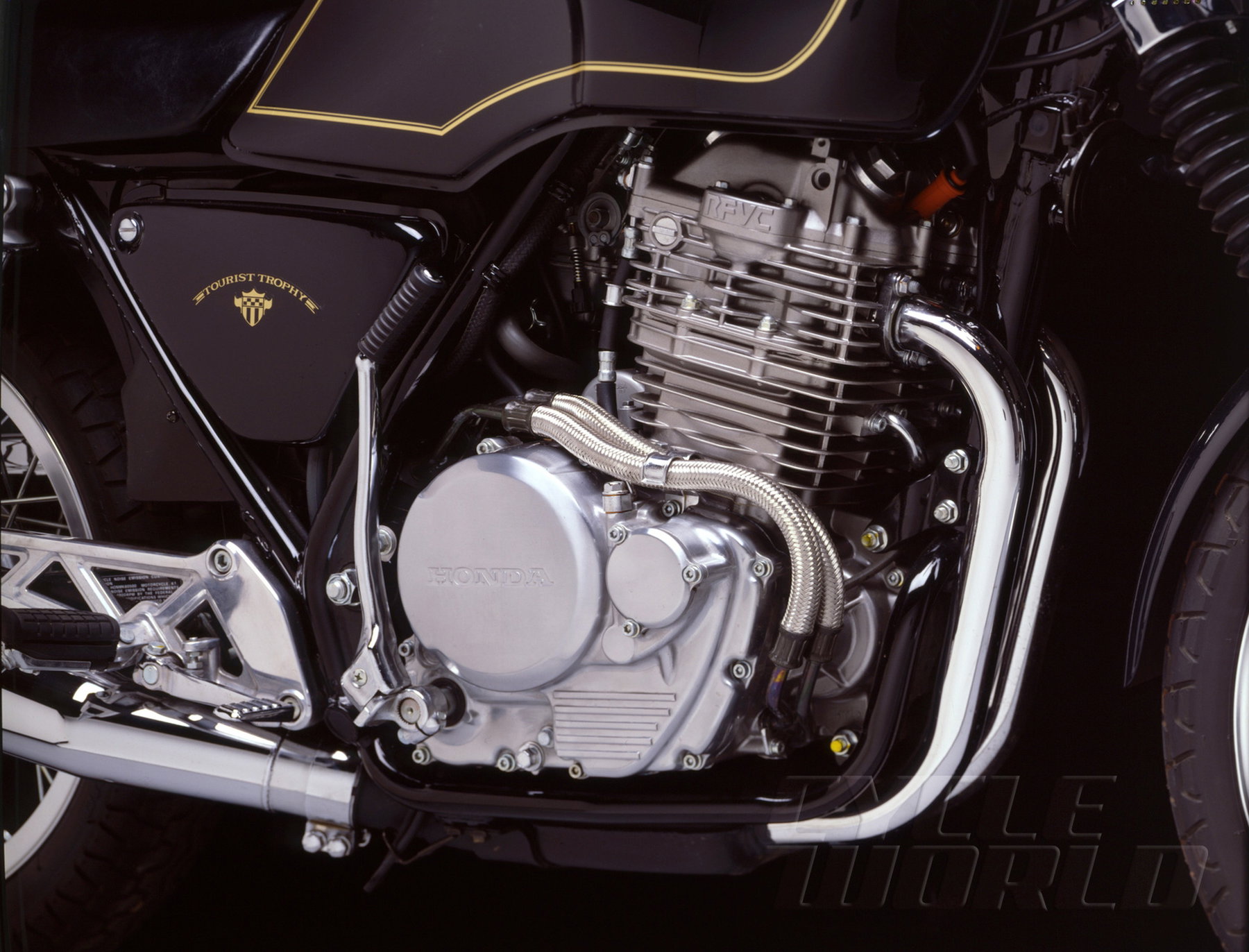
Honda has used the designation once before. From 1985 there was a GB 500 in Japan, which was also sold in the USA in 1989 and 1990 and briefly came to Germany officially as the GB 500 Clubman.
Back then it was a factory café racer with an air-cooled four-valve single, kickstarter and 38 hp (28 kW). That model also had a tubular steel frame, a telescopic fork with gaiters and spoked wheels. What is interesting is the technical thread running to the current engine: the 348 cc single of the GB 350 S is extremely long-stroke with a 70 mm bore and 90.5 mm stroke. Widening the bore to 84 mm would produce exactly 501 cc on paper.
Frequently Asked Questions
-
How much power does the Honda CB 500 have?
The Honda CB 500 produces 28 hp (20.6 kW) from 501 cc. Peak torque is 43.3 Nm (31.9 lb-ft). That makes it perfectly suitable for the European A2 licence class.
-
Is the CB 500 engine the same as in the CB500 Hornet?
No. The CB 500 from India uses a newly developed air- and oil-cooled single, while the CB500 Hornet uses the liquid-cooled 471 cc parallel twin with around 47 hp (34.5 kW). The two models share nothing but the number in the name.
-
Will the Honda GB 500 S come to Germany?
That is not confirmed. Honda registered the GB 500 name as a trademark in the EU and the USA in November 2024, which makes a European launch likely. Sales would be expected from 2027 at the earliest.
-
What does the Honda CB 500 cost?
Honda has not yet announced prices for India or Europe. The smaller GB 350 S serves as a reference point at currently 4,709 euros (around 5,370 US dollars). A European 500 model should sit above that.
-
How heavy is the new Honda CB 500?
No official weight is available yet. The GB 350 S weighs 178 kg (392 lbs) with a full tank, and the 500 should stay below 200 kg (441 lbs). Exact figures will follow with the full technical specifications.
➜ More on this topic in our overview: New Motorcycles 2027: All Models, Releases and Highlights at a Glance.
➜ This article is part of our comprehensive overview: New Motorcycles 2026: All Models, Releases, and Highlights at a Glance. Find all key information on this topic in one place.