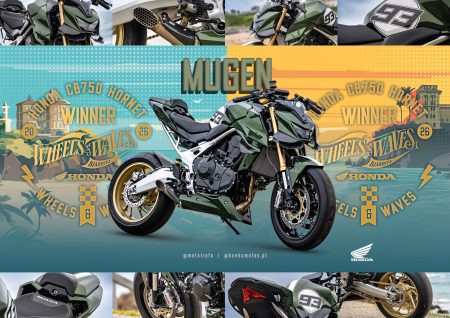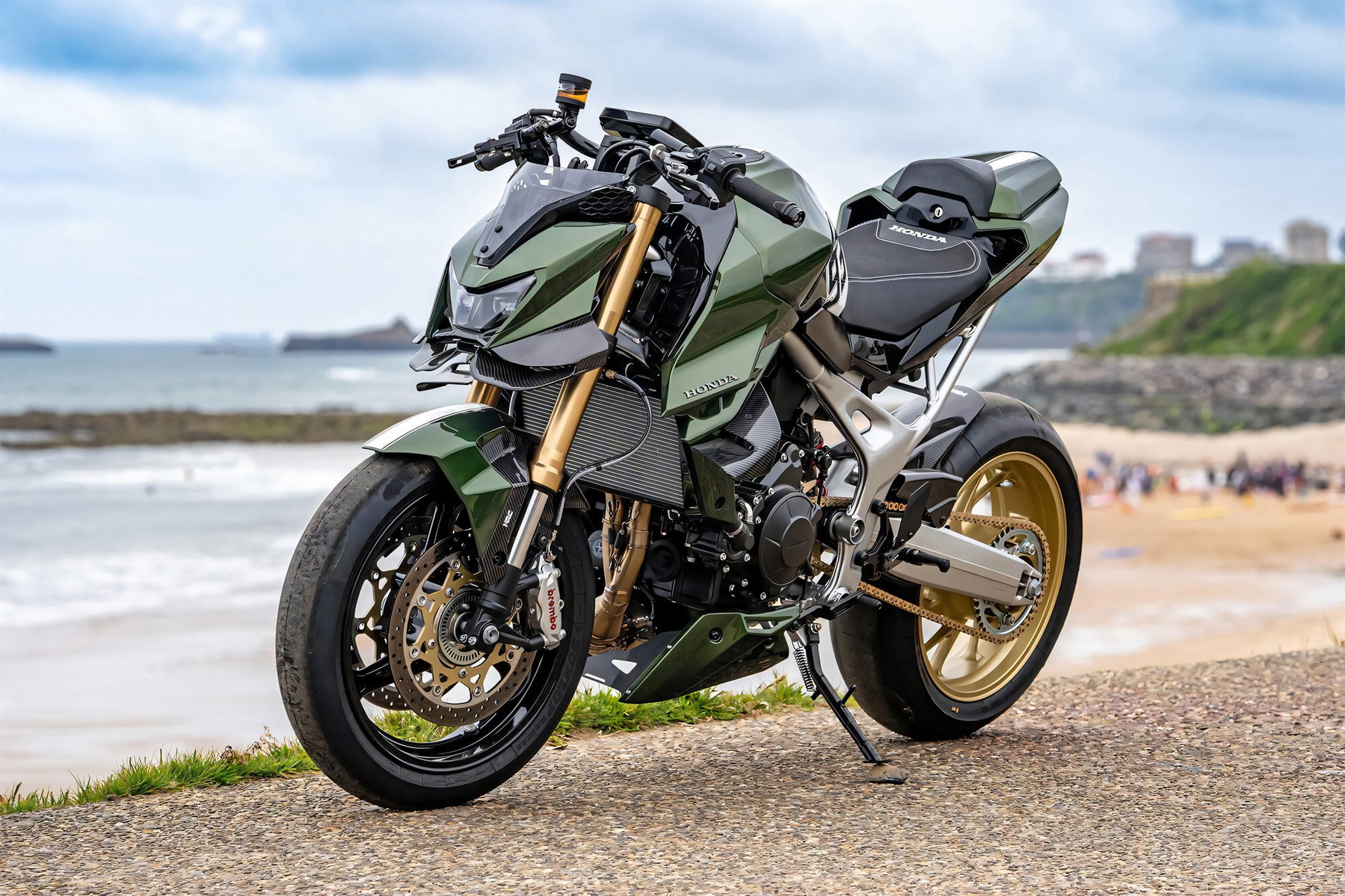
- Base: 2027 model year Honda CB750 Hornet with a 755 cc parallel twin
- Build: Brembo radial calipers, carbon aero package under the headlight, new tail section and banana swingarm
- Build time: six weeks from first sketch to finished motorcycle
Builds based on old motorcycles have shaped the custom scene for years. Café racers, scramblers and trackers made from old machines are still in demand. The Hornet Mugen takes a different path. Portugal’s Mototrofa deliberately chose a current production model and developed it further in a targeted way. With this build, the dealer won the European Honda Customs 2026 competition. The Mugen received 10,092 of a total of 42,119 votes, just under 24 percent. For Mototrofa, it is already the second win after the CB650R “Fénix” from 2021.
Which motorcycle is the Honda Hornet Mugen based on?
According to Honda, the Hornet Mugen is based on the 2027 model year CB750 Hornet. So underneath the build there is no old donor bike, but a current production model.
Today’s CB750 Hornet came onto the market in 2023. It is powered by a 755 cc parallel twin with a 270-degree crank. The engine sits in a lightweight steel diamond frame. For the 2025 model year, the Hornet got a new face with twin projector headlights and revised suspension.
The model is popular with buyers. In 2025, Honda sold more than 10,000 Hornets in Europe, making it one of the best-selling naked bikes on the continent. So Mototrofa did not have to reinvent the Hornet. The team describes the production bike as a motorcycle with a strong personality of its own that still leaves plenty of room for its own ideas.
What does the name Mugen mean?
Mugen roughly translates from Japanese as “without limits” or “infinite”. At the same time, the name alludes to the Japanese tuning and motorsport company Mugen, which has been closely linked to Honda for decades.
According to Mototrofa, it was precisely this link to racing that served as the starting point. The motorcycle was meant to look like performance at first glance. However, the team did not want to build a simple race bike replica. Instead, it took elements such as the aggressive stance, the colours, the graphics and the sense of movement and adapted them to the Hornet.
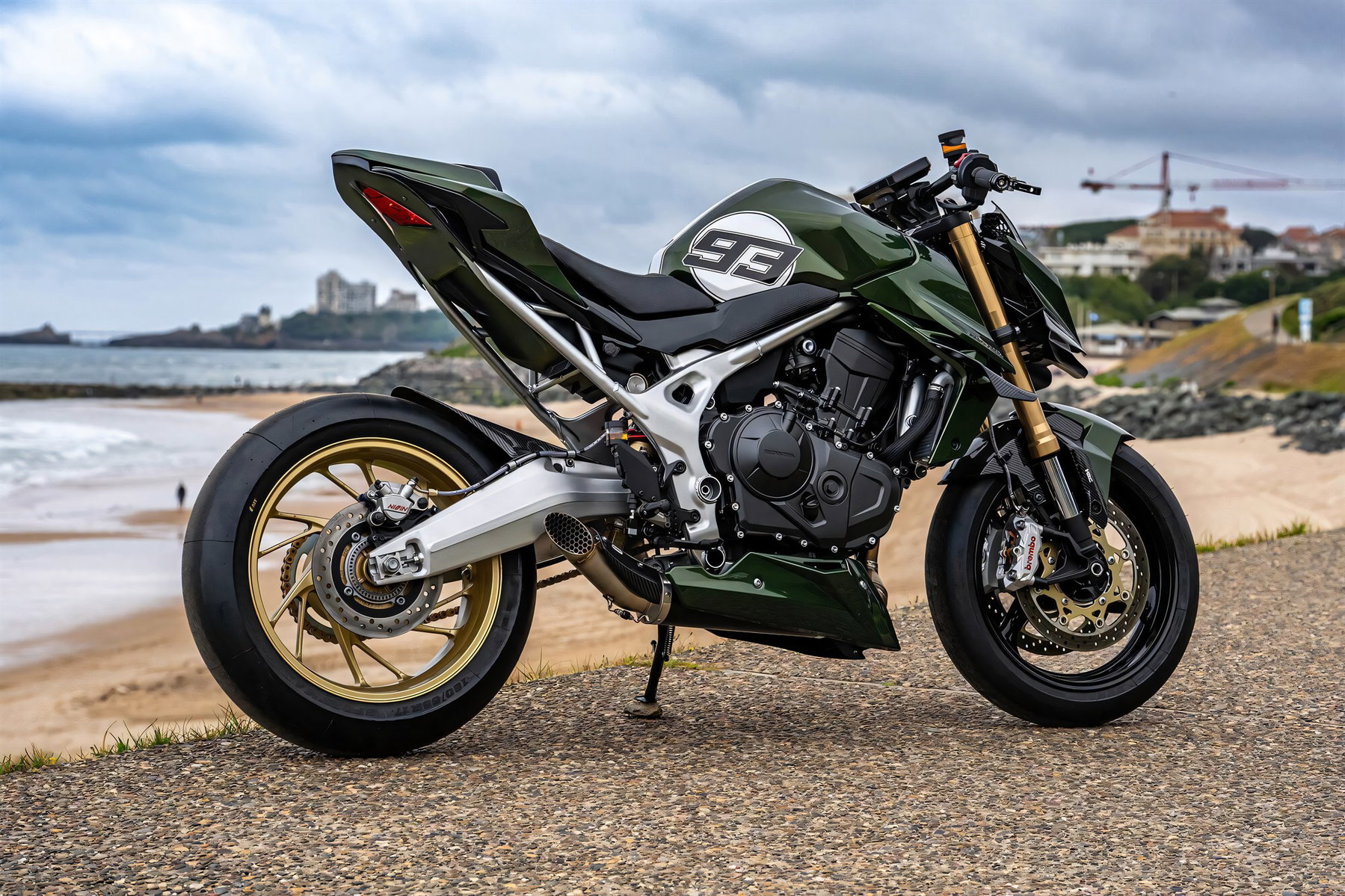
A striking feature is the large race number 93 on the green bodywork. It is seen as a nod to Marc Márquez and his years with Honda in MotoGP.
The guiding principle of the build was: “Form should follow function, not the other way round.” So every change needed a reason. Even so, the machine was meant to remain clearly recognisable as a Hornet. As the team puts it: “Despite all the modifications, you can still look at the motorcycle and immediately recognise it as a Honda CB750 Hornet.”
What was changed on the Hornet’s chassis and brakes?
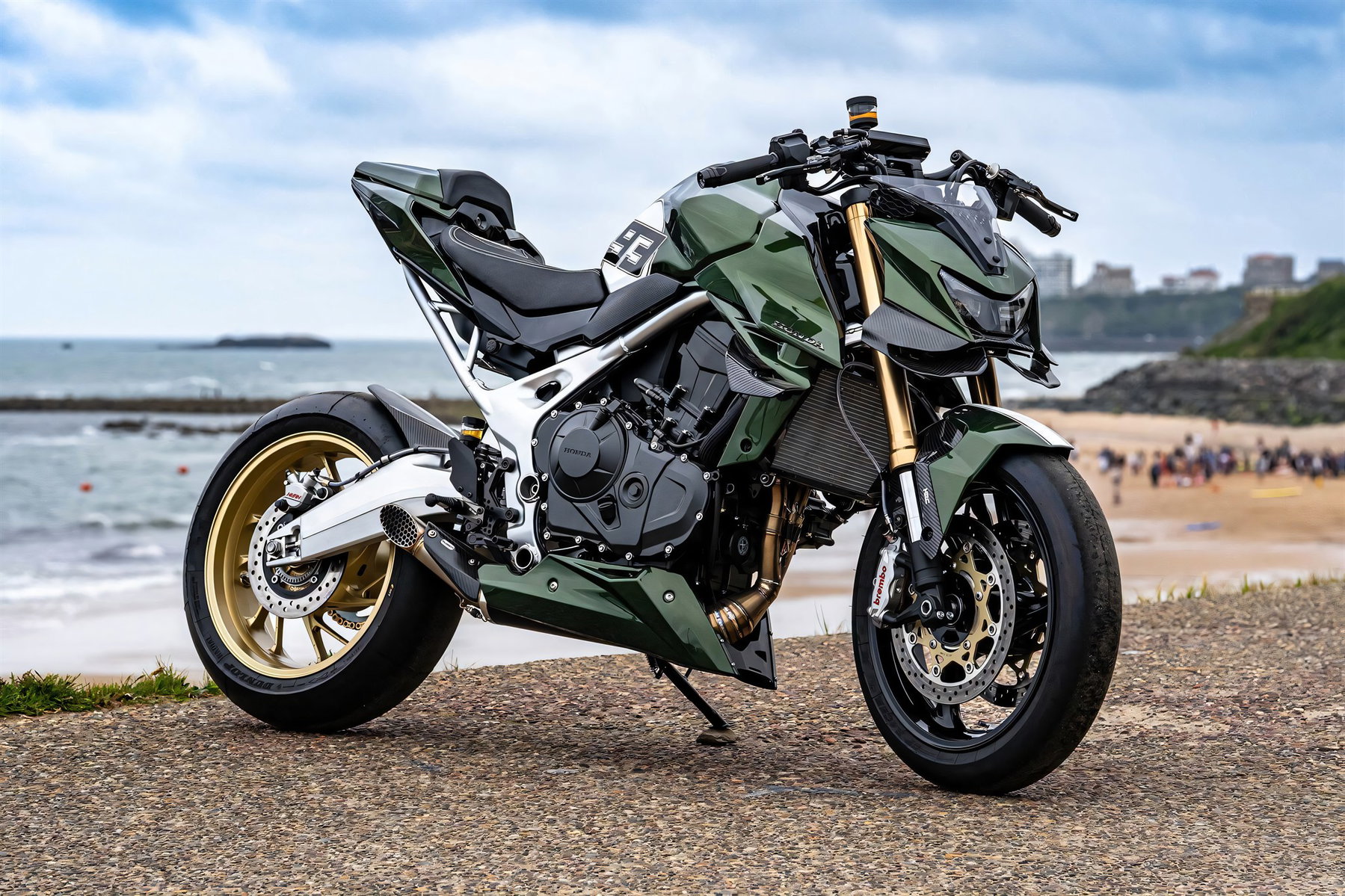
The Mugen’s front end has been lowered, and clip-on bars replace the standard handlebar. As a result, the bike sits with a distinctly forward-leaning stance, as is typical for a streetfighter.
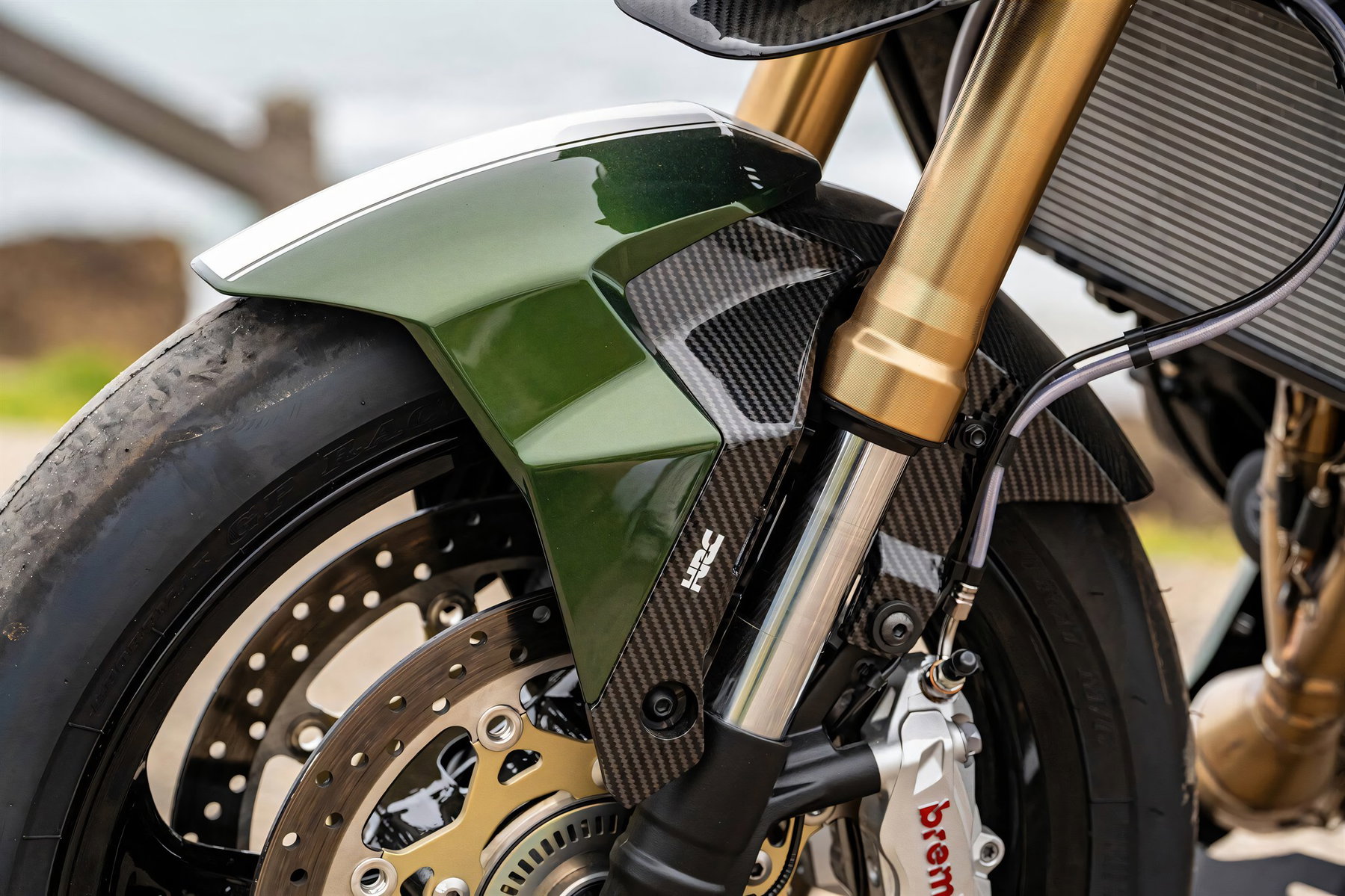
The team also adapted the chassis further. The standard Nissin brakes are gone. In their place are radially mounted Brembo four-piston calipers with braided steel lines. The gold Showa fork legs carry carbon fork protectors with the HRC logo.
At the rear, a shock with a piggyback reservoir, i.e. a separate oil reservoir, does the work. The tail section has been heavily reworked, and there is also a curved banana swingarm. The Mugen uses two colours for its wheels: black at the front, gold at the rear. The rear wheel wears Dunlop racing tyres and is driven by a gold chain. Machined footpegs from Gilles Tooling round off the build.
Which carbon parts does the Hornet Mugen have?
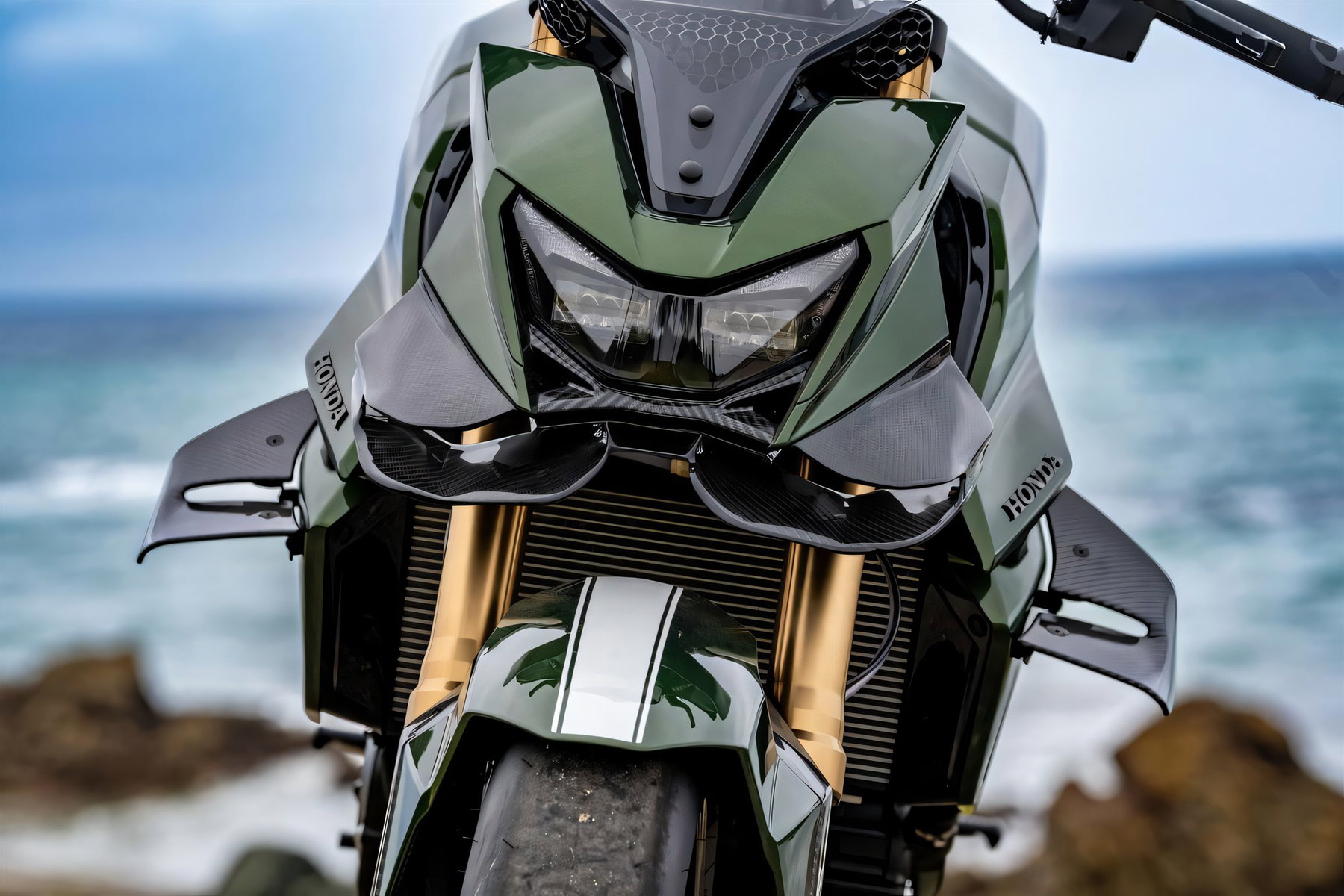
The most eye-catching carbon part is an aerodynamic unit under the headlight. Mototrofa designed it from scratch and made it from real carbon fibre.
Stacked winglets significantly change the front of the Hornet. These are small wings like those known from MotoGP. Even so, the bike’s origins remain recognisable. Further carbon parts can be found on the fork, the front mudguard, the radiator, the rear hugger and the chain guard.
The short, upswept exhaust carries its own carbon heat shield with Mugen lettering and an end cap with a honeycomb structure. Under the engine sits a large, shaped belly pan. The TFT display has moved up above the headlight. This tidies up the cockpit and makes the front look more compact.
Tail and paintwork: Less graphics than originally planned
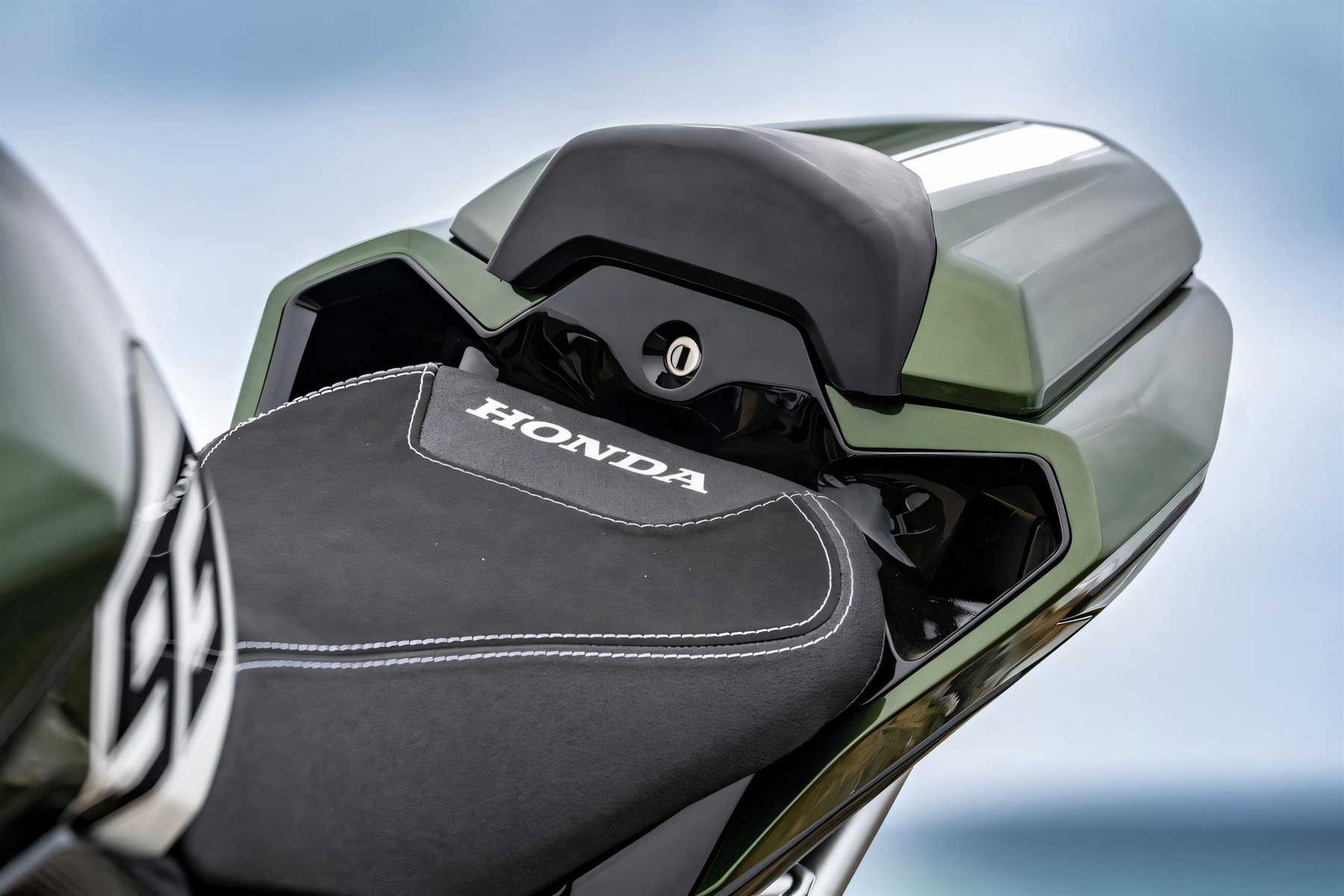
Mototrofa also changed a lot at the rear. The Hornet’s original tail section has practically disappeared. In its place is a very short, upswept tail with visible structure, a custom-upholstered seat and a triangular LED tail light integrated underneath.
According to the team, the biggest hurdle was not the engineering, but the paint and graphics. The result is a deep forest green with a metallic pearl effect that shimmers gold in direct light. A white centre stripe and large number boards with the 93 provide the racing look. Gold can also be found on the fork, rear wheel and chain, plus the heat-tinted exhaust.
Mototrofa tried out many graphic variants. In the end, a restrained solution won out. The team was aware that a wilder paint job might have attracted more attention at first glance. It still opted for fewer graphics, because that was precisely how the Mugen was meant to stand out in a different way.
How long did the Hornet Mugen build take?
Only six weeks passed from the first concept to the finished motorcycle. The experience gained from the first winning project, the Fénix, helped.
Thanks to this, the team knew better what difficulties lay ahead and could make decisions faster. Even so, time was the biggest opponent. Several individual parts first had to be designed, manufactured and delivered. Other parts were adapted and tested during the build, and some ideas were completely rethought along the way.
A small team is behind the Mugen. As with the Fénix, Paulo Ferreira took on creative direction. Guilherme Silva handled communication and accompanied the creative process from start to finish. In the workshop, Ivaldo Lima and Flávio Ferreira carried out the build.
Why does Mototrofa rely on a current Hornet instead of a classic?
For Mototrofa, the Hornet was interesting precisely because of its own character. The team did not want to transform the machine completely, but rather explore how far the production version could be pushed.
The Portuguese therefore describe the Mugen as their very personal vision of what an ideal Hornet could look like. For them, a good base for a build is a motorcycle that inspires even before the first spanner is turned and still leaves room for a story of its own.
In the Honda Customs 2026 competition, five builds based on the CB750 Hornet competed against five based on the XL750 Transalp. The Mugen took 36 percent of all votes cast for the Hornet builds. As its preferred base for a possible next project, Mototrofa names the Honda CB1000F. With its presence and retro-inspired lines, it is said to offer the chance to build something completely different from the Mugen and the Fénix.
Frequently Asked Questions
-
What is the Honda Hornet Mugen?
The Honda Hornet Mugen is a streetfighter-style build based on the CB750 Hornet by Portuguese Honda dealer Mototrofa. It features a forest green paint job with gold details and many carbon parts. With it, Mototrofa won the Honda Customs 2026 competition.
-
Why does the Hornet Mugen wear the race number 93?
The 93 is seen as a nod to Marc Márquez and his time with Honda in MotoGP. It fits the concept of the build, which draws on Honda’s racing history.
-
What brakes does the Hornet Mugen have?
The Hornet Mugen stops with radially mounted Brembo four-piston calipers. They replace the standard Nissin brakes and are paired with braided steel lines.
-
How long did it take to build the Hornet Mugen?
The build took six weeks from concept to finished motorcycle. According to the team, experience from the earlier winning project Fénix, based on the CB650R, helped.