- On sale from 12 August 2026, priced from 699 euros (669.99 US dollars) for the standard bundle
- Two square 1/1.1-inch Sony sensors, 8K 360° video at up to 50 frames per second
- Motorcycle set with a concealed engine microphone, holographic speed display and automatic number plate blurring
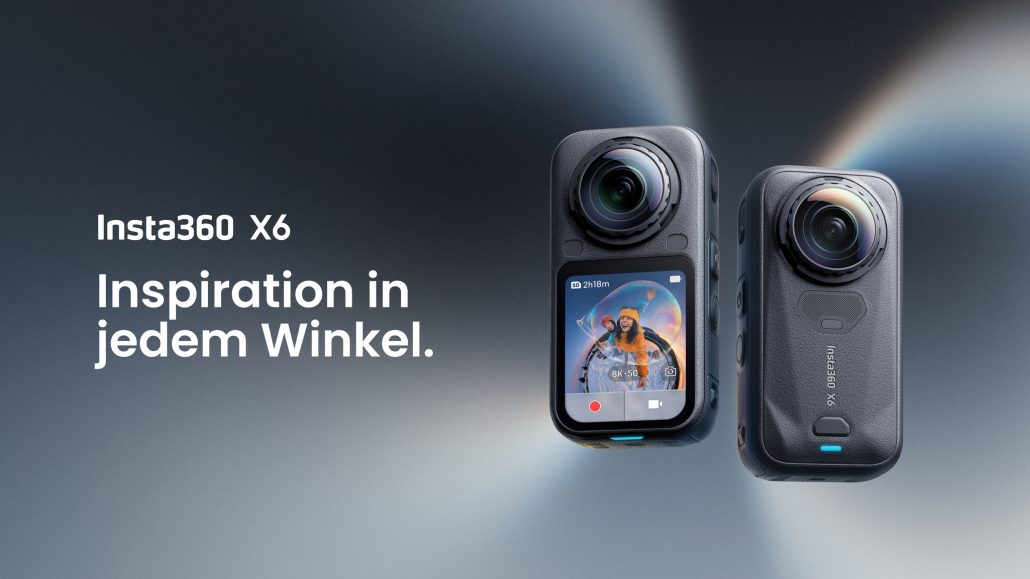
Around 16 months after the X5, Insta360 is following up with the X6, the next generation of its 360-degree camera. The company is celebrating ten years in the 360-degree camera business this year and describes the X6 as the flagship of an entire decade. According to its own figures, Insta360 currently holds a 71 percent share of the global 360-degree camera market by value, based on the Worldwide Quarterly Handheld Smart Camera Tracker Report published by market research firm IDC for the first quarter of 2026. Company founder JK Liu describes the X6 as the camera the company always wanted to build, emphasising that it captures the surroundings in any light and delivers a finished video before anyone even reaches for a smartphone.
What does the Insta360 X6 offer specifically for motorcyclists?
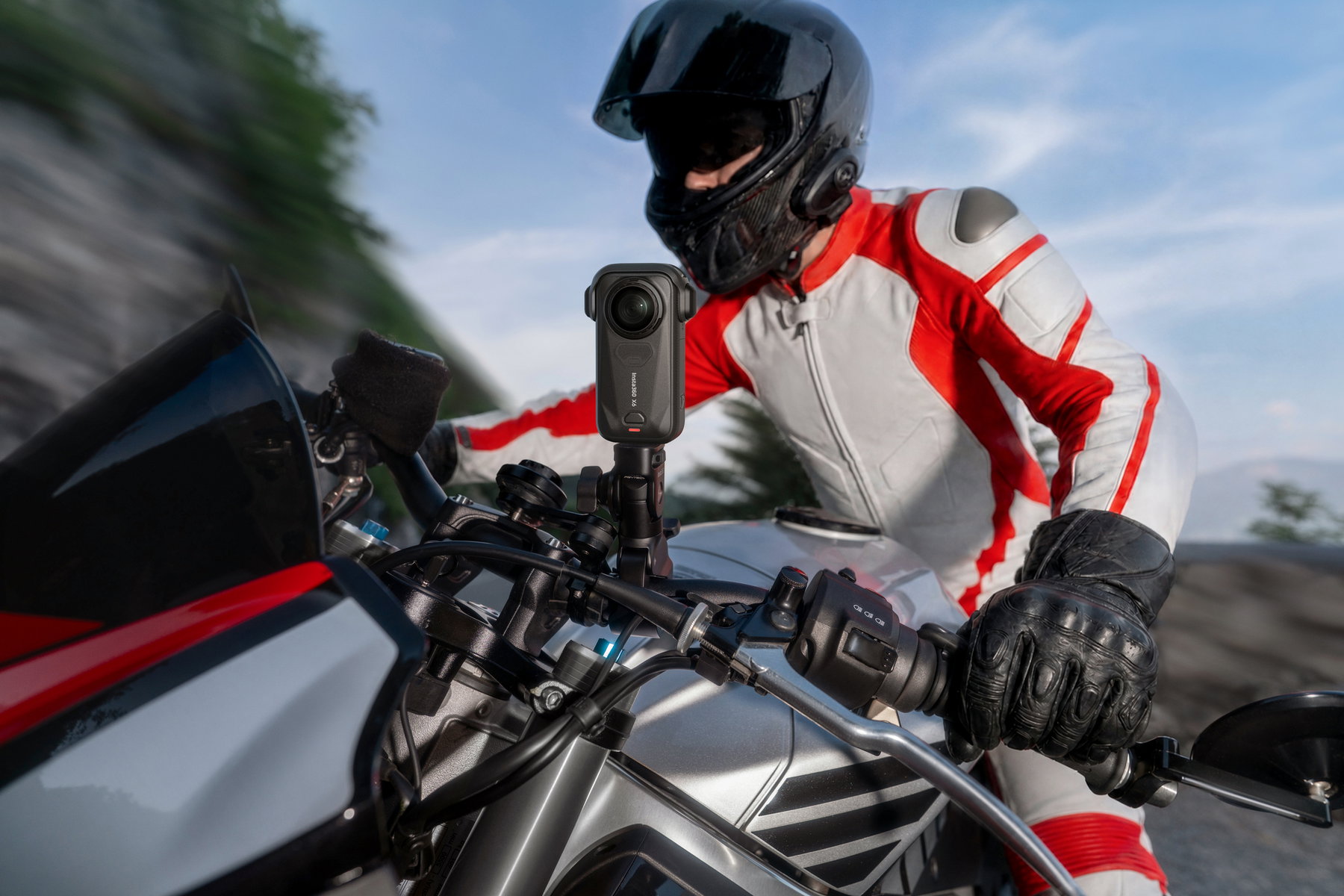
The X6 comes with its own motorcycle set featuring a holographic speed display, a dashcam mode with automatic loop recording and automatic blurring for number plates. On top of that there is a separate, concealed engine microphone which, according to the manufacturer, filters out wind noise and deliberately brings out the engine sound.
The speed display is worth a closer look, because the wording can be misleading. The international announcement refers to a holographic speed overlay, in other words an insert that is laid over the video image.
It remains unclear where the speed data comes from. The X6 data sheet does not list a GPS module. For cyclists, Insta360 explicitly mentions data overlays from Garmin devices, the Apple Watch and other sources. On the X5, according to the manufacturer, such overlays work by taking the data from a paired Garmin device or an Apple Watch, with the overlay only added during editing, including GPS position, altitude and speed. Whether the X6 determines speed itself or likewise needs a paired device is not apparent from the information available so far.
The engine microphone remains similarly unclear for now. The camera has a wind-protected 360-degree microphone system made up of four microphones. In addition, Insta360 describes a separate, concealed engine microphone said to be tuned specifically for motorcycling. What exactly is meant by this remains unclear. It could be a fifth microphone built into the housing and shielded against airflow. It is equally conceivable that it is a separately mountable microphone hidden near the engine on the vehicle.
There is some evidence for the first option. The data sheet lists engine sound amplification as an audio mode of the camera itself, alongside intelligent wind noise reduction, voice enhancement, stereo and Dolby Atmos. The accessory price list also does not include a standalone engine microphone; all that is listed there is a wind shield for the microphones. For external audio recording, Insta360 points to the Mic Air and Mic Pro wireless microphones, two transmitters of which can be paired simultaneously via direct connection. The manufacturer has not yet provided a clear technical description of the engine microphone. It probably refers to revised filtering for the internal microphones that are fitted anyway, though that is not certain.
A dedicated road mode for 360-degree recordings is also on board. It is not new, however, since the X5 already listed this mode on its data sheet. What is new is the combination of number plate blurring, speed overlay and loop recording in one coordinated package.
Also practical for everyday riding is the list of supported helmet headsets. According to the data sheet, the X6 works with the SENA models C30, ST1, 60S, 50S and 10S as well as Cardo Spirit, NEO, 2X and 4X. The list is rounded out by the Airide G7+, ASMAX F1, Lexin Moto G4 and the Vimoto models V9X and V9S. Compared with the X5, the SENA 60S has been added, among others.
How much better is the image quality compared with the X5?
The X6 uses two specially developed, square Sony sensors in a 1/1.1-inch format. Insta360 states that the sensor area is 33 percent larger than on the X5 and that around four times more light is captured per frame.
For context: the X5 works with 1/1.28-inch sensors. For the X6, the manufacturer speaks of 360-degree imaging at 1-inch level, which refers to the combined area of both sensors and not to a single sensor of that size.
Behind the sensors sits a triple AI chip. It consists of a 4-nanometer processor with eight cores and 3.3 gigahertz plus two dedicated imaging chips, in other words specialist chips used exclusively for image processing. According to Insta360, this provides 500 percent more computing power and a 106 percent higher clock frequency while consuming 35 percent less energy. For comparison, the X5 used a 5-nanometer chip with two Pro imaging chips.
For dark scenes there is a low-light mode with two additional ambient light sensors, intended to reduce flicker. AdaptiveTone 2.0 measures each lens separately and records two exposures per frame, which extends the dynamic range. According to the manufacturer, the X6 is also the first 360-degree camera with native Dolby Vision directly in the camera. Together with 10-bit colour depth and more than 1.07 billion recordable colours, the source material alone is said to come with a professional colour profile.
Three camera types in one body
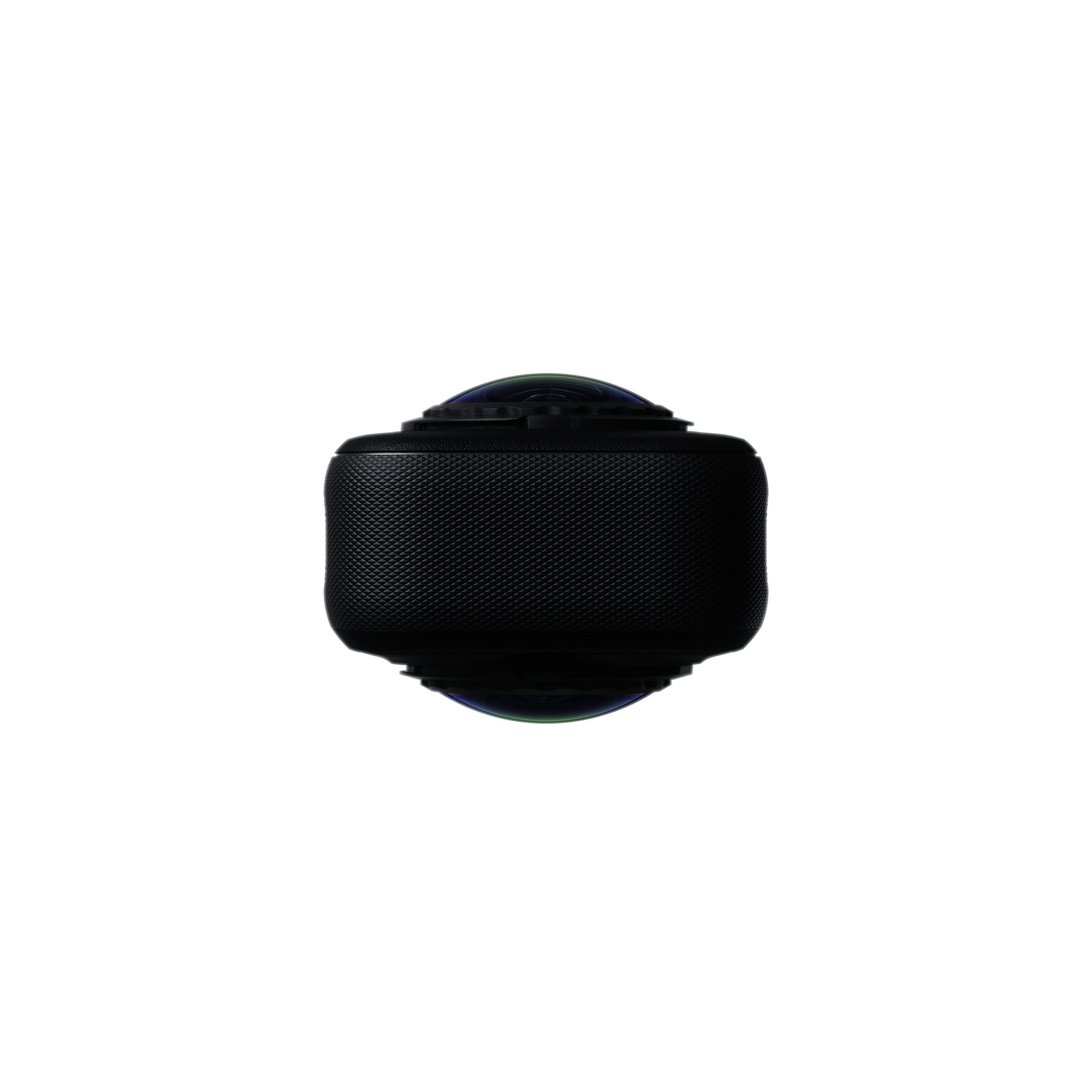
Insta360 markets the X6 as a 3-in-1 solution. It works as a 360-degree camera, as a gimbal camera with subject tracking and as a classic action camera with a single lens, switched with a tap of a finger.
In 360-degree mode the camera records the entire surroundings in native 8K at 50 frames per second. The image section is only defined afterwards, a process known as reframing. The complete scene is retained and can be realigned as often as desired.
InstaFrame 2.0 simultaneously delivers a normal 4K video in which the camera automatically tracks people, animals and objects. Combined with the new folding selfie stick and remote control kit, the tracking can be steered with a joystick, which does away with a separate gimbal. With the POV head tracker, the image section follows the direction of view instead.
In single-lens mode the X6 films like a conventional action camera at up to 5K and 60 frames per second, with a 170-degree wide angle at 5K and 30 frames per second, or at 4K and 120 frames per second for slow motion. The maximum bitrate is listed on the data sheet at 240 megabits per second, recorded in H.265. On the X5 it was 180 megabits per second. For stills, Insta360 quotes up to 120 megapixels in 360-degree mode and 42 megapixels in flat format, compared with around 72 megapixels on the X5.
How long does the Insta360 X6 battery last?
The new Xtreme battery with 2600 milliamp hours manages 140 minutes of recording in 8K at 30 frames per second according to the manufacturer. It charges from zero to 80 percent in 24 minutes, with a full charge quoted at 35 minutes, in each case with a 30-watt power supply and PPS fast charging.
Insta360 puts the increase over the X5 at 51 percent. The official X5 data sheet, however, lists 88 minutes for the same mode, which would work out to a considerably larger gap. When charging, the X5 is even slightly ahead at 80 percent in 20 minutes, which is hardly surprising given its smaller 2400 milliamp hour battery.
According to Insta360, the battery remains reliable down to minus 20 degrees Celsius, and the data sheet quotes an operating range of minus 20 to plus 40 degrees Celsius. For long recordings there is also the X6 battery selfie stick, which adds 180 minutes of runtime and appears in the price list at 78.99 euros (79.99 US dollars).
Hardware, body and accessories
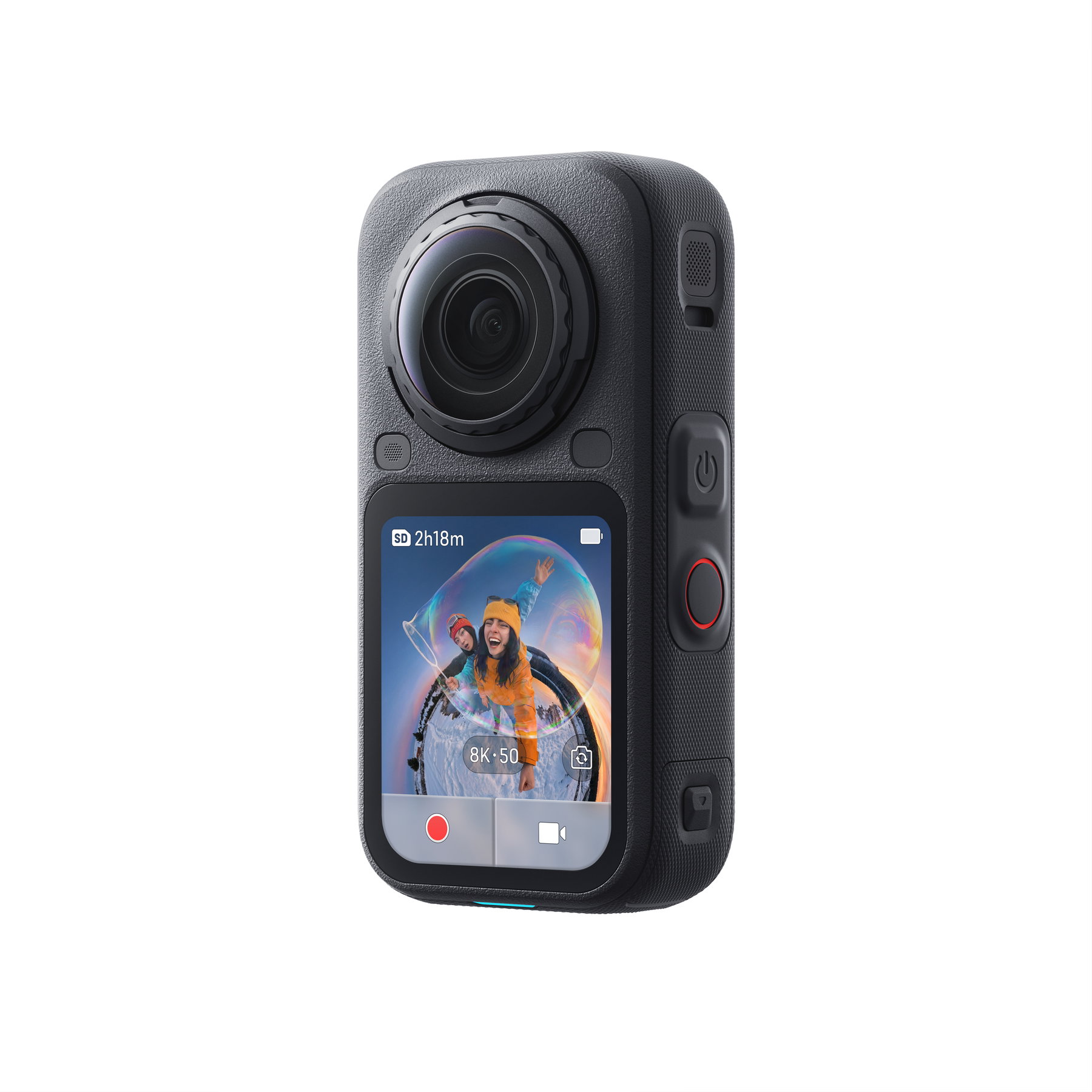
The OLED display measures 2.32 inches, reaches a peak brightness of 1200 nits and stays permanently active. The entire screen surface responds to pressure, which is intended to make operation with gloves easier.
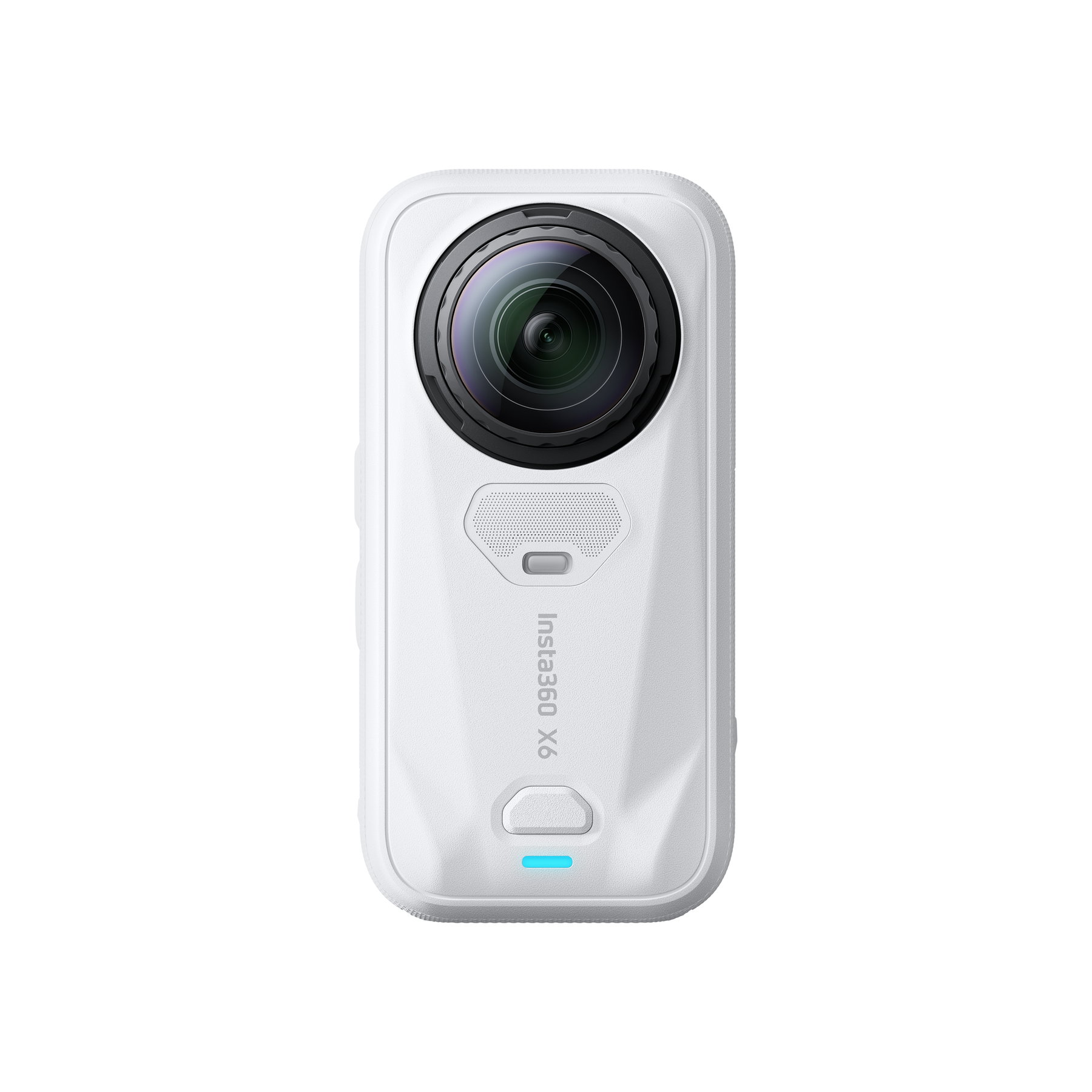
The camera weighs 196 grams (6.9 ounces) and measures 50 by 100 by 40 millimetres including the lens. Without the lens the depth is 26.4 millimetres. That makes the X6 shorter and slightly wider than the X5, which is quoted at 200 grams and 46 by 124.5 by 38.2 millimetres. The X6 is offered in Midnight Black and Arctic White; the X5 was only available in black at launch.
Insta360’s patented Star Ridge cooling system is said to work 10 percent more efficiently than on competing 360-degree cameras and is complemented by an insulated grip so that longer 8K recordings remain thermally stable. The Replaceable Lenses 2.0 are, according to the manufacturer, five times more scratch-resistant and 60 percent cheaper to replace than on the previous generation. A single replacement lens kit costs 23.99 euros (26.99 US dollars).
Without an additional housing the X6 is waterproof to IP68 down to 20 metres; the X5 managed 15 metres. With the Invisible Dive Case Pro for 184.99 euros (179.99 US dollars), 60 metres are possible. The case stays outside the stitching line, meaning the seam where the images from both lenses are combined, and is therefore not visible in the finished video.
Internally there are 64 gigabytes of storage, 47 gigabytes of which are usable, so recording is possible even without a microSD card. In total, Insta360 quotes more than 100 compatible accessories. The magnetic mounting system remains compatible with mounts from the X5, X4 Air and the Ace series, so existing accessories can continue to be used. For data transfer the X6 relies on Wi-Fi 6.0 at up to 100 megabytes per second and USB 3.0 at up to 450 megabytes per second, while Bluetooth works to BLE 5.3.
What can the AI editing on the X6 do?
The X6 creates finished videos without manual editing. This is made possible by PanoMind, an AI model that Insta360 says it trained with more than 10,000 hours of video material from over 30 scenarios, including motorcycling, diving, winter sports and cycling.
When the camera is plugged in to charge, the so-called AI director automatically creates a highlight video from the stored material and transfers the finished clips to the Insta360 app. According to the manufacturer, the analysis runs directly on the camera and not in the cloud, and the function can be switched off at any time. Anyone wanting more influence uses Automatic Editing 2.0, which turns one or more clips into a complete video with cuts, music and transitions at the tap of a finger.
For manual post-production the X6 offers the I-Log colour profile, which retains the full dynamic range and leaves the most room for colour grading. Insta360 Studio remains free for Mac and Windows. In addition there is the Insta360+ cloud service with up to 2 terabytes of storage, whose backup likewise runs during charging and is expressly optional. Moments Pro builds on this, a cloud-based editing tool based on Google Gemini in which subject, mood, style and time period are specified.
What does the Insta360 X6 cost and when is it available?
The X6 is available from 12 August 2026 in the official Insta360 Store, on Amazon and from authorised dealers. The standard bundle costs 699 euros (669.99 US dollars), the Essentials bundle 799 euros (799.99 US dollars).
For context: the X5 launched on 22 April 2025 at 589.99 euros. The series entry price therefore rises by a good 109 euros.
Anyone who buys and activates the X6 before 30 September 2026 receives one year of Insta360+ Premium with 500 gigabytes of cloud storage at no extra charge, plus three months of Moments Pro with two clips per month. Buyers of an X5 or X4 Air in the same period get one year of Insta360+ Premium with 200 gigabytes. The full conditions are set out in the Insta360 app.
Insta360 FlexiCare remains available as an option, covering accidental damage with up to four replacement devices in two years. Early buyers additionally get a free replacement guarantee within the first 90 days. The revised trade-in programme allows old cameras or other equipment to be exchanged for credit.
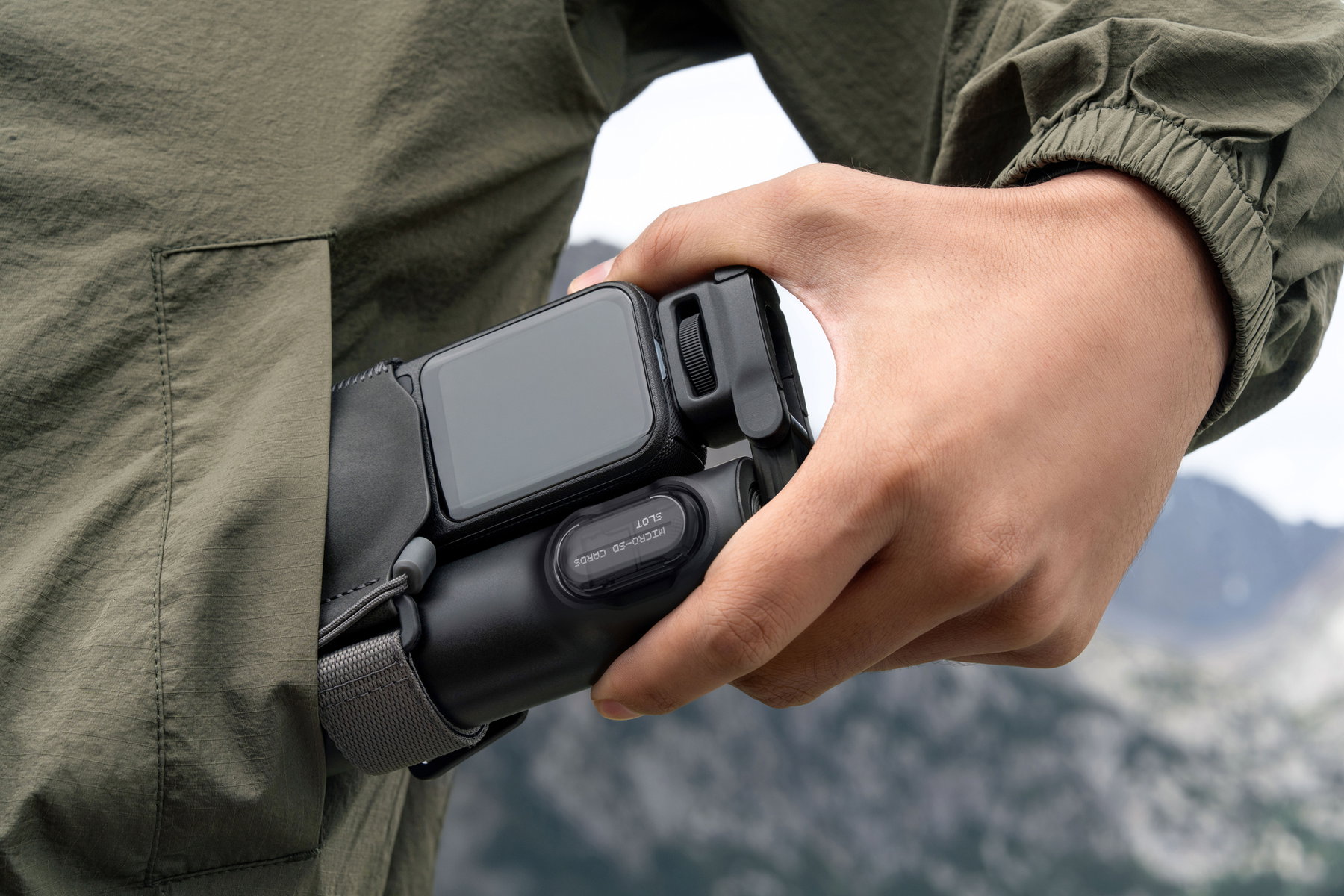
From the motorcycle accessories, the price list includes the folding selfie stick with remote control kit for 74.99 euros (76.99 US dollars), the fast-charging case with two battery and two SD card slots for 64.99 euros (59.99 US dollars) and an additional Xtreme battery for 50.99 euros (44.99 US dollars).
Frequently Asked Questions
-
What does the Insta360 X6 cost?
The Insta360 X6 costs 699 euros (669.99 US dollars) as a standard bundle. The Essentials bundle with an extra battery, a 114 centimetre invisible selfie stick, lens cap, fast-charging case and extended warranty comes to 799 euros (799.99 US dollars).
-
What features does the motorcycle set for the X6 offer?
The motorcycle set includes a holographic speed overlay laid over the video image, a dashcam mode with automatic loop recording and automatic number plate blurring. There is also a separate, concealed engine microphone that filters wind noise and brings out the engine sound. Insta360 has not yet explained in detail whether this microphone sits inside the camera or is mounted separately on the vehicle.
-
How long can the Insta360 X6 record in 8K in one go?
According to Insta360, the 2600 milliamp hour battery manages 140 minutes in 8K at 30 frames per second. It charges to 80 percent in 24 minutes and to 100 percent in 35 minutes.
-
Is the Insta360 X6 waterproof without a case?
Yes, the X6 is waterproof to IP68 down to 20 metres without an additional case. With the Invisible Dive Case Pro, up to 60 metres are possible.
-
Which helmet headsets work with the Insta360 X6?
According to the data sheet, the SENA models C30, ST1, 60S, 50S and 10S are supported, as well as Cardo Spirit, NEO, 2X and 4X. Also included are the Airide G7+, ASMAX F1, Lexin Moto G4 and the Vimoto V9X and V9S.