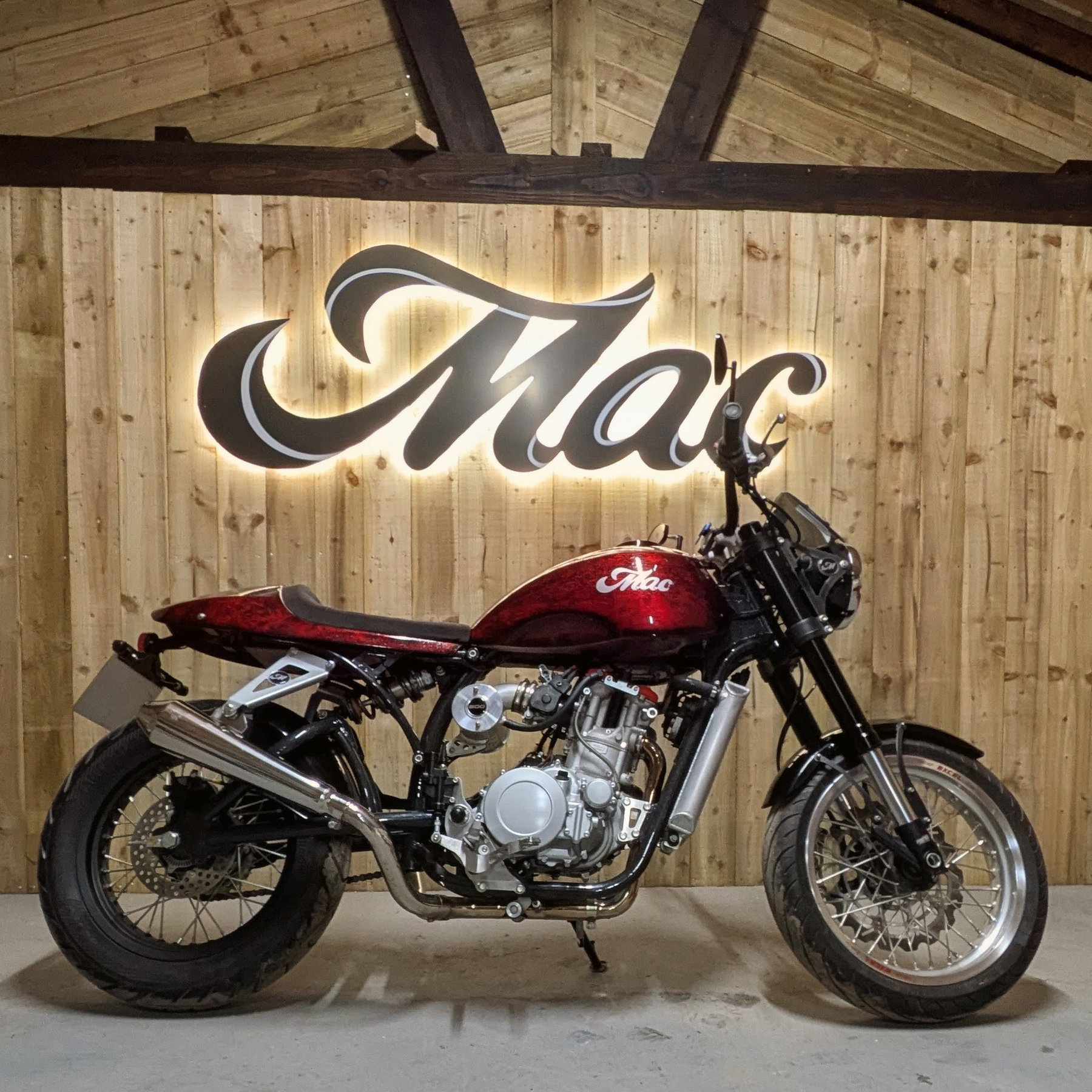
- Mac Motorcycles commenced operations on May 8, 2026, offering two models: the Rex and the Ruby
- Both motorcycles use a liquid-cooled 600cc single-cylinder engine from SWM producing 57 bhp and are hand-assembled in Yorkshire
- The starting price is 15,500 British pounds (approximately 17,900 euros / 20,770 US dollars) including VAT
It took more than a decade for an idea to become a production-ready motorcycle. Mac Motorcycles, a family-run company based near Barnsley in South Yorkshire, officially opened its doors on May 8, 2026. On offer are two retro-styled single-cylinder models: the Rex as an upright roadster and the Ruby as a sportier café racer. Initial customer test rides were already scheduled for late May.
How Did Mac Motorcycles Come About?
Mac Motorcycles started as a pure passion project. The original idea traces back to a collaboration between motorcycle design studio Xenophya Design and Ellis Pitt. At the time, initial concepts were developed based on the 492cc single-cylinder from the Buell Blast, housed in a simple tubular frame. Four models were planned, with names like Spud, Peashooter, Roarer, and Ruby, all conceived as lightweight, air-cooled singles.
Current managing director Ian Oliver joined the project in 2017. Oliver had previously spent a decade working as a powertrain engineer at Jaguar, bringing considerable engineering expertise. Under his leadership, the entire motorcycle was redeveloped from the ground up — the original Buell engine was replaced with the significantly more modern 600cc single-cylinder from SWM. According to Oliver, this meant that practically everything had to be redesigned from scratch: the frame, geometry, supply chain, and production processes.
“We’ve really had to engineer a bike from scratch and build a supply chain from scratch. We tried to keep some of the styling cues, such as the big backbone frame that you can still see on this bike, but we had to completely re-engineer the bike for the SWM engine.”
Oliver describes the motivation behind the project as an attempt to capture the feeling one had as a young person riding motorcycles: the smell, the sound, and the sensation of being outdoors. He himself has been riding since the age of five.
Where Are Mac Motorcycles Built?
Production takes place in a restored 19th-century stone building near the historic Wentworth Castle Estate, which is now managed by the National Trust. The site was essentially prepared by the Oliver family themselves, including insulation, electrics, and infrastructure. According to the British Motorcyclists Federation, Oliver’s wife spent weeks hand-pointing the stone wall in the main room alongside her own full-time job.
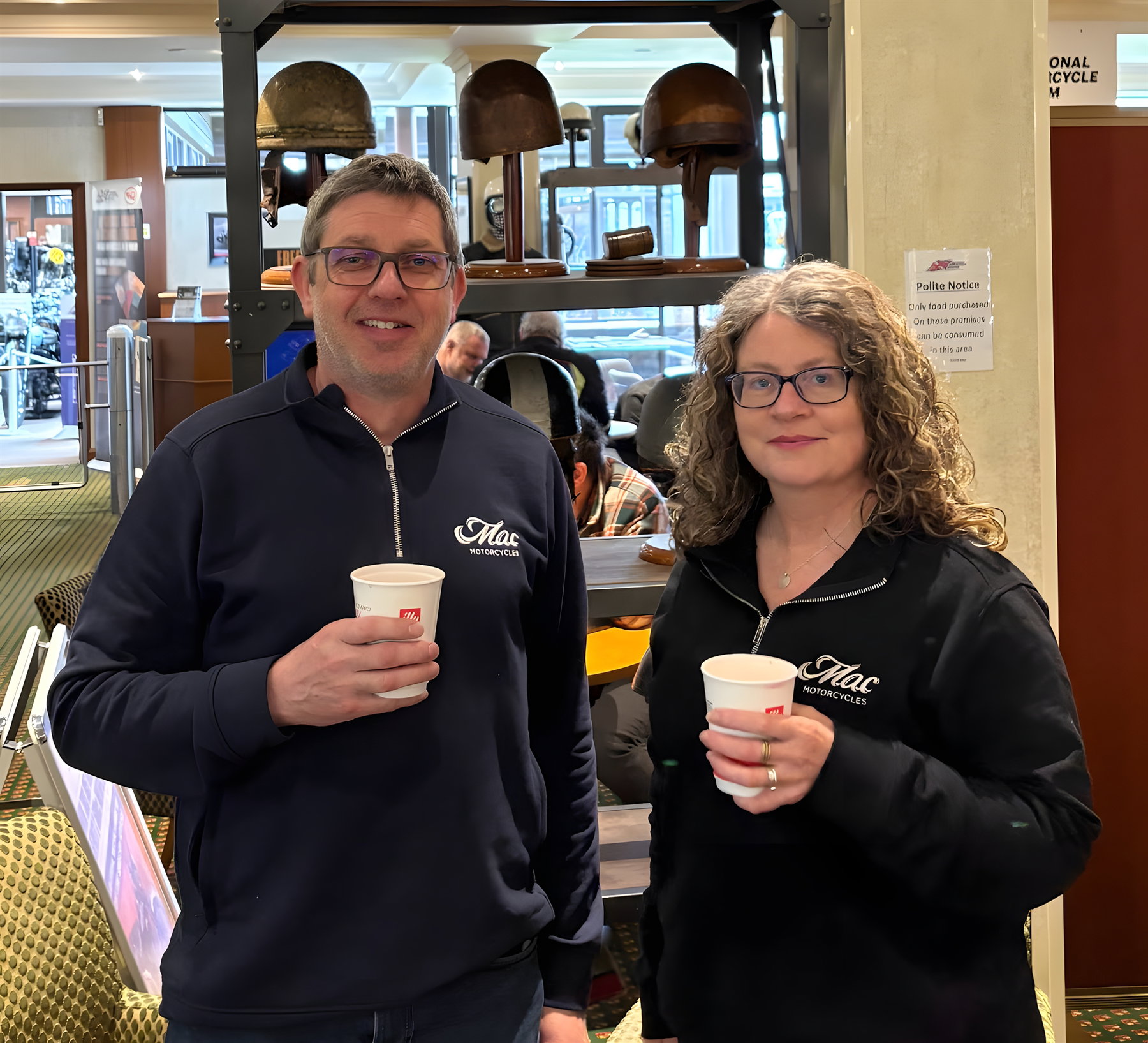
The core team is small: alongside Ian Oliver, his eldest son William works as Product Development Engineer at the company. The two are supported by Vikki Brooks, a virtual assistant from Staffordshire who handles test ride bookings, social media, and day-to-day coordination. Beyond that, there is a network of external specialists and suppliers.
“We’re supporting British brands, British infrastructure, and we quite like the made in Britain philosophy. We care about what we do, and we want them to be a part of our story.” That was William Oliver speaking about the collaboration with predominantly British suppliers.
What Engine Do the Mac Rex and Ruby Use?
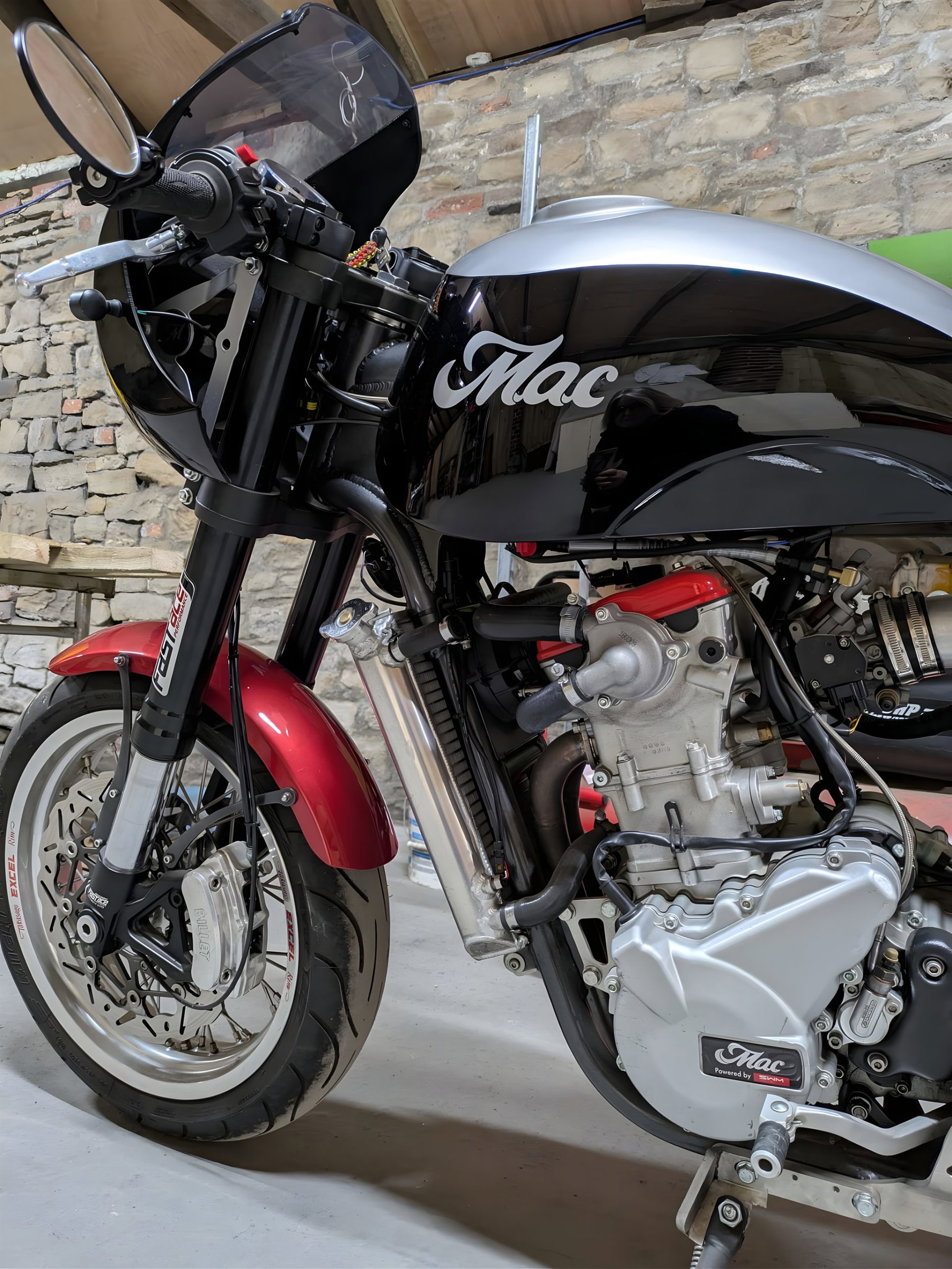
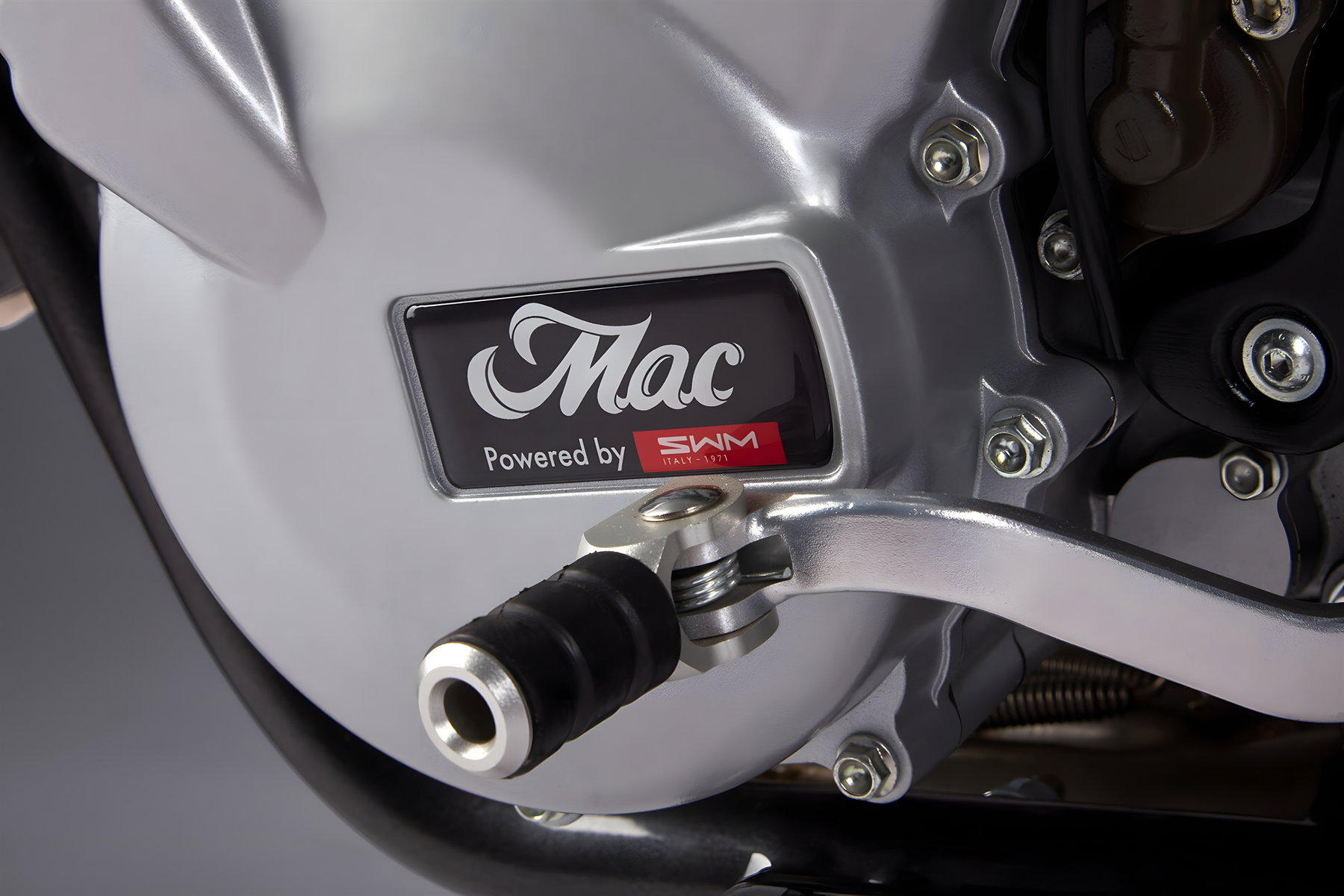
Both models share the same powertrain: a liquid-cooled 600cc single-cylinder produced by SWM in Italy. It is a variant of the proven Husqvarna TE610 engine, which SWM also uses in its Superdual adventure bike. The same engine was also used in the now-discontinued CCM Spitfire and the AJP PR7 Adventure.
Mac has fitted the engine with its own mapping and a new ECU, combined with a Mikuni throttle body. The manufacturer states power output at 57 bhp (approximately 42 kW). An earlier specification from 2022 quoted 52 bhp, suggesting additional development work has been done since.
The key technical specifications of the engine at a glance: single-cylinder, four-stroke, liquid-cooled, four-valve head with chain-driven DOHC, compression ratio 12.4:1, bore 100 mm, stroke 76.4 mm, displacement 600cc, electric starter, and six-speed gearbox. Top speed is quoted by the manufacturer at approximately 100 mph (around 161 km/h).
What Distinguishes the Rex from the Ruby?
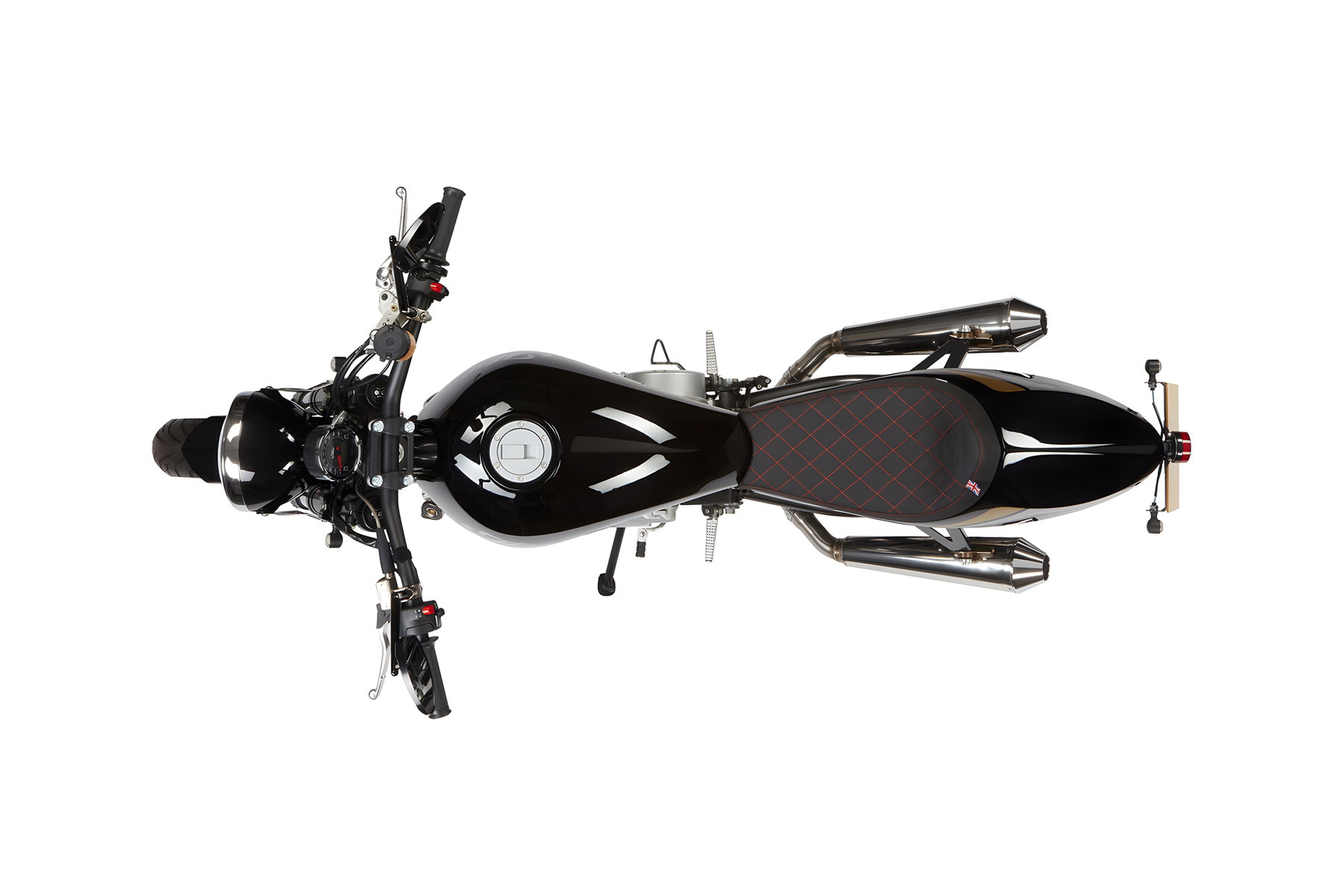
Although both models are based on the same steel-tube backbone frame and identical mechanicals, they target different types of riders. The Rex features wider, taller handlebars for an upright riding position and stylistically references the flat-tracker aesthetic with its tail section. The Ruby, on the other hand, uses classic clip-on bars for a sportier, forward-leaning café racer stance. Both models share an identical seat height of 760 mm and a wheelbase of 1,430 mm.
A notable detail: the wiring harness on both variants is designed long enough to work with either handlebar configuration. The bodywork panels and handlebars are interchangeable between the two. According to Mac, the conversion takes about an hour, allowing an owner to switch between roadster and café racer with reasonable effort. The Ruby additionally features an optional cockpit fairing.
What Components Make Up the Chassis and Brakes?
The frame and swingarm are Mac’s own designs, manufactured in England by Caged Laser Engineering. During the early development phase, the geometry was established in collaboration with the legendary Lester Harris of Harris Performance. The frame is CAD-modeled, tested both digitally and physically, and receives an e-coat primer, powder coating, and clear lacquer seal. Cavity wax is additionally blown into the tubes.
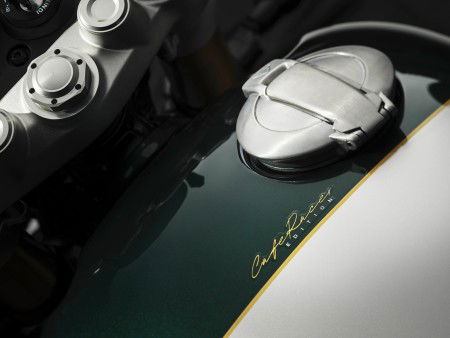
The 16-liter tank comes from Italian specialist Acerbis and was designed by Clive Goodwin. Goodwin was previously Creative Director at Samsung Design Europe and describes his approach as refining an existing concept to develop a cohesive design language from individual elements. The bodywork panels are made from ABS plastic, manufactured in Redditch. Pressed aluminum alternatives are available on request.
Paint is handled by Richard Hammond’s workshop The Smallest Cog in Hereford. In addition to a range of standard colors, customers can also commission custom paint schemes.
For the suspension, the front features 47mm upside-down forks from Fastace with compression and rebound adjustment and 130 mm of travel. At the rear, a fully adjustable Nitron R1 monoshock with a 40mm piston is used, manufactured in Oxfordshire. For the front brake, customers can choose between a British Hel radial caliper and a Brembo caliper, each mounted on a 320mm floating disc. Brembo master cylinders are standard in both cases. At the rear, an SWM caliper operates on a 240mm disc.
The wheels are 17-inch spoked units with polished silver rims, stainless steel spokes, and nickel-plated brass nipples. Tire choice is left to the customer, with Mac already having worked with Mitas, Michelin, and Continental. A 120/70R17 is fitted at the front, while the rear offers 140/60 or 150/60 in 17-inch, each available in road or off-road oriented tread patterns.
The exhaust system is a Mac in-house design made from polished stainless steel with twin reverse-cone silencers. It has been tuned for the characteristic sound of a large single-cylinder and features interchangeable inserts for track use. The dry weight is quoted by the manufacturer at 150 kg (approximately 331 lbs), measured with oil but without fuel.
How Does the Mac Rex Ride? First Impressions from the Pre-Production Version
As part of a test program with pre-production models, the Rex was ridden on the back roads of South Yorkshire, on a mix of smooth B-roads and potholed country lanes — precisely the terrain where many Mac machines will likely spend most of their time. The test ride lasted about an hour and covered a broad spectrum of riding situations.
Immediately noticeable is the low seating position. With a seat height of 760 mm and the slim single-cylinder beneath, the Rex feels compact and accessible. The wide handlebars are easy to reach, and the controls are logically laid out. Wind protection is absent, which is hardly an issue given the character of the motorcycle — the Rex is at its best at moderate speeds.
The engine is clearly the star. The 600cc single thumps aggressively, banging and popping through the Keihan Systems exhaust with its twin outlets. Vibrations are distinctly felt through the handlebars and footpegs, and on both pre-production models tested, at least one mirror vibrated loose. The engine delivers ample low-end torque, allowing the rider to take their time with gear changes. What the powerplant lacks in refinement, it makes up for in character. For those who think of the classic British single experience, this is a contemporary interpretation of it.
However, the test rides also revealed weaknesses. The suspension setup proved noticeably too stiff for lighter riders. Every imperfection was transmitted into the arms and lower back, and the seat became uncomfortable after about 30 minutes. Additionally, the motorcycle showed a reluctance to turn into corners, with the rear wheel working against the front as speeds increased.
Ian Oliver explained after receiving feedback that both test machines were pre-production models with different rear spring rates. Every customer motorcycle will be individually set up to the owner’s preferences, starting from a baseline setting that is still being finalized. Further running-in would be needed to improve the machine’s responsiveness. A re-evaluation of the final production version is planned for a later date.
How Much Does a Mac Rex or Ruby Cost and How Does Ordering Work?
The starting price for both models is 15,500 British pounds including VAT (approximately 17,900 euros / 20,770 US dollars). This positions Mac Motorcycles in the premium segment of the single-cylinder class. According to the company, the price reflects the reality of small-batch manufacturing in Britain, where rising raw material, production, and logistics costs have significantly driven up manufacturing expenses.
Ordering is done through a personal appointment at the company premises. Customers can visit the factory, have a consultation, take a test ride, and then place an order. The configuration includes the choice between Rex and Ruby, brake caliper option (Hel or Brembo), tire tread, color scheme, and material choice for the bodywork. The current delivery time is approximately 14 weeks from order placement.
Ian Oliver stated that there is already a list of interested parties for test rides. How high the conversion rate will be remains unclear, but the interest is sufficient to consider the venture viable. Long-term, Oliver is targeting sales of several hundred motorcycles per year and plans expansion into markets such as the USA.
How Does Mac Motorcycles Fit into the British Motorcycle Landscape?
Mac Motorcycles joins a tradition of British small-batch motorcycle manufacturers that has recently included brands such as CCM and Norton. Both faced considerable difficulties: the CCM Spitfire, which used the same SWM engine as the Mac, has since been discontinued. Norton went through years of restructuring and redevelopment under TVS ownership.
The British Motorcyclists Federation (BMF) has officially welcomed the launch of Mac Motorcycles, describing the start of business as a new chapter for the British motorcycle industry. The federation emphasized the importance of such initiatives against the backdrop of the current economic climate.
Among the upcoming dates is an appearance at Museum Live 2026 at the National Motorcycle Museum, where interested parties can view the motorcycles for the first time outside of the factory premises.
Frequently Asked Questions
-
How much does a Mac Rex or Ruby cost?
The starting price is 15,500 British pounds including VAT, which corresponds to approximately 17,900 euros or 20,770 US dollars. The price applies to both model variants. Depending on the chosen configuration, such as the brake caliper option or custom paintwork, the final price may vary.
-
What engine do the Mac Motorcycles Rex and Ruby use?
Both models are powered by a liquid-cooled 600cc single-cylinder engine from SWM, based on the Husqvarna TE610 engine. The manufacturer states power output at 57 bhp (approximately 42 kW). The engine features a DOHC four-valve head, fuel injection, and a six-speed gearbox.
-
Where are Mac motorcycles manufactured?
Mac Motorcycles builds its motorcycles in a restored stone barn near Barnsley, South Yorkshire. The frame and swingarm are produced by Caged Laser Engineering in England, the tank comes from Italian manufacturer Acerbis, and the paintwork is handled by Richard Hammond’s workshop The Smallest Cog in Hereford.
-
Can you switch between Rex and Ruby?
Yes, the bodywork panels and handlebars of both models are designed to be interchangeable. The wiring harness is long enough to accommodate both configurations. According to the manufacturer, the conversion takes about an hour, allowing an owner to transform their motorcycle from a roadster into a café racer.
-
How long does delivery of a Mac Rex or Ruby take?
The current delivery time after order placement is approximately 14 weeks according to Mac Motorcycles. Orders are placed exclusively following a personal appointment and test ride at the company premises in South Yorkshire.
➜ This article is part of our comprehensive overview: New Motorcycles 2026: All Models, Releases, and Highlights at a Glance. Find all key information on this topic in one place.