- Nine units worldwide, eight of which have reportedly already been sold according to sources close to the manufacturer
- Current price is approximately €43,700 ($49,900) plus shipping, up from about €39,300 ($44,900) at launch
- 821cc Testastretta 11° engine producing around 111 hp (82 kW), dry weight of 175 kilograms (386 lbs)
A custom workshop in Vietnam has turned a Ducati Monster 821 into a fully faired limited series of just nine bikes worldwide. A year after its debut, the price has climbed by roughly 5,000 US dollars, and most of the units are already spoken for.
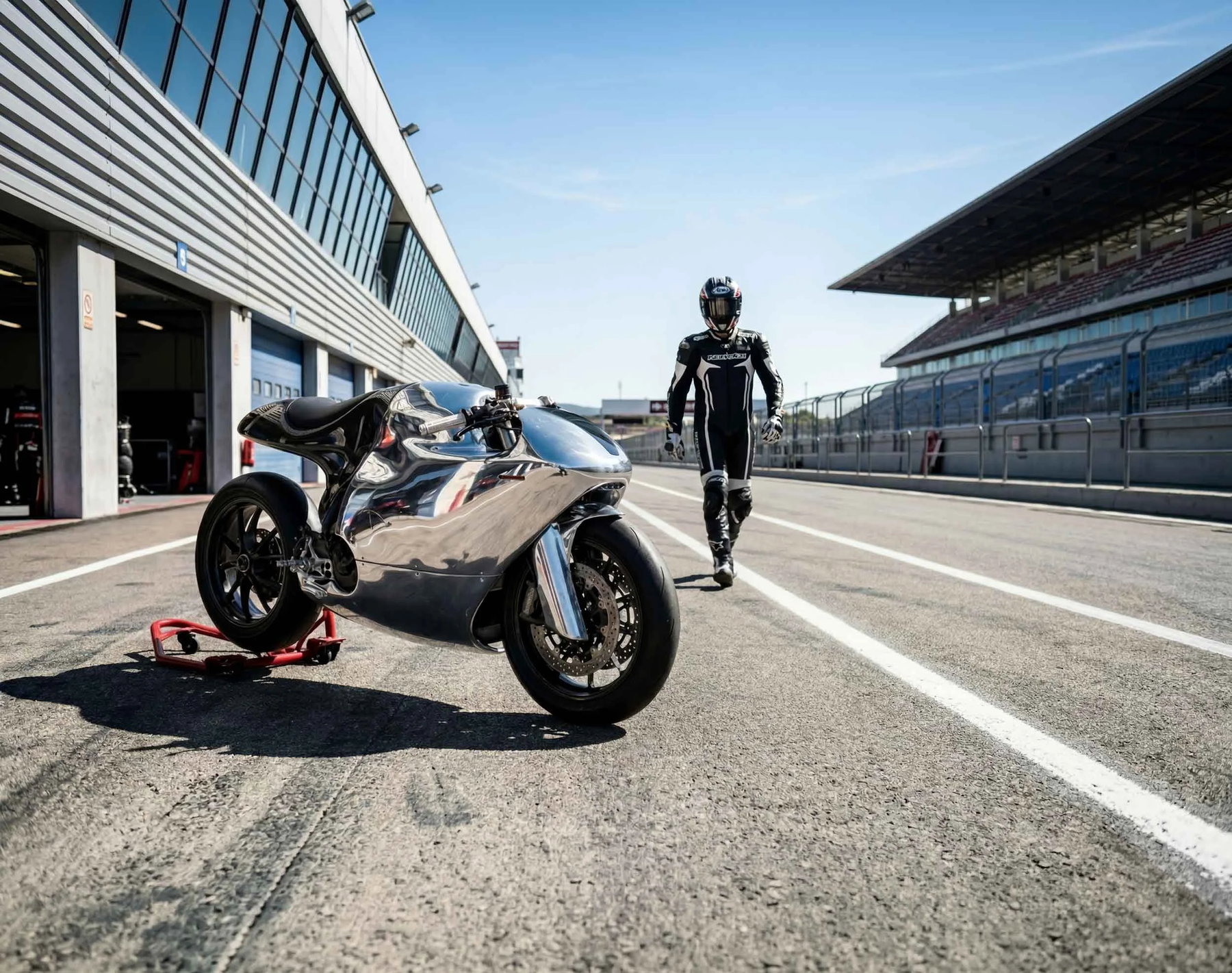
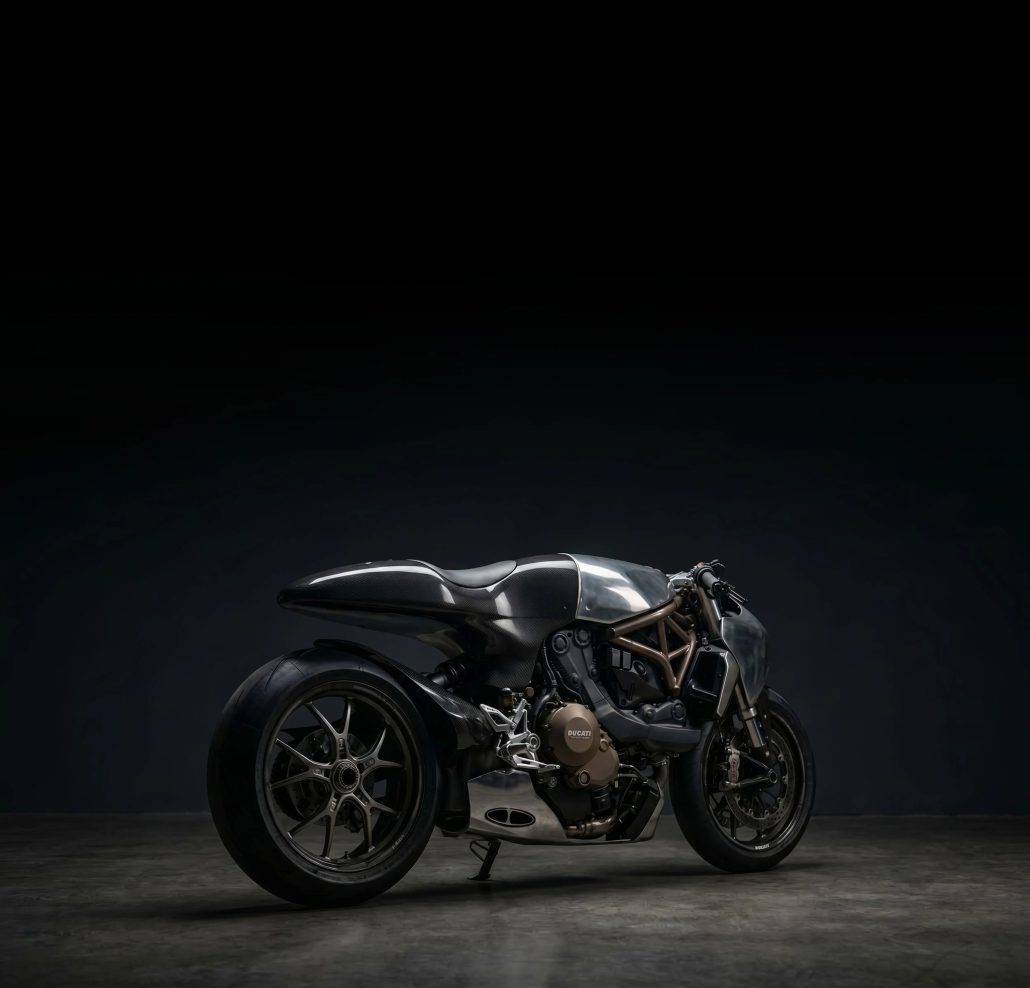
The Ducati Monster 821 was a classic naked bike: no fairing to speak of, plenty of exposed mechanicals, and a compact twin-cylinder engine in a trellis frame. Little of that character survives in Bandit9’s limited series. The Ho Chi Minh City workshop has completely re-clothed the platform, turning it into a fully faired motorcycle whose shape recalls 1950s streamliner bodywork more than a modern sportbike. The Ducati 821 was first shown in July 2025. Since then, one thing above all has changed: the price.
Why Does Bandit9’s Ducati 821 Cost More Now?
The price has risen by $5,000 since launch. When sales opened in July 2025, Bandit9 charged $44,900, roughly €39,300 at the time. The manufacturer now lists the bike at $49,900, around €43,700, in both cases plus shipping.
Bandit9 has not given a reason for the increase. What is known is that the donor motorcycle is included in the price. For comparison, the standard Monster range started at around €11,400 ($12,995) at the time of the debut. The Monster 821 that serves as the donor bike is no longer in production anyway, which shrinks the pool of available donor machines over time.
Of the nine planned units, eight had reportedly already been claimed by the time the covers came off, according to sources close to the manufacturer. That leaves just one bike still up for grabs.
What’s Underneath the Bodywork?
Under the bodywork sits Ducati’s unmodified 821cc twin-cylinder engine. The liquid-cooled, L-configuration Testastretta 11° produces around 111 hp (82 kW) at 9,250 rpm and 89.2 Nm (65.8 lb-ft) of torque at 7,750 rpm, according to the manufacturer.
At Ducati, Testastretta refers to a cylinder-head design with an especially narrow valve angle, and the “11°” figure denotes valve overlap. The engine remains completely stock; Bandit9 has not pursued any power upgrades. From a standstill to 60 mph (about 97 km/h), the Ducati 821 is said to accelerate in 3.3 seconds, with the manufacturer quoting a top speed of 201 km/h (125 mph).
Dry weight comes in at 175 kilograms (386 lbs), according to Bandit9. Some media reports cite 180 kilograms. Even the higher figure remains below the stock Monster 821’s dry weight of roughly 179 kilograms (395 lbs), despite the addition of full bodywork. That is made possible by a purpose-built steel trellis frame with cast aluminum sections.
Suspension, Brakes and Wheels
On the chassis side, it’s notable that Bandit9 has skipped exotic componentry. Up front are non-adjustable Sachs fork tubes with a 43-millimeter diameter, while a Sachs shock at the rear offers preload and rebound adjustment. The brakes come from Brembo: twin 320-millimeter discs up front gripped by radially mounted four-piston monobloc calipers, and a 245-millimeter disc at the rear. ABS is fitted on both axles.
The 17-inch wheels wear 120/70 front and 180/55 rear tires, fitted with a sporty Pirelli road tire. A single-sided swingarm handles the rear wheel and remains one of the few mechanical parts left visible.
What Is the Bodywork Made Of?
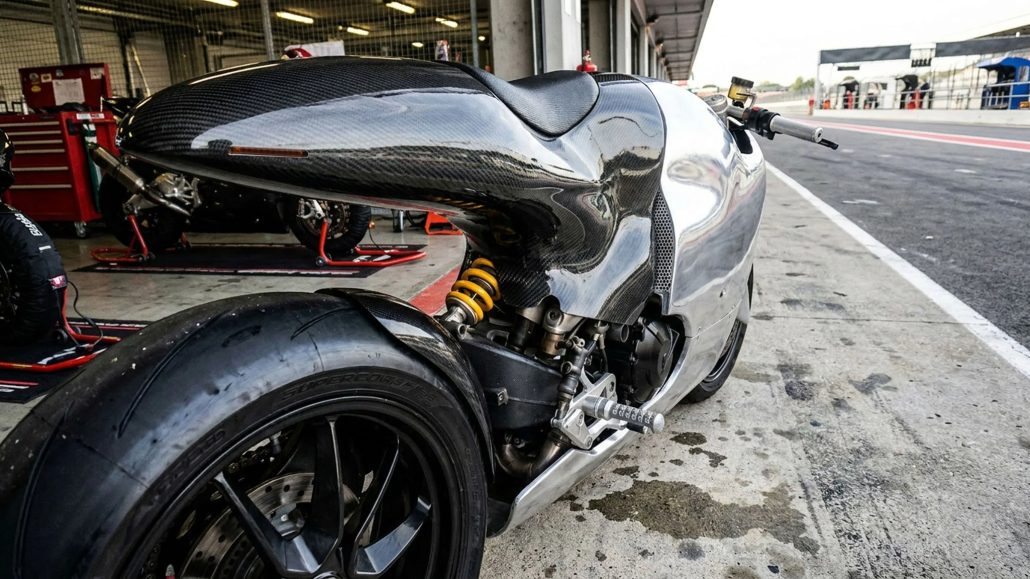
In the standard configuration, Bandit9 combines hand-polished aluminum with race-grade ABS plastic, with carbon fiber available at extra cost. The two-tone look comes from the contrast between the polished aluminum front end and the darker rear section.
On the bikes shown, exposed carbon takes over behind the rider’s seat. The aluminum panels run continuously from the nose down under the engine, with the brushed finish flowing evenly across every change in shape. The headlight sits as a small recessed LED unit in the nose, while the fork tubes disappear beneath molded covers. At the rear, a continuous LED strip runs beneath the tail edge, and the turn signals are set so deep into the surface that they’re barely noticeable when switched off. All cables and lines are routed internally.
Bandit9 describes the approach in its own words: “Every component has been redesigned and hand-fabricated to achieve a singular concept: unity.” Elsewhere, the workshop speaks of “engineering that belongs in a wind tunnel, and design that belongs in a gallery.”
What Is the Cockpit Like?
The riding position is sporty and tight. Low clip-on handlebars, bar-end mirrors, and a seat made of high-density polyurethane foam set into the tail section place the rider inside the motorcycle rather than on top of it. The upper triple clamp is machined from a single billet and integrates the steering head, fork caps, and a small digital display into one component.
Despite its unusual shape, the dimensions stay compact: 2,100 millimeters long, a 1,500-millimeter wheelbase, 860 millimeters wide, and 1,055 millimeters tall. Seat height, however, is a tall 870 millimeters. The tank holds around 17.5 liters according to the manufacturer, with a claimed range of about 233 kilometers.
Who Builds the Ducati 821?
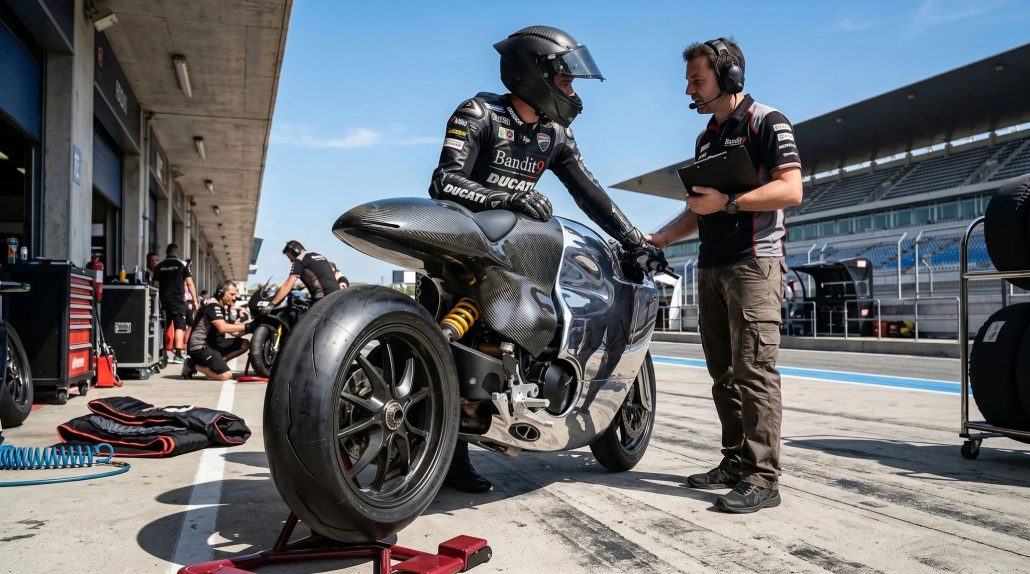
The project comes from Bandit9, based in Ho Chi Minh City, Vietnam, and led by founder and design chief Daryl Villanueva. The workshop is known for builds whose surfaces look machined from a single piece, such as the EVE Odyssey and Supermarine models.
The commission originally came from a collector in San Francisco who had taken notice of the EVE Odyssey and wanted a motorcycle for the mountain roads near his home. That one-off later grew into the limited series capped at nine units.
How Long Does It Take to Build One?
Bandit9 currently states a build time of six to eight months per motorcycle. At launch, the figure quoted was six months, while some media reports mention up to twelve. Development of the first unit reportedly took more than a year, of which around six to eight months went into engineering and design.
Ordering, Delivery and Registration
Every motorcycle is built to order. According to the manufacturer, payment is made in three installments: 50 percent when the order is placed, 25 percent at the halfway point, and the final 25 percent before delivery. Deposits are non-refundable.
Shipping is handled by a logistics partner that also manages import and delivery. Germany is among the countries Bandit9 has already shipped to. Importantly for prospective buyers: the manufacturer explicitly states that registration, type approval, and compliance documentation are not guaranteed. Responsibility for road registration rests entirely with the buyer.
Where It Fits in the 2025-2026 Custom Scene
Bandit9’s Ducati 821 belongs to a group of builds that have moved away from the classic one-off model, instead being offered as very small series with a fixed unit count and fixed price. That puts it in the same territory as limited special editions from major manufacturers, even though it remains a purely artisanal product with no factory backing. The price increase over the course of a year shows that such projects behave similarly to collector vehicles once the available unit count starts shrinking.
Frequently Asked Questions
-
How much does the Bandit9 Ducati 821 cost?
The price currently stands at around €43,700 ($49,900) plus shipping. At its July 2025 debut, it was about €39,300 ($44,900). The donor motorcycle is included in the price.
-
How many units of the Bandit9 Ducati 821 are there?
Nine motorcycles are being built worldwide. Eight of them had already been claimed by the time the limited series was shown to the public.
-
What engine powers Bandit9’s Ducati 821?
It is the unmodified twin-cylinder engine from the Ducati Monster 821, displacing 821cc. The Testastretta 11 degree produces around 111 hp (82 kW) at 9,250 rpm and delivers 89.2 Nm (65.8 lb-ft) of torque at 7,750 rpm.
-
How fast is Bandit9’s Ducati 821?
The manufacturer quotes a top speed of 201 km/h (125 mph). From a standstill to about 60 mph (97 km/h), the motorcycle is said to accelerate in 3.3 seconds.
-
Can the Bandit9 Ducati 821 be registered in Germany?
Bandit9 has already shipped bikes to Germany but does not guarantee type approval or road registration. According to the manufacturer, responsibility for road registration rests entirely with the buyer.
➜ Find all technical specifications, photos and prices in the data sheet of our motorcycle database: Bandit9 Ducati 821 (2026) – Specs.