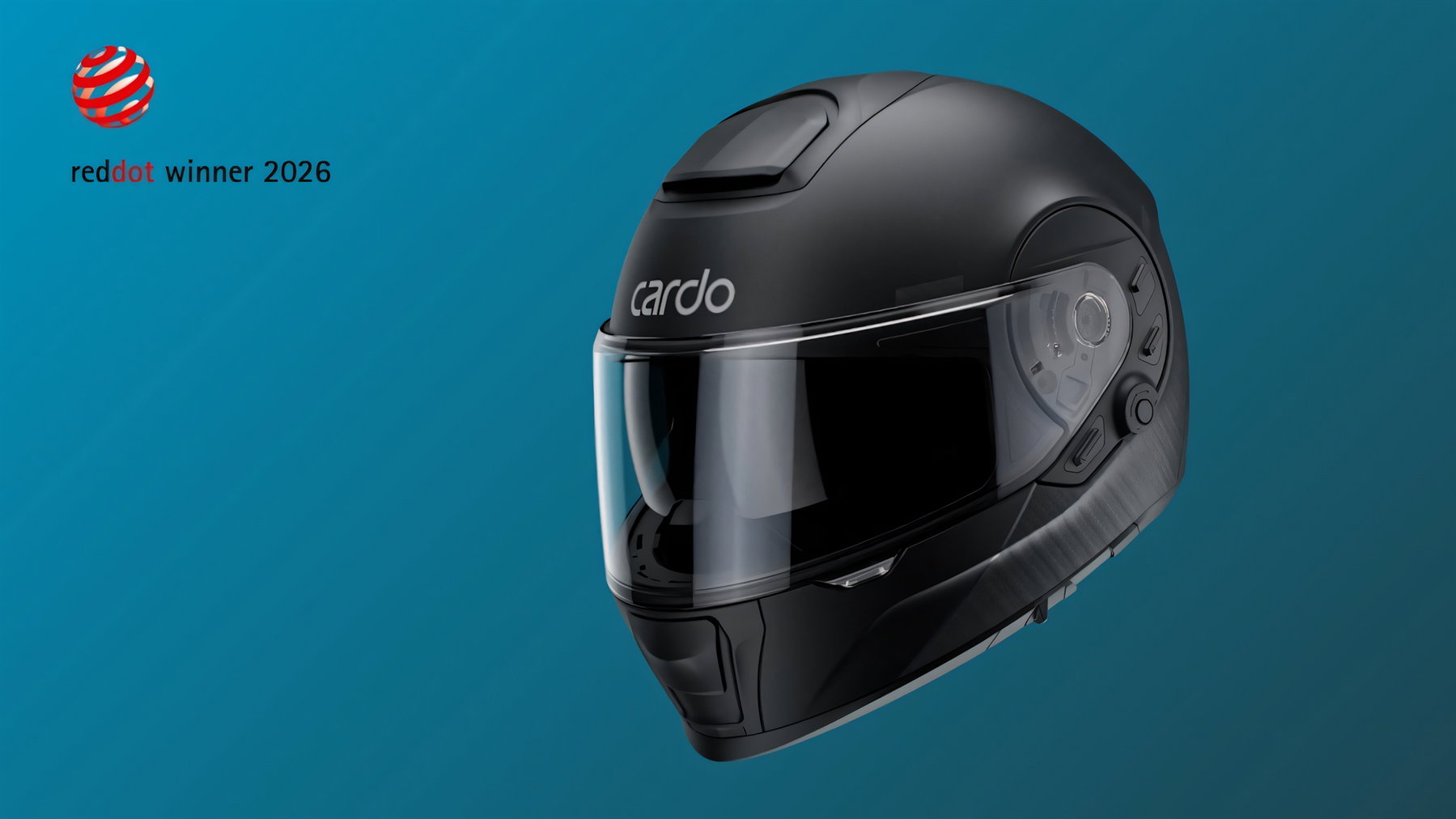
- Award: Red Dot Award in the Product Design category, granted before the sales launch
- Technology: Carbon shell, according to Cardo the world’s first integrated 53-millimeter speakers, Pinlock 200, ECE 22.06 and DOT certification
- Market launch and price: late 2026, GTS €1,199 ($1,199), GT €949 ($949)
A motorcycle helmet winning a design award before a single unit has even shipped is rare. Yet that’s exactly what happened to Cardo’s Beyond GTS. The helmet is the brand’s first fully integrated model, after Cardo built its name mainly on communication systems. Instead of bolting an intercom onto the outside of the helmet, the entire technology is built into the shell from the start. The Red Dot Award jury has now honored this approach even before the market launch.
Why does a helmet win an award before it goes on sale?
The Beyond GTS was recognized for the interplay of integrated technology, safety equipment and industrial design. The Red Dot Award in the Product Design category is one of the well-known design prizes, and according to Cardo the helmet prevailed against thousands of entries. It was developed together with the Austrian design studio Kiska, which was previously responsible for KTM’s styling, among other things. An award like this can be granted before the actual sales launch because prizes of this kind judge concept, design and prototypes rather than sales figures.
What technology is inside the Cardo Beyond GTS?
The Beyond GTS is built around a carbon shell combined with a multi-layer EPS inner liner, a rigid foam that absorbs impact forces in a crash. At its core sits Cardo’s flagship communication system, Packtalk Pro. Through what’s called Dynamic Mesh Communication, a self-managing radio network between riders, up to 31 people can connect with each other. Cardo states the range at up to two kilometers.
For sound, the manufacturer uses 53-millimeter speakers. According to Cardo, these are the world’s first speakers of this size built directly into a helmet, developed by the company’s own sound division. They’re complemented by Active Noise Cancellation, a system designed to dampen fatiguing wind and road noise while still letting important sounds like horns or sirens through.
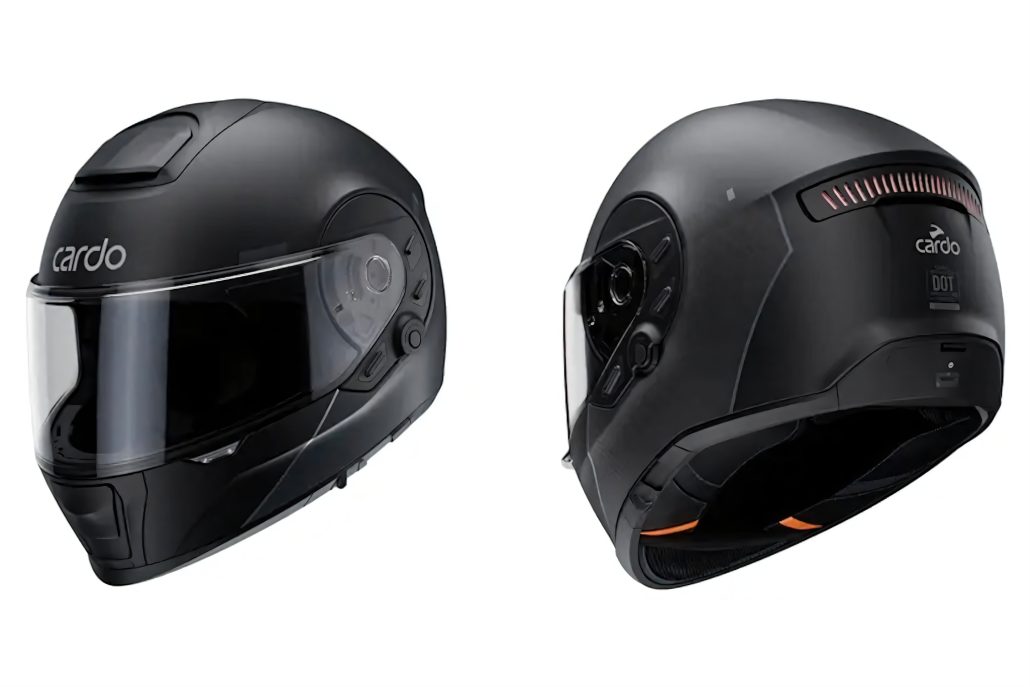
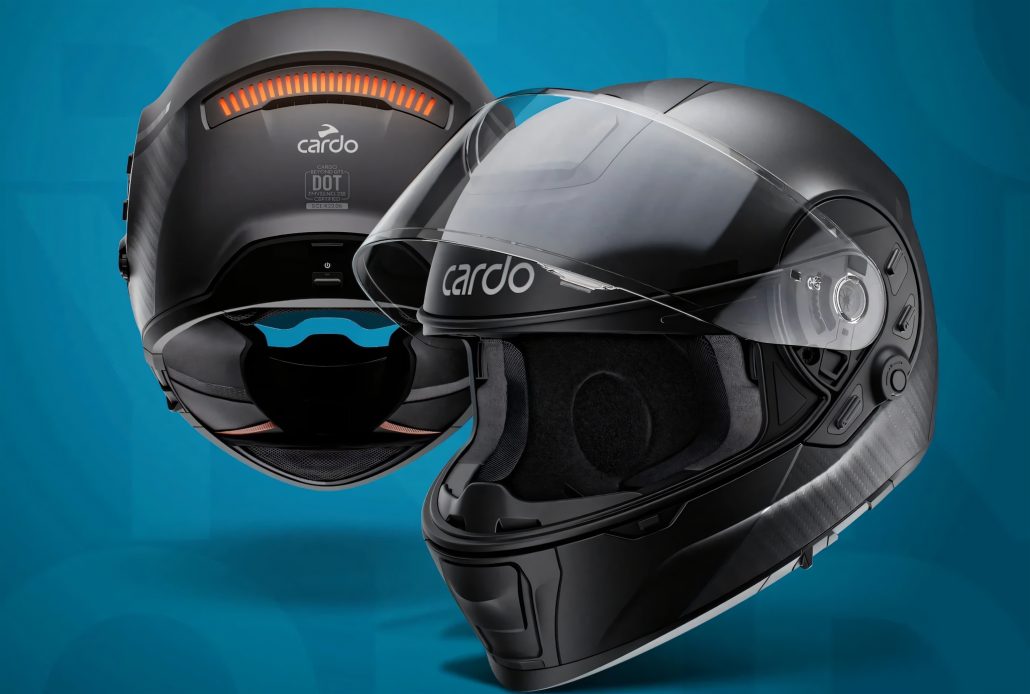
On the safety side, the helmet brings a handful of features rarely found on a helmet. These include an integrated brake light at the back, a crash detection system that can alert a stored emergency contact if needed, and a system that monitors the helmet’s condition. The latter tracks impacts and stress over time and flags when the helmet should be inspected or replaced. There’s also a flip-down sun visor, a double D-ring closure and, according to the manufacturer, the first use of a Pinlock 200 on a production helmet. The Pinlock is an additional inner lens that prevents the visor from fogging up. The Beyond GTS is certified to the ECE 22.06 and DOT standards. It weighs around 1,875 grams, or about 4.1 pounds. The battery holds 2,000 milliamp-hours, is removable and charges wirelessly.
How does the Beyond GT differ from the GTS?
The Beyond GT is the more affordable variant and does without some of the higher-end components. Instead of the carbon shell, the GT uses a fiberglass shell. Active Noise Cancellation isn’t included from the start here but can be added as an upgrade. The battery is smaller at 1,000 milliamp-hours, and there’s no wireless charging. The visor uses a Pinlock 120XLT, and instead of the brake light, the back carries a reflector for better visibility. The core focus on safety, sound and connectivity, however, remains the same.
The Beyond among today’s smart helmets
With the Beyond, Cardo is taking the step from accessory maker to helmet manufacturer. According to the company, it draws on two decades of experience with communication systems and four years of development work on the helmet itself. That places the Beyond among a whole line of connected helmets introduced in recent years. The difference lies in the approach: many riders are wary of integrated helmets because a faulty component or a dead battery could render the entire helmet useless. Cardo addresses this with replaceable components and a removable battery. If a component fails, the manufacturer says the affected part can be sent in and swapped out.
The company’s leadership also frames the helmet as a major step. CEO Alon Lumbroso calls it a turning point for Cardo after 20 years in rider communication. Technology, he says, should enhance riding without distracting from it, and each feature should feel natural and intuitive.

When does the Cardo Beyond GTS arrive and what does it cost?
The Beyond GTS is expected to hit stores toward the end of 2026. The flagship GTS costs €1,199 ($1,199), while the simpler Beyond GT costs €949 ($949). Both helmets are designed as companions for long road tours and are available in various sizes. Whether the built-in technology proves itself in everyday use, and whether riders make the switch from a classic helmet with a bolt-on intercom, will only become clear after the launch.
Frequently Asked Questions
-
What is the Cardo Beyond GTS?
The Cardo Beyond GTS is Cardo’s first fully integrated motorcycle helmet. The communication system, speakers and safety technology are built directly into the carbon shell instead of being attached as external accessories.
-
When does the Cardo Beyond GTS launch?
The launch is planned for late 2026. Alongside the GTS, the more affordable Beyond GT variant will also be released.
-
What does the Cardo Beyond GTS cost?
The Beyond GTS costs €1,199 ($1,199). The simpler Beyond GT variant is priced at €949 ($949).
-
What safety features does the Cardo Beyond GTS have?
The helmet offers an integrated brake light, crash detection and a system that monitors the helmet’s condition. It is also certified to the ECE 22.06 and DOT standards.
-
How many riders can connect via the Beyond GTS?
Through the Packtalk Pro communication system and Dynamic Mesh Communication, up to 31 riders can connect with each other. Cardo states the range at up to two kilometers.