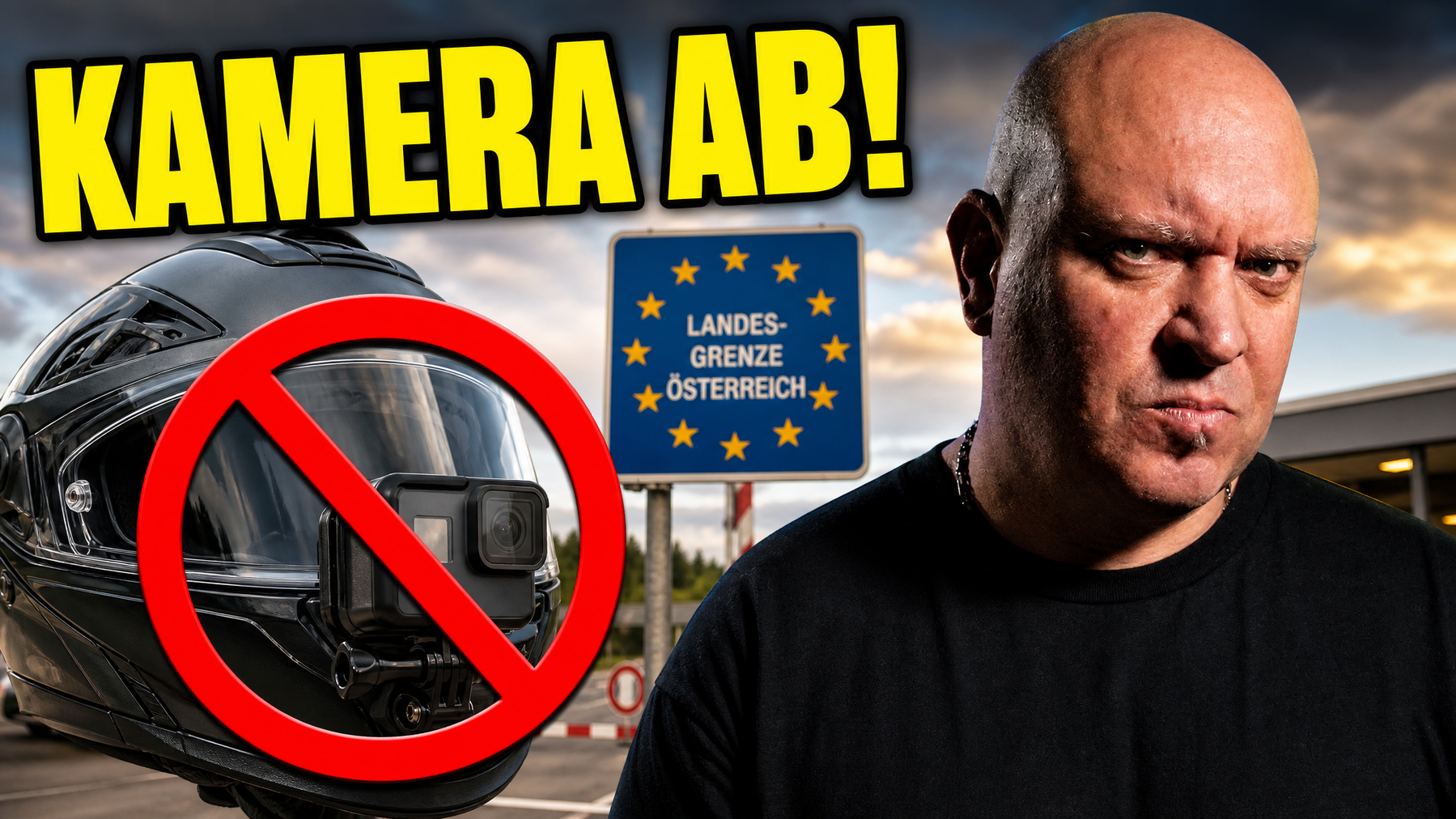
- Cyprus will allow dashcams for the first time starting July 23, 2026 — but video only, no audio.
- Portugal, Austria, Luxembourg and Switzerland remain classic ban countries and are stepping up enforcement in 2026.
- The safe ground rule: camera with loop recording only, microphone off, never publish anything without consent.
Just over a year ago, this space already looked at where in Europe you’re allowed to film with a dashcam or action cam, and where it can get expensive. Since then, quite a bit has changed. One country has explicitly allowed dashcams for the first time, enforcement has tightened in the ban countries, and in the background the EU is working on a reform of data protection law. Legally, most countries make no distinction between a dashcam in a car and an action cam on a motorcycle or helmet. Whether the camera sits on the windscreen or the helmet, the rules mostly apply the same way, which is why this article simply refers to “the camera” throughout. One term keeps coming up: loop recording, meaning the automatic overwriting of footage. It makes things more flexible legally, but it doesn’t protect you if filming is banned outright.
Why is Cyprus allowing dashcams for the first time now?
Cyprus legalized dashcams for the very first time in April 2026. Until then there was no regulation at all, then parliament passed a corresponding law on April 16, 2026. That makes cameras permissible in private, commercial and public vehicles. The catch is in the detail: only video is allowed, audio recording is explicitly banned. In addition, footage may only be used for accident and law-enforcement purposes. Posting a video showing other people online without their consent remains off-limits. The regulation takes effect on July 23, 2026, timed almost perfectly for the travel season. For a trip to Cyprus, that means: camera yes, but microphone off, and keep the footage to yourself.
Which countries ban dashcams in 2026?
Portugal, Austria, Luxembourg and Switzerland remain the classic ban countries, and enforcement there is markedly tougher in 2026. Tourism and transport authorities have issued coordinated warnings for these four countries, and according to consistent reports, police are checking foreign vehicles more often than in previous years.
Portugal remains the toughest case. There, merely possessing a functional camera in the vehicle can be penalized, even switched off and even in the trunk. At the same time, the country is stepping up enforcement: according to available information, the traffic police are set to receive around six million euros (roughly 6.85 million US dollars) for nearly a hundred new vehicles and more than a thousand additional detection devices, plus unannounced checkpoints. The figure of 25,000 euros (roughly 28,550 US dollars) is often cited for penalties. However, that is the upper limit under data protection law, not the amount you’d typically face during an ordinary dashcam check. In practice, confiscation of the equipment and fines under the data protection act are the more likely outcomes.
Austria treats dashcams as unlawful surveillance of public space. The data protection authority can impose fines of up to around 10,000 euros (roughly 11,420 US dollars), rising to 25,000 euros (roughly 28,550 US dollars) for repeat offenses. In practice, though, penalties for a first offense by a private individual tend to be considerably lower, often in the range of a few hundred to around 1,500 euros (roughly 1,713 US dollars). The rule of thumb: owning the camera isn’t illegal, but using it to surveil public space is.
Luxembourg bans any video recording from inside the vehicle in public space. Switzerland isn’t an EU member, but is just as strict: the data protection commissioner considers dashcams clearly unlawful and only permits them if everyone filmed has given prior consent, which is barely feasible in practice. The same concrete advice applies to all four countries: take the camera off and stow it before crossing the border. Not just switch it off — actually remove it.
What’s the legal situation in the rest of Europe?
In most other European countries, use is allowed, though almost always subject to conditions. France, Italy and Spain generally permit filming but set clear limits. In France, private filming is allowed, but when publishing, faces and license plates must be blurred, otherwise steep penalties can follow. Italy allows the camera as long as it doesn’t obstruct the view, is easily removable, and the footage is regularly overwritten. In Spain, use is permitted, but the camera may not be operated while driving, or fines and points are the result.
Croatia and Slovenia take a more relaxed approach. There are no specific dashcam laws there, and use is tolerated as long as data protection rules are respected. Private filming is therefore possible, but published material must be anonymized. Germany sits in the middle: only short, incident-related recordings are allowed, for example via loop recording or at the moment of an accident. Continuous filming is off-limits. In court, however, such footage is admissible as evidence, provided it was obtained in compliance with data protection rules.
Some countries interpret the rules even more strictly. Belgium allows private use, but publishing only with the consent of everyone involved. Greece officially advises against dashcams, where even handing a video over to the authorities can be considered a data protection violation. In Scandinavia — Sweden, Denmark, Norway and Finland — dashcams are allowed as long as they’re easily removable, record in a loop, and data protection is respected.
Does a camera void ECE 22.06 helmet approval?
In theory, a camera fitted after the fact can affect a helmet’s ECE 22.06 approval, but in practice this is rarely ever an issue. The background is the ECE 22.06 helmet standard, which has applied to newly developed helmets since 2024. What’s unusual about it is that helmet accessories are tested as part of the approval. Anything permanently fitted counts toward the certification. That raises the question of whether the approval lapses if an action cam, mount or intercom is added afterwards without having been tested. This is hotly debated in forums, since in theory ECE 22.06 approval really could lapse as a result. In practice, though, the issue is more talked about than acted on, since hardly any cases are known where it ever actually caused a problem, and if so, only in isolated instances in individual countries.
For Germany, there’s no cause for concern at all. No ECE 22.06 helmet is legally required here — the law only calls for a suitable protective helmet. A camera or intercom on the helmet doesn’t make it unsuitable. Interpretation may be stricter in other countries, but even there, serious problems in practice remain the exception.
Why is audio its own risk with dashcams?
Audio is its own — and often stricter — issue in many countries than video. Many cameras record audio by default, and recording conversations is frequently subject to tougher rules than plain video. As noted, Cyprus bans audio entirely, and elsewhere too, audio is often subject to additional restrictions. The simplest way around it: if the audio track isn’t really needed, switching off the microphone in the camera settings is easy to do. That removes an entire legal question from the table.
What is the EU changing about data protection rules?
For dashcam use, the EU’s plans don’t change anything concrete for now, since the rules still hang on national laws. In November 2025, the European Commission proposed reforms to the General Data Protection Regulation as part of the so-called Digital Omnibus package. That changes nothing at the handlebars for now, but it shows that a lot is currently in motion around data protection. That’s exactly why an update like this one is even necessary: what applies this season could already look different again next year.
How can footage be published in a legally safe way?
When publishing, faces and license plates need to be blurred in almost every country. This work no longer has to be done laboriously by hand. YouTube offers a built-in face blur tool, and specialized tools like BlurIt automatically pixelate faces and license plates. Run the footage through once, and it’s considerably safer. One point that’s often overlooked matters here: the data protection violation happens in the country where the filming took place, not only when it’s uploaded. So anyone who filmed in Portugal can theoretically still be caught out even if the video only goes online weeks later, from back home.
What motorcyclists should take away for 2026
Anyone riding through several countries in summer is dealing with a patchwork that can change at every border, and the border, if anything, tends to arrive faster than clarity about the rules. The safest strategy, then, isn’t memorizing every single country’s regulations, but a simple basic approach: camera with loop recording only, microphone off, never publish anything without consent, and in the strict countries, better to remove it entirely. That keeps you on the safe side in almost every European country, without spending hours poring over legal texts beforehand. The direction of travel remains interesting, since Cyprus shows that things are moving — sometimes toward more freedom, sometimes toward tighter enforcement.
Frequently Asked Questions
-
Is a dashcam allowed abroad?
It depends on the country. In France, Italy, Spain, Germany and Scandinavia, private use is allowed under certain conditions, while in Portugal, Austria, Luxembourg and Switzerland it is considered unlawful. Cyprus has allowed dashcams for the first time since 2026, but video only, no audio.
-
From when are dashcams allowed in Cyprus?
The Cypriot parliament passed the law on April 16, 2026, and it takes effect on July 23, 2026. Only video recording is permitted, while audio recording remains explicitly banned.
-
How high are the penalties for a dashcam in Portugal?
A figure of 25,000 euros (roughly 28,550 US dollars) is often cited as the data-protection upper limit, but that amount isn’t typical for an ordinary check. In practice, confiscation of the equipment and fines under the data protection act are the more likely outcomes.
-
Does a helmet camera void ECE 22.06 approval?
In theory, a camera fitted afterwards can affect the approval, since ECE 22.06 tests accessories as part of the certification. In practice, hardly any cases are known, and in Germany an ECE 22.06 helmet isn’t even legally required in the first place.
-
Does the audio on a dashcam need to be switched off?
Many countries apply stricter rules to audio recording than to video, and in Cyprus audio is banned outright. If the audio track isn’t needed, switching off the microphone in the camera settings is the simplest way to avoid this risk.
➜ This article is part of our comprehensive overview: Motorcycle Law & Policy: Legislation, Court Rulings and Developments for Riders. Find all key information on this topic in one place.