- Adult e-scooter riders had a 3.45 times higher risk of traumatic brain injury than motorcyclists
- Only 5.9 percent of the injured e-scooter riders wore a helmet, compared with 75.7 percent of motorcyclists
- In Germany, the number of e-scooter crashes involving personal injury rose by 38.1 percent in 2025 to 16,496
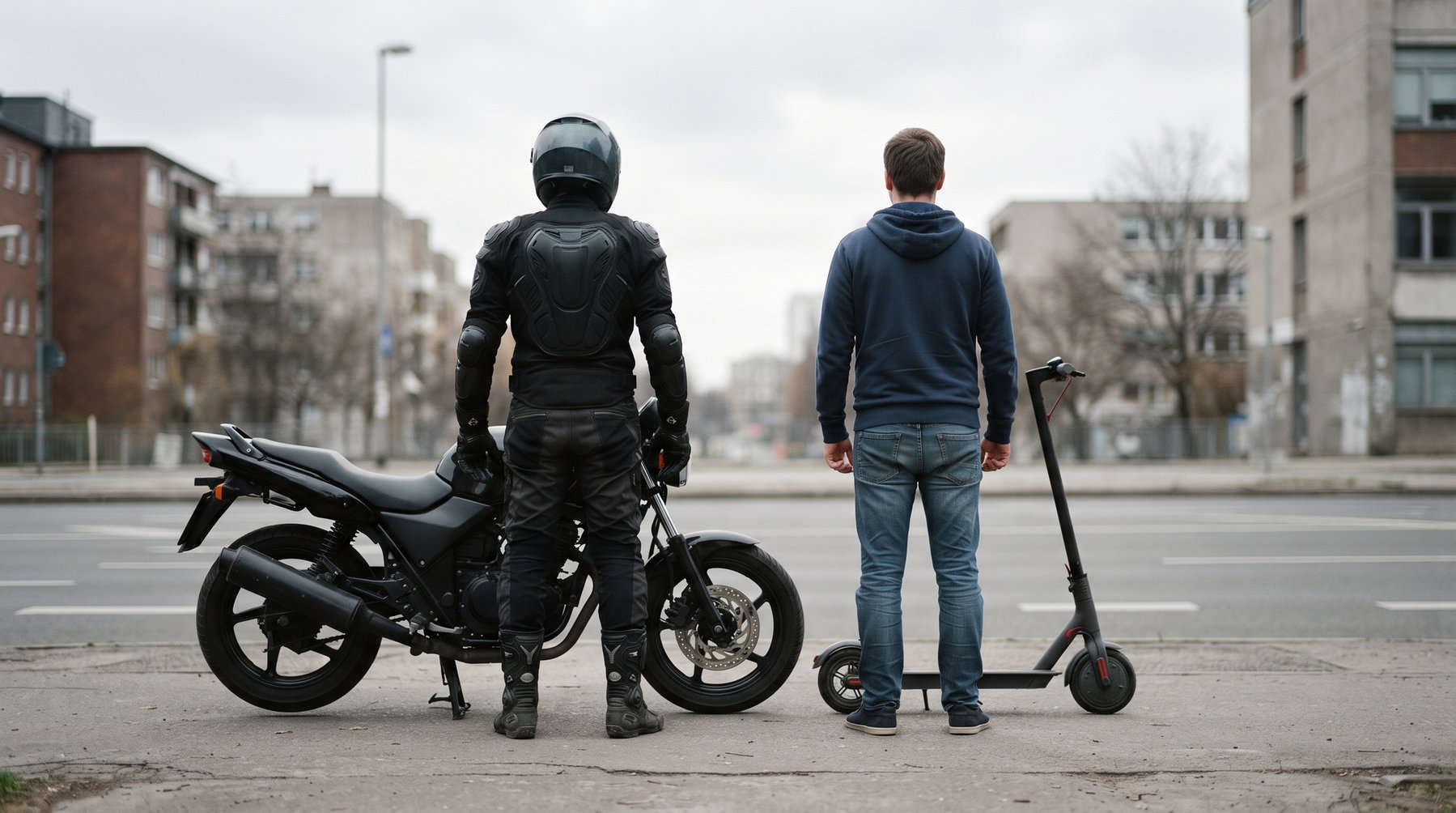
Many people regard the e-scooter as a harmless alternative to the motorcycle. A study published on 6 August 2026 in the journal „Scientific Reports“ calls that picture into question. A team led by first author Garikai Kungwengwe and surgeon David Bodansky of Chelsea and Westminster Hospital in London analysed two very different data sets and arrived at an injury pattern that differs clearly from that of a motorcycle crash. For the two-wheeler industry this is more than a footnote, because e-scooters and motorcycles increasingly compete for the same urban space and the same political debates.
What exactly did the study examine?
The analysis draws on 15,247 patients from the National Major Trauma Registry for England and Wales who were admitted between 2020 and 2022 with moderate to severe injuries. Among them were 580 e-scooter riders, 7,027 motorcyclists and 7,640 cyclists.
In addition, the researchers evaluated 23,193 self-reported incidents from the rental operations of the provider Voi. These reports come from ten trial areas in 18 cities and cover the period from July 2020 to December 2024. Behind them lie more than 33 million trips and 77.8 million kilometres. Both data sets were deliberately analysed separately and not linked to one another, because they capture different parts of the crash picture. The hospital registry shows what severe injuries look like. The operator data provide the reference figure, meaning how much riding actually took place.
Among the adult patients, the risk of a traumatic brain injury was 3.45 times higher for e-scooter riders than for motorcyclists and 1.74 times higher than for cyclists. Internal organ injuries occurred 1.46 times more often, vascular injuries to arteries and veins 3.24 times more often. Conversely, there was an advantage when it came to bone fractures: the fracture risk was 20 percent below that of motorcyclists and 10 percent below that of cyclists. The proportion of children is also striking. 16.2 percent of the injured e-scooter riders were under 18 years old, while for motorcyclists that figure was 6.2 percent.
Why is the comparison with motorcycles only of limited value?
The study does not say that an e-scooter rider crashes 3.45 times more often than a motorcyclist. What was compared is solely how injuries break down among people who had already arrived at hospital with severe trauma.
The authors stress this point repeatedly themselves. The registry does not record mileage for motorcycles and bicycles, so the risk figures describe the distribution of injuries within a mode of transport, not the risk per kilometre or per trip. Anyone wanting to know whether riding a motorcycle or riding an e-scooter is more dangerous overall will find no answer in this work. Further limitations apply. A large part of the survey period fell during the coronavirus lockdowns, when car traffic dropped by around a fifth. And the rental data cover only hire scooters, while in the United Kingdom alone an estimated one million private e-scooters are in use, which are not permitted on public roads there at all.
What role does the helmet play?
The helmet is the most conspicuous difference between the groups and, in the researchers’ assessment, a key reason for the preponderance of head injuries. Helmet use was documented for only 5.9 percent of the injured e-scooter riders, compared with 75.7 percent of motorcyclists and 45.0 percent of cyclists. In the rental data the rate was as low as 0.77 percent.
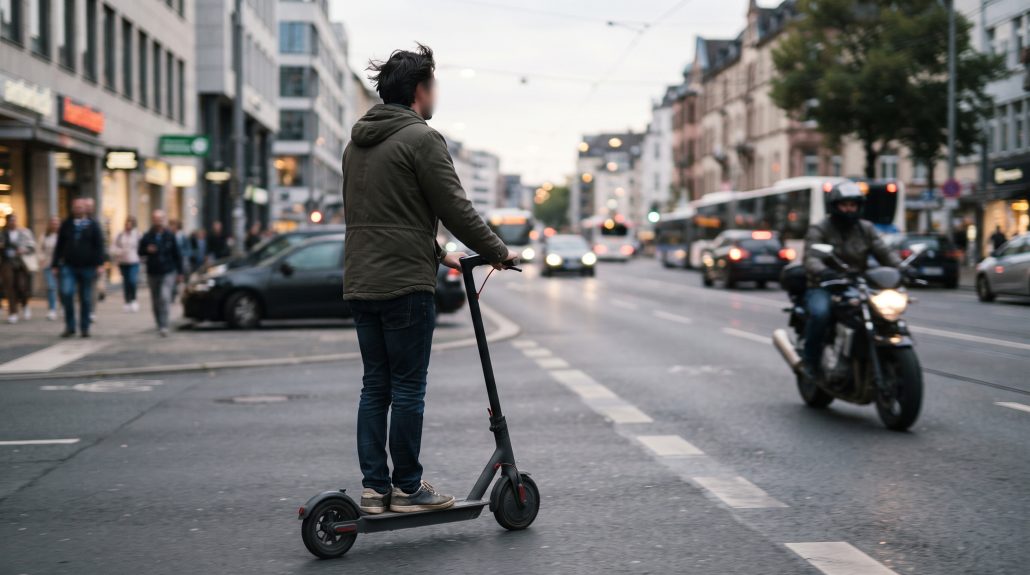
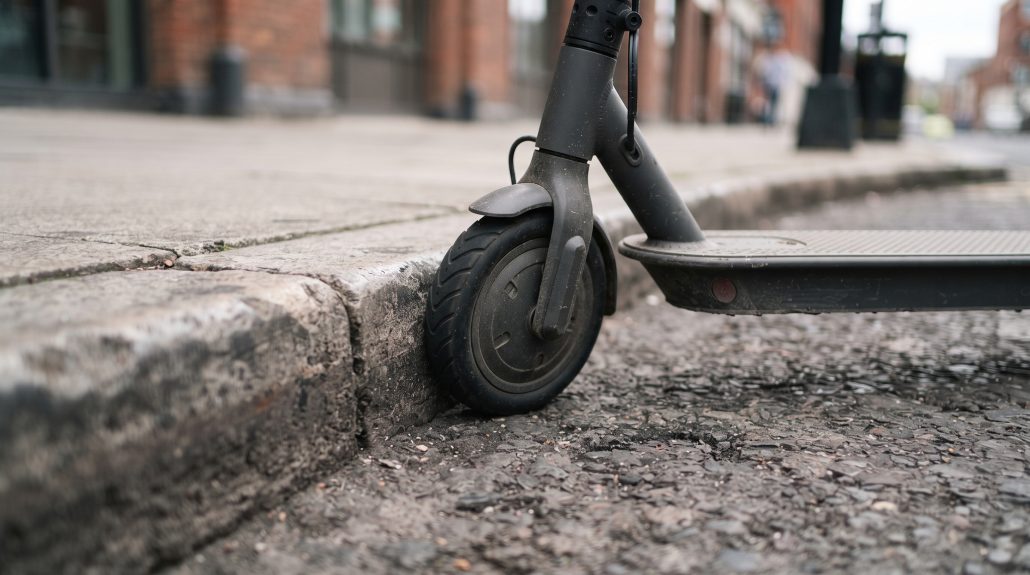
However, the researchers do not attribute the head injuries to the missing helmet alone, but also to the design of the vehicles. The rider stands upright, with a centre of gravity that sits high and well forward. If the scooter brakes abruptly, the body tips easily forward over the handlebars. Add to that small wheels, usually without suspension, which catch on kerbs, potholes or tram rails. In the authors’ view, precisely this mechanism also explains the many abdominal and vascular injuries, because the handlebar is pushed directly into the torso during a fall. As a consequence they call for, among other things, mandatory helmets, stricter speed limits, deformable handlebar grips and better brakes.
Why do women suffer more serious injuries on e-scooters?
In the rental data, women had a more than twice as high risk of reporting a serious injury and at the same time crashed more often than men. The collision rate for men was 36 percent below that of women, specifically 15.5 compared with 24.4 incidents per 100 users.
The study does not provide a clear explanation, but names several possible reasons. Most e-scooters are said to be designed for male body proportions, with handlebar height and centre of gravity demanding more upper-body strength. On top of that, surveys suggest women ride more frequently on pavements and unpaved surfaces, which almost doubles the risk of a serious injury. The age difference is even more pronounced: in the rental data, adults had a 78 percent lower crash risk than children and adolescents.
What does the situation look like in Germany?
The German figures point in the same direction, although with different emphases. According to the Federal Statistical Office, police recorded a total of 16,496 e-scooter crashes involving personal injury in 2025, an increase of 38.1 percent compared with the 11,944 cases of the previous year.
38 people died in these crashes, after 27 in 2024. 1,895 were seriously and 16,184 slightly injured. The share of e-scooters in all crashes involving personal injury rose from 4.1 to 5.5 percent. Young users are particularly affected: 53.6 percent of the injured e-scooter riders were under 25 years old. The most common form of misconduct recorded by police was improper use of the carriageway or pavement at 21.6 percent, followed by riding under the influence of alcohol at 10.9 percent and inappropriate speed at 8.4 percent. For comparison: among cyclists the alcohol share was 7.7 percent, and among registration-exempt motorised two-wheelers such as mopeds and small motorcycles 6.1 percent. The single-vehicle crash rate of 30.5 percent is also striking. 16 of the 33 e-scooter riders killed died without any other party being involved.
Against this background, the German Road Safety Council calls for a proof of competence modelled on the moped test certificate, as well as raising the minimum age from 14 to 15 years. According to a DVR analysis based on the Destatis data, around 2,200 of the injured e-scooter riders or unauthorised passengers in 2025 were younger than 15. Four of them died and 211 were seriously injured. DVR President Manfred Wirsch explains the demand as follows: “Anyone operating a motorised vehicle in road traffic needs the necessary maturity and experience.”
Point of contention: mandatory helmets
On the helmet question of all things, the British and German experts contradict one another. While the study authors recommend mandatory helmets, the Björn Steiger Foundation explicitly rejects them in its investigation completed in December 2025.
The foundation draws on police crash data from 2021 to 2024 as well as an emergency department study by the Unfallkrankenhaus Berlin covering 322 cases. There, too, the head and face region was the most frequently affected body region with 164 cases. According to the foundation’s analysis, however, only eight cases at the head reached a severity level that counts as a serious injury. Many of the remaining injuries were in the lower facial area, such as dental and facial fractures, which a helmet would not have prevented anyway. Mandatory helmets are therefore said to be an excessive intervention, with an urgent wearing recommendation and targeted campaigns being the milder option. Instead, the foundation focuses on the technology and calls for wheels of at least 10 inches to be made binding, with 11 or 12 inches recommended. According to this analysis, almost every second crash involving fatalities or serious injuries was a single-vehicle crash, and 43 percent of single-vehicle crashes were attributable to alcohol, with a further 32 percent caused by collisions with kerbs, bollards or other street furniture. The foundation rejects raising the permitted top speed to 25 km/h, because crash simulations by HTW Berlin showed a marked increase in head and chest acceleration at that speed.
What the figures mean for motorcyclists
For motorcyclists the study is neither a free pass nor evidence that riding a motorcycle is safe. Motorcycles still produce severe injuries, and in the registry data they even account for the higher share of bone fractures and the somewhat higher injury severity scores.
The difference lies elsewhere. In motorcycling, mandatory helmets, protective clothing, rider training and compulsory instruction have developed over decades. The e-scooter arrived on the road without any of that, in Germany since June 2019 under the regulation for small electric vehicles, without a licence and so far from the age of 14. The current debate takes up precisely this gap. From 2027, indicators will be mandatory for new e-scooters in Germany, fines for riding on pavements and for carrying a second person have been increased, and the inclusion of these vehicles in owners’ strict liability is going through the legislative process.
Frequently asked questions
-
How many e-scooter crashes were there in Germany in 2025?
Police recorded a total of 16,496 e-scooter crashes involving personal injury in 2025. That was 38.1 percent more than in 2024 with 11,944 crashes. 38 people died and 1,895 were seriously injured.
-
Are e-scooters really more dangerous than motorcycles?
That cannot be derived from the study. It compares only how injuries break down among patients who have already been severely injured, not how high the crash risk is per trip or per kilometre. In terms of injury pattern, e-scooters come off worse for the head but better for bone fractures.
-
Why do e-scooter riders suffer head injuries so often?
The researchers name two main reasons. First, only 5.9 percent of the injured riders wore a helmet. Second, the design with a high centre of gravity, a standing posture and small unsprung wheels encourages a fall head first over the handlebars.
-
Are helmets mandatory for e-scooters in Germany?
No, there is no helmet requirement in Germany. The German Road Safety Council strongly advises wearing one voluntarily, while the Björn Steiger Foundation rejects a legal obligation, pointing to the predominantly minor head injuries.
-
From what age can you ride an e-scooter in Germany?
The minimum age is 14 and no licence is required. The DVR is calling for this to be raised to 15 as well as for a proof of competence, because around 2,200 of those injured in 2025 were younger than 15.