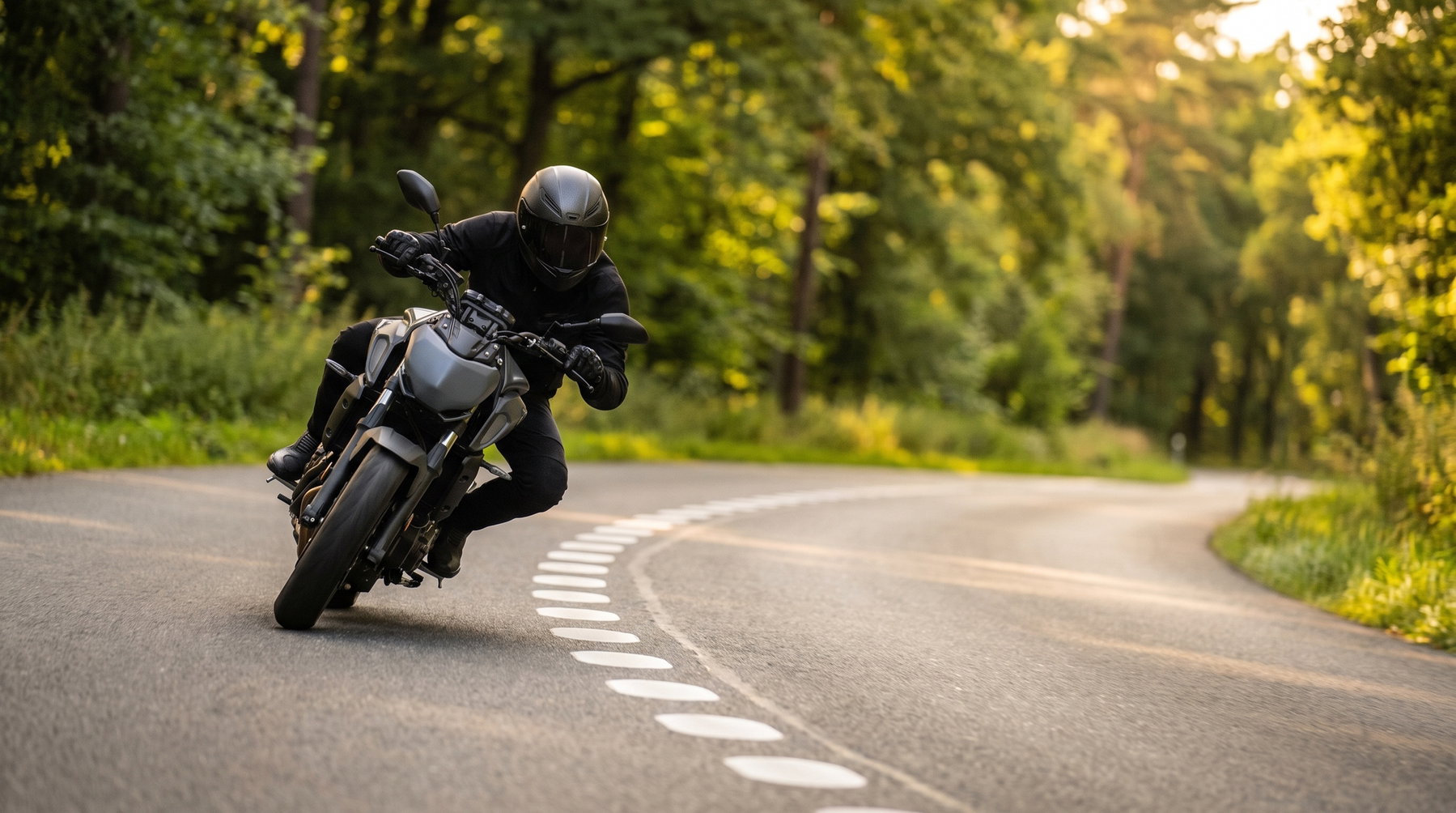
- Tyrol: 19 marked corners, 80 percent fewer motorcycle accidents involving injuries
- Scotland: 61 percent fewer motorcycle accidents with casualties at the trial sites
- Germany: trial running on the L218 in the Eifel region, further stretches are planned
A few white shapes on the tarmac do not exactly look like a major road safety measure at first glance. Even so, the European motorcyclists association FEMA has been pointing out for years that these very shapes change riding behaviour in corners. Evidence now comes from Austria, Great Britain and Germany. Norway has just launched a trial of its own.
How do motorcycle corner markings work?
The markings exploit a simple reflex: motorcyclists avoid riding over paint on the road surface. The systems make use of exactly this behaviour by placing the marking where the riding line should not go.
Behind it lies a well-known accident pattern. In left-hand corners many riders position themselves too far towards the centre of the road. Because of the lean angle, bike and upper body then reach into the oncoming lane. If a vehicle suddenly appears, a spontaneous correction is often no longer possible. According to the Austrian Road Safety Board, running off to the right in a left-hand corner is the second most common type of motorcycle accident after a fall. In an Austrian study, five out of six motorcyclists rode so far to the left that they would have had to correct their line had there been oncoming traffic. The first correction usually still works, the second often fails because of the rider’s fear of leaning further.
The German Road Safety Council describes a second pattern: anyone who cuts the corner and reaches the centre line before the apex will, at a constant speed, be carried out over the right-hand edge of the road at the corner exit.
What has Austria achieved with the ellipses?
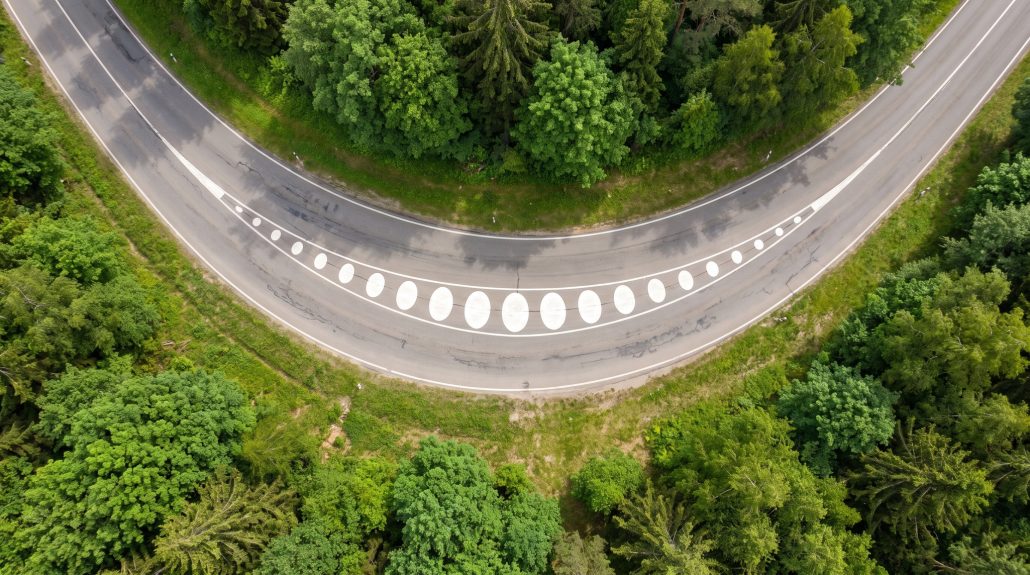
Austria applied white ellipses to 19 particularly accident-prone corners in Tyrol and subsequently counted 80 percent fewer motorcycle accidents involving injuries. The markings sit like a string of pearls along the centre line.
The Road Safety Board had selected the corners together with the province of Tyrol and the local road maintenance depots. These were locations where other measures had already failed. In early summer 2019 a film material of the type 3M Stamark 380 was used, among other reasons because of its high friction value and because the film can be ridden on immediately after application.
The figures behind it: over a comparison period of seven years, these corners saw an average of 13 injured and 0.6 fatalities per year. Between July 2019 and the end of 2021, a total of four accidents involving personal injury were recorded. After deducting the pandemic effect, meaning around ten percent less commuter traffic and 40 percent less leisure traffic, the reduction of 80 percent remains. There have been no fatal accidents in the marked corners since.
The effort involved is manageable. According to FEMA, film material worth less than 1,000 euros (around 1,160 US dollars) is usually enough for one corner, and paint makes it cheaper still. Initial trials with bars and ellipses were already running in Austria from 2017 on eight popular motorcycling routes.
What does the Scottish PRIME system look like?
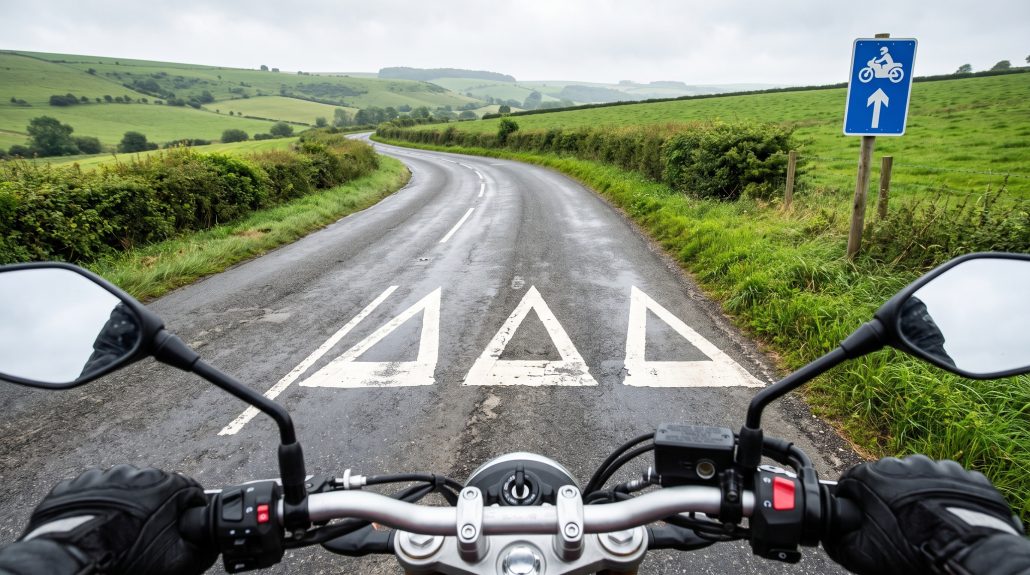
Scotland does not work with ellipses along the centre line but with three arrow-like gates ahead of the corner that the rider passes through. The system is called PRIME, spelled out as Perceptual Rider Information for Maximising Expertise and Enjoyment, and elsewhere at Transport Scotland also as Perceptual Rider Information for Maximisation of Enjoyment and Expertise.
The approach comes from applied psychology, where it is referred to as nudging, meaning a gentle prompt rather than a ban. Ahead of left-hand corners the gates sit at the right-hand edge of the lane, ahead of right-hand corners at the left. That matches the riding line taught in rider training courses. Because there are three gates, every rider can choose their own braking point depending on machine, riding style or weather. A sign ahead of the stretch explains the meaning.
Before installation, 200 motorcyclists and 200 car drivers were surveyed. Among the motorcyclists, 93 percent considered the marking a good idea, 96 percent a sensible concept, and 90 percent said they would use it in future. Among car drivers the figures were 91, 95 and 70 percent. In a further survey with 200 participants, 82 percent preferred the gate variant. White markings and three gates performed best.
The research was led by Professor Alex Stedmon, and the system was developed with the marking manufacturer WJ. The Road Safety Trust provided more than 215,000 pounds (around 247,000 euros / 288,000 US dollars) for it.
How well does PRIME work after five years?
A new report by the Road Safety Trust shows 61 percent fewer motorcycle accidents with casualties across all trial sites. For accidents involving fatalities or serious injuries, the reduction averages 46 percent.
In phase 1 between 2020 and 2022, 22 corners had been marked on trunk roads with speed limits of 50 or 60 miles per hour, spread across 750 square miles in the west of Scotland. Video recordings of more than 32,000 motorcycles were evaluated by hand. The result: significantly lower speeds, better riding position both on approach and at the apex, and better braking behaviour. At the previously known accident cluster sites carrying PRIME markings, there has not been a single motorcycle accident with casualties since the trials began.
Phase 2 from 2023 to 2025 covered a total of 35 sites, including 13 new corners and five sites from phase 1. More than 47,000 motorcycle movements were evaluated. This also showed that the effect carries over into subsequent corners and lasts over two, three and five years. Application itself usually takes one to two hours.
The markings are not legally binding. Nobody has to ride through the gates, and they are not yet prescribed in the British traffic signs regulations. Anyone wanting to use them needs a separate authorisation.
Where are the British sites located?
The markings can now be found in Scotland and in Wales. In Wales the government selected four sites in north and mid Wales: the A487 near Pantperthog in Gwynedd, the A5 at Coed Bwlch in Rhysgog near Llangollen, and two sections of the A483, one near Lower Crochan Farm north of Llanbadarn Fynydd and one at Glascoed Hall south of Newtown.
These sites were chosen because three or more accidents with casualties had occurred at each of them, in which the road layout probably played a role. Dyfed-Powys Police cite 25 accidents with at least one fatality in 2024 as the background, an increase of 66 percent compared with 2023.
In Scotland itself, Highland Council approved six sites on the A939 between Grantown and Nairn in January 2026, funded from Transport Scotland’s road safety fund. Six further local authorities are examining their use. In England, National Highways has applied to the Department for Transport to have the markings authorised.
What is Norway planning?
Norway is first testing in a pilot project whether the markings distract motorcyclists. The project is being led by the Norwegian Public Roads Administration and Nord University.
Selected participants ride a set route in calendar week 25 wearing eye-tracking glasses so that it can be measured where they look. The route was deliberately not made public. In calendar week 36, the same riders will ride the same route again, this time with ellipses on some sections.
The whole thing was initiated by the Norwegian motorcyclists association NMCU. Since August 2024 the association had repeatedly put the question to the roads administration. In June 2025, representatives of the association travelled to Austria together with Nord University, the road safety organisation Trygg Trafikk, the roads administration and the motorcycle importers to ride the ellipses themselves. The group was guided by Martin Winkelbauer of the Austrian Road Safety Board. NMCU managing director Arild Lind describes how he travelled there without any specific expectations and came back convinced that Norway needed a project like this too.
How far along is Germany with corner markings?
Germany has been trialling the ellipses since May 2023 on the L218 in the Eifel region, the so-called Panoramastrasse between Vossenack and Schmidt in the district of Düren. The section is regarded as an accident black spot, especially during the motorcycling season.
Around 30 and 40 ellipses of varying width respectively are laid along the centre line in two left-hand corners. The Institute of Highway Engineering at RWTH Aachen University is providing scientific support for the trial and evaluates riding behaviour using thermal imaging cameras. Number plates and faces are not identifiable on the footage, so no personal data is collected. Alongside Strassen.NRW, the district and the police of Düren are involved, and the state transport ministry is accompanying the project.
The first evaluation in September 2023 already showed that the safe riding line was taken twice as often as before, with lower cornering speeds at the same time. The interim results from April 2024 go into more detail: 85 percent of motorcyclists were riding within the safe zone. Before the markings there had been six accidents in each of 2020 and 2021, afterwards three minor accidents according to the district of Düren. After the markings were adjusted, no further incidents occurred. Strassen.NRW director Sascha Kaiser says the accident black spot can be „brought under control permanently“ in this way.
Formally the sign already exists: as sign Z343, corner marking for two-wheeled road users, it was introduced in the Federal Transport Gazette, although exclusively for the L218 trial stretch. The marking is not legally binding, and anyone may ride over it. For that reason it is deliberately not designed as a closed hatched area. Particular attention was paid to grip, and marking material without retroreflective glass beads is used.
In March 2026, North Rhine-Westphalia’s transport minister Oliver Krischer announced the expansion at the start of the season in Heimbach. Sections of the L234 near Bad Münstereifel are planned first, later the B266 between Vogelsang and Einruhr. There, however, material questions remain open because the route carries heavier lorry traffic. In October 2025 the German Road Safety Council called on the Federal Ministry of Transport to create the legal conditions for nationwide use.
What the markings cannot deliver
The markings replace neither rider training nor appropriate speed. They deliver information exactly where it is needed, and nothing more.
The much-quoted 80 percent figure from Tyrol also comes from a specific trial at selected corners and cannot be transferred to every country road. One point does suggest, however, that the effect is no coincidence: the Austrian study found that general warning signs are barely taken seriously by motorcyclists. The markings, by contrast, are clearly aimed at them alone, and that may be precisely where their effect lies.
According to the Austrian Road Safety Board, similar trials are also running in Switzerland, Luxembourg, Slovenia, Spain and Australia. That makes corner markings one of the few measures in the debate about safe motorcycling routes that involve neither bans nor closures. In North Rhine-Westphalia, 45 motorcyclists died last year, considerably fewer than the year before, while the number of slightly injured rose. Around a third of the accidents are single-vehicle accidents.
Frequently Asked Questions
-
What is a motorcycle corner marking?
A motorcycle corner marking is an additional marking on the road surface that guides riders onto a safe line through the corner. It is applied either as a row of ellipses along the centre line or as a series of three gates ahead of the corner. It is not legally binding, and anyone may ride over it.
-
Where can the markings be found in Germany?
So far only on the L218 between Vossenack and Schmidt in the district of Düren. A traffic trial with around 30 and 40 ellipses respectively in two left-hand corners has been running there since May 2023. Sections of the L234 near Bad Münstereifel are planned, as well as the B266 between Vogelsang and Einruhr in the longer term.
-
Are the markings slippery?
The road authorities deliberately use particularly grippy material without retroreflective glass beads. Measurement campaigns checked in each case whether the grip of the marking remains permanently above that of the surrounding surface. In Tyrol a film was used that has a high friction value and can be ridden on immediately after application.
-
How much do the markings cost?
According to FEMA, film material worth less than 1,000 euros (around 1,160 US dollars) is usually enough for one corner. With paint it becomes cheaper still. Compared with structural measures, the markings are therefore considered very inexpensive and have also proved durable.
-
What does the abbreviation PRIME stand for?
PRIME stands for Perceptual Rider Information for Maximising Expertise and Enjoyment. Elsewhere Transport Scotland uses the variant Perceptual Rider Information for Maximisation of Enjoyment and Expertise. In both cases the same system is meant: three gates ahead of the corner plus an explanatory sign.
➜ This article is part of our comprehensive overview: Motorcycle Law & Policy: Legislation, Court Rulings and Developments for Riders. Find all key information on this topic in one place.