- New EPA and CARB filings list the Ninja H2 and H2 Carbon as 2027 models.
- Certified peak output drops from 228 hp (168 kW) to 197 hp (145 kW).
- The engine now appears to share its emissions data with the naked Z H2 SE.
Documents from two U.S. agencies have surfaced, offering clues about the next evolution of the Kawasaki Ninja H2. The Environmental Protection Agency (EPA) and the California Air Resources Board (CARB) have certified the Ninja H2 and H2 Carbon for the 2027 model year. What stands out isn’t the certification itself, but a notably lower power figure. That puts the news in line with the wave of 2027 model-year updates, though this one carries a rather unusual twist.
What do the new certification documents say?
The filings list the Ninja H2 and H2 Carbon as 2027 models and base their figures on the emissions data of the Z H2 SE. Unlike in previous years, the H2 no longer receives its own separate certification, but instead inherits the data of its naked-bike sibling. The CARB paperwork also reveals that the H2 will use the same exhaust system as the Z H2 SE going forward, including a second catalytic converter. A catalytic converter transforms pollutants in the exhaust into less harmful substances. A second one points to tighter emissions requirements.
How much power does the Ninja H2 2027 lose?
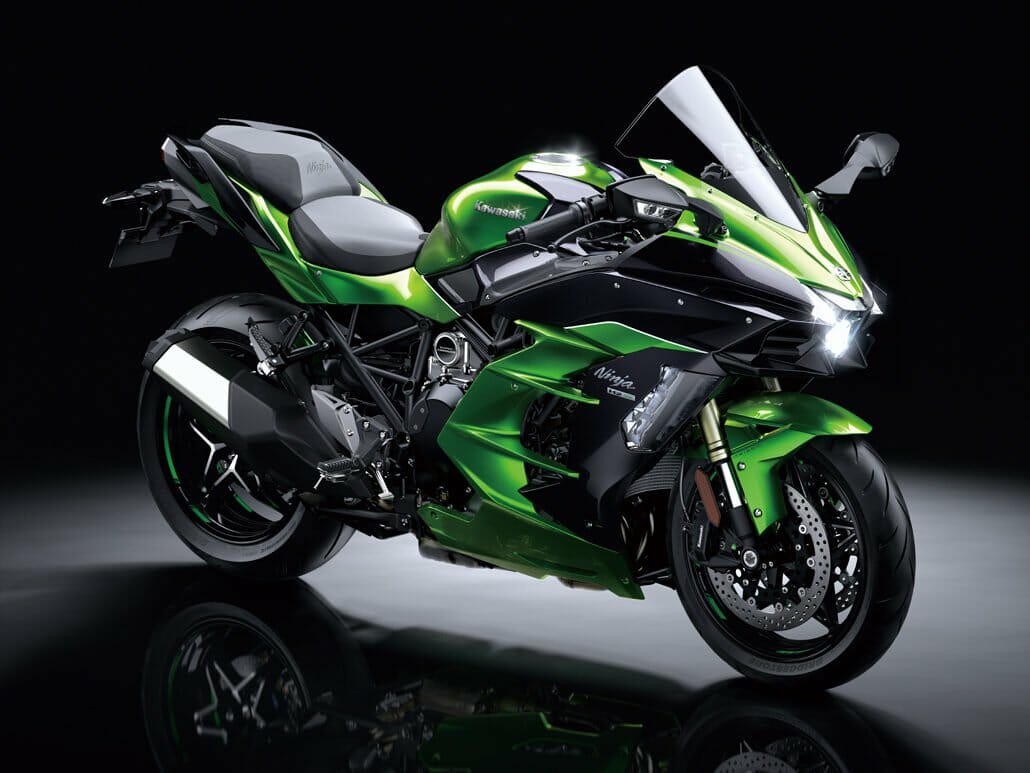
Certified peak output drops from 228 hp (168 kW) to 197 hp (145 kW). At the same time, peak power now arrives 1,000 rpm lower, at 10,500 rpm instead of 11,500 rpm. The fundamental architecture stays the same — it remains the 998cc supercharged inline-four. The supercharger forces extra air into the engine, producing the model’s signature muscular power delivery.
Why are different horsepower figures circulating?
Because two different measurement standards are being applied to the same motorcycle. Kawasaki itself quotes a peak output of 240 hp (177 kW) for the current H2. In U.S. certification papers, the same model had previously been listed at 228 hp. The discrepancy likely comes down to the different testing procedures used by manufacturers versus regulatory agencies. For an accurate comparison, the previous certified figure of 228 hp should be measured against the new certified figure of 197 hp, not the manufacturer’s claim against the agency figure.
Why is Kawasaki cutting the Ninja H2’s output?
Part of the explanation is likely the tighter emissions requirements, but the bigger factor is probably production itself. By adopting the Z H2 SE’s engine and exhaust specification, Kawasaki no longer has to manufacture and certify two closely related supercharged engines in different states of tune. That cuts costs and simplifies production. The second catalytic converter and the shared exhaust system fit the picture of a more unified supercharged engine lineup.

Is this a new generation of the Ninja H2?
Possibly, though it isn’t certain. Australian registration documents show that the 2027 models carry new type designations — ZXT02W for the H2 and ZXT02X for the H2 Carbon. The H2 has so far carried the ZXT02J designation. A change of letters like this suggests Kawasaki considers the model a distinct generation internally. However, the EPA and CARB filings cover emissions-related data exclusively. They offer no information about the chassis, electronics, or design.
Does that make the Ninja H2 2027 slower?
Not necessarily. Whether a lower figure on paper actually translates into a noticeably slower motorcycle is a separate question. A useful comparison is the Suzuki Hayabusa, which launched its redesign with a lower rated output. Many observers expected a noticeable step back, yet in direct riding comparisons it proved to be virtually just as fast. What’s more, 197 hp matches exactly the figure the first-generation H2 was certified at back in 2015. For a model Kawasaki positions as the pinnacle of its engineering, the lower figure remains notable all the same.

Where will the Ninja H2 2027 be available?
So far, only the U.S. market is confirmed; the picture for other regions remains open. The documents originate exclusively from the United States. In the United Kingdom, Kawasaki already announced last year that it would stop taking new orders for the street-legal Ninja H2 and H2 Carbon, making the 2026 model the final edition there. Whether and in what form the 2027 version will reach Europe remains unclear for now.
Frequently Asked Questions
-
How much horsepower does the Kawasaki Ninja H2 2027 have?
The Kawasaki Ninja H2 2027 is certified at 197 hp (145 kW) at 10,500 rpm. That matches the figure of the Z H2 SE, with which the model now shares its emissions data. The H2 was previously homologated in the US at 228 hp.
-
Why does the Ninja H2 2027 have less power?
The Ninja H2 2027 adopts the engine and exhaust specification of the Z H2 SE. That lowers the certified peak output while also helping to meet tighter emissions requirements. Simplifying production is considered the main reason.
-
Is the Kawasaki Ninja H2 2027 a new generation?
New type designations in Australian registration documents point in that direction, ZXT02W and ZXT02X instead of the previous ZXT02J. That isn’t final proof, since the available filings cover only emissions data and contain no information about the chassis, electronics, or design.
-
Is the Ninja H2 2027 coming to Europe?
That is currently unclear. The known documents concern only the United States. In the United Kingdom, Kawasaki is already not accepting new orders for the street-legal H2, which means a European market launch of the 2027 version is not guaranteed.
➜ More on this topic in our overview: New Motorcycles 2027: All Models, Releases and Highlights at a Glance.
➜ This article is part of our comprehensive overview: New Motorcycles 2026: All Models, Releases, and Highlights at a Glance. Find all key information on this topic in one place.