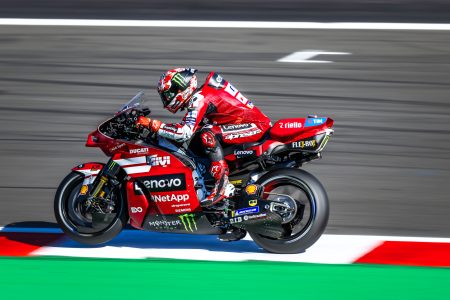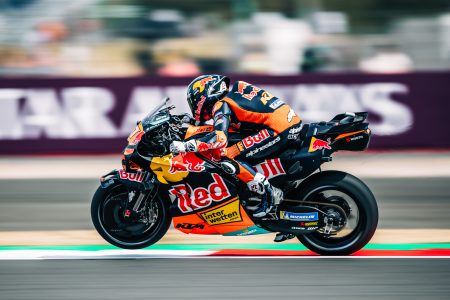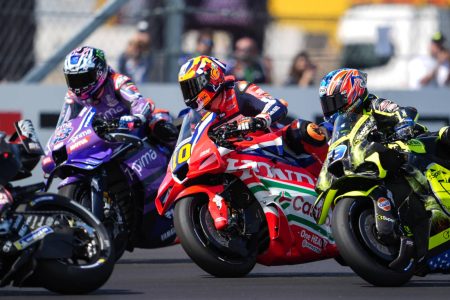
- The proposal was finally buried on the Sunday morning of the British Grand Prix at Silverstone
- KTM refused to agree, which left the manufacturers association MSMA without the required unanimity
- Officially it was about cutting costs, in reality the development status of the new 850 cc prototypes played the decisive role
For almost ten months the MotoGP paddock argued over an idea that would have changed the routine of every race weekend. From 2027, each rider was to have only one motorcycle available. On the Sunday morning before the British Grand Prix the matter was settled. According to a detailed report by the Spanish daily El Periódico, Carmelo Ezpeleta held individual talks with the representatives of all five manufacturers over the Silverstone weekend, meaning Ducati, Aprilia, KTM, Honda and Yamaha. In the end it stayed at two machines per rider.
What exactly was planned with the one-bike rule?
The plan was that each rider would have only one machine available during practice. The second was to stay at the back of the garage or in the truck and only be brought out again later.
Internally the proposal was first called the “WorldSBK rule”. That was a reference to the production-based Superbike World Championship, where each rider likewise has only one motorcycle in the garage. Later it became the “two-bike restriction”.
In the course of the discussion the plan was watered down. Dropping the second machine completely was no longer up for debate. Instead it was to be ready for use again from qualifying onwards, meaning in qualifying and in the race. Only in the remaining practice sessions would a single bike have been allowed. On top of that, a shortening of practice time was planned. This compromise did not find a majority either, and many of those involved regarded it as a cumbersome solution to a problem that would not have existed without the proposal.
Why did Aprilia and Ducati want just one motorcycle?
Officially it was about cutting costs. That argument lost force over the months, because both the championship itself and private teams demonstrated that costs can be reduced in other ways.
The proposal originally came from Aprilia and was immediately backed by Gigi Dall’Igna at Ducati, even though not everyone at the highest level in Borgo Panigale supported it. It was obvious that the savings would have remained modest: a second machine would have had to be on hand in individual parts anyway.
The longer the talks went on, the more clearly a different motive emerged. From 2027 a new technical set of rules applies, with 850 cc displacement, reduced aerodynamics and fewer electronic aids. After the first tests with the new prototypes, Aprilia and Ducati found that their motorcycles were several tenths of a second per lap quicker than those of KTM, Honda and Yamaha. On top of that, all manufacturers start 2027 on the same concession level, meaning with the same development freedoms.
With only one motorcycle in practice, development work becomes considerably slower. Direct comparisons between two set-ups or two new components are then no longer possible, and every change has to be tested one after the other. Opponents of the proposal therefore assumed that the two Italian manufacturers wanted to protect their advantage with it.
What consequences would the rule have had in racing?
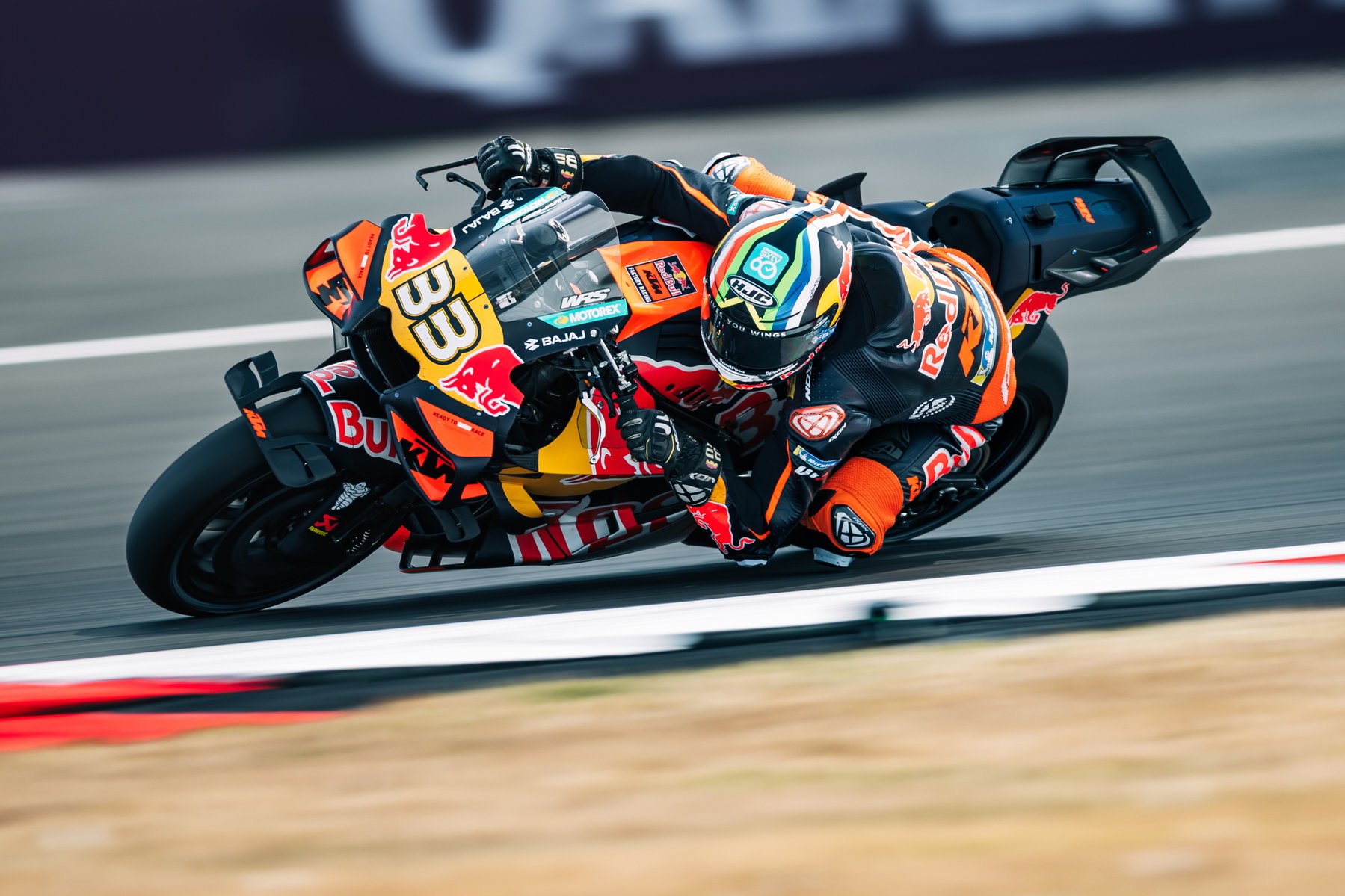
A crash could have taken a rider out of the weekend in an instant. Anyone crashing in practice would not have continued practising, anyone crashing in qualifying would have started from the very back, and anyone crashing in the warm-up would have missed the race.
There is a second point that concerns the sporting side. In so-called flag-to-flag races, riders switch in the pits to the second machine when rain starts, a bike already prepared with suitable tyres and its own set-up. With only one prototype this switch would be practically impossible, because a MotoGP machine cannot be converted from dry to wet in that time.
It is notable that all of this was negotiated without the riders. Not one of them was consulted. Several riders described the idea as far-fetched behind closed doors. One of the five MotoGP world champions in the field spoke out just as clearly at the Sachsenring and asked who had even come up with such a notion.
How KTM brought the proposal down
At an MSMA meeting on the Sunday morning of the Hungarian Grand Prix at Balaton Park it briefly looked like an agreement. KTM agreed there, but by its own account regretted it immediately.
A formal point proved decisive. The manufacturers had only reached a verbal understanding, and nothing legally binding was signed. That is exactly what made the U-turn possible. On the weekend of the Dutch Grand Prix at Assen, KTM informed the other MSMA members that it would not agree to a one-bike solution. From then on the Austrians did not change their position.
At the Sachsenring the differences could not be resolved, partly because Gigi Dall’Igna and Yamaha racing boss Paolo Pavesio were both absent. “The proposal for the one-bike rule is not off the table yet, but at the moment it looks considerably harder to push through”, one of the key people involved said at the time. Three weeks later the final decision was taken at Silverstone.
Honda also committed itself in the end. According to the report from Spain, team manager Alberto Puig played an important part in this, because he convinced Mikihiko Kawase, as Honda’s most senior representative at the track, to vote for two motorcycles. Yamaha largely stayed out of the debate and likewise did not block the solution that had been found.
What does unanimity mean in the MSMA?
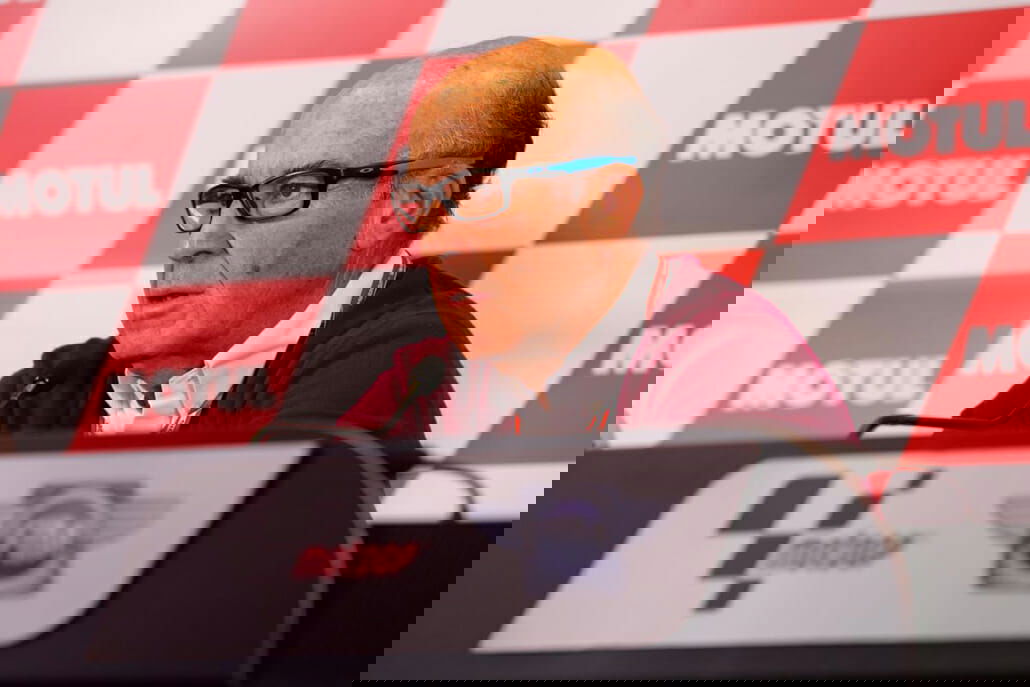
In the manufacturers association, unanimity means five votes out of five. That point caused a curious dispute, because an attempt was made from within the MSMA to sell a four-to-one ratio as unanimity as well.
Carmelo Ezpeleta, who was himself against the one-bike rule, rejected that clearly: “Unanimidad significa ‚sin discrepancias, unánimemente‘, es decir, cinco sobre cinco”. In English: “Unanimity means ‘without disagreement, unanimously’, that is, five out of five”.
The process behind it has two stages. First the manufacturers have to agree within the MSMA, then a proposal goes to the Grand Prix Commission. That body consists of representatives of the FIM, the MSMA, the teams association IRTA and the promoter MotoGP Group, and decides on rule changes by simple majority. Without a united manufacturer front the proposal was therefore blocked before it could even reach that stage. The MSMA is currently chaired by Massimo Rivola, who at the same time runs the Aprilia factory team.
How does MotoGP continue with its cost-cutting course?
Cost pressure remains an issue, just without the one-bike rule. Both the championship and private teams point to other ways of reducing spending.
Among the critics of the proposal was Lucio Cecchinello, owner of the LCR team and president of the teams association IRTA. The satellite teams also rejected the change because they saw no tangible benefit in it. In parallel, MotoGP is discussing a budget cap modelled on Formula 1.
The series is now run by the MotoGP Sports Entertainment Group, after US investor Liberty Media took over the former Dorna Sports. President and chief executive is Derek Chang, who is in constant contact with Ezpeleta. Proposals from the MSMA are generally accepted there, as long as all manufacturers support them jointly.
So the 850 cc era starts next year with one detail that remains unchanged despite all the technical upheaval: two motorcycles per rider in the garage. For the 2027 season, which brings the biggest rule break in decades anyway, that is one of the few constants.
Frequently Asked Questions
-
What was the MotoGP one-bike rule?
The one-bike rule proposed that from 2027 each MotoGP rider would have only one machine per race weekend. In a watered-down version, the second machine would only have been available again from qualifying onwards. Currently, and in future too, every rider has two motorcycles available.
-
Why did the proposal fail?
KTM refused to agree, which left the manufacturers association MSMA without the required unanimity. Without that unanimity the proposal could not even be put before the Grand Prix Commission. Honda ultimately sided with the two-motorcycle camp as well.
-
Which manufacturers were in favour of the one-bike rule?
The proposal came from Aprilia and was supported by Ducati. KTM briefly agreed at the Hungarian Grand Prix, but withdrew that agreement at Assen. Honda and Yamaha did not commit themselves for a long time.
-
What changes in MotoGP in 2027?
From 2027 a new technical set of rules applies, with 850 cc displacement instead of the previous 1000 cc, reduced aerodynamics and fewer electronic aids. All manufacturers start on the same concession level. Nothing changes about the number of two motorcycles per rider.
➜ More on this topic in our overview: 2027 MotoGP Season: The Complete Overview.
➜ This article is part of our comprehensive overview: 2026 MotoGP Season: The Complete Overview – Teams, Riders, Calendar & Championship Standings. Find all key information on this topic in one place.