- Ten mandatory modules and a digital logbook costing £17 (approx. €20 / $23) before the practical test
- The R plate period rises from 12 to 24 months, and the 45 mph limit is scrapped
- Anyone who started before 1 October 2026 can still take the test under the old system until 31 March 2027
Northern Ireland is going its own way on driver licensing. With Graduated Driver Licensing, GDL for short, the UK region is introducing a staged model designed to ease new drivers into road traffic step by step. Infrastructure Minister Liz Kimmins calls it the biggest reform of driver licensing and testing in almost 70 years. Young car drivers are the main focus, but several changes also affect anyone who wants to get a category A1, A2 or A motorcycle licence. Age makes no difference: the rules apply to everyone whose provisional licence starts on or after 1 October 2026.
What is changing for the motorcycle licence in Northern Ireland?
Learner riders must complete a fixed training programme with ten mandatory modules before the practical test and record every step in a logbook. After the test, the probation period is twice as long, but in return new riders may ride as fast as the respective speed limit allows from day one.
Until now, the path to the test was far less structured. The new programme is meant to set out exactly what a learner needs to learn to ride safely. Before the practical test, riders must also pass the theory test as before and complete CBT (Compulsory Basic Training) for the relevant category. The legal basis is an Act from 2016, and the Northern Ireland Assembly passed the necessary regulations on 23 June 2026.
Which training modules do riders have to complete?
The programme for categories A1, A2 and A comprises ten mandatory modules plus an optional eleventh module on motorway riding. The modules cover knowledge, riding skills, attitude and behaviour.
The ten mandatory modules at a glance
The first module focuses on the rider themselves, meaning their attitude and their health. This is followed by a block on risks and hazards, covering fixed and moving hazards, evasive manoeuvres to avoid a crash and emergency situations.
The third module deals with riding on the road. This includes rear observation, moving off, stopping and slow riding, junctions, roundabouts, traffic controls, road positioning, speed and turning. In the fourth module, learners are taught to share the road with others: anticipation, changing position, filtering through traffic, keeping safe distances, communicating with others and overtaking.
Module five is dedicated to vulnerable and other road users. These include children, pedestrians, cyclists, other motorcyclists and mobility scooter users, as well as cars, buses, lorries, horse riders and animals. The sixth module deals with speed, such as speed limits, riding on rural roads and the consequences of riding too fast.
The weather also has its own module. It ranges from rain and wet roads to snow, ice, fog and crosswinds through to dazzling sunlight and heat. Module eight covers riding at night, including the rider’s eyesight and the motorcycle’s lighting. The ninth module is about distraction and motorcycle technology, which also includes sat navs, riding with a pillion and luggage, and group rides. Finally, the tenth module covers fuel-efficient and eco-friendly riding.
Motorway riding as an optional extra module
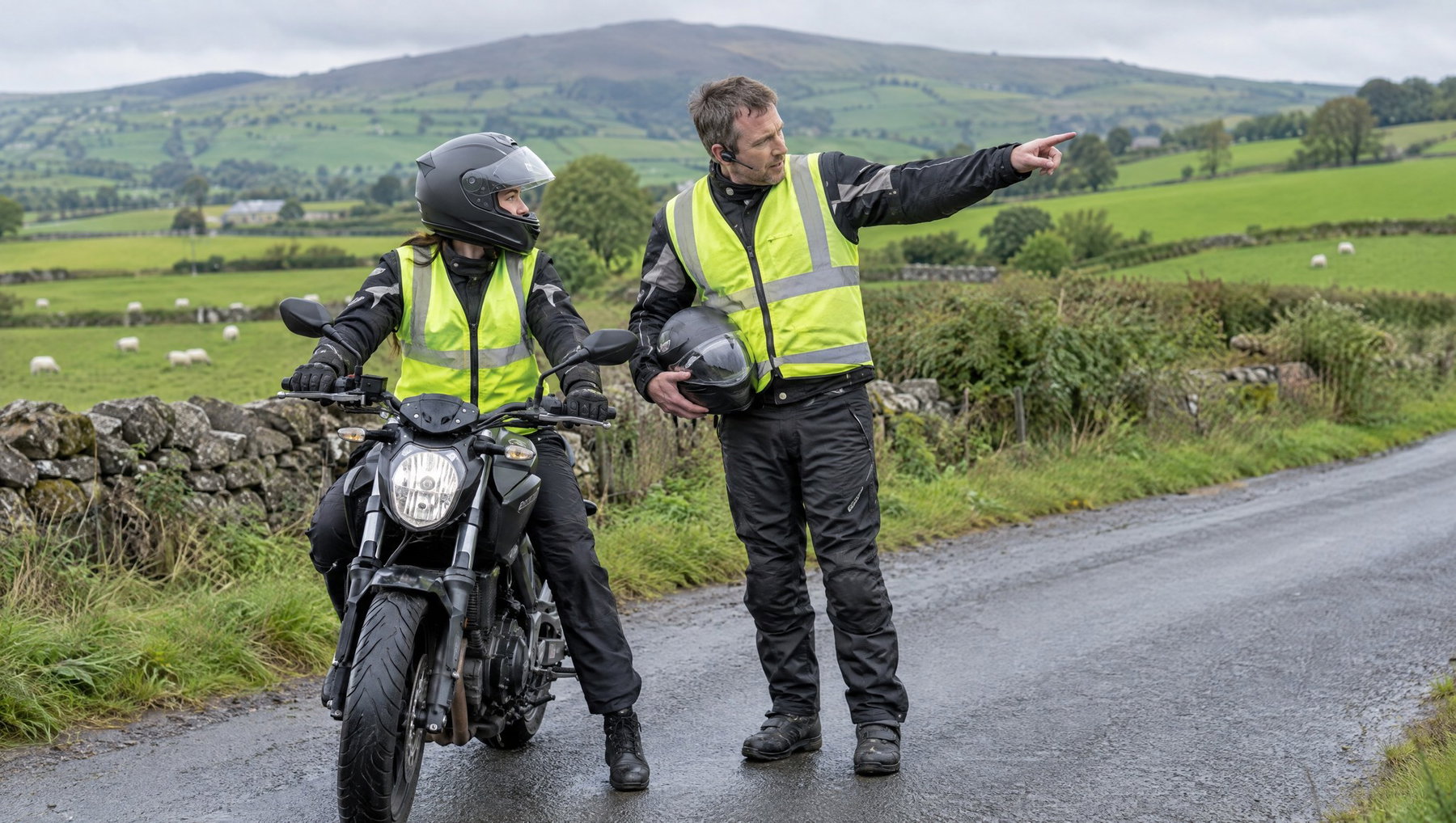
The eleventh module on motorway riding is optional. Learners may only use the motorway accompanied by an approved motorcycle instructor who stays in contact with them by radio. Once they have passed the test, new riders no longer need to be accompanied on the motorway. They can, however, still complete the module with an instructor or an experienced accompanying rider.
How does the digital logbook work?
The logbook is an app in which every completed mandatory module is recorded and signed off by an approved motorcycle instructor or an accompanying rider. Only after a final sign-off is the way clear for the practical test.
The account can be set up online or via an app for iOS and Android from 1 October 2026. It costs £17 (approx. €20 / $23). The system is linked directly to the booking system of Northern Ireland’s licensing authority, the DVA. A test can therefore only be booked once all requirements have been met. According to the Department, the cost of the training itself does not change. Learners can continue to learn with an accompanying driver, an approved instructor or both, and the fee for the practical test also stays the same.
What rules apply after passing the test?
New riders will have to display an R plate on their motorcycle for two years, compared with twelve months previously. At the same time, the previous 45 mph speed limit (around 72 km/h) for learners and newly qualified riders is being scrapped.
This means that newly qualified riders may ride as fast as other road users everywhere. The R plate is meant to show others that an inexperienced rider is on the road and to curb risky behaviour. According to the Department, anyone who fails to display it during the two-year period faces a fine of up to £1,000 (approx. €1,170 / $1,329) and three penalty points. The two years also match the existing probation period: anyone who collects six or more penalty points during this time loses their licence and has to retake the test.
How do the rules for riders differ from those for car drivers?
Motorcyclists are exempt from two key car rules: the six-month minimum learning period and the night-time passenger restrictions. Their training programme is also shorter.
Category B car learners may take the practical test no earlier than six months after their provisional licence begins. They also have to complete 14 mandatory modules instead of ten. In addition, young new drivers under 24 may carry no more than one passenger aged between 14 and 20 between 11 pm and 6 am during the first six months after the test. Neither applies to motorcyclists. They can take the test as soon as the programme, logbook, theory test and CBT are done.
Why is Northern Ireland introducing the staged model?
Northern Ireland wants to reduce the number of serious crashes involving young and inexperienced road users. New drivers and riders should first gain experience in less risky conditions.
Figures from the Department for Infrastructure show the problem mainly among young car drivers. In 2024, 164 people in Northern Ireland were killed or seriously injured in crashes caused by a car driver aged between 17 and 23. This age group is involved in 24 percent of fatal or serious crashes but holds only 8 percent of licences. Among motorcyclists of the same age group, the Department counted twelve killed or seriously injured in self-caused crashes in the same year.
According to the authority, the goal goes beyond pure riding skill. Drivers and riders should end up being safe, not just technically capable of what they are doing. That is why the programme is also meant to teach how attitude, personality, behaviour and emotions influence one’s own riding style. The Department cites the British Transport Research Laboratory, TRL. According to TRL, such staged models reduce crashes among young drivers by 5 to 40 percent, depending on their design. The authority names countries such as Australia, Canada, Norway, Sweden, Finland and parts of the USA as examples.
What applies to learners who started before 1 October?
Anyone who received their category A provisional licence before 1 October 2026 can continue to learn under the old system and take the existing test up to and including 31 March 2027. From 1 April 2027, the new rules apply to everyone.
This means that from this cut-off date, the practical test can only be booked once the new training programme including the logbook has been completed. This also affects learners who fail under the old system and retake the test on or after 1 April 2027. They will then also have to register with the new GDL system.
How do motorcycle organisations view the reform?
The National Motorcyclists Council (NMC) and the British Motorcyclists Federation (BMF) support structured training in principle. However, they want to see whether the new system actually works rather than simply assuming it does.
The organisations are mainly interested in one question: Does the additional training produce safer riders and lead more learners through to a full licence? Or do the extra effort and additional costs put some people off continuing their training? BMF Chairman Jim Freeman stresses that everyone involved shares the goal of reducing the high number of motorcyclists killed and seriously injured. At the same time, he warns:
“But we must also be careful not to assume that simply making motorcycle licensing more restrictive or complicated will automatically make riders safer. Any changes must be evidence-led, proportionate and affordable and should encourage, rather than discourage, riders to undertake further training and progress towards a full motorcycle licence.”
Freeman says Northern Ireland is taking its own path and the organisations will be watching the results closely. If structured training leads to safer riders, better hazard awareness and more full licences, the rest of the UK could learn from it. Equally important, however, is finding out whether individual elements unintentionally deter people from motorcycling or from continuing their training. He describes the shared goal as better-trained, safer riders with an accessible and affordable route to a full licence.
What does the reform mean for the rest of the UK?
For England, Scotland and Wales, the Northern Irish reform changes nothing for now, as motorcycle licensing rules in the UK are a matter for the individual nations. However, Northern Ireland thus becomes a real-world test for the debate in the rest of the country.
The UK government published a new road safety strategy in January 2026. It also includes a review of training, testing and licensing for motorcyclists. The Department for Transport and the testing authority DVSA are also examining how riders who stay on a provisional licence long-term after CBT can be moved towards a full licence. The experience from Northern Ireland is likely to feed into these considerations. However, it will take a while before the first reliable results are available.
Frequently Asked Questions
-
How many training modules are required for a motorcycle licence in Northern Ireland?
Since 1 October 2026, ten mandatory modules have been required for a motorcycle licence in Northern Ireland. There is also an optional eleventh module on motorway riding. The programme applies to categories A1, A2 and A.
-
How much does the logbook for the motorcycle licence cost?
The digital account for the training programme and logbook costs £17 (approx. €20 / $23). It can be used online or via an app. According to the Department, the cost of lessons and the test fee do not change.
-
Does the six-month minimum learning period also apply to motorcyclists?
No, the six-month minimum learning period only applies to category B car learners. Learner riders can take the test as soon as the training programme, logbook, theory test and CBT have been completed.
-
How long do new riders in Northern Ireland have to display an R plate?
New riders will have to display the R plate for two years instead of the previous twelve months. In return, the former 45 mph speed limit (around 72 km/h) for newly qualified riders is being scrapped.
-
What applies to learners who started before 1 October 2026?
They can still take the test under the old system up to and including 31 March 2027. From 1 April 2027, all learners must have completed the new training programme including the logbook before they can book a test.
➜ This article is part of our comprehensive overview: Motorcycle Law & Policy: Legislation, Court Rulings and Developments for Riders. Find all key information on this topic in one place.