- In collisions between cars and motorcycles, car drivers are primarily at fault in roughly two-thirds of cases.
- The most common reason is not speeding or distraction, but simply this: The motorcycle was not seen.
- Science has identified at least four mechanisms that make motorcycles virtually invisible to the human brain.
A car driver approaches an intersection. He looks left, looks right. All clear. He pulls out. Then comes the crash. A motorcycle. He didn’t see it. Not because he was inattentive. Not because he was looking at his phone. He looked directly in the direction the motorcycle was coming from. His brain simply didn’t register it. What sounds unbelievable is scientifically proven and is one of the most common causes of serious motorcycle accidents in Germany.
Why Is the Start of the Riding Season Particularly Dangerous for Motorcyclists?
The most dangerous phase doesn’t begin in the middle of the season, but right at the start. After roughly five months of winter, during which hardly any motorcycles were on the road, car drivers’ brains have readjusted. They scan traffic for what they’re accustomed to seeing: cars, trucks, pedestrians, cyclists. Motorcycles have disappeared from this mental search pattern.
The human brain works with expectations. It constantly compares what the eyes deliver against stored patterns. The narrow silhouette, the single headlight, the different speed of a motorcycle – after a long winter, none of this fits the pattern a car driver’s brain is looking for.
Researchers at Bournemouth University investigated and confirmed this phenomenon in 2022 in collaboration with the organisation DocBike: At the start of the season, the expectation of encountering motorcyclists in traffic is at its lowest. So-called LBFTS accidents (Looked But Failed to See) – crashes where car drivers actually looked but still failed to perceive the motorcycle – cluster precisely in this phase. It is only from mid-season onwards that perception gradually normalises.
How High Is the Risk for Motorcyclists on German Roads?
The numbers underscore the scale of the problem. In North Rhine-Westphalia, the number of motorcyclists killed rose by 48 percent in 2024 compared to the previous year. Nationwide, the fatality risk for motorcyclists is more than four times higher than for car drivers, according to ADAC. In 2023, 492 motorcyclists died in Germany – one in every five road fatalities.
One figure is particularly revealing and puts the entire topic in a different light: In collisions between cars and motorcycles, car drivers bear primary responsibility in roughly two-thirds of cases. Depending on the study, the figure ranges between 66 and 75 percent. The Federal Statistical Office reports a figure of 68.3 percent for 2019, based on 26,221 analysed car-motorcycle collisions. The ADAC evaluation for 2021 arrives at 66.4 percent from 16,435 cases. The Institute for Two-Wheel Safety (IfZ) puts the share as high as 71 to 75 percent.
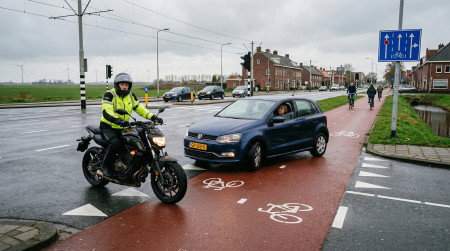
By far the most common accident type is not a collision on a country road and not a speeding crash. It is the classic turning and intersection accident: A car turns or pulls out and overlooks the motorcycle. According to ADAC accident research, 65 percent of motorcycle accidents at intersections occur because the other party violated the motorcyclist’s right of way. And the most common reason is not carelessness in the conventional sense. The most common reason is: The motorcycle was not seen.
What Happens in the Brain When a Motorcycle Is Overlooked?
A famous experiment from 1999 provides the explanation. Psychologists Daniel Simons and Christopher Chabris showed subjects a video in which two teams were passing a basketball back and forth. The task was simple: Count the passes of the white team. In the middle of the video, a person in a gorilla costume walked through the scene, stopped, beat their chest, and walked away. The result: Roughly half of all subjects did not notice the gorilla. Not because they had looked away, but because their brain was so focused on the given task that everything unexpected was filtered out.
Science calls this phenomenon Inattentional Blindness. At intersections, exactly the same thing happens: A car driver is looking for a gap in traffic. They watch for cars, traffic lights, pedestrians. Their brain filters out everything else. A motorcycle that doesn’t fit the expected pattern is simply not perceived.
Kimberley Pammer and her team at the Australian National University specifically investigated this in 2018. 56 adults were shown photos of driving scenes. In one scene, either a motorcycle or a taxi was unexpectedly inserted. The result was clear: 65 percent of participants overlooked the motorcycle. For the taxi, the figure was only 31 percent. Motorcycles were thus overlooked twice as often – and not by distracted or tired drivers, but by people who were attentively watching a scene. The researchers’ explanation: For most car drivers, motorcycles are not part of the so-called Attentional Set – the mental model of what one expects to see on the road. The brain has a kind of checklist, and motorcycle simply isn’t on it for many car drivers.
But there is yet another level that makes the whole thing even more disturbing. Research has shown that car drivers forget a motorcycle five times more often than a car. They saw it, it was registered in short-term memory, but before the information led to an action – such as braking or waiting – it had already vanished. Researchers call this phenomenon “Saw But Forgot.”
What Physical Factors Make Motorcycles Additionally Invisible?
The psychological effects are only part of the problem. There are also purely physical reasons why motorcycles are harder to detect.
When a car driver turns their head at an intersection, their eyes don’t move smoothly like a camera. They move in rapid jerks called saccades. During these movements, the brain completely shuts down visual processing to prevent motion blur. The driver notices nothing because the brain seamlessly fills in the gaps. But the gaps are there.
Kevin Williams documented this for his research on the “Science of Being Seen.” The shutdown begins three to four hundredths of a second before the eye movement and lasts about a tenth of a second after it begins. Since typical fixations at intersections last only about 0.4 seconds, a narrow object like a motorcycle can fall completely into such a gap. A car driver turns their head, their eyes jump, and in precisely the fraction of a second when the motorcycle would be in their field of vision, their brain is blind. This is not a failure of attention. It is a fundamental limit of human perception that science calls Saccadic Masking.
Added to this is the so-called Size-Arrival Effect. Researchers at the University of Queensland demonstrated in 2005 that people systematically overestimate the arrival time of smaller objects. A motorcycle approaching a car driver at the same speed as a car is perceived by the brain as further away and slower. The reason: The narrow silhouette offers fewer reference points. A single headlight instead of two provides less depth and speed information. Japanese researchers confirmed in 2024 with over 2,700 subjects: Car drivers accept smaller gaps before approaching motorcycles than before cars. They pull out because they believe the motorcycle is still far enough away. But it isn’t.
And then there is the A-pillar. Modern cars have increasingly thick A-pillars, driven by rollover protection requirements, curtain airbag housings, and steeper windshields. A motorcycle can completely disappear behind this pillar. With SUVs and crossovers with higher seating positions and wider pillars, the problem is particularly pronounced. A French study by Van Elslande and Fouquet showed that in 61 percent of the investigated car-motorcycle accidents, visual obstructions due to vehicle design were a contributing factor. The European MAIDS study, which analysed 921 motorcycle accidents in five countries in detail, identified poor conspicuity as a causal factor in 46 percent of all motorcycle accidents.
When you add all these factors together – Inattentional Blindness, Saccadic Masking, the Size-Arrival Effect, and the A-pillar – it becomes clear: The problem is not a single phenomenon. It is an entire system of perceptual traps working together.
What Can Car Drivers Concretely Do to Better Detect Motorcycles?
If two-thirds of accidents occur because the motorcycle was not seen, a large part of the solution lies with car drivers. The good news: There are concrete measures that demonstrably work.
First and foremost is the shoulder check. German driving education teaches a clear sequence: interior mirror, exterior mirror, indicator, shoulder check, then steer. In the driving test, omitting the shoulder check is an immediate fail. A Hamburg district court awarded 100 percent liability to a car driver who had caused an accident without a shoulder check. Yet surveys show that every third car driver with a blind spot assistant completely forgoes the shoulder check. Electronic assistance systems are a supplement, but no substitute for looking over your shoulder.
The second point sounds trivial but has a concrete neurological effect: Scan more slowly. If you consciously turn your head more slowly at an intersection, you reduce the saccadic gaps and increase the chance that your gaze actually lands on a motorcycle and registers it.
The third point is known among safety researchers as the “pigeon trick.” On the second look, lean slightly forward to change the viewing angle around the A-pillar. This makes objects visible that were previously hidden behind the pillar. It takes half a second and can make the decisive difference.
Fourth point: Look twice – left, right, left. The second look catches objects that fell into a saccadic gap or were behind the A-pillar the first time. This is not an exaggerated precaution; it is applied neuroscience.
The fifth point is possibly the most important: Actively search for motorcycles. Nottingham Trent University investigated in its 2025 study “Motorcycles in the Mind’s Eye” what happens when car drivers are educated about psychological blind spots. The result: In 92 percent of car drivers, the perception of motorcycles improved. Professor David Crundall summarises the findings: “Car drivers don’t deliberately ignore motorcyclists – they simply don’t expect them. Our brains are trained to search for what we’re used to seeing.”
British research also shows: Simply reading or hearing the word “bike” temporarily activates the brain to perceive motorcycles. This phenomenon is known as semantic priming. Car drivers who also ride motorcycles themselves detect motorcycles in traffic significantly better than car-only drivers, according to studies by the University of Nottingham using eye-tracking technology. Experience changes expectation, and expectation changes perception.
What Can Motorcyclists Themselves Do for Their Visibility?
Motorcyclists cannot control what happens in a car driver’s head. But they can control how visible they are.
In Germany, motorcycles are required by law to ride with their lights on. Studies put the safety benefit of daytime running lights at around 27 percent less accident risk. That alone helps, but there are additional measures with measurable effect.
A comprehensive study in the British Medical Journal examined the effectiveness of various visibility measures. Fluorescent or reflective clothing reduces accident risk by 37 percent. Light-coloured helmets provide a reduction of 24 percent. These are not estimates or opinions, but measured values from a population study.
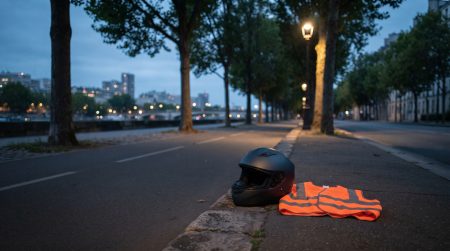
Nobody has to ride in a neon-yellow hi-vis vest. But a light helmet instead of a black one, a jacket with reflective elements – especially on shoulders and arms, where movement is visible to other road users – makes a measurable difference. Particularly at dawn and dusk and with low sun, precisely the conditions that occur most frequently at the start of the season.
Equally important is one’s own riding behaviour. The basic rule is: Ride as if you are invisible. Because for the brains of many car drivers, that is exactly the case. Concretely, this means: Expect that the car driver at the intersection doesn’t see you. Expect that the left-turning driver overlooks you – because that is the most common fatal accident constellation. Seek eye contact where possible. And when in doubt, brake once too often rather than once too few.
Four Mechanisms Working Together
The invisibility of motorcycles in road traffic is not a single phenomenon, and certainly not a problem of lacking attention. It is the interaction of at least four scientifically documented mechanisms: Inattentional Blindness causes the brain to suppress things it doesn’t expect. Saccadic Masking makes car drivers blind for fractions of a second without them noticing. The Size-Arrival Effect creates the illusion that the motorcycle is further away than it actually is. And the A-pillar of modern vehicles hides it in the blind spot.
All of this is particularly dangerous at the start of the riding season, when car drivers no longer expect motorcycles to be on the road after five months of winter. The Bournemouth University study confirms: It is only from mid-season onwards that perception normalises.
For both sides, there are concrete countermeasures. As a car driver: Consistently perform shoulder checks, scan slowly, look twice, and actively watch for motorcycles. As a motorcyclist: Dress visibly, expect to be invisible, and ride defensively.
A second look at the intersection takes two seconds. Behind every motorcycle helmet is a person with family, friends, and a life – someone is waiting for them.
Frequently Asked Questions
-
Why do car drivers overlook motorcycles so frequently?
Science has identified at least four mechanisms that work together. Inattentional Blindness causes the brain to suppress objects it does not expect. Saccadic Masking makes the driver blind for fractions of a second during rapid eye movements. The Size-Arrival Effect makes motorcycles appear slower and further away than they actually are. And thick A-pillars on modern vehicles can completely hide a motorcycle from view.
-
What percentage of car-motorcycle accidents are caused by car drivers?
In collisions between cars and motorcycles, car drivers bear primary responsibility in roughly two-thirds of cases. The Federal Statistical Office reports a figure of 68.3 percent for 2019, the ADAC evaluation for 2021 arrives at 66.4 percent. The Institute for Two-Wheel Safety puts the share at 71 to 75 percent.
-
What helps car drivers perceive motorcycles better?
Nottingham Trent University showed in 2025 that 92 percent of car drivers improved their perception of motorcycles simply through education about psychological blind spots. Concrete measures include consistent shoulder checks, slower scanning at intersections, looking twice, and consciously searching for motorcycles in traffic.
-
How can motorcyclists increase their visibility in traffic?
According to a study in the British Medical Journal, fluorescent or reflective clothing reduces accident risk by 37 percent, and light-coloured helmets provide a reduction of 24 percent. Daytime running lights, which are mandatory in Germany, reduce risk by around 27 percent. Reflective elements on shoulders and arms are particularly effective because movement there is visible to other road users.
-
Why is the start of the riding season in spring particularly dangerous for motorcyclists?
After roughly five months of winter, motorcycles have disappeared from car drivers’ mental search pattern. Researchers at Bournemouth University confirmed in 2022 that LBFTS accidents (Looked But Failed to See) cluster at the start of the season and that perception only normalises from mid-season onwards. In North Rhine-Westphalia, the number of motorcyclists killed rose by 48 percent in 2024 compared to the previous year.