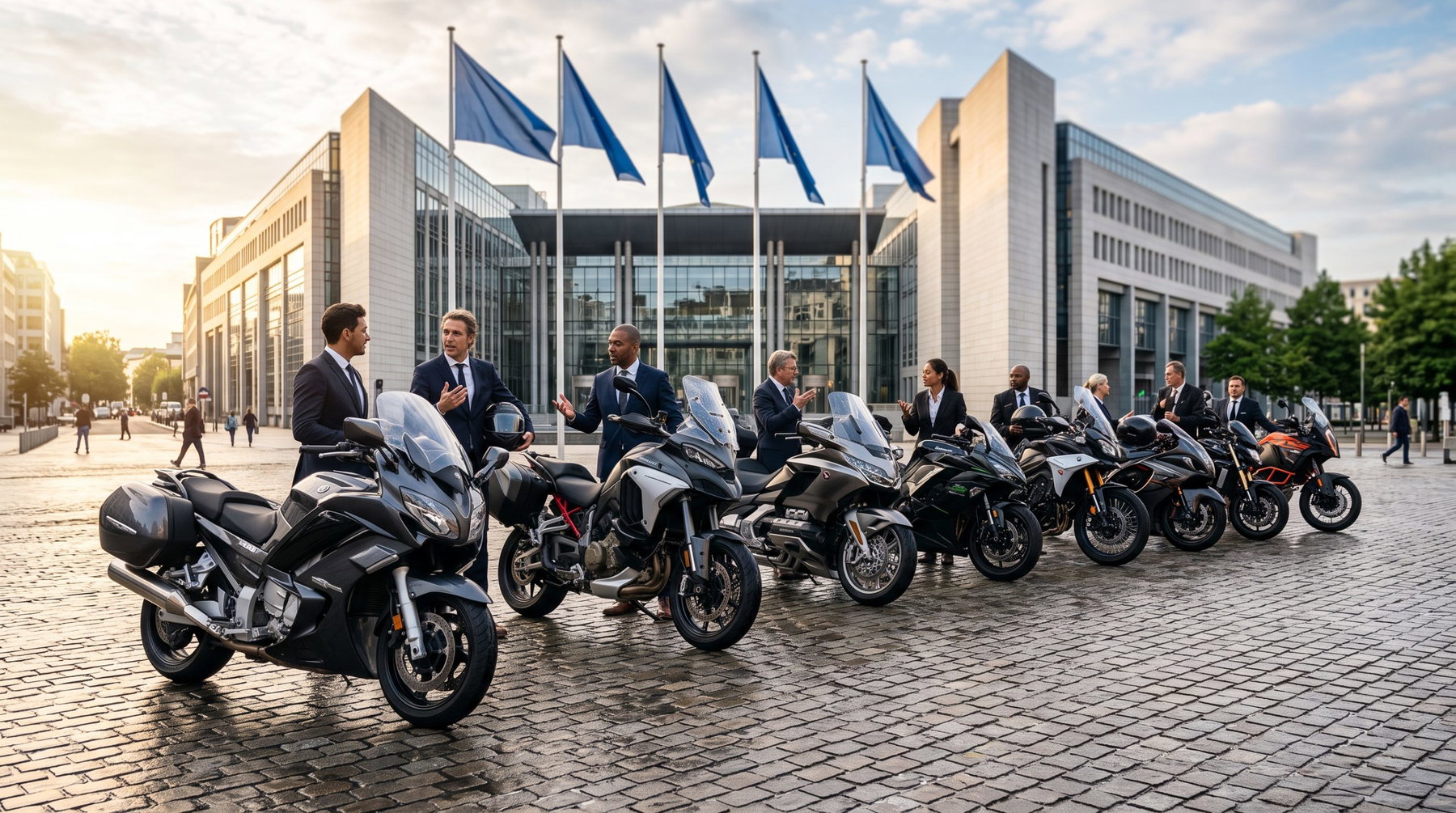
- Founded on 1 July 2026, chaired by German MEP Andreas Glück
- The rider organisations FEMA and FIM are official observers, the administration is handled by the manufacturers’ association ACEM
- For the kick-off, the founding members rode around 50 kilometres from ACEM headquarters to Lac de Genval
For years, rules have been created in Brussels that directly affect motorcycling. Emissions regulations are part of that, as are requirements on recycled plastics, vehicle safety, batteries and the recycling of end-of-life vehicles. Until now, such projects have mostly been developed with cars and trucks in mind, and two-wheelers simply ran along on the side. This is exactly where the new Motorcycling MEP Club comes in. It is meant to ensure that motorcycles, scooters and mopeds are considered before a draft law is politically locked down.
What exactly is the Motorcycling MEP Club?
The Motorcycling MEP Club is an official, cross-party group within the European Parliament that was founded on 1 July 2026. It has an elected board, is subject to the EU transparency rules and serves as a permanent channel of dialogue between members of parliament and the motorcycle industry.
According to FEMA, the European umbrella organisation of motorcyclists’ associations, the group is intended to give politicians a better understanding of the role that powered two-wheelers play in European mobility and in society. To that end, the club brings together MEPs, rider organisations, manufacturers, road safety experts and researchers. The organisational support is provided by the European manufacturers’ association ACEM.
Who sits on the club’s board?
The chair is held by German MEP Andreas Glück of the liberal Renew Europe group. Elected as vice-chairs were Matej Tonin from Slovenia for the European People’s Party, Bernd Lange from Germany for the Social Democrats and Nora Junco García from Spain for the European Conservatives and Reformists.
This composition is the real heart of the matter. Four countries, four political groups from the left through to the conservatives. That makes the Motorcycling MEP Club more than the initiative of a single political camp: it is a format capable of addressing majorities right across parliament. For a subject that has always been a marginal issue in parliament, that is a noticeable difference.
Which topics does the club want to follow?
The club is to deal with licensing rules, technical requirements for vehicles, environmental specifications, infrastructure and road safety. That covers practically every area in which European regulations feed through into the everyday life of motorcyclists.
The timing is no coincidence. The EU is currently setting a lot of new course for mobility and climate protection, and this has long since stopped being just about emissions figures. Requirements on recycled material, on battery technology and on the disposal of end-of-life vehicles also land sooner or later with the manufacturers of L-category vehicles. That umbrella term covers mopeds, motorcycles, three-wheelers and quadricycles. Anyone who only reacts once a proposal is on the table in parliament is usually too late.
What role do FEMA and FIM play?
Both organisations have joined the club as official observers. So they sit at the table without being voting members, and they bring in the perspective of riders as well as of motorcycle sport.
Wim Taal, Secretary General of FEMA, frames the founding as a channel of dialogue rather than a classic lobbying stage. In his words: “For both FEMA and FIM, the Motorcycling MEP Club should be viewed less as a lobbying target and more as a long-term relationship platform.” He goes on to explain that this makes it possible to build an understanding of motorcycling across party lines before legislative proposals harden politically. FEMA contributes the perspective of everyday riders and public policy, while FIM stands for motorcycle sport, technical expertise and international reach. Together, they want to present motorcycling as a societal topic and not as a niche interest.
The first ride led to Lac de Genval
A few minutes after the founding session, those involved got into the saddle. That same evening, ACEM held the second edition of its Summer Ride, attended by MEPs, representatives of the European Commission, industry representatives and delegates from FIM and FEMA. The route ran for around 50 kilometres from ACEM headquarters to Lac de Genval. All the founding members of the club rode along, so the body’s first day was also its first joint ride. The event concluded with a reception at the Parc du Cinquantenaire.
Symbolism is part of occasions like this. The practical value lies in the fact that legislators have experienced for themselves the subject they will later vote on. Also riding along was Uwe Seitz, the new managing director of the German industry association Industrieverband Motorrad.
Markus Flasch takes office as ACEM President
For Markus Flasch, the evening was his first public appearance as president of the European manufacturers’ association ACEM, and it fell on his first working day in that role. The CEO of BMW Motorrad had been elected in June at the ACEM general assembly at BMW Welt in Munich for a two-year term that began on 1 July 2026. He succeeds Michele Colaninno of the Piaggio group, who remains on the board as vice-president. Also on the board are Ducati boss Claudio Domenicali and Clément Villet of Yamaha Motor Europe.
Flasch has named three priorities for his term: L-category vehicles should feed more strongly into the urban mobility plans of major European cities, the industry should continue its path towards cleaner drivetrains without losing its competitiveness, and motorcycling in leisure, tourism and sport should become more visible as an economic factor. In the statement from BMW Motorrad he is quoted as saying: “L-category vehicles are not a niche, but part of the solution to the mobility challenges of our time.”
The figures behind this are modestly documented, but clear. ACEM represents 16 manufacturers as well as 17 national industry associations from 16 European countries. According to the association, around 300,000 jobs in Europe depend on the L-category, and according to a 2019 estimate more than 39 million motorcycles and scooters are on European roads.
What does this mean for motorcyclists in Germany?
Nothing changes immediately. The Motorcycling MEP Club does not pass laws, it creates access to those who do.
In the medium term, it can nevertheless have an effect. Two of the four board members come from Germany, and with Andreas Glück a German MEP holds the chair. The new ACEM president heads BMW Motorrad, his association elected him in Munich, and the German industry association was represented at the launch event. For Europe’s largest motorcycle market, that is an unusually dense set of personal connections to Brussels.
On top of that comes an effect that reaches beyond the EU. Technical standards and environmental requirements created in Brussels are frequently adopted worldwide by manufacturers, because separate model ranges for individual markets rarely pay off. Decisions in the European Parliament therefore often take effect in places where they do not legally apply at all. With that, the founding of the club fits into a development in which European transport and environmental policy increasingly determines how motorcycles are built, registered and ridden.
Frequently Asked Questions
-
What is the Motorcycling MEP Club?
The Motorcycling MEP Club is an official, cross-party group in the European Parliament that was founded on 1 July 2026. It is intended to improve the exchange between MEPs and the motorcycle industry and to ensure that two-wheelers are taken into account in new EU projects.
-
Who leads the Motorcycling MEP Club?
The chair is German MEP Andreas Glück of Renew Europe. The vice-chairs are Matej Tonin from Slovenia, Bernd Lange from Germany and Nora Junco García from Spain.
-
Which topics does the club address?
The agenda covers licensing rules, technical requirements for vehicles, environmental specifications, infrastructure and road safety. The club therefore covers the areas in which European legislation has a direct effect on motorcyclists.
-
Are rider organisations involved?
Yes, FEMA and FIM have joined the club as official observers. The administration of the club is handled by the manufacturers’ association ACEM.
-
Who is the new ACEM President?
Markus Flasch, CEO of BMW Motorrad, took office on 1 July 2026 for two years. He was elected in June at the ACEM general assembly at BMW Welt in Munich and succeeds Michele Colaninno.
➜ This article is part of our comprehensive overview: Motorcycle Law & Policy: Legislation, Court Rulings and Developments for Riders. Find all key information on this topic in one place.