- On average, fines are set to rise by 2.7 percent, but rounding pushes some individual amounts up by as much as 10 percent.
- Running a red light, overtaking on the right and unnecessary noise will each cost 330 euros, tailgating from 400 euros.
- Parliament and the Council of State criticise the increase, but the government is sticking to it for now.
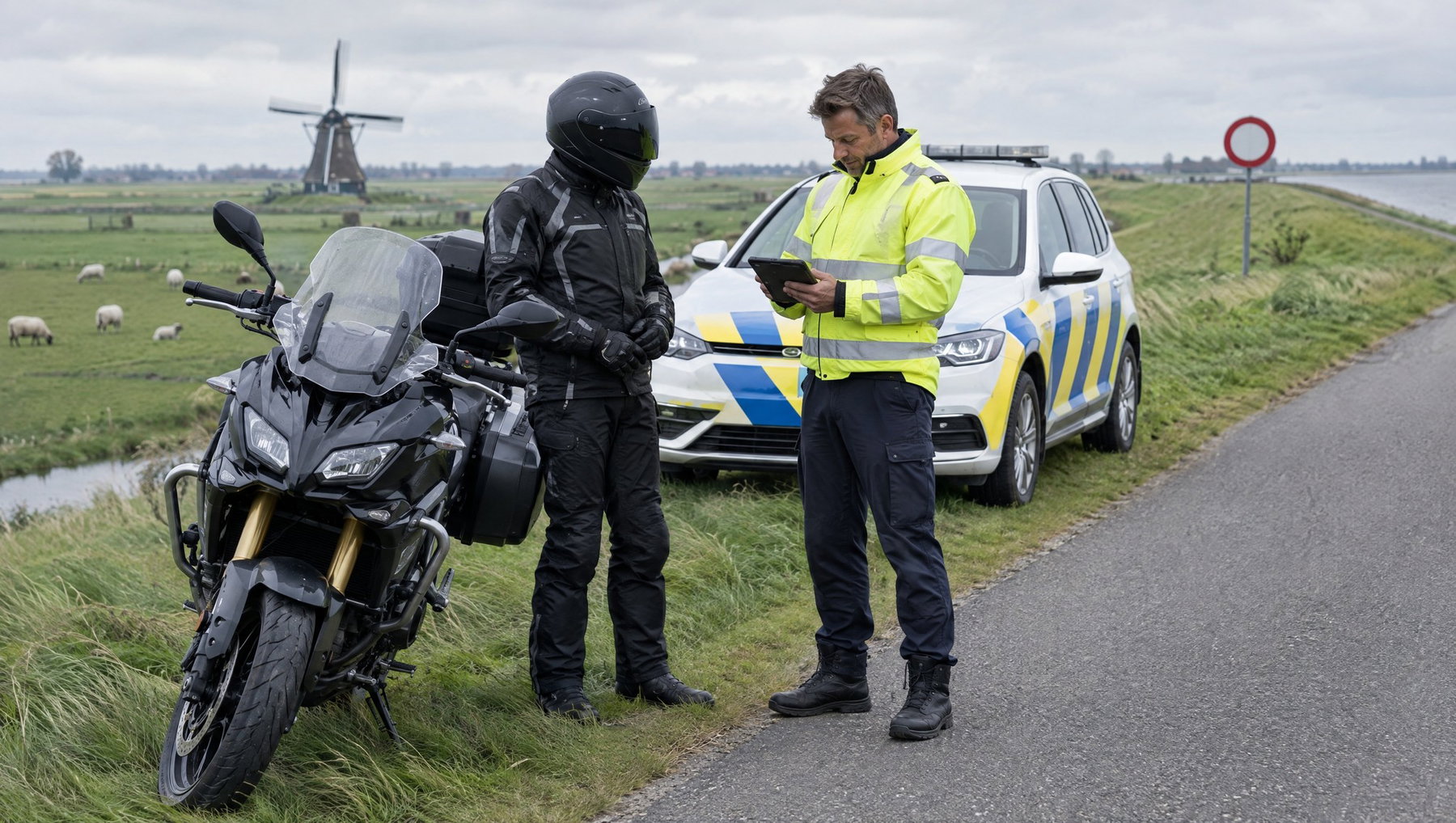
Anyone riding a motorcycle to the North Sea coast, through Limburg or along the dykes of Friesland should already take the traffic rules in the Netherlands seriously. Most offences there cost many times what is charged in Germany. For 2027, the government in The Hague is planning the next round. The basis is a draft from the Ministry of Justice which, as every year, is meant to adjust fines in line with inflation. Most of the new amounts apply equally to motorcycles and cars, while some items only concern cars. The plans are part of a series of legal changes in Europe that motorcyclists should know about before their next trip abroad.
How much will fines in the Netherlands rise in 2027?
On average, fines are set to rise by 2.7 percent. That matches inflation between March 2025 and March 2026. Because the amounts are rounded, however, some increases turn out considerably higher.
The rule behind it is simple. Most fixed fines above 100 euros are rounded to the nearest ten euros. A calculated increase of a few euros can therefore quickly become 10 or 20 euros. One example is needlessly riding in the left lane of a motorway or expressway: it will cost 300 euros instead of 280 euros, a good 7 percent more. Anyone unable to show their driving licence at a check pays 120 instead of 110 euros, an increase of around 9 percent.
The biggest jump concerns driving a car without insurance: the amount rises from 500 to 550 euros, an increase of 10 percent. The provisional list for 2027 does not include a figure for uninsured motorcycles.
Speeding offences are an exception. These amounts are rounded down to whole euros and therefore rise only slightly, usually by 2 to 3 percent. For comparison: in 2026, fines were raised by 2.6 percent overall.
What will speeding offences cost from 2027?
A fine is due from just 4 km/h over the limit, after deducting the measurement tolerance, and it increases with every additional kilometre per hour. The amount depends on whether the offence takes place in a built-up area, outside built-up areas or on the motorway.
The planned amounts for 2027 at a glance, with the 2026 figure in brackets where known:
- 5 km/h too fast in built-up areas: 47 euros (46).
- 10 km/h too fast: built-up areas 98 euros (95), outside built-up areas 92 euros (89), motorway 86 euros (84).
- 20 km/h too fast: built-up areas 262 euros (255), outside built-up areas 250 euros, motorway 235 euros (229).
- 30 km/h too fast: built-up areas 458 euros (446), outside built-up areas 436 euros (424), motorway 400 euros (389).
On the motorway, fixed amounts apply up to 40 km/h over the limit. At 37 to 40 km/h too fast, the fine there is 538 euros. In and outside built-up areas, the fixed tariff already ends at 30 km/h. Beyond that there is no flat-rate amount, and the public prosecutor decides on the penalty. Separate, higher amounts apply in roadworks and in traffic-calmed residential zones.
Which offences cost motorcyclists the most?
Apart from speed, the offences that get expensive on a trip are mainly those involving overtaking, traffic lights and following distance. Many of them will cost 330 euros, and tailgating at least 400 euros.
One item is particularly relevant for motorcyclists: making unnecessary noise with a vehicle will cost 330 euros from 2027 instead of 320 euros. The draft sets the same amount for a whole range of other offences:
- Overtaking on the right: 330 euros instead of 320 euros.
- Ignoring a no-overtaking rule: 330 euros.
- Red light: 330 euros instead of 320 euros.
- Failing to give way to traffic from the right: 330 euros instead of 320 euros.
- Blocking a junction: 330 euros.
- Using or stopping on the hard shoulder without reason: 330 euros instead of 320 euros.
Tailgating is even more expensive. At speeds up to 80 km/h, the fine is at least 400 euros, up from 380 euros. At higher speeds, the public prosecutor decides. Needlessly riding in the left lane on a motorway or expressway costs 300 euros.
On top of that come smaller items that can happen quickly. Riding over a footpath or cycle path costs 200 instead of 190 euros, and unnecessary use of the horn also costs 200 euros. A defective brake light costs 200 euros, an illegible number plate 190 euros. Turning without indicating costs 130 euros. As for lighting, an unnecessarily switched-on front fog light costs 130 euros, and a rear fog light used without reason 200 euros. Entering a low-emission zone without authorisation also costs 130 euros.
Which fines matter specifically for motorcyclists?
Some offences apply exclusively to motorcycles, such as an exhaust that is too loud, a missing helmet or missing mirrors. The provisional list for 2027 contains no amounts for these and a few other items, so the following figures reflect the 2026 rates.
The exhaust can be the most expensive. If it is louder than permitted, the fine is 380 to 500 euros, depending on how far the limit is exceeded. Which limit applies depends on the type of motorcycle and its engine capacity.
Equipment can also quickly cost money:
- No helmet: 190 euros per person, so also for the pillion.
- No mirrors fitted: 190 euros.
Some offences that affect all riders and drivers also have no 2027 figure yet. With the driving licence, it depends on the case. Anyone riding or driving without a licence at all pays 430 euros, as does anyone whose licence expired more than a year ago. If it expired less than a year ago, the fine is 130 euros. Anyone driving despite a confiscated licence pays 460 euros.
What changes for car drivers?
The most expensive fixed fine mainly affects car drivers: anyone holding a mobile phone while driving will pay 450 euros instead of 440 euros. There are also some items that only apply to cars.
Not wearing a seat belt costs 200 euros instead of 190 euros. Carrying children under 12 years and under 1.35 metres tall without a child seat costs 300 euros instead of 280 euros. If the third brake light fails on a car first registered after 30 September 2001, the fine is 130 euros. The fine for a car without a valid roadworthiness test remains unchanged at 190 euros.
Little changes when it comes to parking. Illegal parking, parking without a parking disc where one is required, and stopping on the pavement still cost 130 euros. On a general disabled parking space it is 410 euros, and on a space reserved for a specific vehicle 500 euros.
How expensive is this compared with Germany?
The differences from Germany are considerable. For the same offences, most fines in the Netherlands cost many times as much.
A simple red-light offence costs 90 euros and one point in Flensburg in Germany, while in the Netherlands it will cost 330 euros. Anyone 30 km/h too fast outside built-up areas pays 150 euros in Germany. On a Dutch motorway it is 400 euros, on a rural road 436 euros. Using a phone at the wheel costs 100 euros in Germany and 450 euros across the border.
The amounts also differ widely for overtaking and following distance. Overtaking on the right outside built-up areas can cost 100 euros and one point in Germany, but 330 euros in the Netherlands. A following-distance offence up to 80 km/h with endangerment costs around 30 euros in Germany, compared with 400 euros in the Netherlands.
The Netherlands has no points system like Flensburg. Experienced drivers there only receive a point for alcohol offences, while stricter rules apply to novice drivers. Even so, you can quickly lose your licence: anyone 50 km/h or more over the limit who is stopped by police must surrender it immediately. The public prosecutor then decides within ten days whether it will be withheld. A driving ban from the Netherlands only applies there, and offences abroad do not lead to points in Flensburg.
Has the increase for 2027 already been approved?
No, the new amounts are not yet final. They come from the government’s draft, which is planned to take effect on 1 January 2027.
There is political resistance to the plans. On 22 September, the House of Representatives, the Dutch parliament, adopted a motion calling on the government to drop the increase altogether. The motion is backed by parties with a combined 83 seats. Their argument: fines are meant to improve road safety, not to plug holes in the budget. The government had advised in advance that the motion be rejected because it contains no counter-financing. The governing parties voted against it. Such a resolution is not binding, so the draft remains on the table. As early as November 2025, the then minister had stated that he would not implement a similar motion.
The Council of State, the government’s most important advisory body, is also sceptical. It demands a better justification of why a further increase should be necessary and appropriate. In its view, lost revenue must not be the deciding factor. Forgoing the annual adjustment would, in the Council of State’s opinion, be an obvious first step. The government is not bound by this advice either.
The timetable was tight from the start. According to a Ministry of Justice note from April, the public prosecution service was to load the new amounts into its systems by 6 November at the latest so that the 1 January date could be met. Whether this has happened, the ministry has not yet made public, and the increase has not yet been published in the official gazette. If the procedure is delayed, the increase is to come on 1 February or 1 March 2027. According to the ministry, forgoing the annual adjustment would permanently cost the budget around 30 million euros a year. Each month of delay would therefore mean roughly 2.5 million euros less revenue.
Why are Dutch fines being criticised?
Over decades, fines have risen far faster than prices. Since 1994 they have increased by more than 220 percent, while the cost of living rose by only about 70 percent over the same period.
The reason is that the government has at times raised the amounts for budgetary reasons, not just because of inflation. The Council of State describes the consequence as follows: fines for simple traffic offences, which are imposed in a separate administrative procedure, are now on average higher than comparable penalties under criminal law. The government itself admits that the two systems have become unbalanced.
As early as May 2023, the public prosecution service presented a report identifying precisely this imbalance. One of its recommendations was to stop adjusting fines for inflation until the balance has been restored. The government rejected this in June 2025, citing the financial consequences of up to 300 million euros a year if all recommendations were implemented.
What happens if a fine from the Netherlands is not paid?
Anyone who does not pay on time pays considerably more. With the first reminder, the amount rises by 50 percent. With the second reminder, a further 100 percent is added to the already increased amount, tripling the fine. A 330 euro red-light fine thus first becomes 495 euros and then 990 euros.
Since 1 July 2026, the central collection agency CJIB has been testing a preliminary stage: anyone who misses the payment deadline first receives a free payment reminder with a yellow section. After that, there are still two weeks to pay the original amount. Only then does the first increase apply.
In addition, every fine currently carries a 9 euro CJIB administration fee. A red-light offence thus becomes 339 euros. Ignoring it does not help: fines from the Netherlands are also enforced in Germany via the Federal Office of Justice, and the Netherlands makes regular use of this. The threshold is 70 euros including fees. That is quickly reached for most offences, at the latest after one reminder.
Frequently Asked Questions
-
Netherlands fines 2027: When do the new amounts apply?
The planned date is 1 January 2027. However, the increase has not been finally approved, and parliament has called on the government to drop it. If the timetable slips, the government intends to introduce the new amounts on 1 February or 1 March 2027.
-
How expensive is speeding in the Netherlands in 2027?
That depends on how far over the limit you are and where. 10 km/h too fast costs 98 euros in built-up areas and 86 euros on the motorway, 30 km/h too fast costs 458 euros in built-up areas and 400 euros on the motorway. From 31 km/h over the limit in and outside built-up areas, and from 41 km/h on the motorway, the public prosecutor decides.
-
What does unnecessary noise with a motorcycle cost in the Netherlands?
Making unnecessary noise with a vehicle will cost 330 euros from 2027, up from 320 euros. If the exhaust is louder than permitted, the 2026 rates are 380 to 500 euros depending on how far the limit is exceeded. A 9 euro administration fee is added in each case.
-
Does the Netherlands have penalty points like Germany’s Flensburg system?
No, there is no points system like the one in Flensburg. However, anyone caught 50 km/h or more over the limit and stopped by police must surrender their licence on the spot. Offences in the Netherlands do not lead to points in Flensburg.
-
Does a Dutch fine have to be paid in Germany?
Yes, Dutch fines of 70 euros or more including fees can be enforced in Germany. Anyone who misses the deadline pays one and a half times the original fine after the first reminder and three times the original fine after the second reminder.