- Only engines from the British Sportbike class, a control ECU from Solo Engineering, minimum weight rises from 220 to 245 kg
- Team ARC with Lee Crawford, Gibson Racing and Michael Russell will skip the TT 2027
- Engines and electronics are fixed, transition rules and a financial support package are under review
Since 11 November it has been set out in black and white what the sidecar teams have to implement before the Tourist Trophy next May. That the 600cc four-cylinder engines had had their day was already known since the decision in principle in September. But only the detailed regulations show how deep the changes really go: they affect engine installation, electronics, the fuel tank and even the driver’s seating position. For some teams the sums were quickly done, and they will stay at home in 2027. The reform was triggered by two serious crashes in practice at the TT 2026, including the flip of Ryan and Callum Crowe after a jump at high speed. Afterwards the organiser cancelled the sidecar races for the rest of the event.
What do the new sidecar regulations for the TT 2027 require?
Only engines homologated for the Sportbike class of the British Superbike Championship (BSB) are permitted, combined with mandatory control electronics. On top of that come higher minimum weights, a new fuel tank rule and a ban on all aerodynamic parts.
Engine and mounting position
Until now the teams had a lot of freedom. Production-based four-cylinders up to 600 cc, triples up to 675 cc and parallel twins up to 900 cc were allowed. Work on the engine, gearbox and clutch was permitted as long as bore and stroke matched the production engine.
From 2027, engines from models such as the Yamaha R7, the Triumph Daytona 660, the Aprilia RS660 or the Kawasaki Ninja 650 come into question. Homologated in this case means: the engines are officially approved for the Sportbike class, and their parts must correspond exactly to that specification. Changes are only allowed if a parts list or the TT regulations explicitly permit them. Also new is a rule on the mounting position. The engine may deviate by no more than 25 degrees from its position in the solo motorcycle, so the previously common flat, laid-down installation is banned. Air intake is limited too: the airbox gets a single round inlet with a maximum internal diameter of 100 mm.
Control electronics instead of team ECUs
Team-specific ECUs and wiring looms, as allowed up to 2026, are no longer permitted. ECU, dashboard, wiring loom and the left-hand switch unit follow the electronics system of the Sportbike class with the SPTBK_A control unit. The only official supplier is Solo Engineering. Teams do not have to buy the wiring loom there, but it must follow the wiring diagram of the chosen engine exactly. A Solo loom may be adapted to the respective outfit. Additional electronic modules are only allowed to a limited extent, and the regulations specify which sensors are connected directly to the ECU. With the control electronics, TT technical officials should be able to better manage and check the performance of the outfits.
Which new safety rules apply to weight, fuel tank and bodywork?
The outfits get heavier, receive a protected safety fuel cell and must leave the driver visible from more sides. Wings and other aerodynamic aids are banned completely.
The outfit itself must in future weigh at least 245 kg (540 lbs) instead of 220 kg (485 lbs). That is 25 kg (55 lbs), or a good eleven percent more. For the first time there is also a minimum weight for the crew: driver and passenger together must weigh 160 kg (353 lbs). In total that makes 305 kg (672 lbs). If the crew is lighter, ballast is only allowed with the express permission of the Technical Director. The outfit alone may never fall below 245 kg.
For the fuel tank, the regulations require an FIA-approved safety fuel cell, at least to the FT3 standard. This is a safety standard for fuel containers from car racing. The cell sits in a housing made of aluminium at least 1.5 mm thick or steel at least 1 mm thick; carbon fibre is not allowed for this. In addition, the tank must be independently protected against ground contact. Venting still runs via a non-return valve into a catch tank of at least 500 ml. As for fuel, it remains 97 or 99 octane petrol from a filling station on the island. What is new is that imported pump fuel can be sampled and tested before the first practice session.
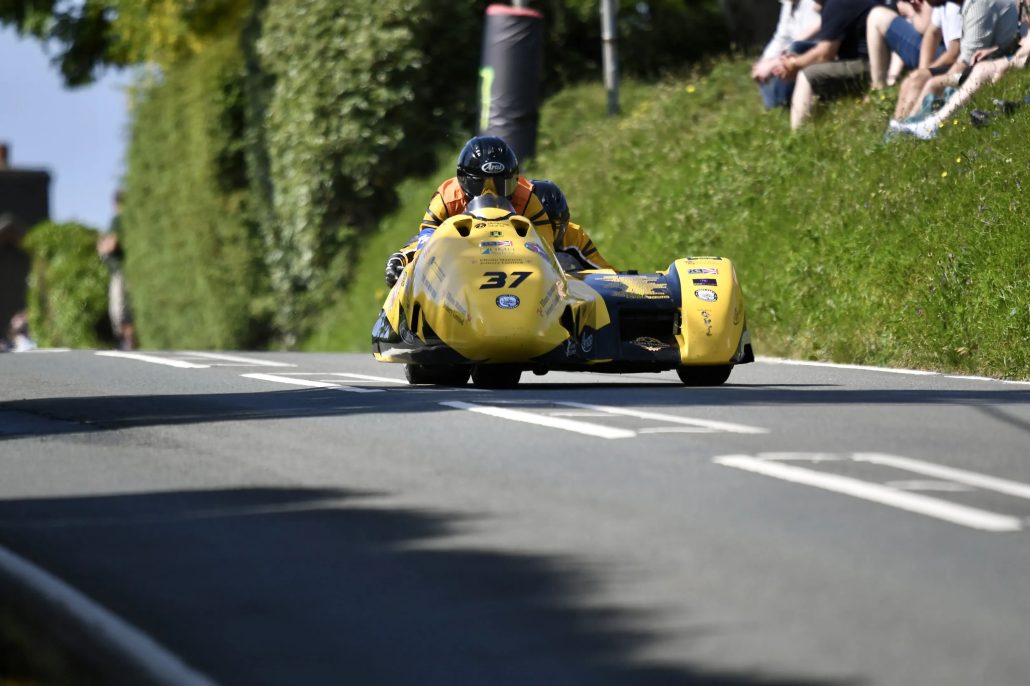
The bodywork also has to change. Until now the driver had to be fully visible from above, with only arms, legs and feet allowed to be covered. In future this also applies from the side opposite the sidecar, and only the forearms may be covered. The legs must not be enclosed. Wings, spoilers, splitters, diffusers and vortex generators are banned in any form.
Which teams are skipping the Sidecar TT 2027?
So far Team ARC with Lee Crawford, Gibson Racing and Michael Russell have announced that they will not race at the TT in 2027. Wiggert Kranenburg also does not want to compete under these conditions.
The withdrawal of Team ARC carries the most weight. Lee Crawford and his passenger Scott Hardie finished third on the podium in both sidecar races in 2025. The team neither wants to compete nor tackle the required modifications. Instead, it is working with the organisers of the Southern 100 on a long-term future for sidecar racing.
At Gibson Racing, the regulations render a fresh investment worthless. At the end of 2025 the team switched from Suzuki to KTM engines because it had expected an upheaval in the class anyway. However, the KTM engine is not one of the approved units. According to the team, it cannot afford another engine change along with new bodywork, electronics and wiring loom. For 2027, Gibson Racing is instead planning short-circuit outings with two outfits.
Michael Russell, who races both solo machines and sidecars, calls the Sportbike requirements “way outside my financial remit”. He estimates that around 80 percent of the sidecar community feel the same. Without significant financial support he does not intend to start, which means his passenger Alice Smith will also miss the TT.
Already at the Sidecar Festival in Oschersleben, Eckart Rösinger had announced that his son-in-law Wiggert Kranenburg would skip the Tourist Trophy under these circumstances.
Why are the teams criticising the new regulations?
The criticism is aimed above all at the timetable and the process: there is no transition period, and the new direction was never up for discussion in the preceding consultation. In addition, an outfit built to TT specifications can hardly be used at other events.
Between publication on 11 November and the TT in May there is only one winter, around half a year. In that time the teams have to source parts, rebuild and test. A new engine alone is not enough. According to Team ARC, engine mounts, exhaust, airbox and electronics all have to be redesigned along with it. The teams do not necessarily have to replace the chassis, however.
On the process, the team rejects the impression that competitors had been consulted. There was indeed a consultation. But according to the team, the switch to Sportbike engines and the electronics package were neither presented as an option nor recommended by any participant. In a list of questions, Team ARC wants to know, among other things, how the costs for existing teams were taken into account and what say competitors had in the final decision. One sentence from its statement sums up the team’s position: “The future of sidecar racing should be developed with its competitors, not simply decided for them.”
A look at other road races makes the situation even worse. After talks with the teams and the Auto Cycle Union, the Southern 100 did not create a new class but revised its 2025 F2 regulations, mainly on safety details. There, the 600cc Supersport engines remain permitted. Since no other series currently races under the new TT rules, teams that attend several events would have to build a separate outfit for a single race weekend.

How is the organiser responding to the criticism?
The organiser is sticking with the Sportbike engines and the control electronics, but wants to make improvements to individual rules and to the transition. A meeting has been scheduled for Monday, 16 November.
In an initial response, the Isle of Man Government’s Department for Enterprise, which runs the TT, referred to the decision in principle of 9 September. It was preceded by the Sidecar Sustainability Review, an assessment of the class involving competitors, constructors and technical experts. The department acknowledges that the change represents a major upheaval for the teams, but puts safety above everything else.
A few days later the organiser took a step towards the teams. It confirms that sidecars are firmly scheduled for 2027, 2028 and 2029 with two races each, and expects the entry list to settle at a sustainable level by then. At the meeting on 16 November, representatives from the sport, technical side and organisation will discuss the feedback received. On the table are adjustments to individual technical rules as well as short- and medium-term transition rules. Engine specification and control electronics are explicitly not up for discussion. In parallel, the organiser is working on a financial support package for teams making the switch for 2027. Further information has been announced for Wednesday, 18 November.
What is next for the sidecar races at the TT 2027?
The sidecars return in 2027, but with two races over two laps each instead of three. How big the field will be depends on how many teams can manage the conversion financially and in time.
The shorter races are part of a cautious restart, and qualifying is also being changed. This makes the sidecars one of the biggest construction sites of the TT 2027. Whether anything changes in the conditions for the teams after 16 November will become clear next week. Only then is it likely to be clear whether Team ARC, Gibson Racing and the other withdrawals will reconsider their decision.
Frequently Asked Questions
-
Why are teams pulling out of the Sidecar TT 2027?
The teams consider the switch too expensive and too short-notice. New engines, control electronics and the necessary changes to exhaust, airbox and engine mounts have to be completed within one winter. So far there is no transition period.
-
Which engines are allowed for sidecars at the TT 2027?
Only engines homologated for the Sportbike class of the British Superbike Championship are allowed, for example from the Yamaha R7, the Aprilia RS660 or the Kawasaki Ninja 650. The previous 600cc four-cylinders are no longer permitted. Engine parts must match the homologated specification.
-
How heavy must sidecars be from 2027?
The outfit must weigh at least 245 kg (540 lbs), up from 220 kg (485 lbs). Driver and passenger together must weigh at least 160 kg (353 lbs), making a total of 305 kg (672 lbs).
-
How many laps will the sidecars race at the TT 2027?
Both sidecar races in 2027 will run over two laps instead of three as before. The organiser has scheduled the class up to and including 2029 with two races per year.