- Three-year commitment: two sidecar races per year from 2027 through 2029
- Instead of 600 cc four-cylinders, near-production engines to British sportbike rules
- A spec ECU and a Balance of Performance approach are meant to cap output
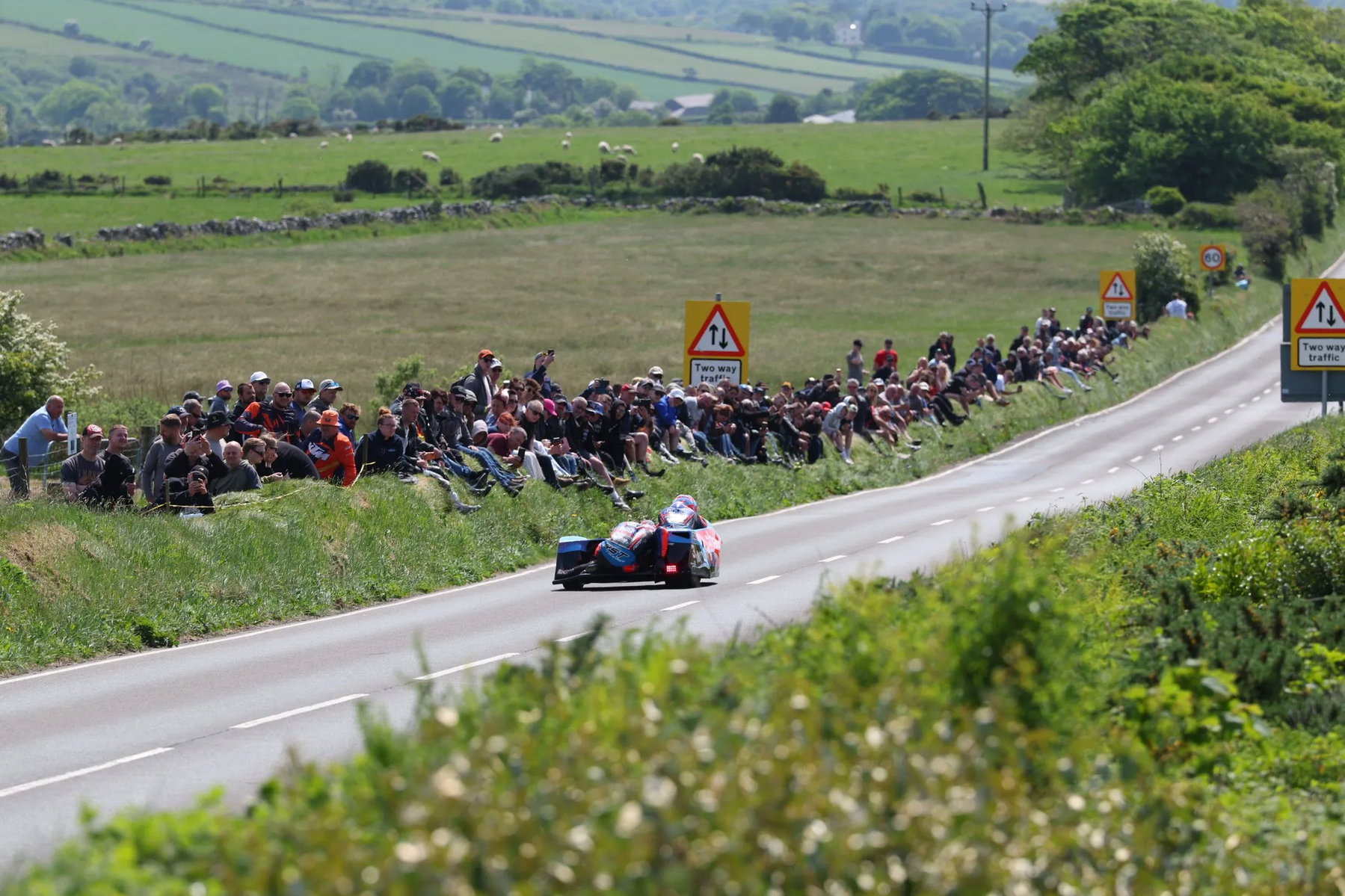
After the class was pulled at the 2026 TT, it was an open question whether the outfits would ever return to the Snaefell Mountain Course. On 9 September 2026 the organiser answered it. Sidecars will be part of the event again from 2027, but under terms that differ sharply from anything that applied over the past decades. It continues the reset that began after the class was suspended in early summer 2026.
How long is the sidecars’ return guaranteed?
The commitment covers three years, specifically 2027 to 2029. Two sidecar races are to be run in each of those years.
That is more than a formality. Teams and constructors have to invest in hardware for the new rules, and that only pays off if the class is not up for debate again after a single season. Paul Phillips, Head of Motorsport of the Isle of Man TT Races, names exactly that point as the reason for the three-year window. Riders and constructors need certainty if they are being asked to invest in change.
On the general outlook for the class Phillips says: „We believe there is a future for the class.“ A plain return to the old formula, by contrast, was never the right answer.
The decision followed a sustainability review launched after the class was suspended. Its first report set out a possible way back in summer 2026, but without a commitment and with the clear message that an unchanged return was off the table. The rules now presented are the result of that work.
Which engines may the outfits use from 2027?
Near-production engines that follow the technical rules for British sport motorcycles will be permitted. The organiser cites the Yamaha R7, the Aprilia RS660 and the Kawasaki Ninja 650 as examples, and explicitly allows further engines within the defined framework.
That ends the era of the classic 600 cc four-cylinder that shaped the class for decades. The reasoning is twofold. First, the power of the outfits is to become easier to control. Second, the market has changed: the classic supersport platform with 600 cc and four cylinders is increasingly running into its limits in current production machines and in manufacturer development. New engines of that layout are simply barely coming through any more.
Rather than restricting the existing formula further, the organiser is therefore betting on a platform that can evolve over the coming years. The mid-range twins named above are widely available in production form and are already used in other race series.
Spec electronics and Balance of Performance
Alongside the engine switch comes a spec engine management system. All outfits are to use a Mectronik ECU in future, that is a control unit that manages the engine and governs fuelling and ignition.
From race control’s point of view the benefit lies in oversight. A single electronics framework gives the Tourist Trophy’s technical director considerably more scope to manage and verify the power level of the class. That is backed up by a Balance of Performance approach intended to align the permitted engines on output. The principle has long been familiar from car racing.
Behind it sits a problem the organiser names openly. Under the previous rules, substantial investment in engine development could hand the best-funded teams a noticeable advantage. The new regulations are meant to narrow that scope.
Gary Thompson MBE BEM, Clerk of the Course of the Tourist Trophy, frames the step as a significant change that nonetheless gives race control far more scope to manage the power of the class. He also points to the direction of the motorcycle industry as a whole. The 600 cc four-cylinders served sidecar racing extremely well, he says, but what is needed now is a formula based on modern production engines. His summary of the objective: „The aim is a more controlled and competitive formula.“ What should count more in future is preparation, chassis set-up and, ultimately, the performance of driver and passenger.
What changes for chassis and bodywork?
Existing chassis designs remain eligible. A spec chassis as used in some other series is not planned, so teams do not have to replace their frames.
What is new are the requirements around the chassis. Construction, identification, modification, repair and inspection will be regulated more strictly. Every outfit is to become technically traceable, which with some ageing frames has not consistently been the case.
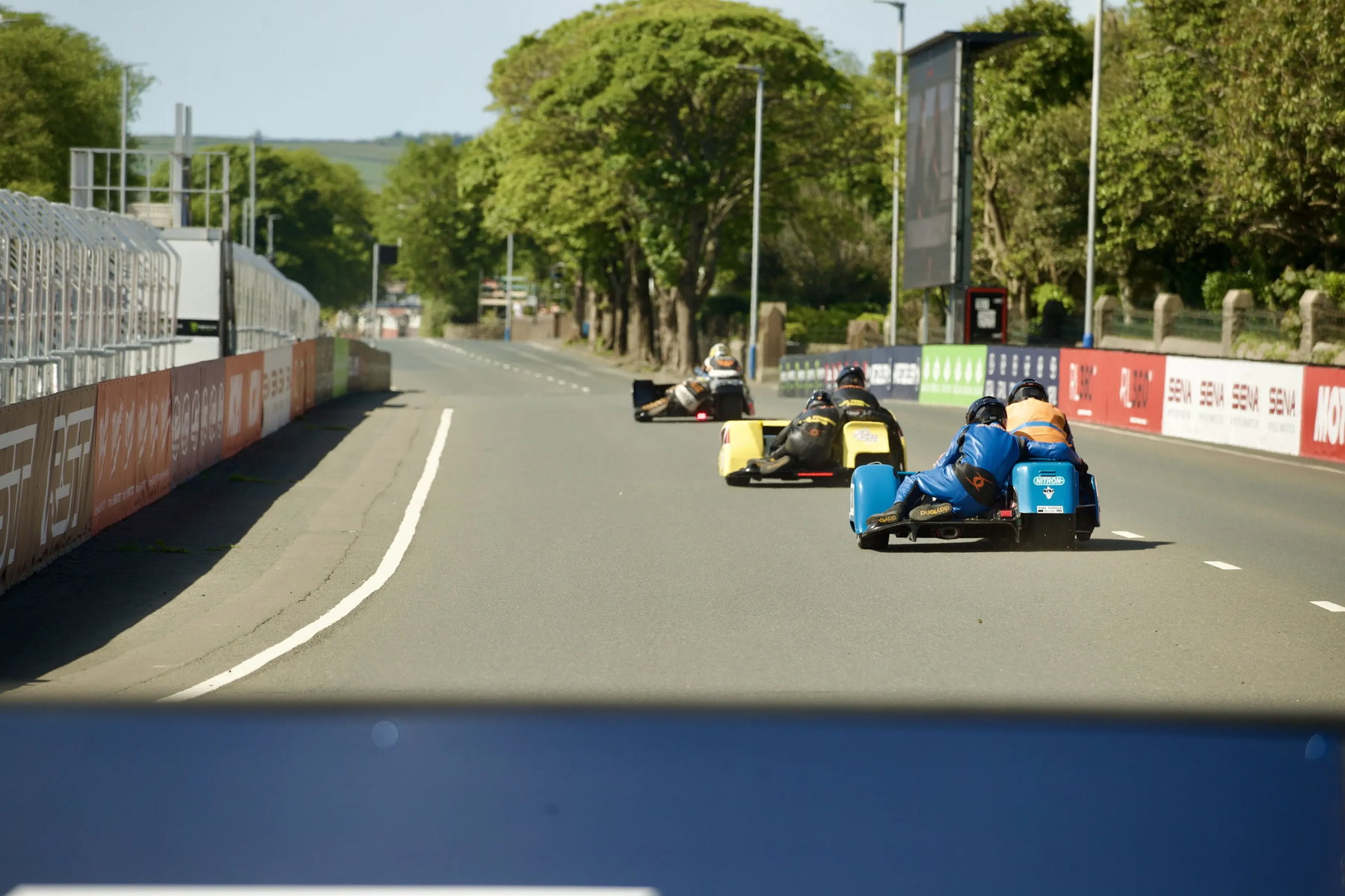
The bodywork rules are markedly tighter. Clearer limits apply to floors, undertrays, wheel arches and other aerodynamic elements. Separate wings, aerofoils, fins and spoilers will be banned. The organiser wants to rein in aerodynamic development while improving structural strength and easing technical scrutineering. Another point concerns safety in an emergency: medical staff and rescue crews are to reach the occupants more easily.
Further measures on weight, fluid retention, machine safety and technical compliance are to form part of the final rulebook.
How long will the 2027 sidecar races be?
Both 2027 legs will run over two laps of the Mountain Course. The race distance for 2028 and 2029 is only to be set once there is experience with the new package.
The organiser explicitly describes the 2027 format as a starting point rather than the final shape of the new sidecar formula. Existing arrangements for the qualifying phase and the sidecar sessions remain in place, and the shorter distances are intended to provide a more conservative framework in the first year with new hardware. Phillips puts it this way: the point is not to restore the sidecar class of the past overnight, but to create a viable platform in 2027 and then develop it properly from there.
The new formula will subsequently be assessed on technical data, incident records, competitor feedback, entry numbers and the experience from qualifying and racing.
Stricter requirements for competitors
It is not only the technology that is being reset. Entry conditions and qualifying standards are being tightened too, with more weight on current competition experience, medical fitness and demonstrated preparation for the demands of the Mountain Course.
With that, the organiser picks up a point already described as a problem in the sustainability review. Anyone who wants to start on the island in future has to show they are up to what the course demands, and not merely race occasionally.
How is the paddock reacting?
Broadly positively, but with a clear reservation about cost. Lee Crawford, who took two podium finishes at the 2025 Sidecar TT, calls the return of the class ideal news while warning at the same time about extreme costs in implementing it.
For some teams the switch will, in his assessment, be a major challenge. That is understandable, because a different engine plus spec electronics means conversion work on every single outfit, on top of purchase costs. How high the outlay ends up being depends on which conversions the rulebook demands in detail.
When will the full rulebook be published?
The technical regulations for 2027 are currently being drawn up and, according to media reports, are due before December 2026. They will cover the permitted engines, the allowed modifications, the electronics, chassis and bodywork as well as weight and technical compliance.
Details of the sporting regulations, the entry conditions and the schedule are still to be announced by the organiser. That would leave teams the winter to convert their machines. The 2027 TT runs from 31 May to 12 June and looks set to become the key date of the road racing season.
Frequently asked questions
-
Will sidecars race at the 2027 TT?
Yes. On 9 September 2026 the organiser confirmed that the class will be part of the Tourist Trophy again from 2027. The commitment covers three years through 2029, with two races per event.
-
Which engines are permitted for the 2027 Sidecar TT?
Near-production engines to the technical rules for British sport motorcycles are eligible. The organiser names the Yamaha R7, the Aprilia RS660 and the Kawasaki Ninja 650 among others, and further engines within that framework are possible. The previous 600 cc four-cylinders are dropped.
-
Why was the sidecar class suspended at the 2026 TT?
After a serious incident involving brothers Ryan and Callum Crowe in qualifying, race control suspended the class for the remainder of the event. The step was justified on safety grounds and triggered the sustainability review.
-
Will aerodynamic add-ons be banned on the outfits?
Separate wings, aerofoils, fins and spoilers will be prohibited. Clearer limits apply to floors, undertrays, wheel arches and other aerodynamic elements so that aerodynamic development does not escalate further.
-
When will the 2027 Sidecar TT regulations be published?
According to media reports the full rulebook is due before December 2026. That leaves teams the winter to convert their outfits to the new engines and the spec engine management system.
➜ This article is part of our comprehensive overview: Isle of Man TT 2027: The Complete Overview – Dates, Classes, Regulations & Riders. Find all key information on this topic in one place.