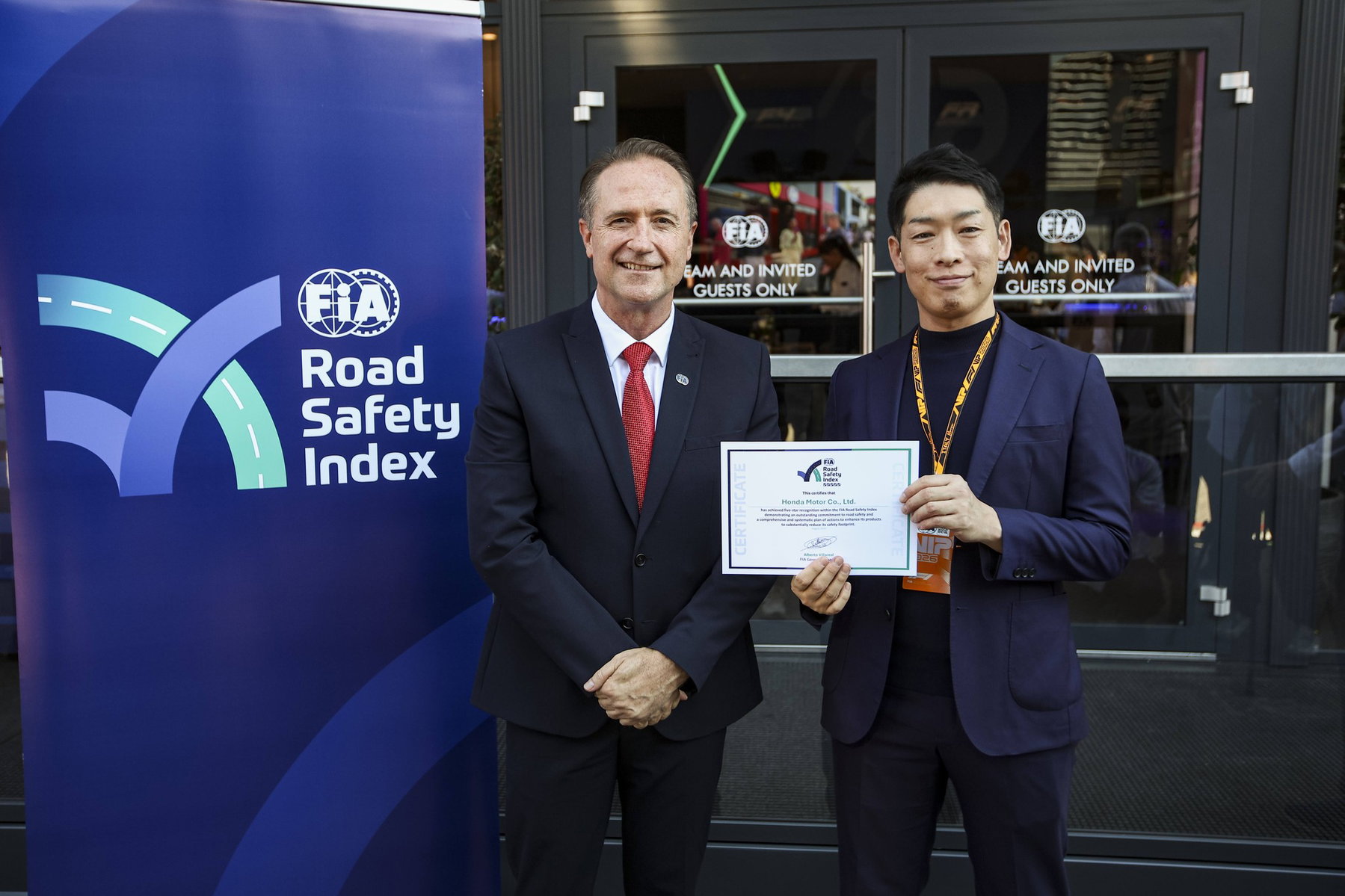
- Five stars in the products and services category, presented alongside the Formula 1 race at Monza
- Assessment scope widened to 17 countries, covering more than 90 percent of all Honda motorcycle and car sales
- Stated goal: half as many road deaths involving Honda vehicles by 2030, none at all by 2050
The FIA, the world motorsport and mobility federation, has expanded its Road Safety Index from three to five stars. Honda is the first company anywhere to receive the new top rating. The award was handed over in early September at the Autodromo Nazionale Monza during the Formula 1 race in Italy. What makes this interesting is less the certificate than what was examined for it. Unlike a crash test, this is not about a single vehicle but about how a corporation organizes, measures and documents safety. And Honda’s motorcycles were a fixed part of that assessment.
What is the FIA Road Safety Index?
The FIA Road Safety Index is a rating system that lets companies and organizations measure and disclose their impact on road safety. The FIA compares it to a carbon footprint: a safety footprint makes it measurable where an organization stands and which measures actually make a difference.
The system consists of two separate ratings. The supply chain rating covers company processes from raw material sourcing through development and production to delivery to the customer. The product and service rating, by contrast, assesses the safety characteristics of the products and services themselves. Honda received its five stars in the second category.
Why are there now five stars instead of three?
The FIA expanded the index because the previous three-star scale only covered commitment and footprint. For four and five stars, three additional assessment modules apply that go considerably deeper.
The first module is called planning and requires a clear, traceable action plan built on measurable safety factors. The second module, safety performance monitoring, checks whether a company tracks its results along the entire value chain and makes those results accessible. The third module concerns safety culture and the coverage of the supply chain or of the products and services.
The decisive difference lies in the evidence. According to the FIA, anyone seeking the top rating has to demonstrate that safety requirements are implemented and monitored in practice. Presenting formal commitments and control mechanisms is no longer enough. Willem Groenewald, FIA Secretary General for Automobile Mobility, Sustainability and Tourism, told media that Honda had to submit a broader framework of action and corresponding evidence for this.
What did Honda have to prove for the top rating?
Honda had to widen the assessment scope considerably and was examined in 17 countries. Together, these countries account for more than 90 percent of Honda’s global sales of motorcycles and automobiles.
The countries assessed were Japan, the United States, the United Kingdom, France, Germany, Italy, Spain, Turkey, China, Thailand, Vietnam, Indonesia, Malaysia, India, Pakistan, the Philippines and Brazil. That also covers the large two-wheeler markets of Southeast Asia and India, where Honda sells the bulk of its motorcycles.
According to Honda, the FIA rated five points positively: a medium to long-term safety strategy backed by top management, the worldwide recording and tracking of road deaths and injuries, monitoring of target achievement by a global safety council as part of sustainability governance, the worldwide rollout of advanced safety technology together with work on safety culture, and the active publication of road safety information. Overall, the PDCA process was recognized, that is the cycle of plan, do, check and act.
What role do motorcycles play in the assessment?
Motorcycles are a fixed part of the assessment and not a footnote. Both the scope of the review and Honda’s safety targets explicitly cover motorcycles and automobiles together.
That is the genuinely notable point about this award. In the first assessment in February 2025, the FIA rated Honda as the first car and motorcycle manufacturer ever, though at the time only on the basis of its activities in Japan. Honda received the then highest possible rating of three stars in both categories. With the extension to 17 countries, the two-wheeler business is now covered to an extent that largely reflects global sales.
Mikihito Kojima, Assistant Vice President and General Manager of Traffic Safety Promotion Operations at Honda Motor, puts the ambition behind it into context. He says the company is concerned not only with safer products but with every single customer and everyone who shares the road with them: “At Honda, our goal goes beyond delivering safer products. We look to the safety of each and every customer who uses our products, and everyone sharing the road around them.”
The targets for 2030 and 2050
Behind the rating there is a concrete numerical target. Under the safety slogan Safety for Everyone, Honda wants to halve the number of road deaths involving Honda motorcycles and automobiles by 2030. That is measured not in absolute numbers but per 10,000 units sold and against the 2020 base year. By 2050 the figure is to fall to zero worldwide.
Kojima describes the five-star rating as an interim step on that path and points out that the index has given the company a clearer view of where it currently stands and what needs to be tackled next. Honda says it intends to examine more closely in future how effective its own safety technologies actually are in real-world crashes.
What the FIA intends to do with the index
For the FIA, Honda is above all a reference case. With the index, the federation wants to push organizations from the public and private sectors to measure and improve their impact on road safety.
FIA President Mohammed Ben Sulayem goes a step further. He is calling on governments to examine whether the methodology of the index could be used for regulatory frameworks in order to strengthen safety standards worldwide. Groenewald, in turn, describes the extension to five stars as an attempt to make road safety a measurable and verifiable part of corporate decisions.
The index is not purely a manufacturer topic. Its users include Amazon, Uber and Waymo, and in May 2025 the vehicle fleet of the City of New York, with around 29,000 vehicles, became the first municipal fleet in the world to sign up.
Frequently Asked Questions
-
What is the FIA Road Safety Index?
The FIA Road Safety Index is a rating system from the world motorsport and mobility federation FIA that allows companies and organizations to measure and report on their impact on road safety. It consists of a supply chain rating and a rating for products and services. Since 2026 the scale has run from one to five stars.
-
Why did Honda receive five stars?
Honda received the top rating in the products and services category because the company provided the required evidence that its safety requirements are actually implemented and monitored. To do so, Honda widened the assessment scope to 17 countries. Among the aspects assessed were the long-term safety strategy, the worldwide recording of crash figures and oversight by a global safety council.
-
Does the rating apply to motorcycles as well?
Yes, the rating explicitly includes the motorcycle business. The 17 countries assessed cover more than 90 percent of Honda global sales of motorcycles and automobiles. The safety targets for 2030 and 2050 also apply to both vehicle types.
-
When did Honda receive its first rating?
Honda was rated under the FIA Road Safety Index in February 2025 as the first company in the automotive sector and received three stars, the highest level available at the time. The assessment was then limited to its activities in Japan. The award was announced alongside the 4th Global Ministerial Conference on Road Safety in Marrakech.
➜ This article is part of our comprehensive overview: Motorcycle Law & Policy: Regulations, Court Rulings and Developments for Riders. Find all key information on this topic in one place.