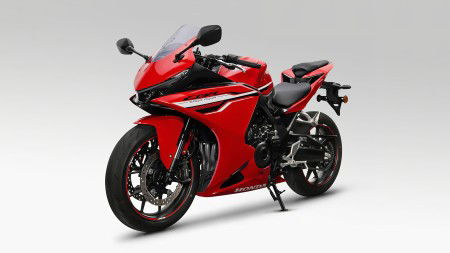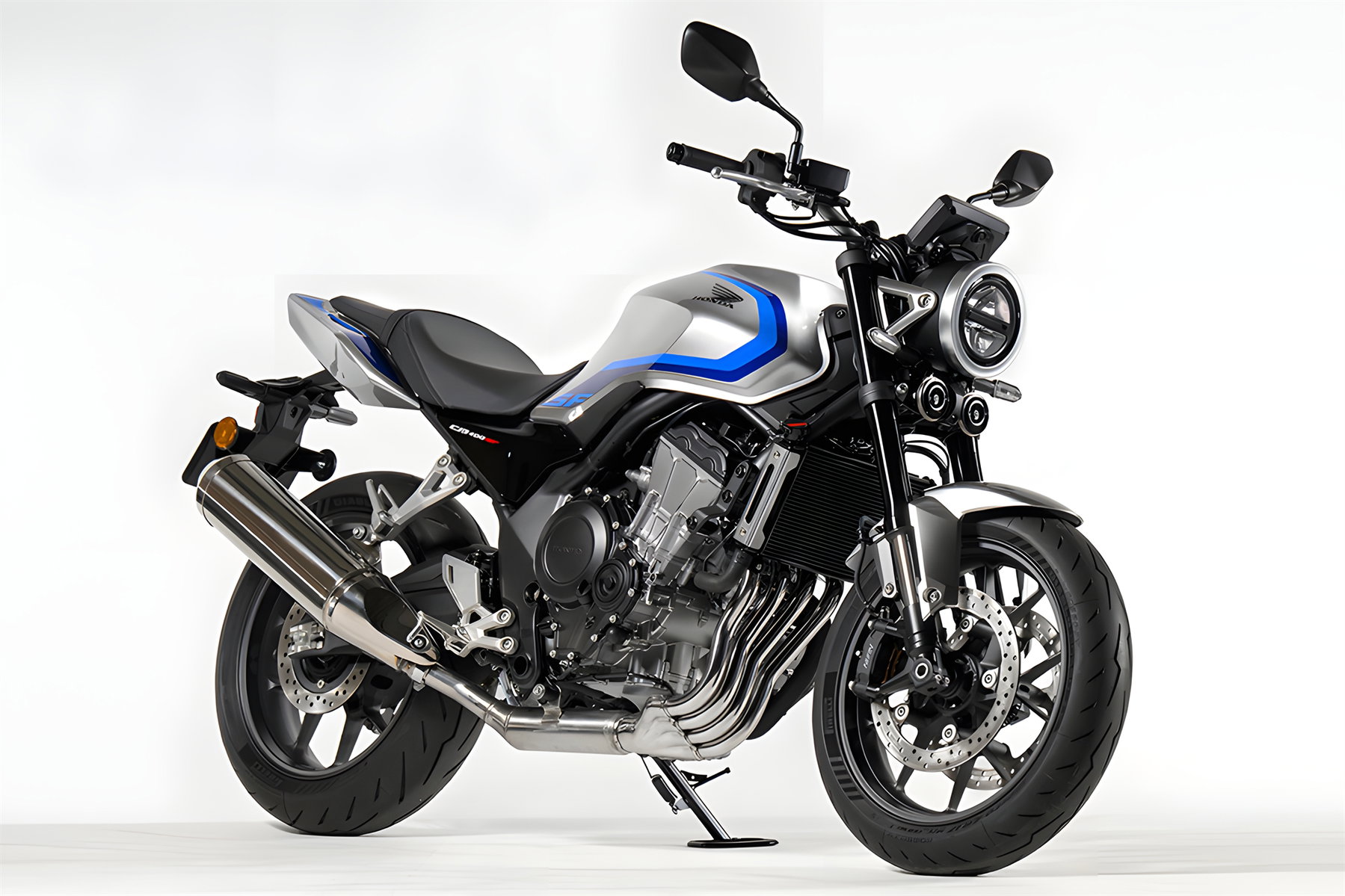
- Market launch in Japan: the CB400 Super Four from August 21, the CBR400R from September 18
- New 399cc inline four-cylinder engine with around 58 hp (43 kW), E-Clutch and throttle-by-wire
- Sales initially limited to selected markets, Europe still open
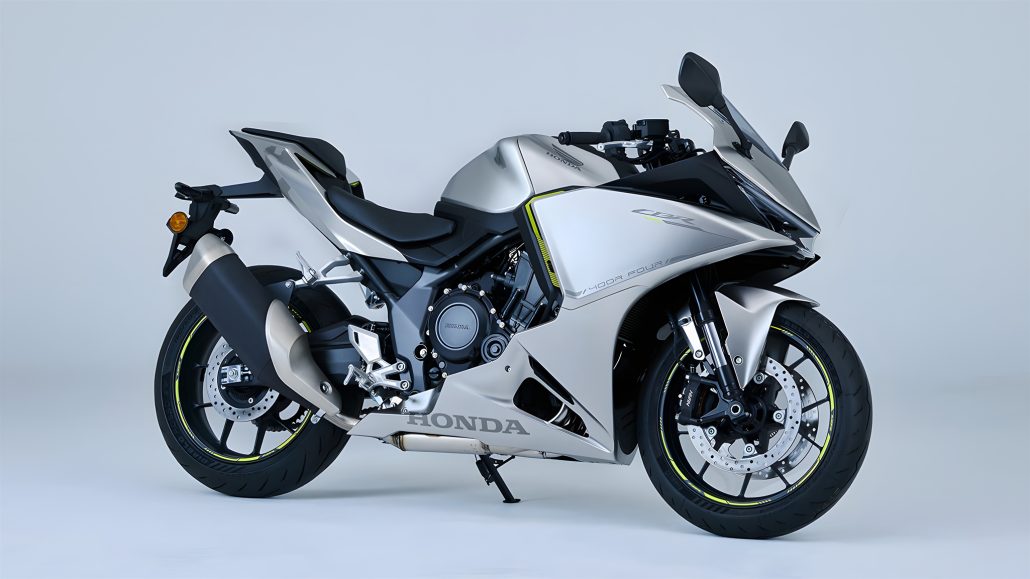
Honda is bringing back the small four-cylinder. The Japanese manufacturer has confirmed that the naked CB400 Super Four and the fully-faired CBR400R are entering series production. Both carry the E-Clutch designation and target riders looking for a free-revving engine with modern technology. Sales are initially planned only in selected markets.
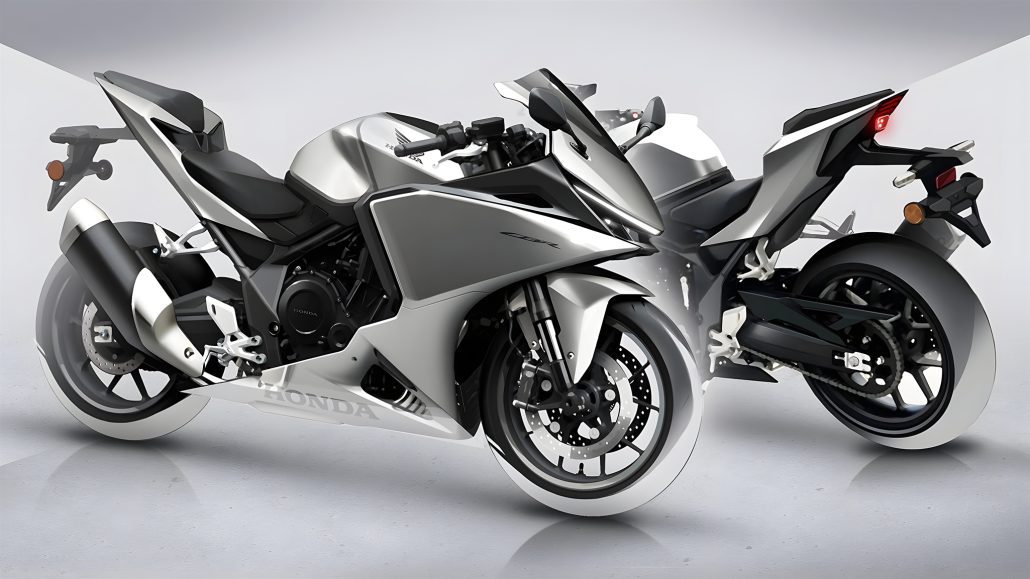
When do the Honda CB400 Super Four and CBR400R launch?
The CB400 Super Four is set to arrive at selected Honda Dream dealers from August 21, with the CBR400R following from September 18. Both models are initially earmarked for the Japanese market.
Honda quoted the prices as approximate figures. The CB400 Super Four is expected to cost around 998,800 yen (about 5,375 euros / 6,155 US dollars), while the CBR400R comes in at around 1,199,000 yen (about 6,450 euros / 7,385 US dollars). Honda had already shown near-production prototypes earlier in spring.
What’s under the hood of the new four-cylinder 400s?
Both models share a new 399cc inline four-cylinder engine that produces around 58 hp (43 kW) at 11,500 rpm and 38 Nm (28 lb-ft) at 9,750 rpm, according to factory figures. The engine features double overhead camshafts, is liquid-cooled, and sits in a steel tube frame paired with a six-speed gearbox.
Factory figures put the weight at 187 kg (412 lbs) and the seat height at 780 mm. Both models come with a 5-inch TFT color display and four riding modes. Up front sits a blacked-out upside-down fork, while a single shock handles the rear via a twin-sided swingarm. Braking duties up front are handled by twin Nissin radial calipers. A USB-C port sits near the instruments. The wheels measure 17 inches front and rear, fitted with a 120-section tire up front and a 160-section tire at the rear. The CB400 Super Four’s tank holds 15 liters, while the CBR400R holds one liter less. The engine doesn’t rev quite as hard as the small 400cc sport bikes of the 1990s. The CBR’s handlebar sits in a moderate position and the footpegs are set fairly low, which should make everyday use easier.
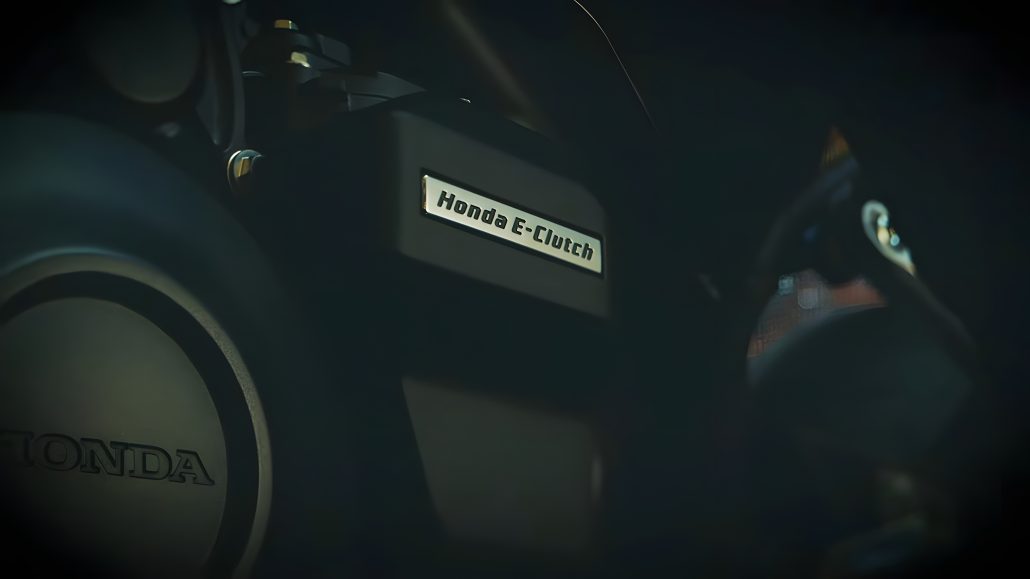
How does Honda’s E-Clutch work?
The E-Clutch controls the clutch electronically, so pulling away, stopping, and shifting gears are all possible without pulling in the clutch lever. Riders who prefer to do so can still operate the lever manually as normal.
The system is complemented by throttle-by-wire, an electronic throttle for direct throttle response. Honda first introduced the E-Clutch in 2024 on the CB650R and CBR650R before rolling it out across the range, including the Rebel 300 and the Transalp XL750. The automated clutch is aimed primarily at younger and less experienced riders.
The return of a long-time favorite
The CB400 Super Four launched in 1992 and was built for roughly three decades at the Kumamoto plant before it was dropped from Honda’s Japanese lineup in 2022. It emerged from the CB-1 and became a fixture for younger and learner riders — in Japan, it even served as a riding school model. Over the years, Honda kept developing the engine further, including with the VTEC system, which adjusts valve timing to engine speed.
The new generation replaces the previous CB400 Super Four V-TEC II and the sportier CBR400RR, nicknamed Baby Blade. Honda first showed the two newcomers publicly as concepts in March at the Osaka Motorcycle Show, followed by appearances in Tokyo and Nagoya.
How do the CB400 Super Four and CBR400R fit into Honda’s lineup?
The CB400 Super Four borrows its styling from the larger CB1000F, while the CBR400R takes cues from the CBR250RR. Both sit on a new platform with a new frame and new suspension.
The CB400 Super Four can be seen as an entry point toward the CB1000F, which launches in 2026 with a detuned Fireblade engine dating back to 2017. With the two 400s, Honda continues the trend toward compact four-cylinder engines, positioning itself against rivals such as the Kawasaki Ninja ZX-4R. There remains steady demand for the 400cc class in Japan due to local licensing rules. Among the 2026 model year’s new motorcycles, the two models rank among the smaller but technically elaborate entries.
Are the new Honda 400s coming to Europe too?
Whether and when the models will arrive in Europe remains open. Honda has not made any commitment on this so far.
A spokesperson said when asked: “We have no comment to make at the moment on possible future additions to our European line-up.” For the CBR400R, finding a place in the European lineup is tricky, since Honda already offers the twin-cylinder CBR500R there as an A2-compliant sport model, as well as the four-cylinder CBR650R with around 95 hp (70 kW). The latter costs around 10,485 euros / 12,005 US dollars with the optional E-Clutch. The naked CB400 Super Four could have somewhat better odds as a standalone retro model. Overall, there is clear demand for small four-cylinder motorcycles, driven by models such as the Kawasaki ZX-4RR and the upcoming QJMotor SRK421RR.
What colors does Honda offer for the two models?
The CBR400R comes in silver (Beta Silver Metallic) or black (Matte Ballistic Black Metallic), while the CB400 Super Four offers a wider selection. Its colors include Wolf Silver Metallic, among others.
This paint scheme uses a silver base with light and dark blue lines and evokes the CB750F that Freddie Spencer raced in the United States during the 1980s. A similar look can also be found on the larger CB1000F.
Frequently Asked Questions
-
How much does the Honda CB400 Super Four cost?
The CB400 Super Four is expected to cost around 998,800 yen in Japan (about 5,375 euros / 6,155 US dollars). The fully-faired CBR400R comes in higher, at around 1,199,000 yen (about 6,450 euros / 7,385 US dollars). Honda quoted both prices as approximate figures.
-
How much horsepower does the Honda CBR400R have?
The CBR400R produces around 58 hp (43 kW) at 11,500 rpm and 38 Nm (28 lb-ft) at 9,750 rpm, according to factory figures. It’s powered by a new 399cc inline four-cylinder engine. The CB400 Super Four uses the same engine.
-
When does the Honda CB400 Super Four arrive?
The CB400 Super Four is set to arrive at selected Dream dealers in Japan from August 21. The CBR400R follows from September 18. Sales are initially planned only for selected markets.
-
Is the Honda CB400 Super Four coming to Europe?
That remains open, as Honda has not made any commitment so far. A spokesperson declined to comment on possible future additions to the European lineup. Potential overlap with models such as the CBR500R and CBR650R complicates the picture.
-
What does E-Clutch mean for Honda?
The E-Clutch is an electronic clutch control system. It allows pulling away, stopping, and shifting gears without pulling in the clutch lever, though the lever can still be operated manually. The system is complemented by an electronic throttle.
➜ This article is part of our comprehensive overview: New Motorcycles 2026: All Models, Releases, and Highlights at a Glance. Find all key information on this topic in one place.