- According to Bcomp, production emits up to 85 percent less CO2 than carbon fibre
- Stiffness and weight are on a par with carbon, but carbon remains stronger
- Suzuki plans to use more natural fibre, and parts for production motorcycles are under discussion
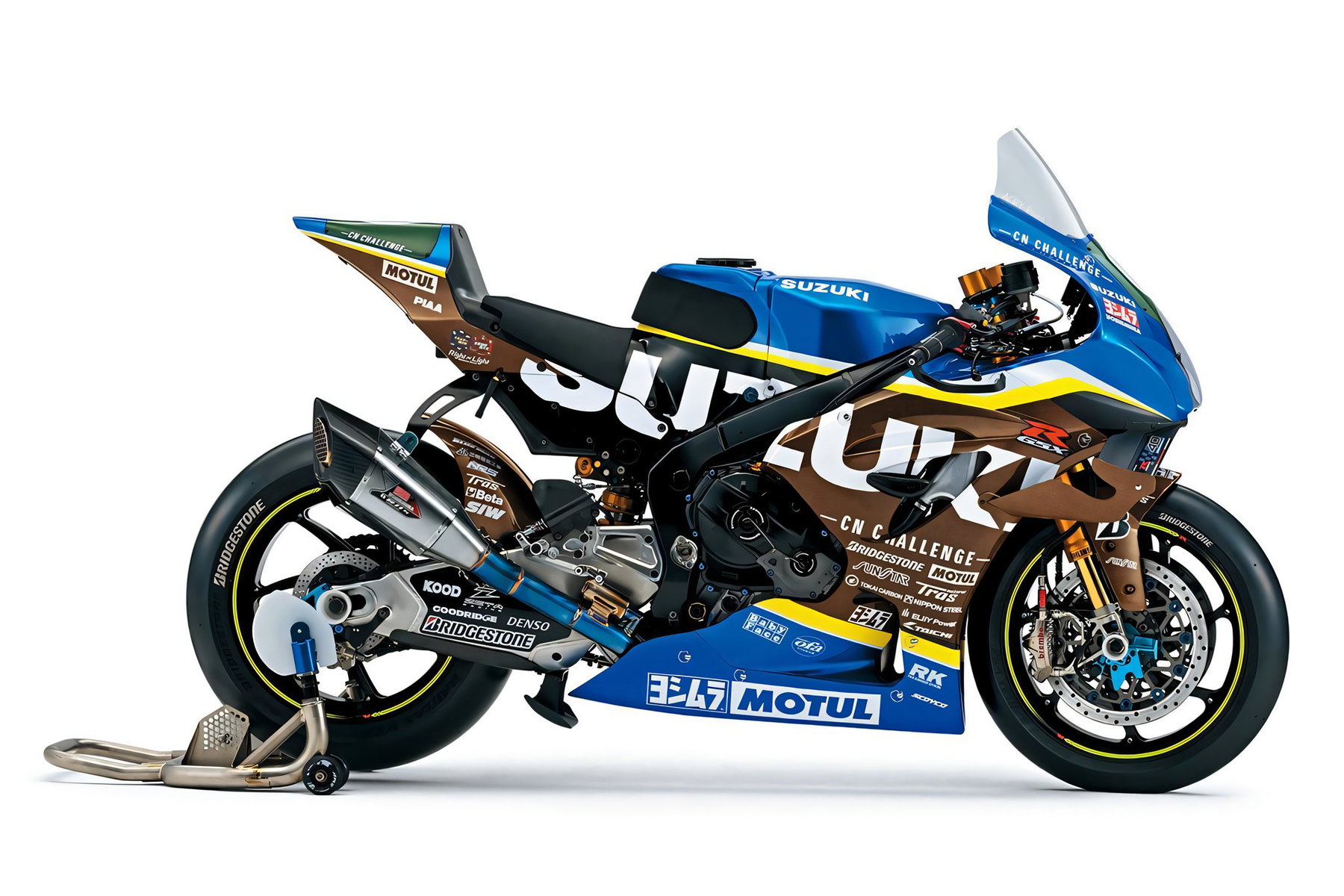
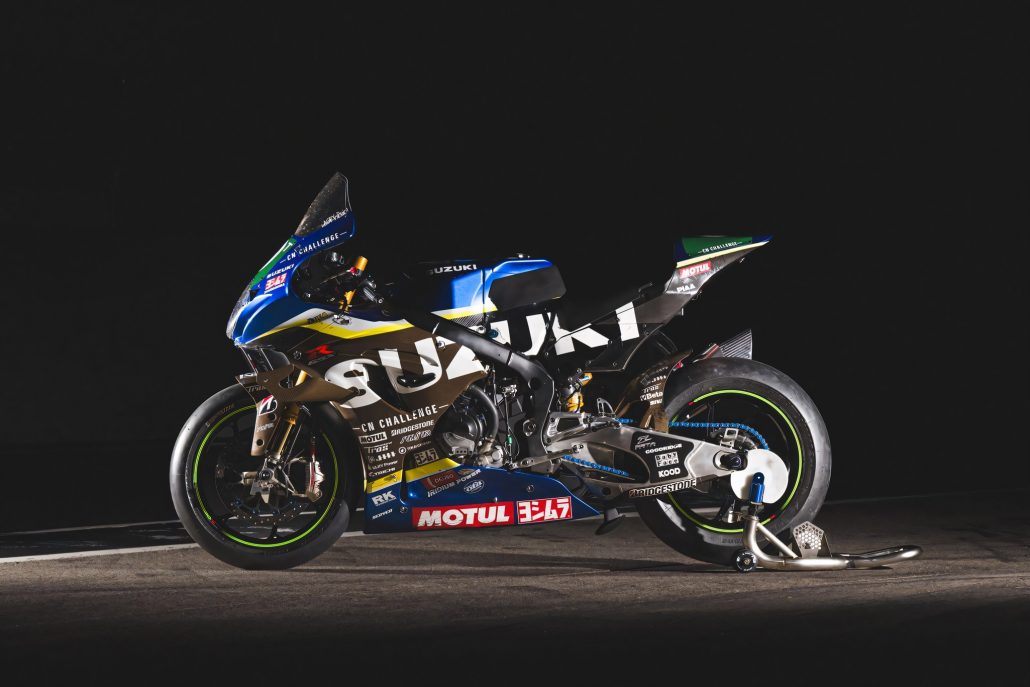
Carbon fibre has been the go-to material for light, stiff components in racing for years. Its production, however, requires a great deal of energy. That is why Bcomp, a company based in Fribourg, Switzerland, relies on flax, a plant most people know from linen fabrics. Team Suzuki CN Challenge shows that natural fibre instead of carbon also works on a motorcycle. CN stands for Carbon Neutral. The team uses the flax parts on its GSX-R1000R, which has lined up at the Suzuka 8 Hours three years in a row. Ken Kruck, responsible for motorsport sales at Bcomp, explains where the natural fibre can keep up and where it cannot.
What are Bcomp’s natural fibre composites?
In Bcomp’s composites, flax fibres instead of carbon fibres provide the strength. As with carbon, the fibres are impregnated with resin and then cured into a solid component.
Bcomp offers two products for this. The first is called ampliTex and is a woven technical fabric. The second is named powerRibs. It is a reinforcement grid whose shape is reminiscent of the veins of a leaf. It makes a component stiffer without making it noticeably heavier.
The difference from carbon lies at the start of the production process. To make carbon fibres, a precursor material called polyacrylonitrile has to pass through ovens at up to 3,000 degrees Celsius. According to Kruck, this is exactly where most of the CO2 emissions are generated. With flax, the sun does this work, because the fibre grows in the field and is then spun into yarn. From this point on, everything works as with carbon: the yarn is woven into fabric, impregnated with resin, laid into moulds and cured in an autoclave. An autoclave is a kind of pressure oven. Switching from carbon to flax therefore requires no new tooling.
How much CO2 does natural fibre save compared with carbon?
According to Bcomp, CO2 emissions in production drop by up to 85 percent. The figure covers the path from raw material to finished product at the factory gate.
There are also differences at the end of the product’s life. With carbon, the resin has to be removed by pyrolysis, i.e. combustion without oxygen. Only then can the fibre be recycled or disposed of. Natural fibre parts, on the other hand, can simply be incinerated, and the resulting heat can be used as energy.
According to Kruck, the raw material will not run short. Flax has been processed in the textile industry for centuries, so the supply chains have long been established. Bcomp sources all of its flax from Belgium and the Netherlands, and production takes place in Switzerland and France. There is also a benefit for agriculture: flax is well suited to crop rotation, improves soil structure and needs little or no nitrogen fertiliser.
Where are the weaknesses of natural fibre compared with carbon?
The weakness lies in strength, where carbon is clearly superior. In terms of stiffness, however, flax is on a par according to Kruck.
The difference between the two terms is important. Stiffness describes how much a component bends under load. Strength describes how much load it can take before it breaks. Kruck admits that Bcomp could match the strength of carbon, but the parts would become too heavy. The company therefore focuses on bodywork and semi-structural components. Fully structural parts are not the goal.
How do powerRibs keep the weight down?
The powerRibs form a raised, three-dimensional rib structure on one side of a thin shell. This makes the component thicker and stiffer, but thanks to the openings in the grid the weight barely increases. According to Bcomp, this can triple a part’s bending stiffness while requiring less base material. That saves weight and production waste.
In production, for example, a layer of ampliTex is impregnated with slightly more resin than usual. The dry powerRibs are placed on top and soak up the excess resin. Kruck describes this as an advantage because the resin is distributed evenly throughout the component. According to Bcomp, an all natural fibre layup thus achieves the weight and stiffness of a thin-walled carbon shell. The powerRibs can also reinforce components made of carbon or glass fibre. Suzuki used them on all natural fibre parts of the GSX-R1000R for Suzuka.
How can carbon and natural fibre be combined?
Carbon and flax can be mixed in a single component. This makes the natural fibre part stronger and the carbon part more climate-friendly.
Such hybrid layups have already been used in the Japanese Super Formula series. There, Bcomp reinforced the edges of components with carbon and made the rest from natural fibre. The principle has also been used in Formula 1. McLaren Racing built a driver’s seat for Lando Norris made entirely of powerRibs and ampliTex. The seat of his then teammate Daniel Ricciardo, by contrast, was a hybrid: here ampliTex was sandwiched between two carbon layers so that the team could meet the driver weight regulations.
How did Suzuki come to use natural fibre bodywork?
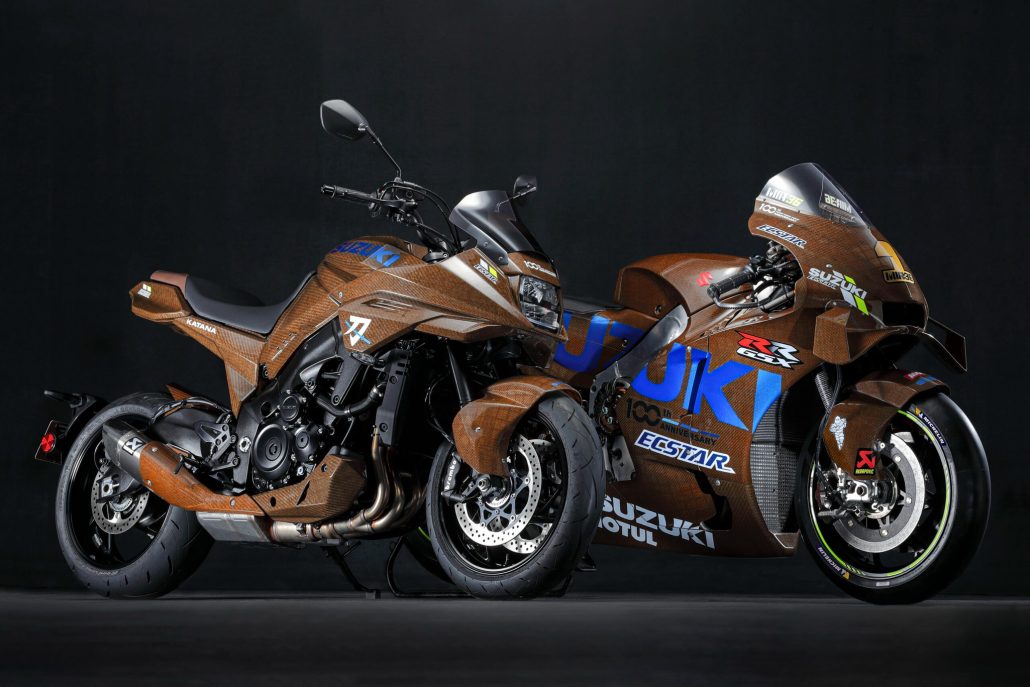
The impetus came from Bcomp’s Japanese partner Tras, which had manufactured bodywork parts for Suzuki’s MotoGP machines for more than 20 years. Tras presented the material to Suzuki’s then factory MotoGP team in 2021.
The goal was a complete fairing for the GSX-RR. A prototype was built in 2022, tested privately and received positive feedback. However, the project ended with Suzuki’s withdrawal from MotoGP. The formal collaboration between Team Suzuki CN Challenge, Tras and Bcomp began in 2024, initially with the mudguards. The team competes in the Experimental class of the FIM Endurance World Championship at the Suzuka 8 Hours.
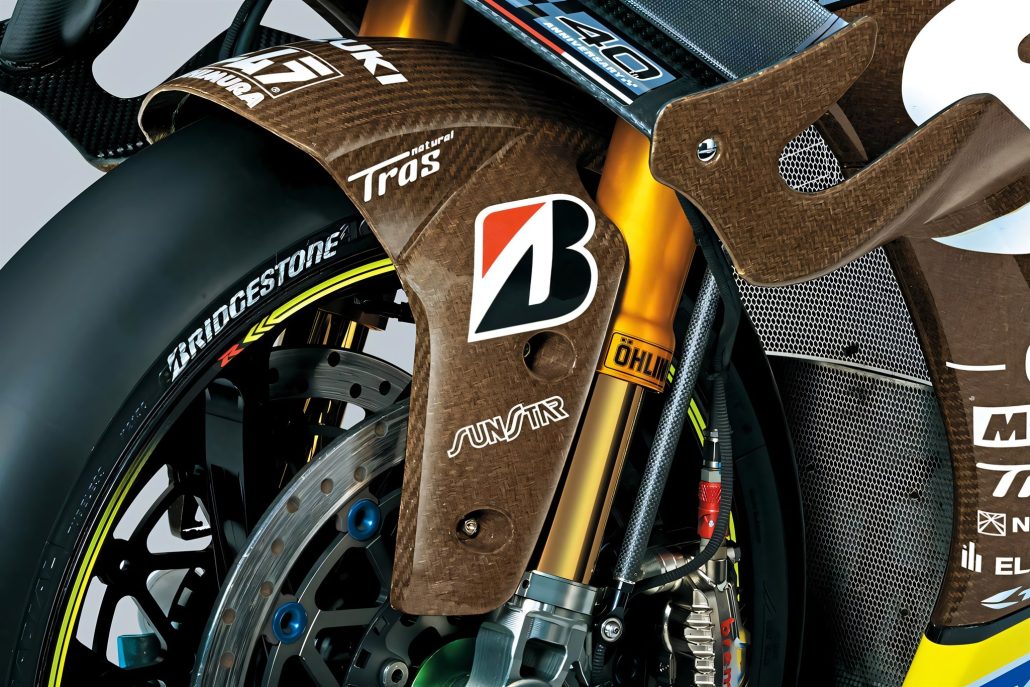
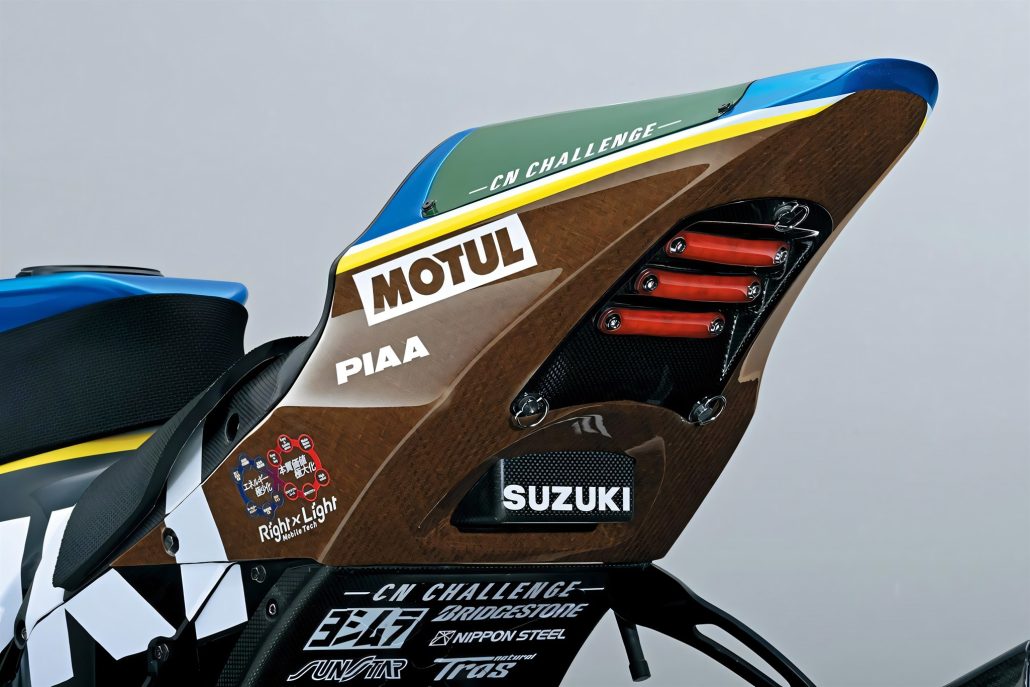
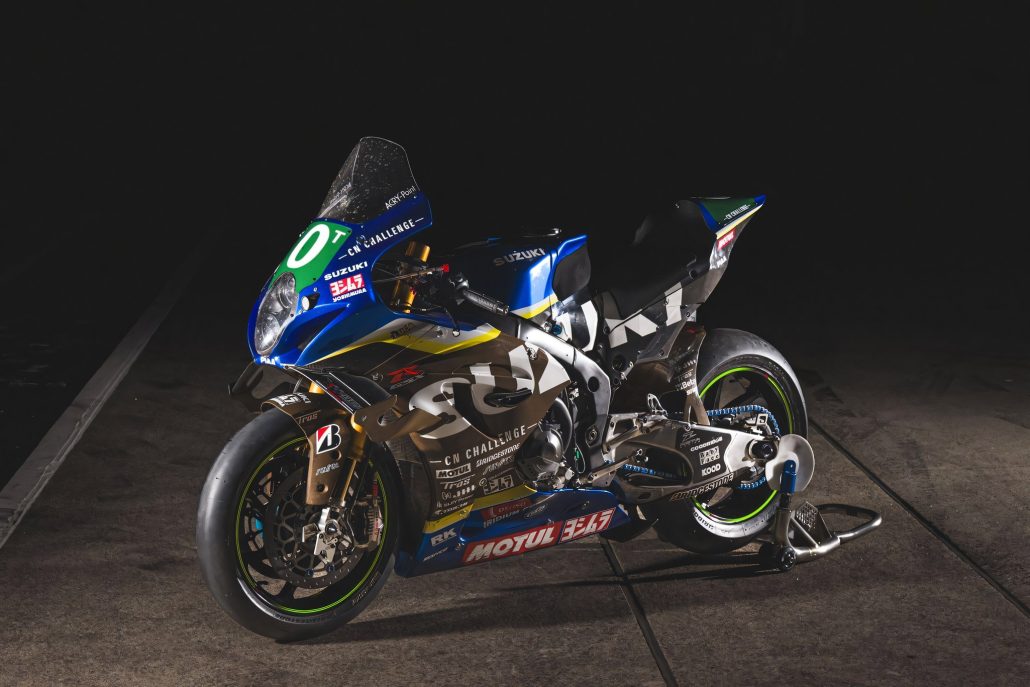
At the 2026 Suzuka 8 Hours, the front and rear mudguards, the side fairings, the seat cowl and the winglets were made of natural fibre. The parts were left unpainted so that the natural colour of the flax remains visible. Shinichi Sahara, head of Suzuki Motorsports, says: “Embracing the natural color of ampliTex in our bodywork and winglets has great visual impact.” Masanao Nitta, Representative Director at Tras, highlights the processing: “The new ampliTex prepreg even withstood the hot and humid manufacturing environments typical of Southeast Asia.” A prepreg is a fibre fabric that has already been pre-impregnated with resin.
The bodywork is only one part of the project. The GSX-R1000R also runs on sustainable fuel, tyres with recycled content, bio-based engine oil and an environmentally friendly titanium exhaust system. The team clothing is also made from recycled fabric.
What happened in the crash at Suzuka 2025?
At the 2025 Suzuka 8 Hours, the team’s GSX-R1000R crashed and the middle fairing was badly damaged. The part with powerRibs cracked but kept its shape and stayed on the motorcycle.
This is exactly where Kruck sees an advantage that weighs just as heavily as the environmental one. Carbon shatters into sharp fragments on impact. Flax, on the other hand, breaks more like Kevlar, i.e. without sharp splinters. This significantly reduces the risk, Kruck explains. The mechanics benefit too. In an endurance race, they have to remove damaged parts quickly during pit stops and, according to Kruck, often cut themselves on the edges. In addition, natural fibre dampens vibrations better than carbon.
Will natural fibre soon appear on production motorcycles?
There is no specific production model yet, but Suzuki is said to be considering natural fibre parts for production motorcycles. According to Kruck, the team also wants to increase the share further next year.
A more affordable version of the technology already exists for production vehicles and is used in car manufacturing. Kruck expects the price to fall further as volumes increase. That could pave the way for natural fibre parts on ordinary road motorcycles.
Protective gear such as helmets or ankle protectors is also on the agenda. According to Kruck, the lower strength does not rule out such products, because a mix with carbon offers a solution. There have already been talks with helmet manufacturers and protective gear suppliers, and Bcomp sees this as an important market. Because the company is still fairly small, however, Kruck says he has to weigh carefully where to direct the available capacity. The former kart racer stresses that the helmet is a rider’s most personal piece of equipment and would like to see helmets made of natural fibre.
What role does car racing play for natural fibre parts?
Car racing and the automotive industry are currently driving the technology forward strongly. According to Kruck, this helps finance the development, from which motorcycles will later benefit as well.
Use is growing above all in GT classes, especially GT4. According to Kruck, a rule change there mandates natural fibre for certain bodywork parts. The largest order in series production comes from BMW. Bcomp is building a new plant in Eastern Europe because the company has been selected as a supplier for upcoming models from BMW M GmbH. Kruck feels vindicated by the experience at Suzuka: “Performance and sustainability are no longer mutually exclusive.”
Frequently Asked Questions
-
What are the advantages of natural fibre instead of carbon on a motorcycle?
According to Bcomp, production emits up to 85 percent less CO2 than carbon. Weight and stiffness are on the same level, flax also dampens vibrations better and does not shatter into sharp pieces in a crash. At the end of their life, the parts can simply be incinerated for energy recovery.
-
Is natural fibre as strong as carbon?
No, carbon is superior in terms of strength. In terms of stiffness, both materials are comparable according to Bcomp. That is why Bcomp mainly uses natural fibre for bodywork and semi-structural parts.
-
Which parts of the Suzuki GSX-R1000R are made of natural fibre?
At the 2026 Suzuka 8 Hours, the front and rear mudguards, the side fairings, the seat cowl and the winglets were made of natural fibre. The parts come from Bcomp and its Japanese partner Tras. They were left unpainted so that the colour of the flax remains visible.
-
Are there natural fibre parts for production motorcycles?
Not yet, but Suzuki is said to be considering parts for production motorcycles. A more affordable version of the technology is already used in car manufacturing. The price is expected to fall further with higher volumes.