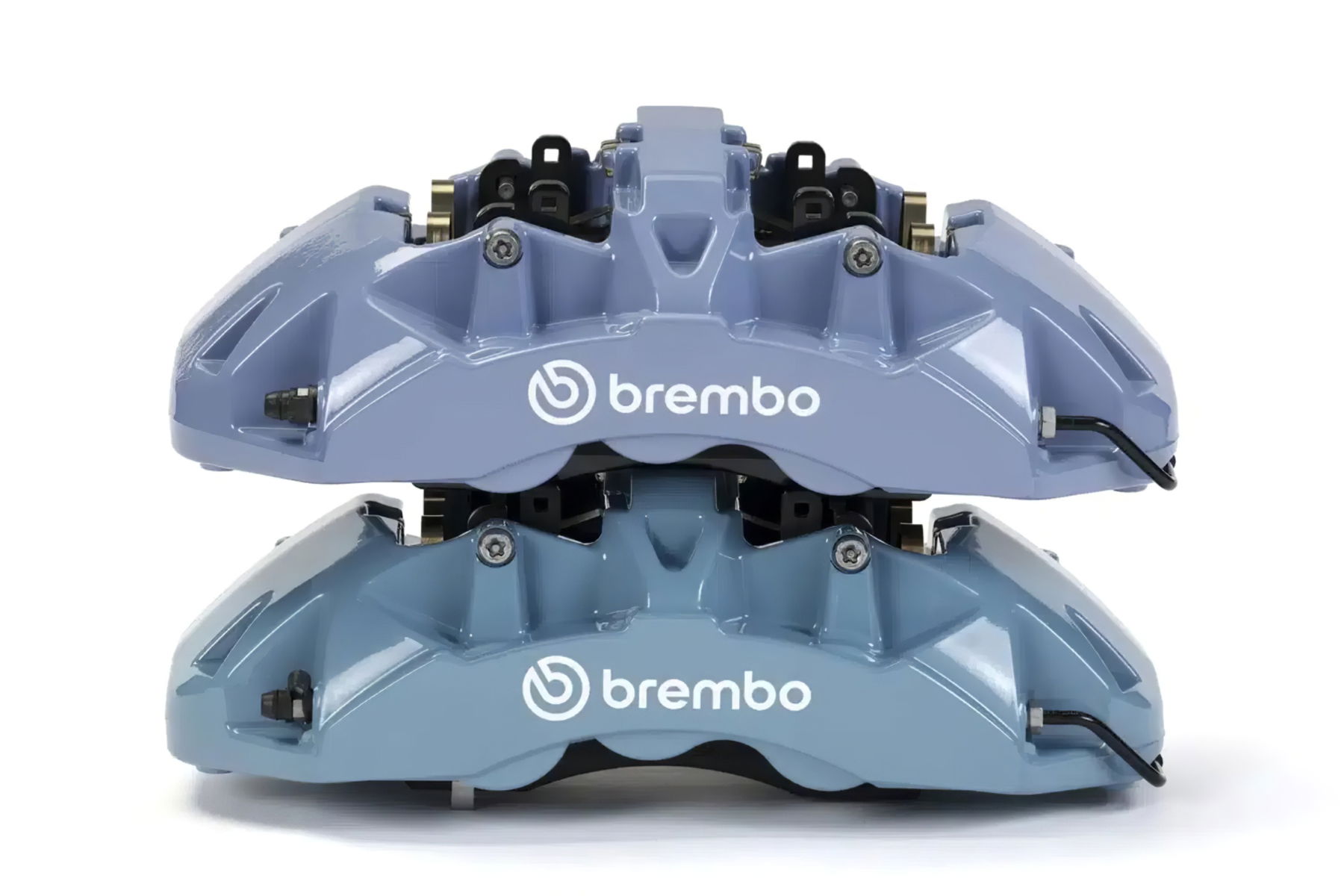
- About 80 grams lighter per caliper, roughly 160 grams saved across both front calipers
- Same hydraulic ratio and same pistons, keeping the familiar braking feel
- Already delivered to all teams, with testing in Misano and Brno
MotoGP faces a profound technical shake-up in 2027. With the switch to 850cc displacement, reduced aerodynamics, the removal of ride-height devices, and the tyre change from Michelin to Pirelli, the demands on almost every part of the prototypes are changing. The braking system is no exception. Brembo reacted early and has unveiled a completely reworked brake caliper designed specifically for the new generation of 850cc machines.
What is new about the Brembo brake caliper for 2027?
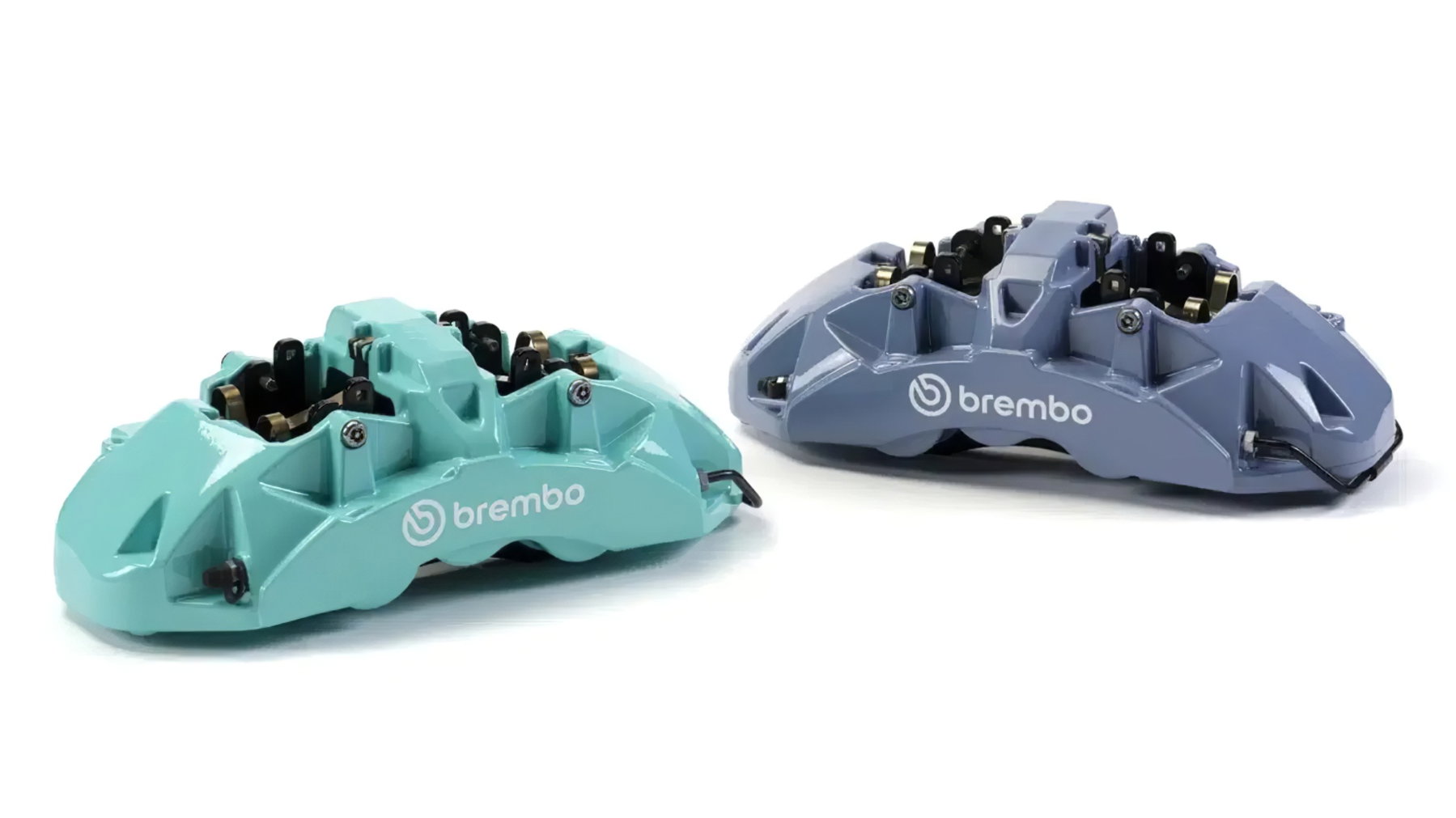
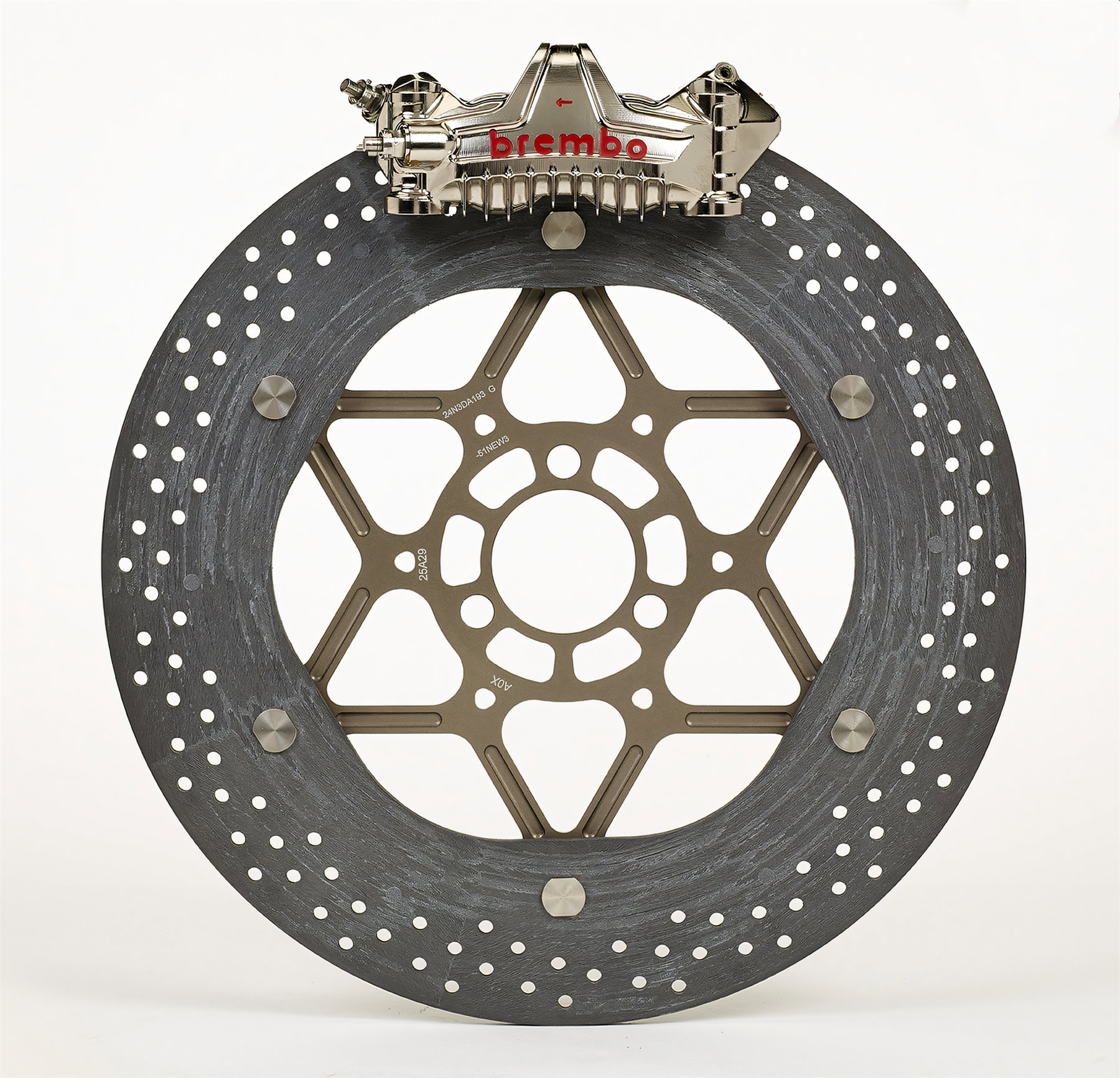
The new Brembo brake caliper for 2027 is about 80 grams (roughly 0.18 lbs) lighter than the current part and does away with the distinctive cooling fins. In their place is a much simpler, more technical-looking shape that results from what is known as topological optimization. Starting from the component’s 3D model, material is removed exactly where no high forces act, and kept only where it is actually needed. For the teams, the switch remains straightforward, since the caliper uses the same brake pad as the current version and is largely designed as a plug-and-play solution. This means the new part can be compared directly with the previous design without having to replace the entire package.
Why is the new brake caliper lighter?
The caliper is getting lighter because braking loads with the 850cc machines are expected to be somewhat lower than with today’s bikes. The reasons are the smaller displacement, reduced front-end aerodynamics, the removal of downforce systems, and a changed overall weight. Brembo therefore redesigned the caliper from scratch. Per component, the saving amounts to about 80 grams; across both front calipers combined, that adds up to around 160 grams (about 0.35 lbs). Andrea Pellegrini, who is responsible for motorcycle racing at Brembo, puts the benefit of this saving into context: “Dynamically, the rider doesn’t really feel the difference directly, but for engineers, having lighter solutions is always important, because it then allows us to position weight where it’s needed on the bike.” This weight shift can matter especially at the front wheel, where mass strongly influences handling.
Does the braking feel stay the same for riders?
Yes, the braking feel is expected to remain largely unchanged, because Brembo keeps the same hydraulic ratio and the same pistons as on the previous caliper. With this, the manufacturer wants to avoid altering the feedback at the lever that has been fine-tuned over years. Externally the part looks new, but functionally it should feel familiar to the rider. The anti-drag system is also retained, preventing the pads from touching the disc as soon as the rider releases pressure on the lever. The caliper also keeps the quick-release fittings, which are useful when the caliper needs to be removed for a wheel change or disc work, without having to bleed the system every time. One change concerns the anti-shaking valve, which is no longer housed in the brake caliper but has been relocated to the master cylinder.
How did the current finned caliper come about?
The current caliper, fitted to the 1000cc machines, was introduced in 2020 to cope with significantly increased power, temperatures, and loads. Part of this load resulted from growing aerodynamics and downforce. At the time, Brembo increased the surface area in contact with the air to dissipate more heat. The cooling fins used for this became a defining feature and were later also adopted for the calipers in Moto2 and Moto3. Many of these approaches originate from Formula 1, from which Brembo has transferred, among other things, finned brake calipers and supercooling pistons into motorcycle racing. With the switch to the 850cc bikes, this development is now partly reversing, because the thermal demands are different.
When will the new brake caliper be used?
The new brake caliper could already be used towards the end of the current season and is likely to be one of the central technical innovations of the 2027 season. Brembo has delivered one set to every manufacturer and team, so that everyone has the same opportunity to test at the same time. Some teams have already tried the part during testing in Misano, with more expected to follow in Brno. The final decision then lies with the teams. The fact that Brembo is equipping every motorcycle at all is not a regulatory requirement, but the result of a choice made by all the teams.
What is changing with the brake discs?
For the brake discs, it looks like the large 355-millimeter discs, also known in the paddock as “pans” because of their shape, could be used less often in the first year of the new era. The most commonly used solution is expected to be the 340-millimeter discs, available in a standard and a ventilated version. Brembo is nevertheless keeping all variants in its range, since the choice depends on the tracks and the teams’ requirements. For 2028, Pellegrini considers the 355mm discs useful on particularly brake-intensive circuits such as Austria and Motegi. The large disc was originally introduced to reduce the risk, on such tracks, of having to interrupt a race for a disc change. If performance were to drop significantly with the new machines, Pellegrini says a return to the 320-millimeter discs, which have not been used for around three years, would also be conceivable.
How does this new development fit into MotoGP 2027?
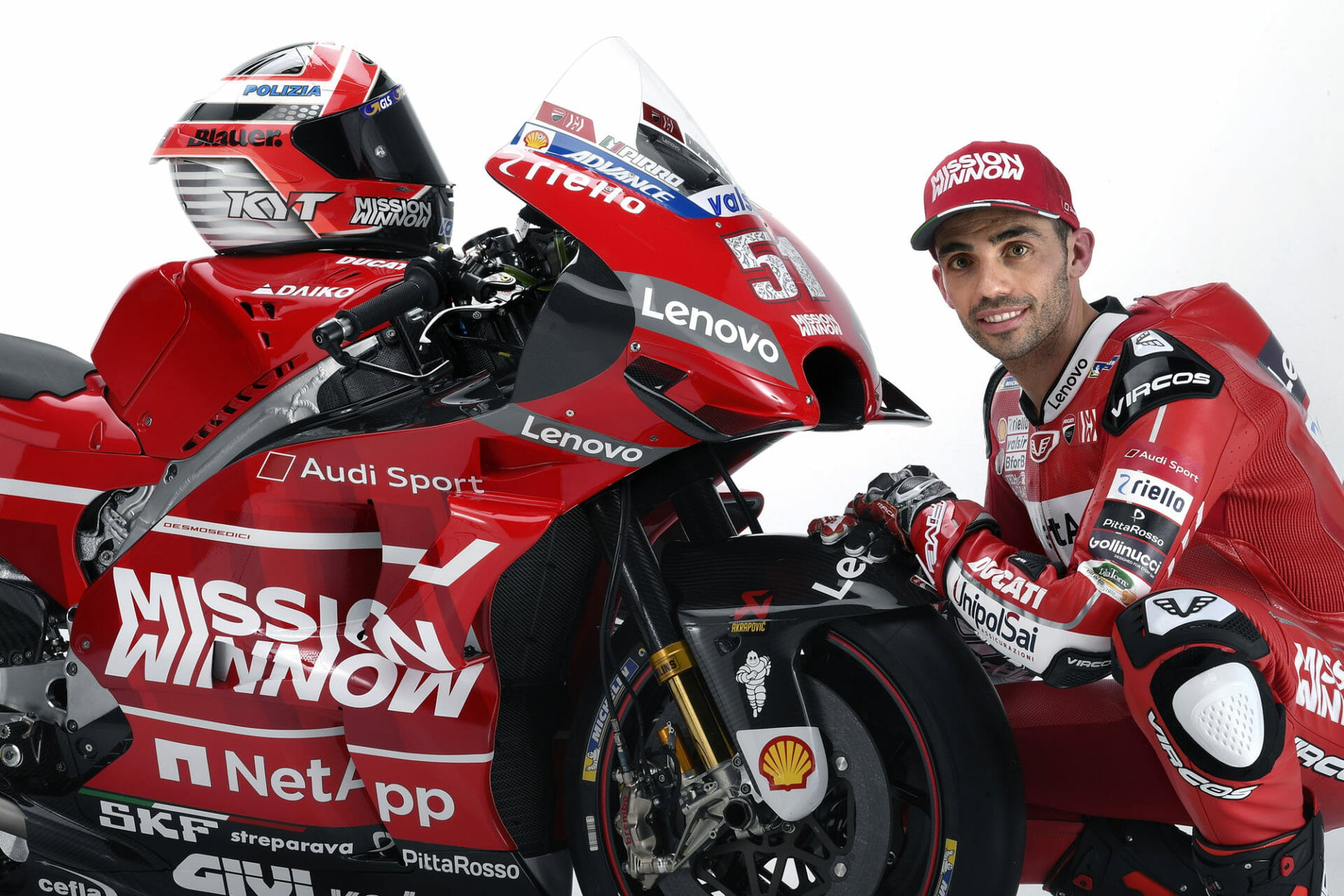
The brake caliper is just one piece of a comprehensive overhaul that the entire grid is preparing for. As early as spring 2026, Ducati ran a first 850cc prototype with test rider Michele Pirro during a private shakedown in Misano, fitted with simplified aerodynamics, no ride-height adjustment, and early versions of the Pirelli tyres. From Brembo’s point of view, these tyres are seen as the biggest unknown, since no one can yet reliably predict how the performance level will develop. This matters for the brakes, because longer braking phases heat up the system more, while shorter, harder braking tends to produce pressure spikes instead. Regarding the weight of the new machines, there has so far been talk of roughly eight to twelve kilograms (about 18 to 26 lbs) less, though precise figures are still pending. A first joint test with Pirelli is planned for the period after the Misano Grand Prix, initially using adapted current machines.
➜ This article is part of our comprehensive overview: 2026 MotoGP Season: The Complete Overview – Teams, Riders, Calendar & Championship Standings. Find all key information on this topic in one place.
Frequently Asked Questions
-
How much lighter is the new Brembo brake caliper for 2027?
The new Brembo brake caliper for 2027 is about 80 grams (roughly 0.18 lbs) lighter than the current part. Across both front calipers, that adds up to a saving of around 160 grams. This is achieved through topological optimization, where material is kept only where it is actually needed.
-
Does the new caliper change the braking feel for riders?
No, the braking feel is expected to stay largely the same. Brembo keeps the same hydraulic ratio and the same pistons as the current caliper, so the feedback at the lever remains familiar. The anti-drag system and the quick-release fittings are also retained.
-
When will the new brake caliper be used in MotoGP?
The new caliper could be used as early as the end of the current season and is expected to be one of the key technical innovations for the 2027 season. Brembo has already supplied the part to all teams; initial testing took place in Misano, with further running planned in Brno.
-
Why is MotoGP changing its technical regulations for 2027?
From 2027, MotoGP switches to 850cc displacement, reduces aerodynamics, removes ride-height devices, and changes tyre supplier from Michelin to Pirelli. The changes are intended to make racing safer and to limit costs and effort, while also altering the demands placed on the braking system.
-
Which brake discs will MotoGP use from 2027?
The 340-millimeter discs, available in standard and ventilated versions, are expected to be the most commonly used option at first. The larger 355-millimeter discs may be used less often in the first year but will remain part of the range. For particularly brake-intensive tracks, they are expected to be an option again from 2028.
➜ More on this topic in our overview: 2027 MotoGP Season: The Complete Overview.