- Waymo is starting in Munich with mapping runs; the public service is planned for the end of 2027
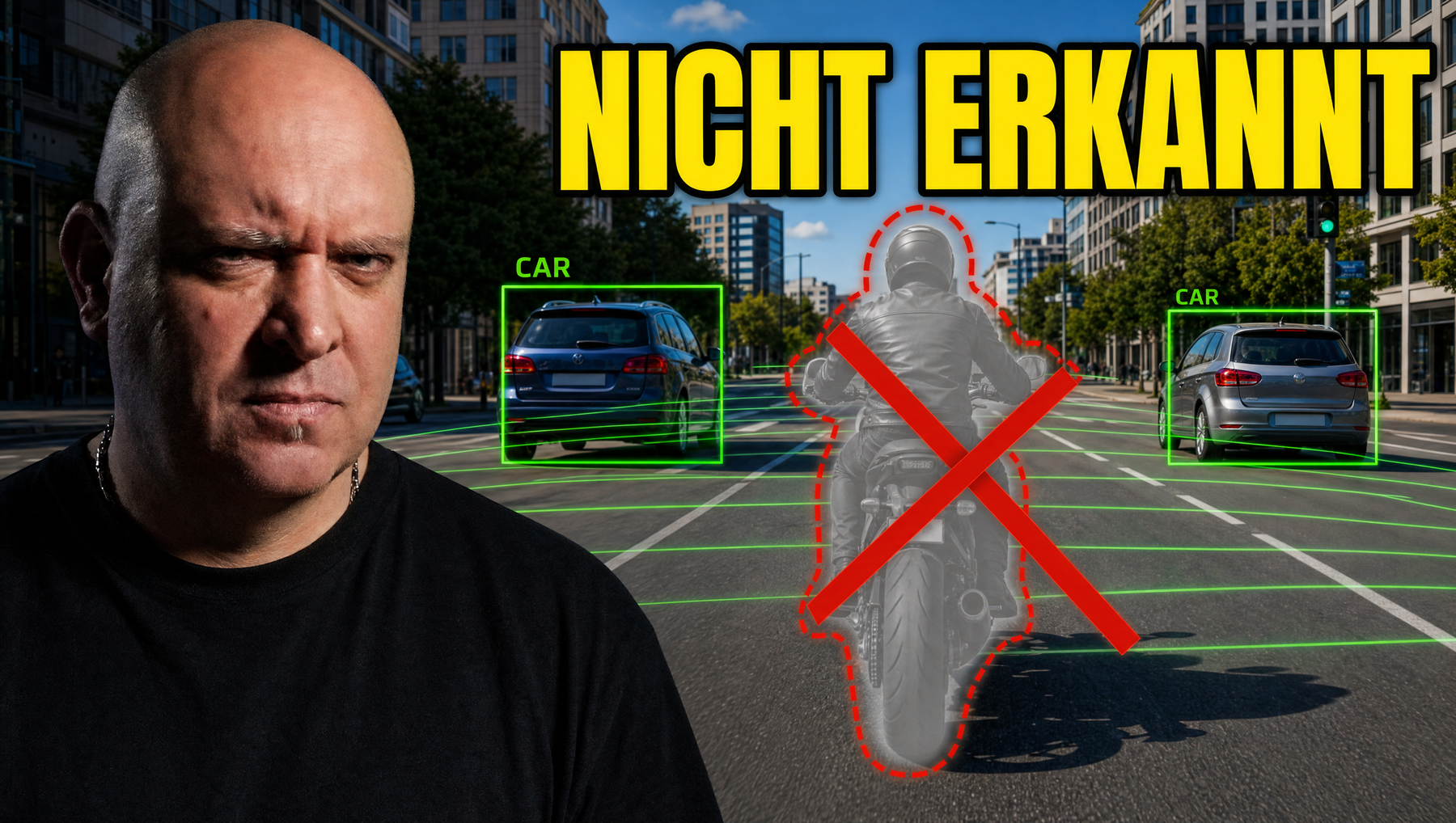
- According to a study by the Connected Motorcycle Consortium, driver assistance systems in cars respond correctly to other cars in 96 percent of cases, but to powered two-wheelers in only 59 percent
- The remote-driving regulation in force since December 2025 covers cars, buses and trucks; motorcycles do not appear in it at all
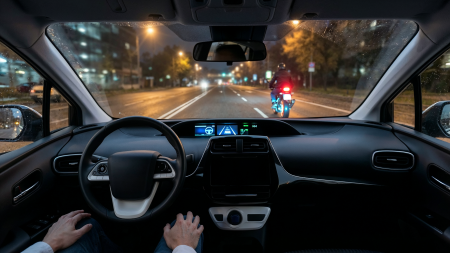
Over the coming months Munich will become the largest test bed for automated driving in Germany. Several operators are sending vehicles onto the same streets that motorcycles use in summer. The technology behind them is at different stages of development, and it differs above all in its sensors. For motorcyclists this is not an abstract topic, because detecting narrow vehicles has been considered a weak spot of such systems for years. How many vehicles will be on the road in total is a figure no operator has yet given.
What is starting in Munich right now?
Waymo is preparing a fully autonomous ride service in Munich and will put its first vehicles on the road in the coming weeks. The company, which belongs to Google parent Alphabet, is proceeding in stages.
At first, trained specialists steer the cars through the city by hand while creating high-resolution maps of the road network. Only afterwards does the software take over, with a safety driver remaining behind the wheel during this phase. The company says it is targeting public operation towards the end of 2027. The necessary approvals are not yet fully in place; Waymo points to ongoing discussions with the Federal Motor Transport Authority, the state authorities and the city. According to media reports, the company is starting with a small fleet of the electric Jaguar I-Pace. Munich would be the first commercial market in the European Union, and a European offshoot is already running in London.
Waymo is not alone there. Chinese developer Momenta received a nationwide testing permit for level 4 trials in urban traffic from the Federal Motor Transport Authority at the end of July and is working with Uber in Munich. There is no date for the first paying passenger. In parallel, Uber is testing together with Nvidia and the Israeli start-up Autobrains. That system is a technical special case, because according to the German automobile club ADAC it observes its surroundings exclusively via cameras and artificial intelligence, with no radar systems involved. On top of that comes an autonomous city bus from MAN, which is due to operate from autumn on behalf of the Munich transport authority with a closed user group.
Politically, this is intended. Florian Herrmann, head of the Bavarian State Chancellery, says the technology now needs to get onto the road and into everyday life quickly, and has announced plans to cut red tape and remove regulatory hurdles. The Bavarian economics ministry wants to see robotaxis in practical use by IAA Mobility 2027.
Who is liable if a robotaxi hits a motorcyclist?
With a driverless vehicle, the motor liability insurance of the registered keeper, meaning the operator, pays out. For accident victims, nothing changes about the process for now.
Operation has been possible since 2021. Germany was one of the first countries to pass a law on autonomous driving at the time, permitting level 4 vehicles. Level 4 means that a vehicle drives entirely by itself within a predefined operating area and, in the event of a fault, brings itself into a safe state without human intervention, for example by stopping at the roadside. A driver is then no longer needed. What is required instead is technical supervision, meaning a person who monitors several vehicles remotely and approves driving manoeuvres in case of doubt. The autonomous driving regulation has governed the details since July 2022; the vehicle and the operating area are approved by the Federal Motor Transport Authority and the state authorities.
Because there is no longer a driver at the wheel at level 4, driver liability no longer applies. Keeper liability remains. The insurer can subsequently recover the money from the manufacturer if the technology failed. Insurance group Allianz wants to stick with this model and additionally proposes a European type-approval test for autonomous vehicles as well as an EU database for near misses.
A second rule has applied since 1 December 2025, the road traffic remote-driving regulation. It permits a vehicle to be steered from a control centre, for instance so that a car-sharing vehicle can drive itself to the next customer. The maximum permitted speed is 80 kph, the delay between camera image and control command must not exceed 0.2 seconds, and an emergency braking assistant is mandatory. The regulation applies to vehicle classes M and N, meaning cars, buses, trucks and vans. Motorcycles fall under class L and are not covered. So the technology is being regulated for the vehicles that drive alongside motorcycles, not for the motorcycles themselves.
How reliably do assistance systems detect a motorcycle?
Considerably worse than they detect other cars. The Connected Motorcycle Consortium, an association of motorcycle manufacturers, suppliers and research institutions, found in a study that assistance systems respond correctly to other cars in 96 percent of cases, but to powered two-wheelers in only 59 percent.
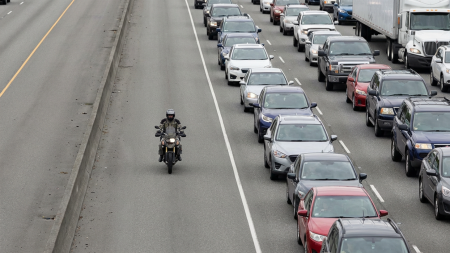
Particularly striking were the tests in which the two-wheeler rode offset within the lane or sat directly behind a larger vehicle, which is to say exactly the positions that are common in city traffic. The technical reason is simple: a motorcycle is narrow and offers radar only a small reflective surface. From this the consortium derives the thesis that accident figures between cars and motorcycles could rise again the more car drivers rely on their assistance systems. As countermeasures it proposes more reflectors on the two-wheeler and greater use of vehicle-to-everything communication, in which vehicles inform each other about their position.
The US insurance institute IIHS therefore tightened its test for emergency braking assistants in 2024 and has since also driven towards a motorcycle dummy at 50, 60 and 70 kph, both centred and offset within the lane. Of the first ten compact SUVs tested, only the Subaru Forester achieved the top rating, with the Honda CR-V and Toyota RAV4 one level below. Four models failed, among them the Chevrolet Equinox, which in most runs either did not warn at all or warned too late against the motorcycle target and barely slowed down. Manufacturers have since caught up: from the 2026 model year, the institute says more than 77 percent of the vehicles tested achieve an acceptable or good rating. Euro NCAP has also been testing with its own motorcycle scenarios this year.
Why braking behaviour becomes a risk of its own
A robotaxi has considerably more sensor hardware than a normal car. Waymo combines cameras, radar and laser scanners, known as lidar, which scans the surroundings three-dimensionally using laser pulses. On its safety page, for the data set up to March 2026, the company states that it records 84 percent fewer crashes involving injured motorcyclists than human drivers on comparable routes, which in absolute numbers is 32 cases fewer. This evaluation comes from the United States and from Waymo itself.
It says nothing, however, about how such a vehicle behaves when a motorcycle is following it. A robotaxi drives by the rules, but not always in the way a human expects. In Tempe in the US state of Arizona, at around half past one in the morning in September 2025, a Waymo without a passenger slowed down in front of a driveway because pedestrians were standing there. The motorcyclist behind ran into it, was then struck by another vehicle whose driver fled the scene, and died in hospital. Under the legal situation the robotaxi was presumably not at fault; according to the company the vehicle had indicated and slowed down in accordance with the rules.
At Amazon subsidiary Zoox, the US traffic safety authority investigated two cases in which robotaxis braked hard for no discernible reason and motorcyclists ran into them. How often such braking manoeuvres occur internally is shown by an analysis of occupational safety data reported by a US trade publication at the end of August. According to that report, Waymo and Zoox saw more than two dozen injuries to test drivers caused by hard braking or sudden evasive manoeuvres in 2024 and 2025, including strains, bruises and whiplash. At the Waymo sites there were 16 reported cases, at Zoox up to eight. Those affected were people sitting in the vehicle with their seatbelts on. Anyone riding behind on two wheels does not have that protection.
What does the Tesla case from Ohio show?
It shows how little about such crashes becomes public. On 23 July 2025 in Moraine in the US state of Ohio, at around 8.15 pm, a Tesla Model X collided with a three-wheeled motorcycle at an intersection. The rider, 55-year-old Leonidas Davis, was thrown from the vehicle and died at the scene.
Local reporting spoke merely of a saloon car. Only in early September 2026 did a US trade publication match the case to a report that Tesla itself had submitted to the US traffic safety authority. In it the vehicle is listed as a 2024 Model X, the status of the driving system is noted as confirmed active, verified via the vehicle data. The speed before the collision is given as 49 miles per hour, around 79 kph. Which system exactly was running, Autopilot or the more expensive Full Self-Driving, is redacted. Also redacted are the crash narrative, the software version and the video, in each case as a trade secret. According to the trade publication’s analysis, practically all of almost 4,000 Tesla reports contain a redacted crash narrative.
Part of the context is that this is not a robotaxi. The system is a level 2 assistant in which the human at the wheel bears responsibility at all times. But it is precisely the system whose investigation the US traffic safety authority extended to 3.2 million vehicles in March 2026. The allegation is that the purely camera-based system detects a vehicle ahead too late or not at all in glare, dust or restricted visibility. Fatal rear-end crashes involving Teslas and motorcycles at night had already led to investigations before that.
What is coming to European roads
In Europe this system is already on the road. The Dutch vehicle authority RDW approved Full Self-Driving in its supervised variant in April 2026, and it has since been enabled in five EU states: alongside the Netherlands, these are Denmark, Belgium, Estonia and Lithuania. The Federal Motor Transport Authority is still assessing it and is testing a vehicle of its own; there is no German recognition so far.
For EU-wide recognition, the European Commission’s technical committee on motor vehicles would have to agree by qualified majority, meaning at least 15 of the 27 member states representing 65 percent of the EU population between them. The five states so far account for around nine percent. 6 October 2026 is named as a possible date for the vote, but there is no official confirmation from the Commission. Authorities in Sweden, Finland, Denmark and Norway have raised concerns, among other things about the name, which they consider misleading. The European Transport Safety Council is calling for the procedure to be suspended.
Two developments are therefore converging. On one side are robotaxis with extensive sensor hardware that drive by the rules but can brake in situations where a human does not expect it. On the other side are assistance systems that work with cameras alone. Mandatory tests with pedestrians and cyclists now exist for new vehicles; associations have been calling for binding tests with motorcycles for years, but so far these take place mainly in voluntary test programmes.
The fact that a system detects a bicycle does not automatically mean it also detects a motorcycle. The silhouette differs, for instance because of fairings, panniers or a rider leaning into a corner. Above all, though, a motorcycle moves differently. It accelerates to country-road speed in a matter of seconds, decelerates harder than a car, and is not only travelling at city speeds. So a system must not only see a motorcycle, but also correctly judge its speed and where it is heading. That is exactly what humans regularly fail at; the classic motorcycle crash is the turning car whose driver has underestimated the speed.
Part of the context is also that this technology is at an early stage. The IIHS test series show that motorcycle detection has measurably improved over the past two years. What is a weakness today may be solved in a few years. Traffic in Munich, however, is happening now. Anyone riding behind a vehicle with visible sensor hardware is safer with more distance, because that vehicle brakes according to its own software. And anyone with such a vehicle behind them is more likely to be detected if they are not riding at the edge of the lane or hidden behind a larger vehicle. That puts the Munich test operation in line with a development that already occupies motorcyclists when it comes to emergency braking assistants and unexpected braking manoeuvres by modern cars.
Frequently Asked Questions
-
When does the robotaxi service start in Munich?
Waymo wants to open the service to the public towards the end of 2027. Before that, mapping runs and test drives with a safety driver will take place. The full approvals are not yet in place.
-
Do self-driving cars detect motorcycles?
Not as reliably as they detect other cars. According to a study by the Connected Motorcycle Consortium, assistance systems respond correctly to cars in 96 percent of cases, but to powered two-wheelers in only 59 percent. Robotaxis have considerably more sensor hardware, but there is no European comparative data on this so far.
-
Who is liable in a crash involving a driverless car?
The motor liability insurance of the registered keeper, meaning the operator, pays out. Driver liability does not apply at level 4 because there is no longer a driver at the wheel. The insurer can then seek recourse from the manufacturer if the technology failed.
-
Does the remote-driving regulation also apply to motorcycles?
No. It covers vehicle classes M and N, meaning cars, buses, trucks and vans. Motorcycles belong to class L and do not appear in the regulation.
-
Is Tesla’s Full Self-Driving approved in Germany?
No. The Federal Motor Transport Authority is assessing the system and testing a vehicle of its own; there is no recognition so far. It has been enabled in five EU states, and EU-wide recognition would require a qualified majority in the responsible EU committee.
➜ This article is part of our comprehensive overview: Motorcycle Law & Policy: Regulations, Court Rulings and Developments for Riders. Find all key information on this topic in one place.