- 904cc inline-twin with 95.2 hp (70 kW) and 90 Nm (66 lb-ft)
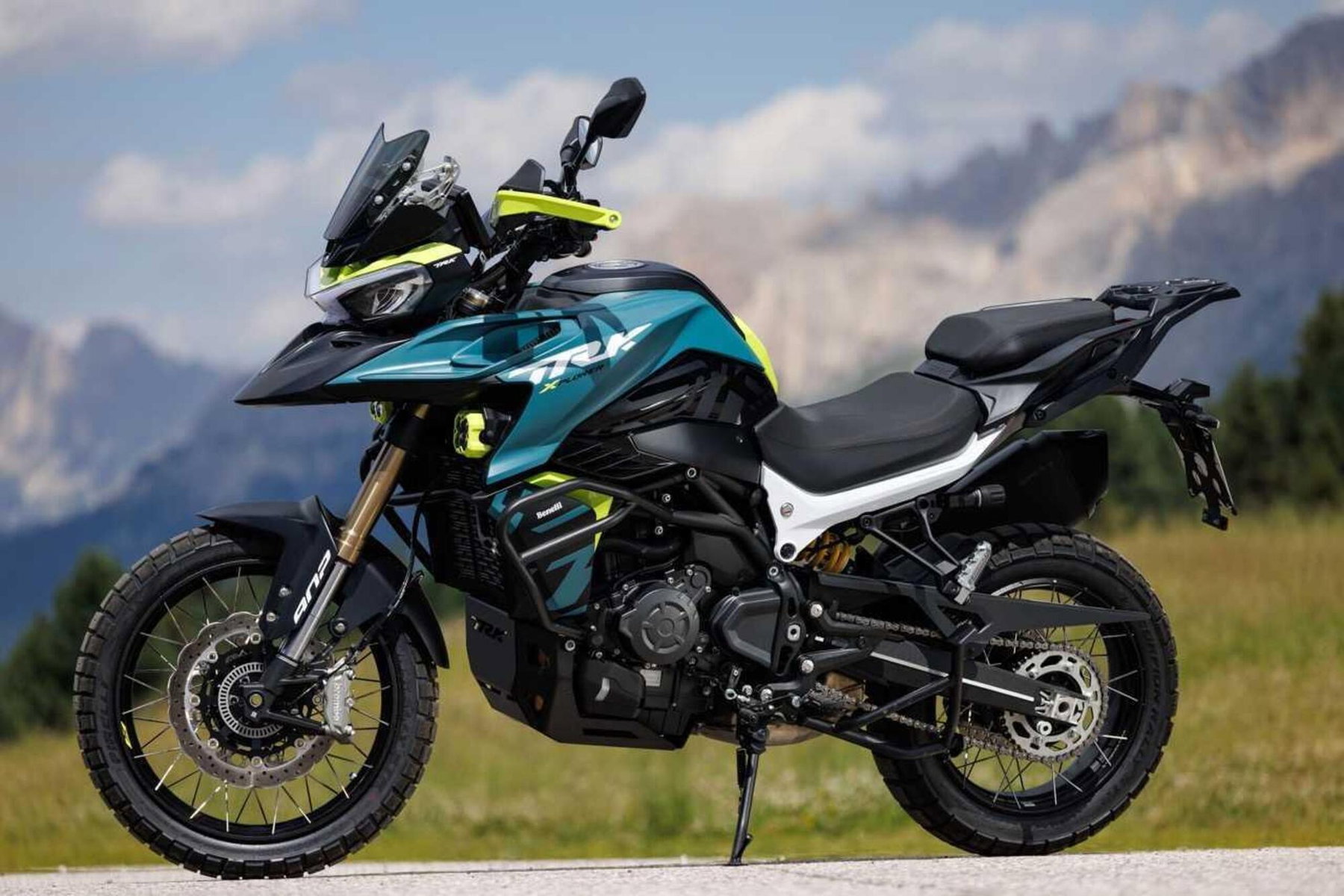
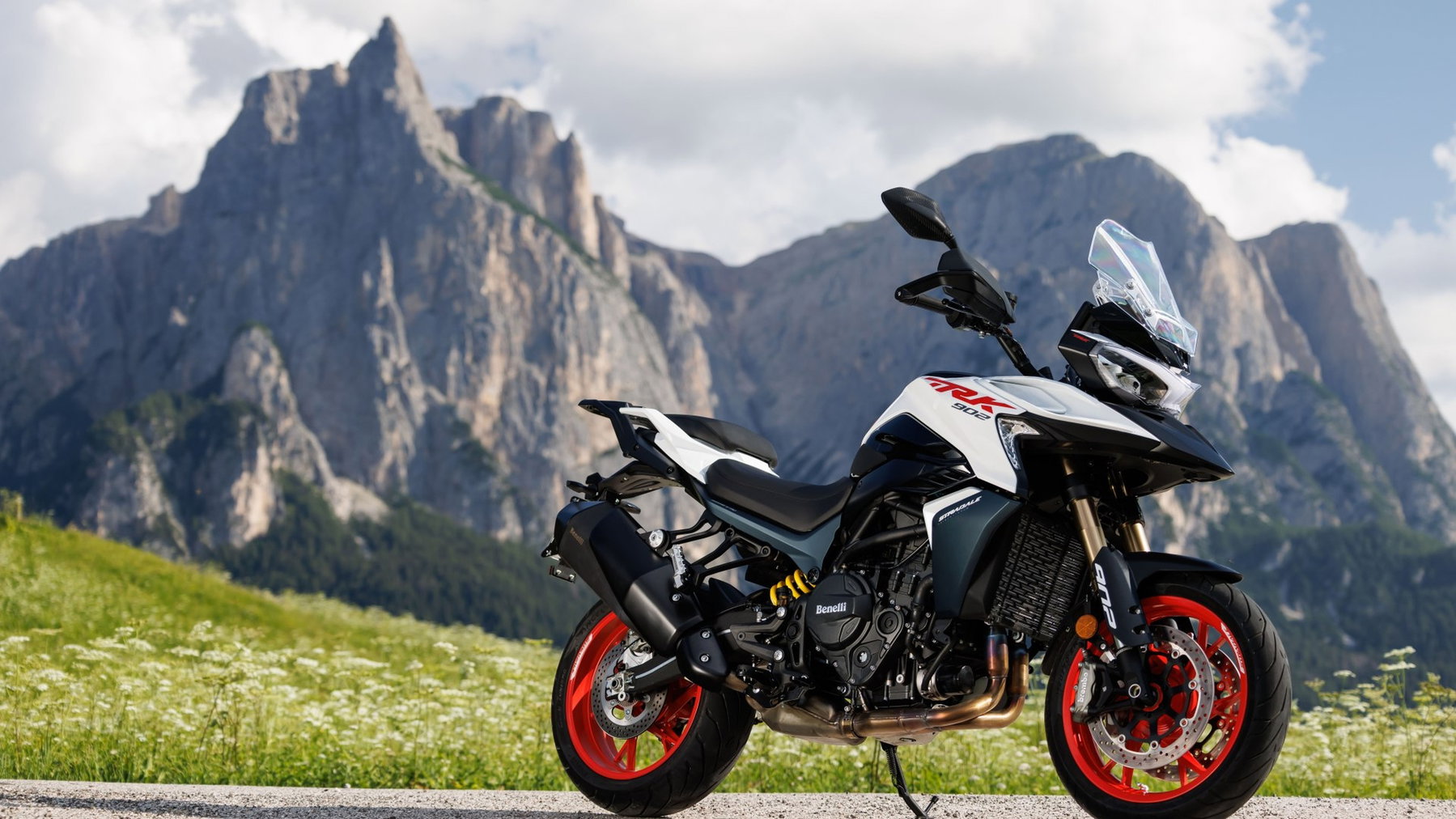
- Two variants: Stradale with a 17-inch front wheel, Xplorer with a 19-inch spoked wheel
- Prices starting at 8,790 euros (about 10,280 US dollars) ex-works in Italy
Four years after the first prototype, the TRK 902 is on the market. For Benelli, this marks a milestone, as the Pesaro-based brand is entering the class benchmarked around 1,000cc and 100 hp for the first time. The price is made possible by production in China within the QJ Motor group, to which Benelli belongs. As with the smaller TRK models, there are two versions built on a shared base: the Stradale for asphalt and the Xplorer for anyone who also wants to head off the beaten track. At the international press launch, both were on the program for a full day between Alpe di Siusi, Passo Lavazè and Lake Carezza.
What’s under the skin of the Benelli TRK 902?
Both versions share an inline-twin engine with 904cc, four valves per cylinder, two overhead camshafts and a 270-degree crank throw. According to the manufacturer, the Euro 5+ homologated engine produces 95.2 hp (70 kW) at 9,000 rpm and delivers 90 Nm (66 lb-ft) at 6,500 rpm.
Power reaches the rear wheel via a six-speed gearbox, with a bidirectional quickshifter included as standard. The base is a steel trellis frame that builds on experience with the Leoncino 800, complemented by a curved, banana-shaped aluminum swingarm. The subframe is welded rather than bolted on.
Benelli shares the platform with the QJ Motor SRT, which reached the market earlier. Benelli subsequently developed its own version further, especially in electronics, surfaces, ergonomics and tuning. Marzocchi supplies the suspension, with a fully adjustable upside-down fork and a shock whose rebound is adjustable and whose spring preload can be adjusted via a remote adjuster. The brakes come from Brembo: twin 320 mm discs up front with radially mounted M4.32 monoblock calipers and a radial pump, plus a 260 mm disc at the rear.
How do the Stradale and Xplorer differ?
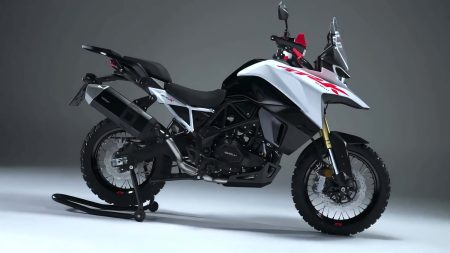
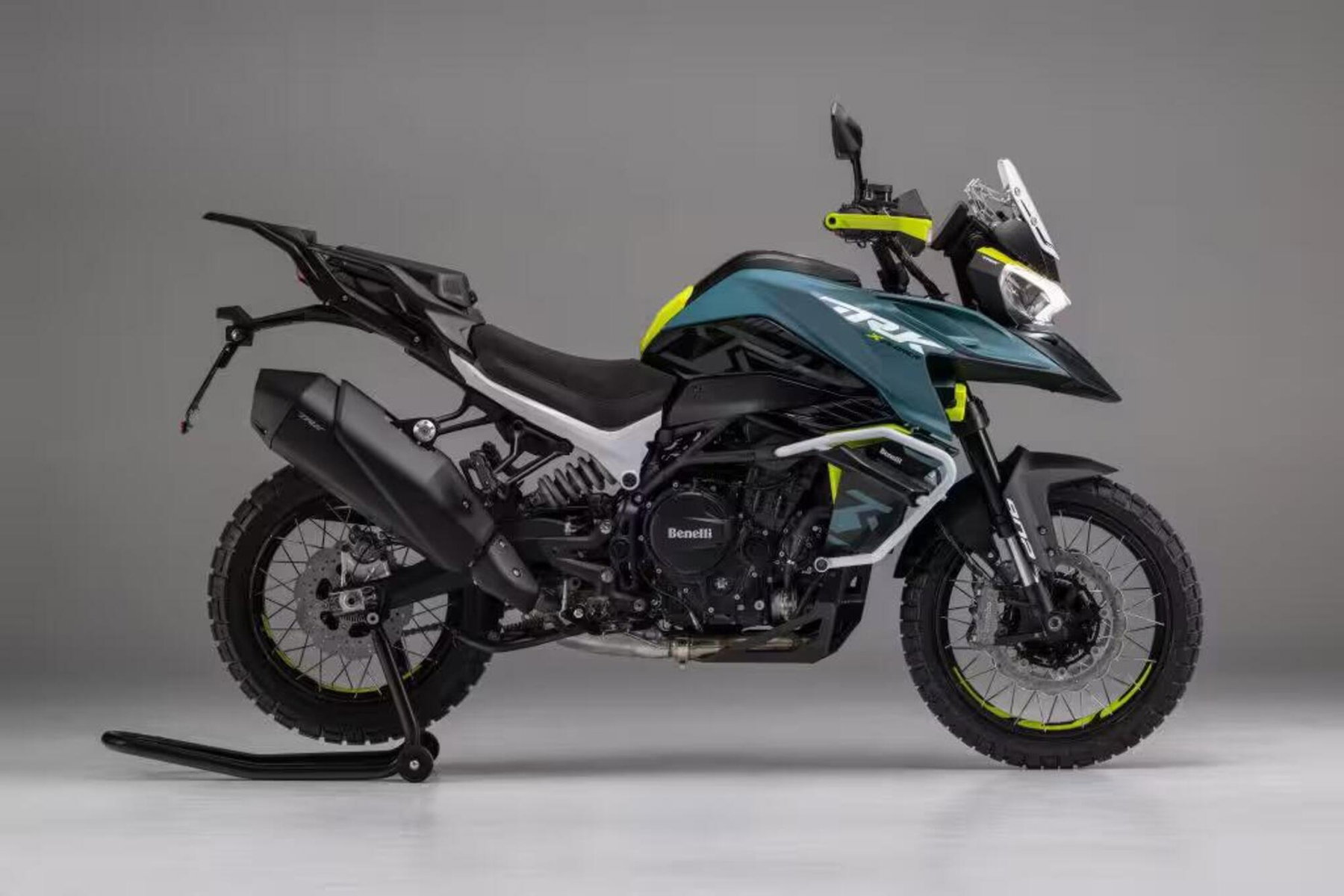
The difference lies mainly in the front wheel and suspension travel. The Stradale rolls on two 17-inch cast wheels with Pirelli Angel GT tires in 120/70 ZR 17 and 180/55 ZR 17, with 130 mm of travel front and rear, while the Xplorer gets a 19-inch cross-spoked wheel that can run tubeless despite the spokes, along with Pirelli Scorpion Rally STR tires and 170 mm of travel at both ends.
The rest follows from that: the Xplorer has 215 mm of ground clearance, more than the Stradale, making it the only one of the two suited to light gravel sections. Seat height also differs, at 820 mm for the Stradale and 840 mm for the Xplorer. Dry weight comes in at 230 kg (507 lbs) and 240 kg (529 lbs) respectively, with the heavier Xplorer additionally bringing a center stand, aluminum engine guard and fog lights.
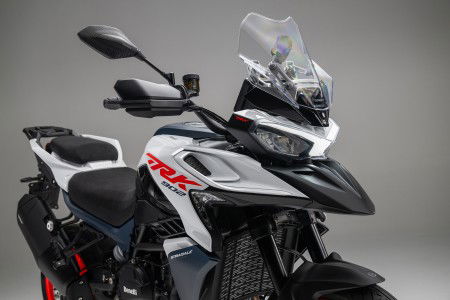
Visually, the two are set apart mainly by paint, windscreen, and the arrangement of turn signals and auxiliary lights. The Stradale gets a larger, electrically adjustable windscreen, while the Xplorer has a more compact, manually adjustable one.
What is the Benelli TRK 902 like to ride on the road?
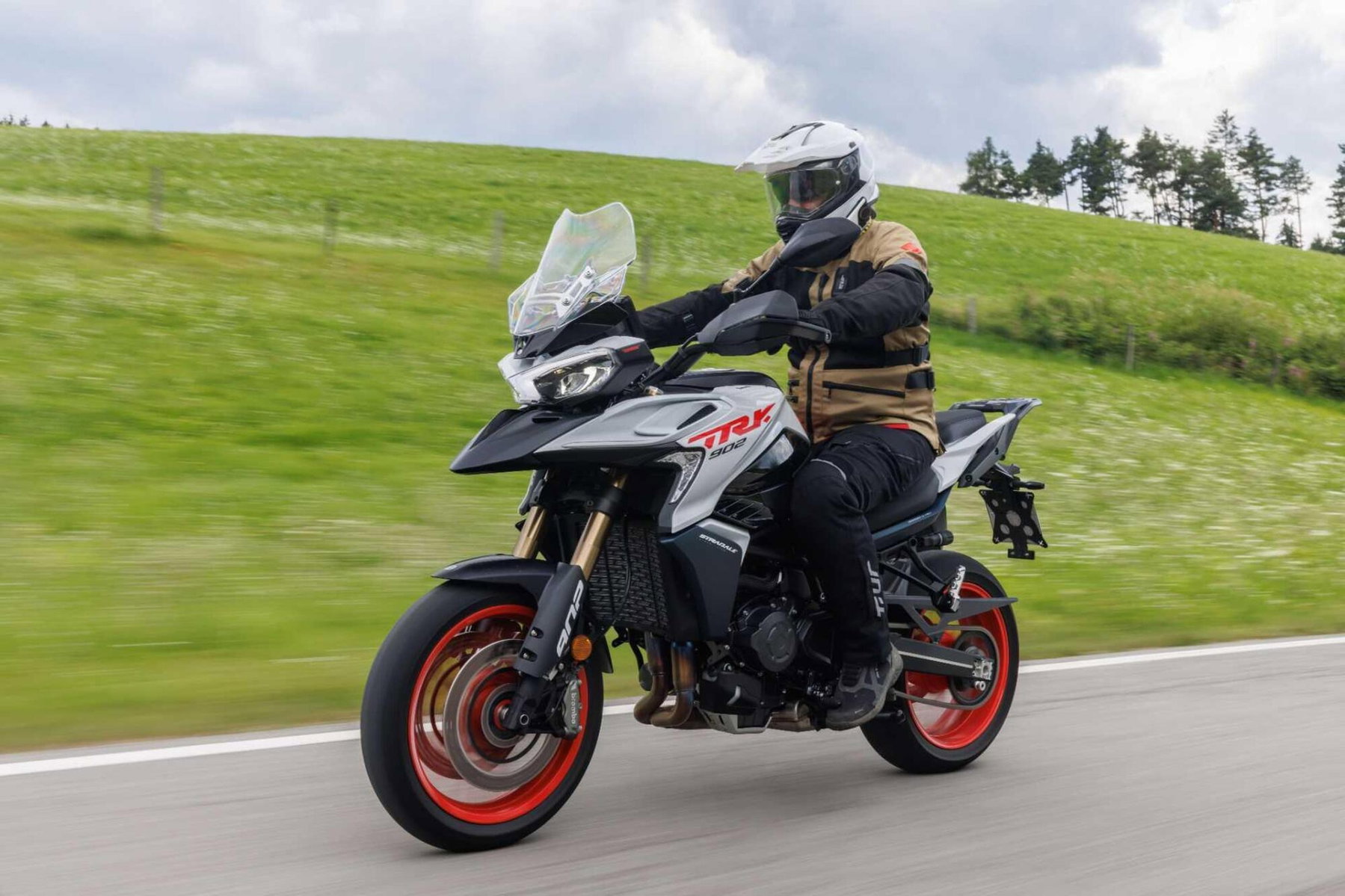
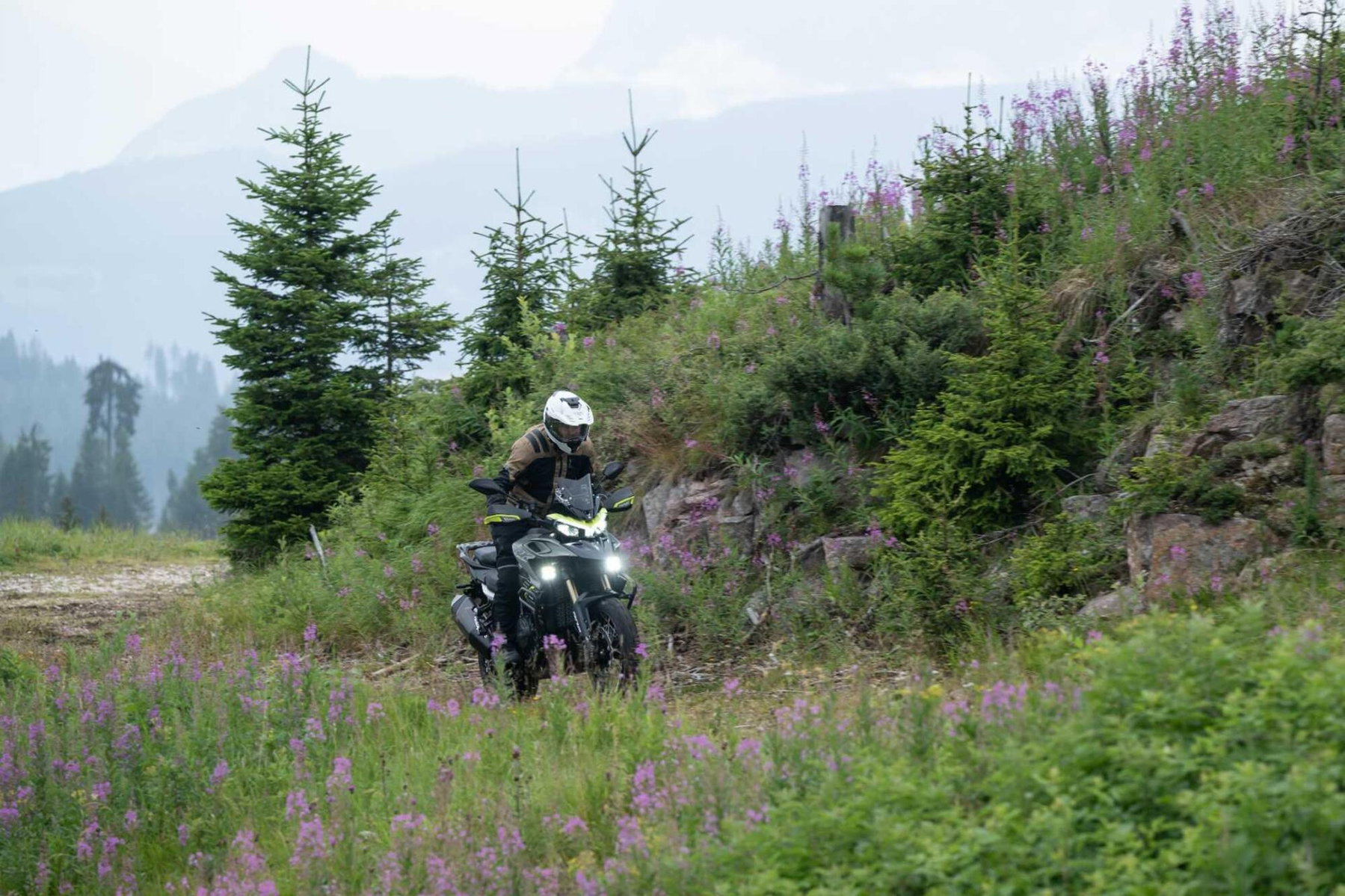
The two variants respond noticeably differently as soon as the road turns twisty. Because of its flatter tire profile, the Stradale needs a slightly firmer initial input at the bars, but then tips in quickly and scores points when flicking rapidly from one lean angle to the other.
That’s down to roughly ten kilograms less weight, a lower center of gravity and the lower rotational mass of the smaller wheels. The Xplorer, by contrast, carves rounder lines, feels very stable at speed, but demands noticeably more effort when changing direction. In return, it scores points for comfort, since the longer suspension travel and slightly softer setup absorb bumps better.
The biggest criticism remains the weight. It’s most noticeable when maneuvering and pushing the bike, since the mass doesn’t sit particularly low. The brake bites within the first few millimeters of lever travel, which comes at the expense of fine modulation. The electronic aids work unobtrusively and don’t intervene too early.
How well does the engine perform?
The twin pulls decently off the throttle but loses drive above the middle of the rev range. As a result, acceleration feels more subdued than the spec sheet would suggest.
In detail, there’s a flat spot right after the initial throttle opening, before drive returns between 3,000 and 4,000 rpm and holds until peak torque at 6,500 rpm, accompanied by noticeable intake noise. From around 4,000 rpm onward, vibrations appear, felt mainly through the handlebars and becoming intrusive at highway speed. Accelerating in a tall gear also produces a slight jerkiness. Overall, riders shift more often than on comparably sized motorcycles. That said, the gearbox works precisely, and the quickshifter performs better on upshifts than on downshifts. Some of the subdued impression may be down to the altitude of the test route, so a final verdict on the engine will have to wait for lowland riding.
In Sport mode, there’s also a slight jolt on throttle pickup. Overall, three riding modes are available: Rain, Normal and Sport. Rain mode is said to limit output to 35 kW.
What electronics are on board?
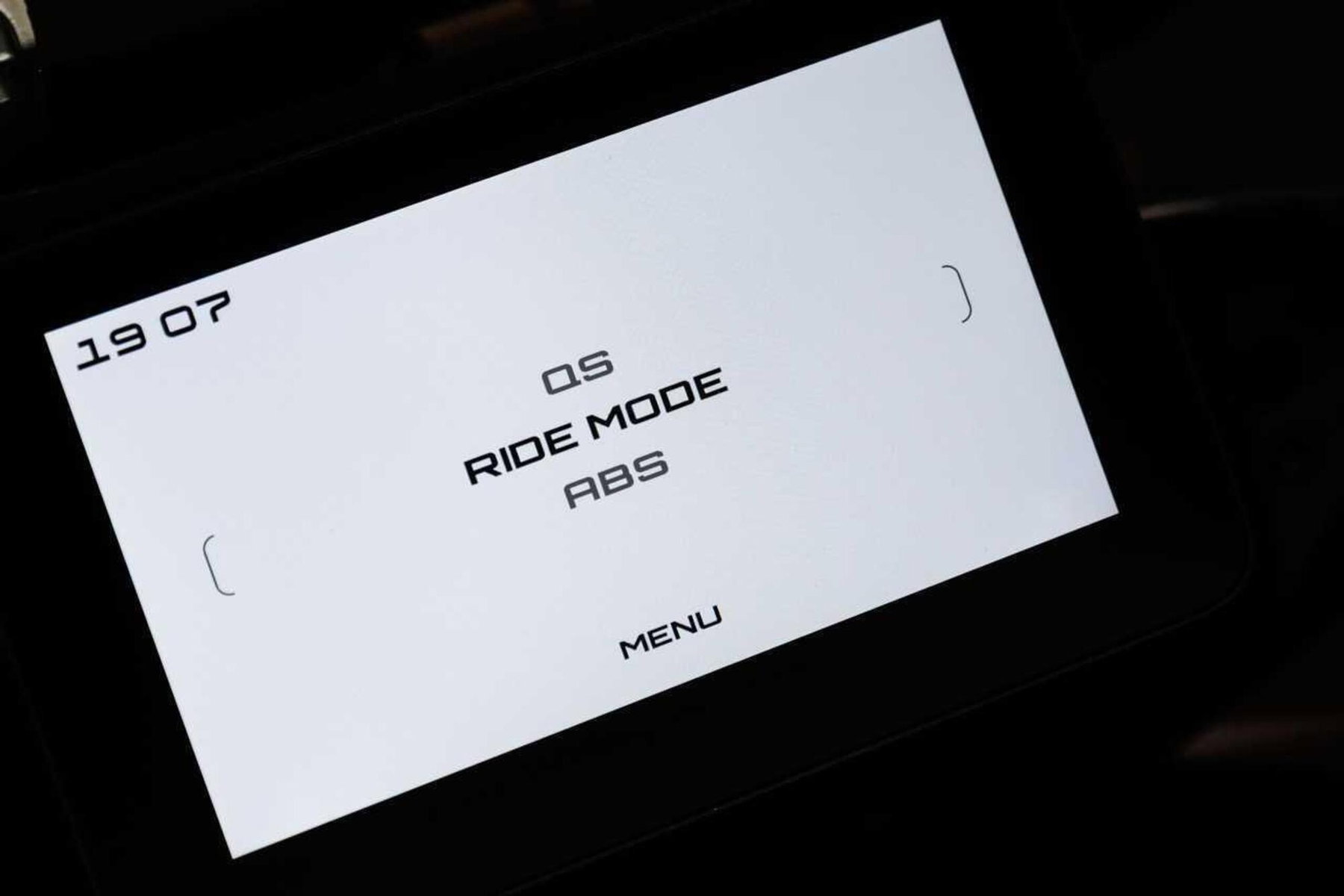
For this price class, the equipment list is unusually complete. Alongside the ride-by-wire throttle, the TRK family debuts a six-axis inertial measurement unit from Bosch, enabling lean-sensitive ABS.
ABS can be switched off completely, even on the Stradale. Traction control, on the other hand, works without lean-angle reference and without adjustable levels. Also on board are a 7-inch TFT color display, Bluetooth and WiFi, map navigation via an app that’s free only for the first year, and two USB ports.
Notable additions are a forward-facing dashcam and a rear radar with collision warning and blind-spot monitoring. Such systems were previously only found in much higher price classes. In practice, however, the radar proves overly sensitive, flagging vehicles even when the distance isn’t critical. When riding in a group, it warns almost constantly, complete with an audible tone and warning lights in the display and mirrors. Some fine-tuning appears necessary here, so this equipment advantage doesn’t turn into an annoyance.
Comfort and ergonomics on long stages
Benelli has clearly put work into the riding position. The footpegs sit more centrally than on previous TRK models, giving the seating position a more active feel and less of a scooter-like character. The knees sit closer together than on the technically related QJ Motor, the seat is narrow at the front and wider at the rear, and the passenger sits less far forward than before.
Standard equipment includes seat and grip heating with three levels each, cruise control, and hand guards with integrated turn signals. Wind protection impresses at the shoulders and upper body, with the Stradale’s wider windscreen blocking noticeably more than the Xplorer’s shorter one. The tank holds 21 liters, and Benelli quotes fuel consumption of around 5 liters per 100 kilometers. That can’t be verified on the road, though, since the onboard computer lacks a corresponding menu. There’s also no outside temperature display.
One detail that high-mileage riders should keep in mind: maintenance is due annually or every 6,000 kilometers. For a motorcycle explicitly positioned as a touring machine, that’s a fairly short interval.
What does the Benelli TRK 902 cost?
In Italy, the Stradale is listed at 8,790 euros (about 10,280 US dollars), the Xplorer at 8,990 euros (about 10,520 US dollars). Both prices include a three-year warranty as well as packaging and transport, with registration costs on top.
Both versions have officially been on the price list since July 1, 2026, with the first units reaching dealers from mid-July. The Stradale is available in gray and white, the Xplorer in gray, green and sand. A price for Germany had not yet been announced by importer MSA at the time of writing. For context: the smaller TRK 702 and TRK 702 X start at 8,299 euros (about 9,710 US dollars) in Germany, while the closely related QJ Motor SRT 900 SX costs 9,999 euros (about 11,700 US dollars) including three aluminum panniers.
The gap of just 200 euros between the two variants is strikingly small. The decision therefore comes down less to budget than to intended use.
Where does the TRK 902 fit into the 2026 model year?
It’s Benelli’s biggest step upmarket to date, and at the same time an attempt to carry the success of the smaller TRK models into a higher class. The TRK 502 sold around 30,000 units, the TRK 702 around 14,000 in three years, and both were at times the best-selling motorcycles in Italy.
In the 2026 model year, the TRK 902 goes up against a segment where established European and Japanese rivals hold a technical edge. The equipment level exceeds what’s typical for this price class. However, riders switching from a Japanese or European adventure tourer will notice differences in engine character and weight that the lower price only partly offsets. It also remains to be seen how both versions perform on long highway stretches, as that terrain wasn’t covered during the first kilometers.
Frequently Asked Questions
-
What does the Benelli TRK 902 cost?
The TRK 902 Stradale costs 8,790 euros (about 10,280 US dollars), the TRK 902 Xplorer 8,990 euros (about 10,520 US dollars), both ex-works in Italy. Both prices include a three-year warranty as well as packaging and transport. A price for the German market had not yet been announced at the time of the launch.
-
How much horsepower does the Benelli TRK 902 have?
The 904cc inline-twin produces a claimed 95.2 hp (70 kW) at 9,000 rpm, according to the manufacturer. Maximum torque is 90 Nm (66 lb-ft) at 6,500 rpm. The engine meets the Euro 5+ emissions standard.
-
What is the difference between the Stradale and the Xplorer?
The Stradale runs on 17-inch cast wheels front and rear with road tires and has 130 mm of suspension travel, while the Xplorer uses a 19-inch cross-spoked wheel with knobby tires and 170 mm of travel. The Xplorer additionally comes with a center stand, engine guard and fog lights, while the Stradale gets an electrically adjustable windscreen. The two are separated by just 200 euros in price.
-
How much does the Benelli TRK 902 weigh?
Dry weight is 230 kg (507 lbs) for the Stradale and 240 kg (529 lbs) for the Xplorer. The weight is especially noticeable when maneuvering and during quick changes of direction. As a result, the lighter Stradale feels more agile on twisty roads.
-
How often does the Benelli TRK 902 need servicing?
Benelli specifies service intervals of once a year or every 6,000 kilometers. For a motorcycle designed as a touring machine, that interval is comparatively short. High-mileage riders should factor this into their running costs.
➜ Find all technical specifications, photos and prices in the data sheet of our motorcycle database: Benelli TRK 902 Xplorer (2026) – Specs.
➜ This article is part of our comprehensive overview: New Motorcycles 2026: All Models, Releases, and Highlights at a Glance. Find all key information on this topic in one place.