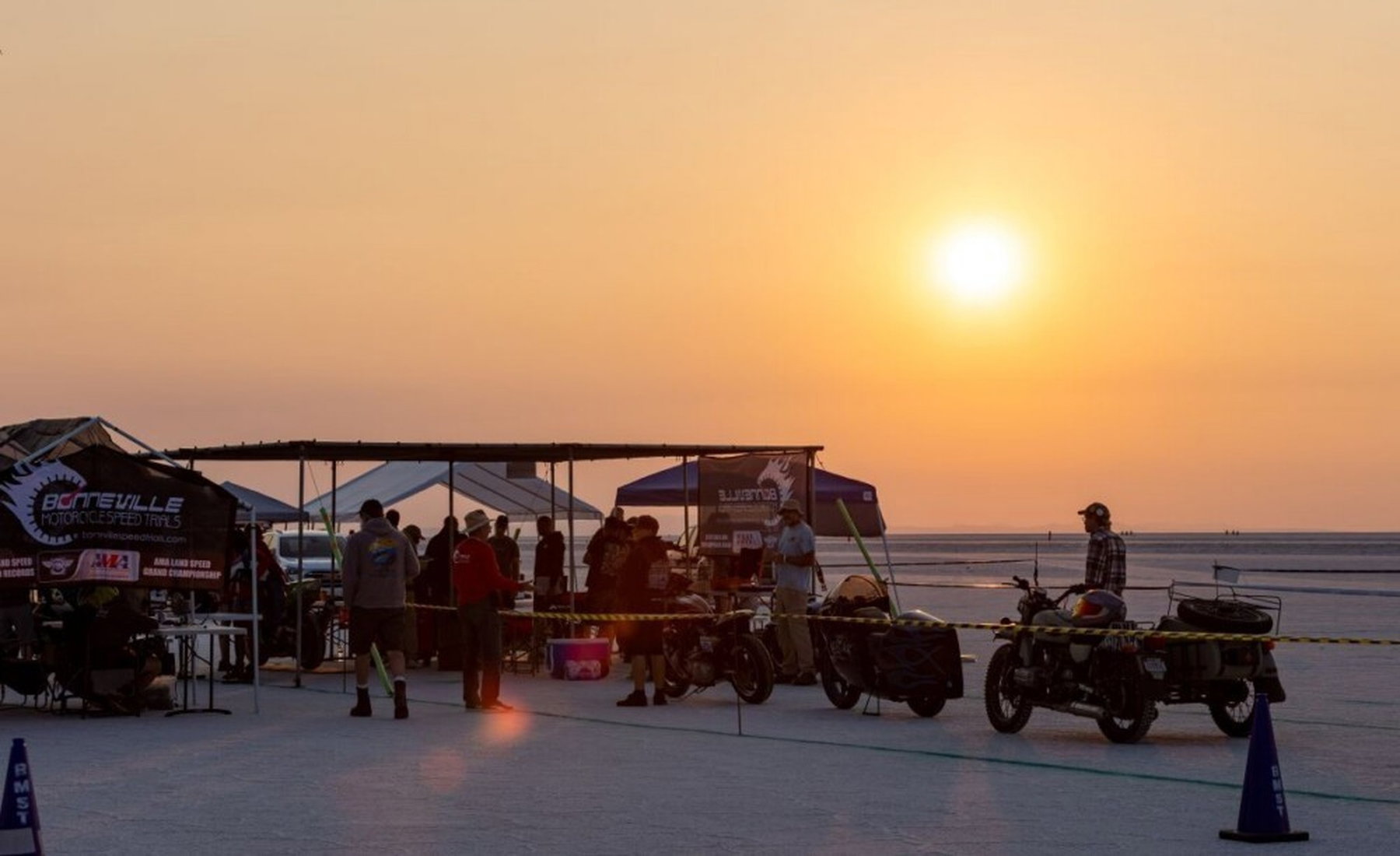
- Date: 23 to 27 August 2026, Bonneville Salt Flats in the US state of Utah
- Chris Rivas takes on the outright record of 605.697 km/h with the BUB Seven Streamliner
- Eva Hakansson returns for the first time since 2017, with the electric streamliner Green Envy
One week in August, a salt flat in the middle of the desert and a field of motorcycles that could hardly be more varied: the Bonneville Motorcycle Speed Trials are the most important date on the calendar of the FIM Land Speed World Records. This year the signs point to a productive meeting. Entry numbers are up on last year, the salt crust is considered solid, and the weather forecast looks better than in 2025. That was precisely where the 2025 edition partly came unstuck.
When do the Bonneville Speed Trials 2026 take place?
The Bonneville Speed Trials 2026 run from 23 to 27 August. Racing takes place over five days on the Bonneville Salt Flats, around 200 kilometres west of the state capital Salt Lake City and roughly 1,300 metres above sea level.
The meeting is organised by Deliciate Promotions LLC and was held for the first time in 2004. The event is double sanctioned: it counts both as an FIM world record event and as the Land Speed Grand Championship of the American Motorcyclist Association. Anyone who enters can therefore target a world record and a national US title at the same time.
Two courses are used. The shorter Mountain Track and the longer International Track are opened depending on the condition of the surface. In 2025 the longer course had to be closed several times for safety reasons, which meant almost all of the action took place on the Mountain Track.
How does an FIM record attempt at Bonneville work?
A record attempt consists of two runs in opposite directions, timed over one kilometre. After the first run there are two hours for the return run, a two-way average is calculated from both times, and that average counts as the official speed.
The classes are gender neutral. Entries are split purely by technical criteria: type of drive, fairing, energy source, displacement and number of cylinders. The result is a very fine grid that ranges from 50 cc machines to fully faired streamliners with 3,000 cc. A streamliner is a fully enclosed vehicle in which the rider lies inside a closed cell.
What condition is the salt course in?
The condition of the salt is regarded as considerably better than last year. Delvene Reber, owner and director of the event and involved since it was founded in 2004, points to the Speed Week run by the Southern California Timing Association in early August, where high speeds were already being recorded.
Reber describes the situation like this: “the salt is so much better than last year when it was really brittle”. She also notes that entry numbers are higher than in 2025 and that the organisation moves to a different section of the flats depending on wear.
That is more than a footnote. Of all the FIM disciplines, none depends on the weather as heavily as record running on the salt. In 2025 rain, fluctuating temperatures and strong winds forced cancellations; on one Monday the entire day was scrapped because water was standing on the access road.
Chris Rivas and the hunt for 400 mph
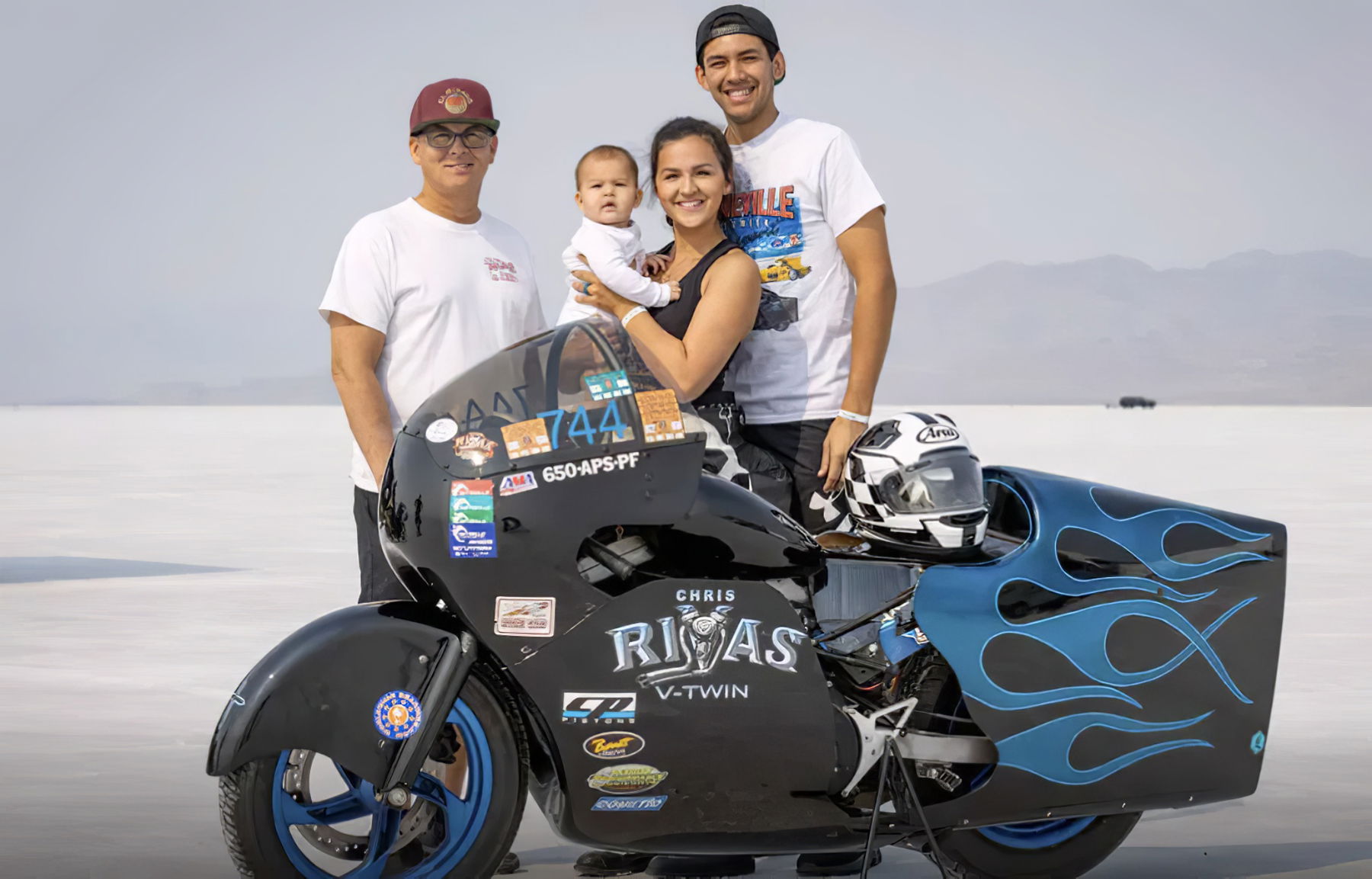
The centrepiece is the only attempt on the outright record. Chris Rivas, 59 years old and from Florida, sits in Denis Manning’s BUB Seven Streamliner, powered by a turbocharged V4 with 2,997 cc. The mark to beat stands at 605.697 km/h and dates from 2010, set by Rocky Robinson on a Suzuki Hayabusa 2600.
Beyond that, Rivas is aiming at the symbolic barrier of 400 mph, which equates to 643.738 km/h. Last year he never got his chance because the state of the course did not allow a run. For this record class Bonneville has no alternative: since September 1955 every successful attempt on the outright motorcycle world record has been made there.
What are Eva Hakansson’s plans with the Green Envy?
Eva Hakansson wants to set a new FIM record for electric motorcycles. The 45-year-old mechanical engineer comes from Sweden, now lives in New Zealand and is returning to Bonneville for the first time since 2017.
She made her name with the KillaJoule, an electric motorcycle she built in her own garage. With it she reached 434.523 km/h in 2014 and for a time held the title of fastest female motorcyclist in the world. Her new machine is called Green Envy and is also a streamliner. The target is the benchmark of 455.737 km/h that six-time world champion Max Biaggi set in Cape Canaveral in 2021.
Which records from last year are up for discussion again?
Of the three riders who set a combined four FIM world records in 2025, two are back. Both are competing under changed circumstances.
Lianne Langlois from Canada again brings her sidecar outfit based on a 2012 Triumph Rocket 111 Roadster, a three-cylinder with 2,295 cc prepared by JKR Powersports. In 2025 she set a world record of 219.404 km/h with it over the timed kilometre. Her team has since fitted a partial fairing, which moves the outfit into a different class and puts it in contention for a new benchmark.
Lisa Cipolla from the state of Washington is once more on the Kawasaki ZX-6R run by Zlock Racing LCC, a four-cylinder with 600 cc from 2012. The 66-year-old librarian took two records in 2025: 236.251 km/h with a partial fairing and 217.979 km/h once the bodywork had been removed.
The third record setter from 2025 is missing. Dale Zlock, who at the age of 69 took his partially faired Suzuki SV with 600 cc to 243.172 km/h and improved his own record by more than 36 km/h, is not entered. Instead his older brother Dan Zlock is starting. He is going after a mark that has stood for 33 years: 299.825 km/h, set by Loris Capirossi on a works machine from HRC Honda in the partially faired 750 cc class.
Who else is chasing FIM records
The entry list shows the full breadth of the discipline. Ronald Knight from the USA is competing on a rare 1972 Yamaha with 100 cc and two cylinders, a model that was built for a single year only.
Jay Allen, a fixture on the scene for years, is targeting two records, on a Harley-Davidson Dyna and an Electra Glide. Jim Cole is entered with a Suzuki Hayabusa, and multiple FIM record holder Hirohisa Koiso with two Harley-Davidson Dyna Super Glides.
Added to that are Angus Wing with a 2009 Kawasaki ZX-14 outfit, Tyrell Marlow on a 2002 Suzuki TL1000R and Kim Krebs from Australia, who has already run 392.6 km/h and this time is riding a 1999 Suzuki GSX-R750. American Tyler Rafferty makes his event debut on a 2025 Kawasaki ZX-10R.
Why Bonneville is under pressure as a record venue
The salt flat was formed more than 10,000 years ago, when Lake Bonneville dried up after the last ice age and left behind a layer of salt that is almost two metres thick in places. That very crust is the problem today.
Decades of industrial salt mining have weakened the layer, despite a replenishment programme that began in the mid-1990s. On top of that came unusually heavy rainfall, which washed mud onto areas that would otherwise be usable. Finding a consistently safe course of around ten kilometres is getting harder from year to year. Speed Week was cancelled entirely in 2014 and 2015 as a result, and the motorcycle event has also had to be called off several times in recent years.
Against that background, this year’s edition is more than just a date on the racing calendar. After the mixed 2025 season, which still produced four records despite poor weather, a productive 2026 would also be a signal that the salt flats still work as a stage for speed records.
Frequently Asked Questions
-
When are the Bonneville Speed Trials 2026?
The Bonneville Speed Trials 2026 take place from 23 to 27 August. Racing runs over five days on the Bonneville Salt Flats in Utah, around 200 kilometres west of Salt Lake City.
-
What is the outright motorcycle speed record?
The outright record recognised by the FIM stands at 605.697 km/h. Rocky Robinson set it at Bonneville in 2010 on a Suzuki Hayabusa 2600. Chris Rivas is attacking it in 2026 with the BUB Seven Streamliner.
-
How is a speed record measured at Bonneville?
Timing is done over one kilometre, in both directions. After the first run there are two hours for the return run, and a two-way average is calculated from both times. Only that figure counts as the official record.
-
Why have events at Bonneville been cancelled several times?
Decades of mining have made the salt crust thinner and more brittle. Combined with heavy rainfall, it has repeatedly been impossible to prepare a safe course of around ten kilometres.
-
Who is Eva Hakansson?
Eva Hakansson is a 45-year-old mechanical engineer from Sweden who lives in New Zealand. In 2014 she rode her self-built KillaJoule to 434.523 km/h and was for a time regarded as the fastest female motorcyclist in the world. In 2026 she is competing with the electric streamliner Green Envy.