- Four rally locations: East Side Gallery, Checkpoint Charlie, Wittenbergplatz and Gendarmenmarkt
- Seven speakers from clubs, associations and initiatives talked about civil liberties and legislation
- According to the organisers, the demonstration passed off without incident
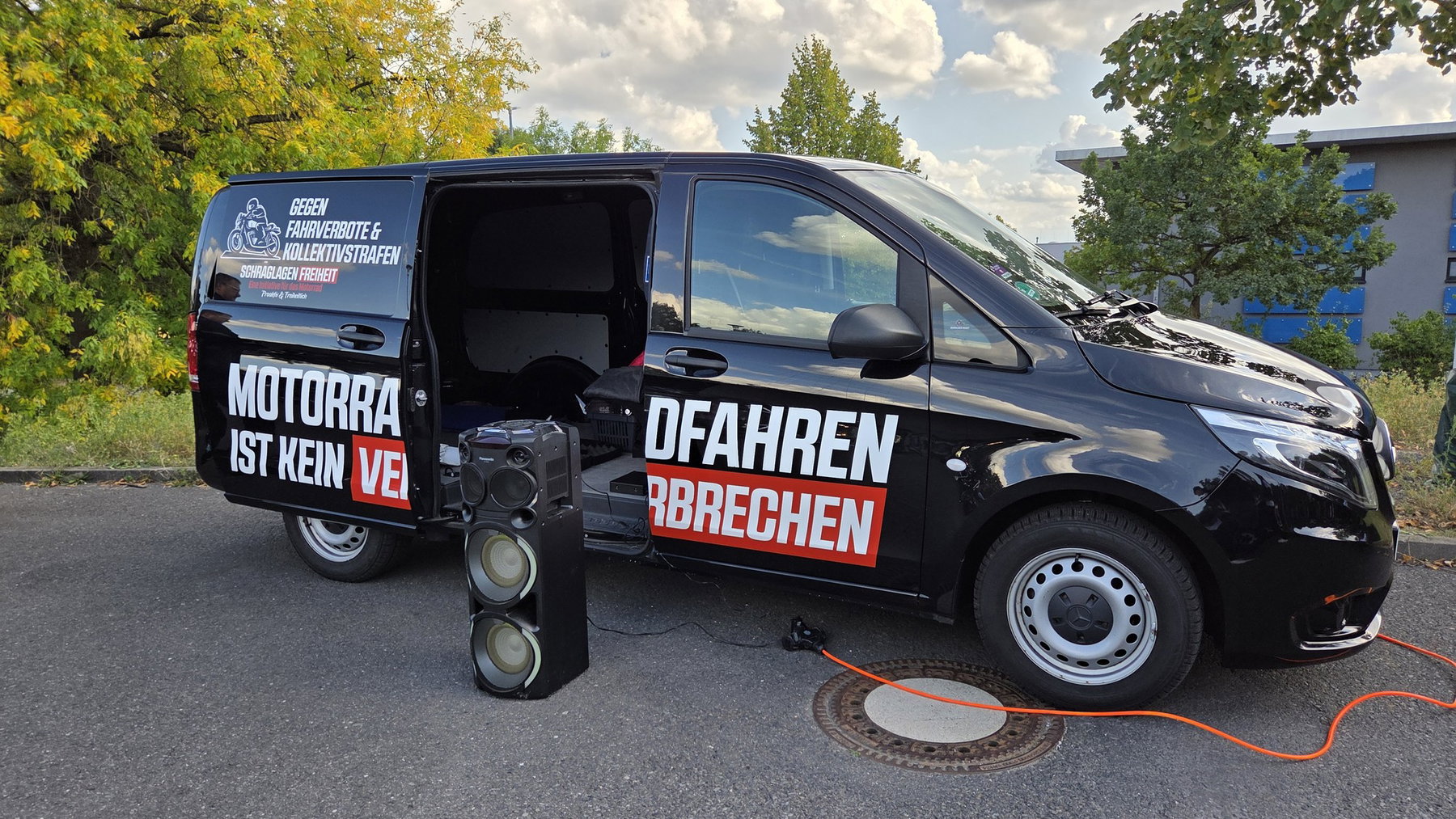
For ten years the date has fallen on the second Saturday in September. The organiser is the association FREEDOM IS OUR RELIGION e. V., founded in 2017 after an amendment to the law on associations meant that some motorcycle clubs were no longer allowed to wear their club insignia. What began as a response to the so-called colours ban has since grown into an event that deals more broadly with civil liberties, social cohesion and the free democratic basic order. The anniversary edition fell into a politically charged period: it took place eight days before the election to the Berlin House of Representatives.
How many motorcycles took part in the demonstration?
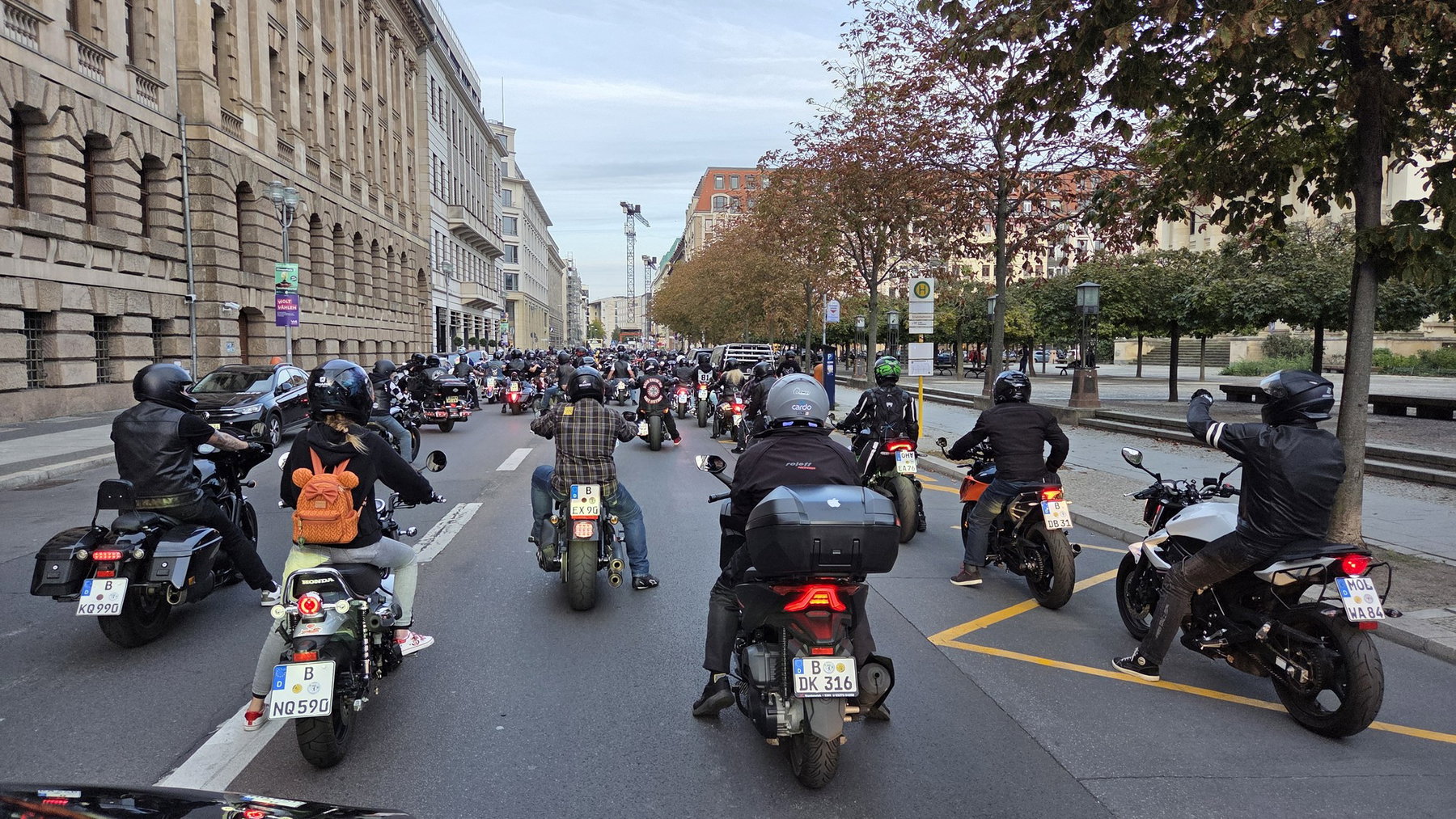
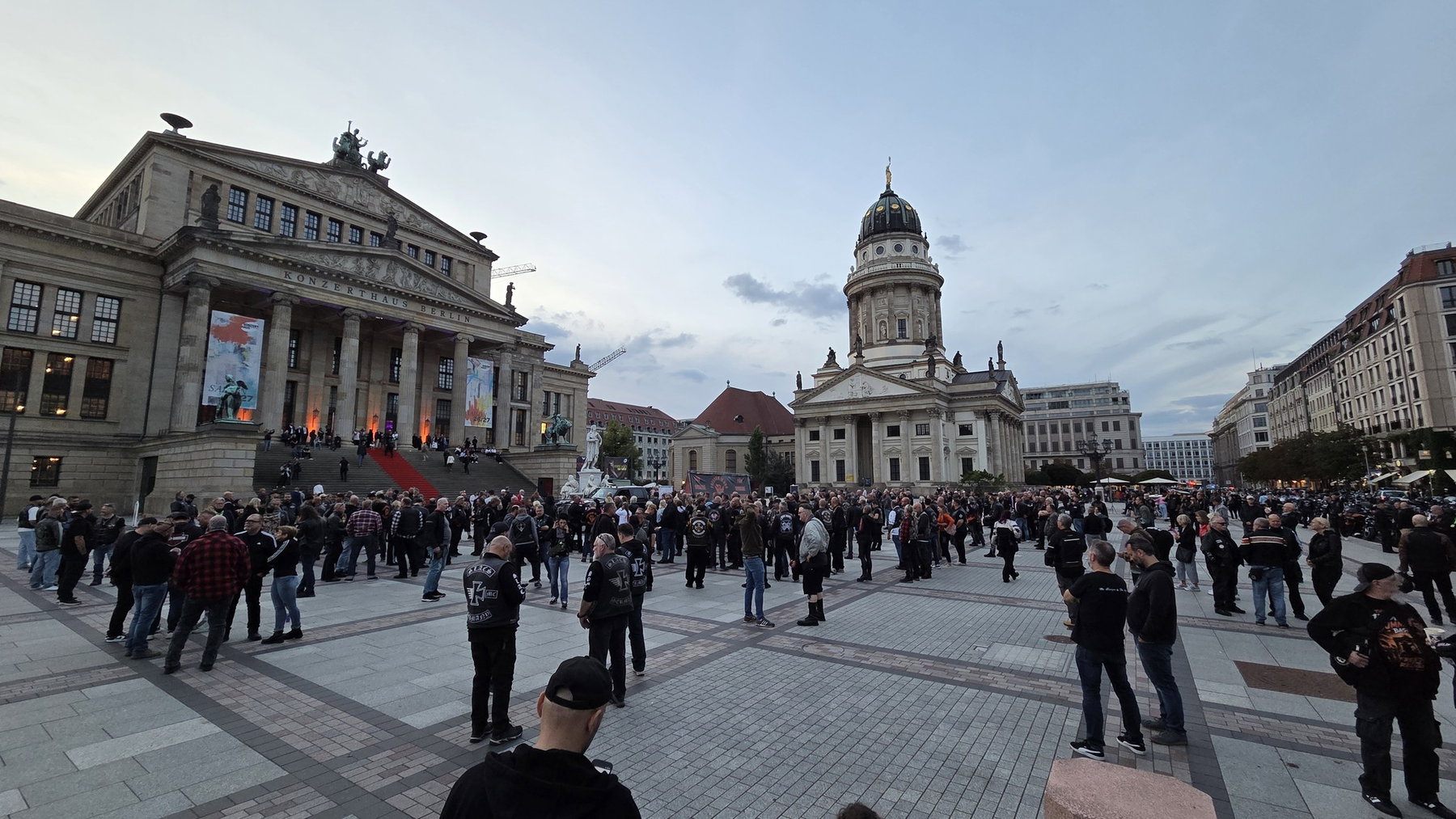
The organisers counted more than 700 motorcycles over the course of the demonstration. The car park at the Theater am Park on Frankenholzer Weg was filling up long before the procession set off at 5:00 p.m.
There is no independent count, the figure comes from the association itself. From the organisers’ point of view, the turnout shows that the willingness within the motorcycling community to stand up visibly for their own rights is growing. Berlin police accompanied the procession throughout. According to the organiser, the demonstration went ahead without disruption, as in previous years.
Which places did the procession head for?
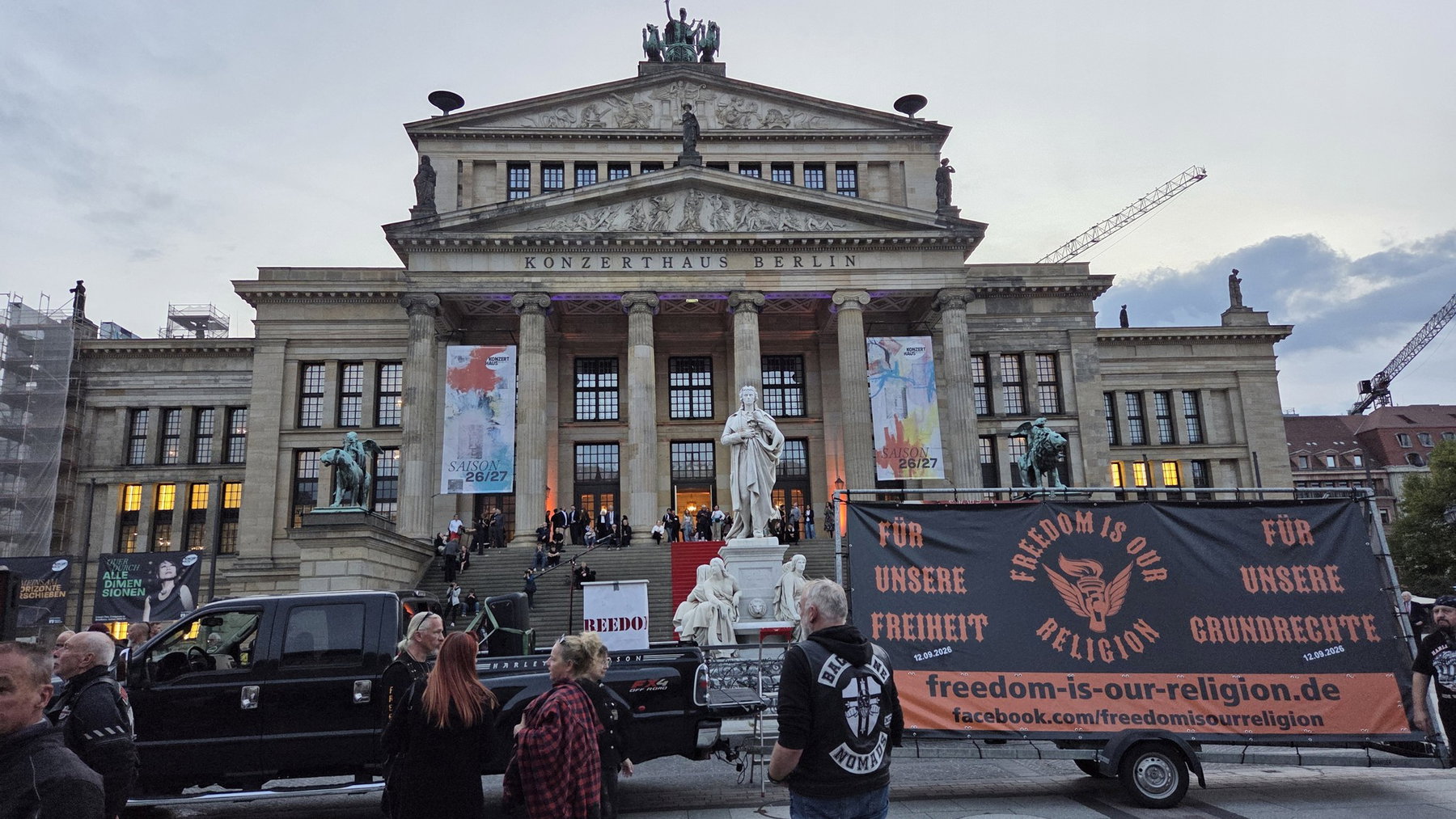
The procession led from Frankenholzer Weg through central Berlin and stopped at four points. Interim rallies were held at the East Side Gallery, at Checkpoint Charlie and at Wittenbergplatz right next to the KaDeWe department store, while the main rally took place against the backdrop of the Gendarmenmarkt.
The selection is no coincidence. Each of these places stands in its own way for freedom, social change, participation or the overcoming of political and social boundaries. The East Side Gallery is the longest surviving section of the Berlin Wall, and Checkpoint Charlie was one of the best-known border crossings of the divided city. Wittenbergplatz added a location that stands for the city’s consumer and everyday life. The Gendarmenmarkt as the closing point offered the most representative setting of the day.
Who spoke at the rallies?
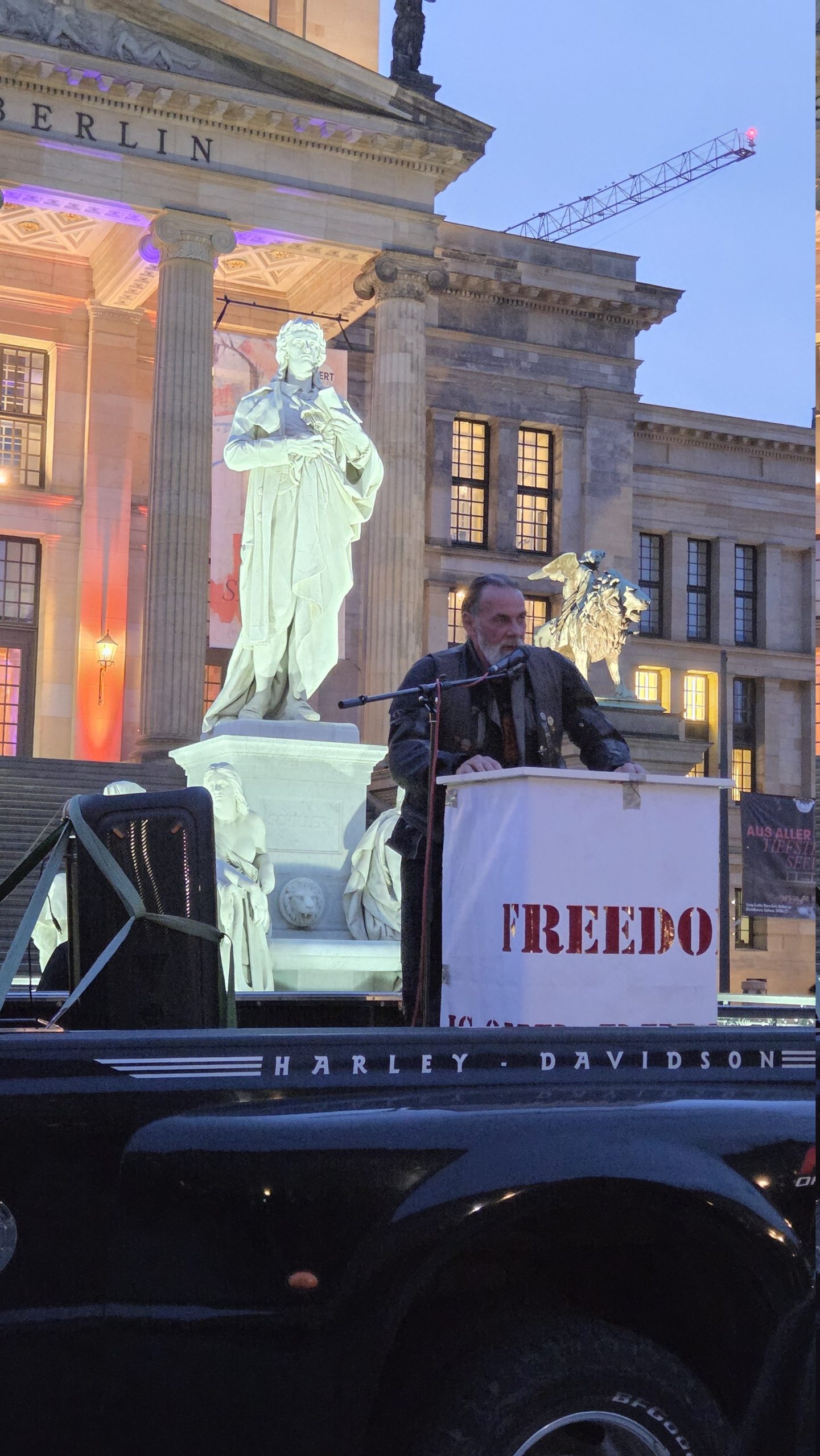
Seven speakers and contributors appeared at the rallies. Authors, clubs, associations, initiatives and musicians were represented.
The list of speakers included the author Lothar Berg, Teddy Bach of Biker Union e. V., Peter Hünecke of Backbone Nomads MC, Sunny Jäger of Verdandi Hood, Lars Böhler of the Schräglagenfreiheit initiative, the musician Frank Schwung and Carsten Hoffmann of H-DC Karlsgarten Berlin e. V. Böhler also acted as press contact for the event. The mix of interest groups and clubs reflects the aim of representing more than just a single part of the scene.
What were the speeches about?
The focus was on the German constitution as a guarantor of individual and social freedom. Several speakers stressed that a free democracy does not only live on guaranteed rights, but also on citizens actually exercising those rights and taking responsibility.
A second focus, in the speakers’ view, was the gradual restriction of civil liberties. Lars Böhler criticised what he sees as a partly arbitrary application of the law on associations. Teddy Bach used concrete examples to argue that symbolic legislative changes remain ineffective in his view while still curtailing civil liberties. Peter Hünecke spoke, in a contribution celebrated by the audience, about the subtle hollowing out of the constitution to the detriment of citizens.
Böhler summed up the occasion as follows: “For the tenth time there is reason and need to demonstrate for the protection of our civil liberties. For the tenth time we also have the opportunity to exercise this right within our free democratic basic order. We use this right and we defend it.”
From the organiser’s point of view, more and more people are recognising that standing up for their own rights requires active engagement. Comments on social networks alone are not enough. Democratic participation, they say, also means carrying one’s own stance onto the street peacefully, visibly and together.
What is behind the dispute over Berlin’s police law?
The speeches also addressed an application for judicial review filed by the parliamentary groups of Bündnis 90/Die Grünen and Die Linke on 28 August 2026 with the Constitutional Court of the State of Berlin. In such a review, a court examines whether a law is compatible with the constitution.
The application targets provisions of the General Security and Public Order Act, known in Berlin as the police law, which was tightened in December 2025 by the coalition of CDU and SPD. Across 155 pages it challenges five extended powers: the preventive use of spyware on phones and computers, AI-supported video surveillance with so-called behaviour scanners, biometric mass matching against publicly accessible data from the internet, the training of AI systems with police data including possible transfer to third parties, and automated data analysis, meaning the merging and evaluation of different police databases on one platform.
The move is politically contested. CDU politicians and the police union rejected the criticism and argued that the new powers are necessary for preventing danger. The two parliamentary groups did not file an urgent application because the legal hurdles for that are high. The law therefore remains in force for the time being. A decision by the court is not expected for at least one to two years. For the motorcycling scene, the topic is of interest because it touches on the same fundamental question that has occupied the association since 2017: how far the state may extend its powers without hollowing out fundamental rights.
How did the day of the demonstration end?
After returning to the starting point on Frankenholzer Weg, the event moved on to the nearby site in Alt-Biesdorf for the “Indian Summer Bash”. Live music kept the celebration going there until after midnight.
Attention is already turning to the association’s next date: on 15 May 2027, the international motorcycle demonstration “Steel & Speed – Heartbeat of Motorcycling” will take place in Berlin.
Frequently Asked Questions
-
When does “Freedom is our Religion” take place?
The demonstration takes place every year on the second Saturday in September in Berlin. In 2026 that was 12 September, with the procession starting at 5:00 p.m. at the Theater am Park on Frankenholzer Weg. It was the tenth edition of the event.
-
How many participants did the Berlin motorcycle demonstration have in 2026?
The organisers counted more than 700 motorcycles. There is no independent confirmation of this figure. Berlin police accompanied the procession and, according to the organisers, there were no incidents.
-
Who organises “Freedom is our Religion”?
The organiser is the association FREEDOM IS OUR RELIGION e. V. from Berlin. It was founded in 2017 after an amendment to the law on associations banned some motorcycle clubs from wearing their club insignia. The press contact for the demonstration is Lars Böhler of the Schräglagenfreiheit initiative.
-
Which route did the procession take through Berlin?
The procession led from Frankenholzer Weg through central Berlin and ended back at the starting point. Interim rallies were held at the East Side Gallery, at Checkpoint Charlie and at Wittenbergplatz, while the main rally took place at the Gendarmenmarkt.
-
When is the next big motorcycle demonstration in Berlin?
The association’s next date is 15 May 2027. That is when the international motorcycle demonstration “Steel & Speed – Heartbeat of Motorcycling” takes place in Berlin.